How to propagate Zephyranthes grandiflora and its flowering period, and how does it differ from Zephyranthes candida?
Zephyranthes grandiflora is extremely beautiful and has very strong vitality; it can grow whether in dry places or in relatively moist places. What are its propagation methods? When does it bloom, and what is the difference from Zephyranthes candida?
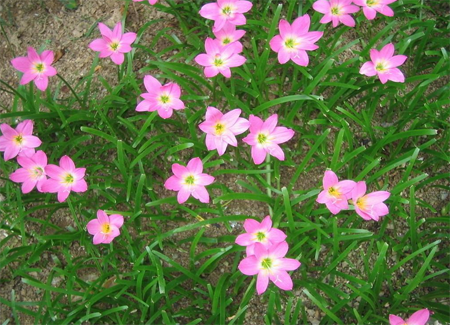
Propagation methods of Zephyranthes grandiflora:
Propagate by bulb separation or by sowing seeds
It prefers moist, fertile and well-drained soil.
It can be planted by division or by bulbs
This can be done throughout the year, but spring is best. Simply dig up the bulbs, plant 3 - 5 bulbs at each spot, water to maintain appropriate moisture, and they will very easily survive. When digging up the bulbs, be careful not to damage them. If there are too many leaves and flower stems, cut off the upper part and plant with the intact bulb and 6 - 8 cm of leaves retained. If the bulb has already sprouted flower buds, after dividing water thoroughly and it can still bloom.
Propagate by the bulb division method, which can be done in spring and autumn
Plant at a depth such that the top of the bulb is slightly exposed, and divide the bulbs once every 2-3 years. Potted plants need plenty of sunlight, fertilizer and water. After a batch of flowers fades, water should be withheld for 50-60 days, then normal watering resumed. This alternating dry and wet cycle can promote multiple bloomings, and it can bloom 2-3 times a year.
Flowering period of Zephyranthes grandiflora:
It prefers warmth, moisture and full sunlight, and also tolerates partial shade. It does best in well-drained sandy loam rich in humus. The flowering period is from June to September.
Distribution area of Zephyranthes grandiflora:
It is native to Central America and South America and has been introduced and cultivated in tropical and subtropical regions. It is propagated by seeds, but by convention the bulbs are divided and transplanted.
Differences between Zephyranthes grandiflora and Zephyranthes candida:
The leaves of Zephyranthes candida are round, upright and not very prone to bending or lodging, while the leaves of Zephyranthes grandiflora are flat, somewhat wider, and more prone to bending or lodging;
As for the flowers, the flowers of Zephyranthes candida are generally white, while the flowers of Zephyranthes grandiflora are generally pink, and the flowers of Zephyranthes grandiflora are slightly larger than those of Zephyranthes candida.
Left is Zephyranthes grandiflora, right is Zephyranthes candida
Propagation methods and pest and disease control of Zephyranthes grandiflora, and how it differs from Zephyranthes candida
Zephyranthes grandiflora has larger flowers in pink, with petals slightly curved and drooping; the small Zephyranthes grandiflora is deep peach-red, and every bulb of a mature plant can bloom. The clustered flower clusters shine brilliantly under the bright sun, charming and lovely, loved by all who see them. What are the propagation methods of Zephyranthes grandiflora? What are its methods for pest and disease control? Come and learn with the editor.
Propagation methods and pest and disease control
It can be planted by division or by bulbs, and this can be done throughout the year, but spring is best. Simply dig up the bulbs, plant 3-5 bulbs at each spot, and water to maintain appropriate
moisture, and they will very easily survive. When digging up the bulbs, be careful not to damage them. If there are too many leaves and flower stems, cut off the upper part and plant with the intact bulb and 6-8 cm of leaves retained. If the bulb has already sprouted flower buds, after dividing water thoroughly and it can still bloom. [6]
The seeds of Zephyranthes grandiflora generally mature from September to October. Because its flowering period is relatively long, the time for seed collection is also not concentrated. Watch for when the fruit skin changes from green to black, then select plump, well-filled seeds and harvest them promptly; otherwise the fruit will split open, and once the seeds fall off they are hard to collect. After the fruit is collected, it should be dried promptly; once the fruit skin splits, thresh promptly and remove debris to obtain pure seeds. Because Zephyranthes grandiflora has slightly poor cold tolerance, spring sowing should be used.
Seed storage: Because the seeds of Zephyranthes grandiflora are relatively small and have low moisture content, once fully dried, the processed seeds can simply be put into kraft paper bags for storage to prevent mildew and rot.
Diseases include leaf rust and leaf spot; pests include white grubs. The small Zephyranthes grandiflora has relatively strong resistance to pests and diseases. When disease occurs, spray the whole plant with 1:3000 thiophanate-methyl; for underground pests, drench the plants with phoxim.
Differences between Zephyranthes candida and Zephyranthes grandiflora
(1) Leaves
The leaves of Zephyranthes candida are round, upright and not very prone to bending or lodging; the leaves of Zephyranthes grandiflora are flat, somewhat wider, and more prone to bending or lodging.
(2) Flowers
The flowers of Zephyranthes candida are generally white, while the flowers of Zephyranthes grandiflora are generally pink, and the flowers of Zephyranthes grandiflora are slightly larger than those of Zephyranthes candida.
Main varieties
Amaryllidaceae; aliases: chives lotus (Beijing), false saffron (Guangxi, Guizhou), drought daffodil, hollow chives (Guizhou), calamus lotus, red jade curtain, rain flower (North China), red calamus lotus (Beijing). The plant height is about 15-30 cm, and mature plants grow in clumps. The leaves are linear, very much like chives. The flower stems emerge from the leaf clusters, with 6 petals. The small Zephyranthes grandiflora is deep peach-red, and every bulb of a mature plant can bloom. It is native to southern Mexico to Guatemala, and has been introduced and cultivated in gardens across northern and southern China, and is commonly seen in Guizhou, Guangxi and Yunnan.
Growth habits
It is robust by nature, drought-tolerant and resistant to high temperatures, and easy to cultivate. The optimum growth temperature is 22-30 degrees, and fertile sandy loam is best as the cultivation soil. Zephyranthes grandiflora likes light but also tolerates partial shade. It likes a warm environment but is also relatively cold-tolerant. It prefers deep soil, flat terrain and well-drained loam or sandy loam. It likes moisture and fears waterlogging. It has strong adaptability, strong resistance to pests and diseases, and strong bulb sprouting ability, making it easy to propagate.
The above is all the content I have learned today about Zephyranthes grandiflora. I hope flower lovers will find this article helpful. To learn more about Zephyranthes grandiflora, please continue to follow Duorou Huapu, and we will provide you with more related knowledge!
How to grow Zephyranthes grandiflora and points to note: teaching you how to grow Zephyranthes grandiflora
Zephyranthes grandiflora has linear leaves, very much like chives, hence it is called chives lotus. Its clustered flower clusters shine brilliantly under the bright sun, loved by all who see them. So do you know how to grow Zephyranthes grandiflora and what to note? Let us take a specific look below.
Introduction to Zephyranthes grandiflora:
Zephyranthes grandiflora, aliases: chives lotus, rain flower; Latin name: Zephyranthes grandiflora, is a perennial herb in the genus Zephyranthes of the family Amaryllidaceae.
The bulb is ovoid, 2-3 cm in diameter. The basal leaves are usually several in a cluster, linear and flat, and the plant height is about 15-30 cm, with mature plants growing in clumps. The leaves are linear, very much like chives. The flower stems emerge from the leaf clusters, and the petals are mostly 6, sometimes 8. Zephyranthes grandiflora has larger flowers in pink, with petals slightly curved and drooping; the small Zephyranthes grandiflora is deep peach-red, and every bulb of a mature plant can bloom. The clustered flower clusters shine brilliantly under the bright sun, charming and lovely, loved by all who see them. The flowering period of Zephyranthes grandiflora is April-September; the flowering period of the small Zephyranthes grandiflora is about May-August in summer. It is suitable for planting along the edges of garden flower beds or in pots.
How to grow Zephyranthes grandiflora and points to note:
How to grow it:
Zephyranthes grandiflora can be planted by division or by bulbs, and this can be done throughout the year, but spring is best. Simply dig up the bulbs, plant 3-5 bulbs at each spot, water to maintain appropriate moisture, and they will very easily survive. When digging up the bulbs, be careful not to damage them. If there are too many leaves and flower stems, cut off the upper part and plant with the intact bulb and 6-8 cm of leaves retained. If the bulb has already sprouted flower buds, after dividing water thoroughly and it can still bloom.
Points to note when growing Zephyranthes grandiflora:
1. Soil: Fertile sandy loam is best as the cultivation soil for Zephyranthes grandiflora. Plant 3-4 bulbs per hole, and the planting depth should be such that the top of the bulb is slightly exposed above the soil surface. When the plant clump becomes crowded, it must be forced to divide.
2. Fertilizing: For potted plants, apply base fertilizer each year together with bulb division and repotting or soil changing. Fertilizers can include organic fertilizers such as oil cake, compost, or nitrogen, phosphorus and potassium fertilizers, applied once every 2-3 months. Increasing phosphorus and potassium fertilizer proportionally can promote bulb enlargement and good flowering.
3. Watering: During the growth period, Zephyranthes candida needs sufficient water, and the potting soil should be kept moist often, but not waterlogged. In dry weather, also spray water on the leaves often to increase air humidity, otherwise the leaf tips tend to turn yellow and wither.
4. Temperature: The most suitable growth temperature for Zephyranthes grandiflora is 22-30 degrees. After planting, be careful to irrigate to maintain moisture. It stops growing when the ambient temperature is below 10°C, and cannot overwinter safely when frost occurs.
5. Light: Zephyranthes candida likes light but also tolerates partial shade. The cultivation site should have sufficient sunlight; in shady places it is not easy to produce offsets, nor is it easy to bloom.
Morphological characteristics of Zephyranthes grandiflora:
Perennial herb. The bulb is ovoid, 2-3 cm in diameter. The basal leaves are usually several in a cluster, linear and flat, 15-30 cm long and 6-8 mm wide. The flower is solitary at the top of the flower stem, with a spathe-like involucre below; the involucral bracts are often tinged with pale purplish red, 4-5 cm long, and fused at the lower part into a tube; the pedicel is 2-3 cm long; the flower is rose-red or pink; the perianth tube is 1-2.5 cm long, with 6 perianth lobes, the lobes obovate, slightly pointed at the apex, 3-6 cm long; stamens 6, about 2/3-4/5 the length of the perianth, with anthers attached at the middle; the ovary is inferior, 3-locular, with many ovules, the style slender, and the stigma deeply 3-cleft. The capsule is nearly spherical; the seeds are black. The flowering period is summer and autumn. [3]
Zephyranthes grandiflora is about 15-30 cm tall, and mature plants grow in clumps. The leaves are linear, very much like chives. The flower stems emerge from the leaf clusters, and the petals are mostly 6, sometimes 8. Zephyranthes grandiflora has larger flowers in pink, with petals slightly curved and drooping, deep peach-red, and every bulb of a mature plant can bloom. The clustered flower clusters shine brilliantly under the bright sun, charming and lovely, loved by all who see them. The flowering period of Zephyranthes grandiflora is April-September; the flowering period of the small Zephyranthes grandiflora is about May-August in summer. It is suitable for planting along the edges of garden flower beds or in pots. Differences from the common Zephyranthes grandiflora: the flowers are smaller, the color is deeper and more vivid, the petals are relatively stiff and not prone to drooping, and the flower shape can be maintained very well. Because of soil variation, the variety of Zephyranthes grandiflora can also vary; for example, in greenhouses in northern China the leaves are relatively broad and thick, while grown in California in the United States the leaves are relatively narrow and the fragrance is also relatively strong.
Growth habits of Zephyranthes grandiflora:
It is robust by nature, drought-tolerant and resistant to high temperatures, and easy to cultivate. The optimum growth temperature is 22-30°C, and fertile sandy loam is best as the cultivation soil. Zephyranthes candida likes light but also tolerates partial shade. It likes a warm environment but is also relatively cold-tolerant. It prefers deep soil, flat terrain and well-drained loam or sandy loam. It likes moisture and fears waterlogging. It has strong adaptability, strong resistance to pests and diseases, and strong bulb sprouting ability, making it easy to propagate.