How to grow and care for the Norfolk Island pine, and how much does it cost?
The Norfolk Island pine is extremely well suited to indoor growing and has incredibly strong vitality. If you are growing a Norfolk Island pine for the first time, you may still feel a bit unsure about where to start. So what are the methods and precautions for growing a Norfolk Island pine? And how much does it cost?
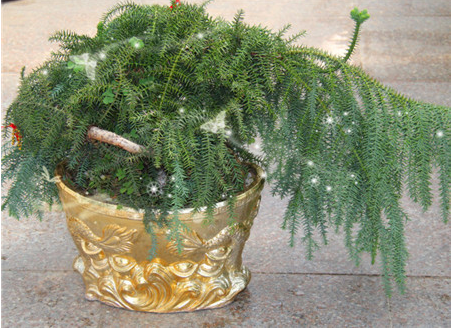
Methods and precautions for growing the Norfolk Island pine:
1. Soil: The Norfolk Island pine is suited to well-drained, humus-rich, slightly acidic sandy loam. When growing it in a pot, a substrate made by mixing garden soil, leaf mold and peat moss is best.
2. Watering: From spring to autumn, the Norfolk Island pine should be watered more often, but waterlogging in the pot must be avoided. When it is hot and dry, spray water on the potted plant and the ground nearby to lower the temperature and raise humidity. Water promptly; do not wait until the soil has dried out before watering. From late autumn onward, gradually reduce watering to strengthen its cold resistance.
3. Light: The Norfolk Island pine likes diffused light and is best placed in a bright spot inside a shed or greenhouse. If it is kept in a dark place for a long time, move it into the sunlight for appropriate exposure every few weeks; this keeps the deep green leaves a beautiful color.
4. The growing season is long. Except when summer temperatures exceed 32°C, the Norfolk Island pine can grow all year round.
5. Fertilizing: During the growing season, apply fertilizer every 2 weeks, preferably a compound fertilizer containing nitrogen and potassium. Insufficient fertilizer tends to make the branches and leaves turn yellow.
6. Pests and diseases: The Norfolk Island pine has very few pests and diseases. When cared for indoors, scale insects are the most commonly seen problem; spraying methidathion, chlorpyrifos emulsifiable concentrate, or Guoguang Jie Bisi and similar products gives good control results.
Precautions:
1. Summer and autumn are the growing seasons.
Potted plants can be placed in a semi-shaded spot outdoors, or kept in a bright, ventilated spot by a window. Avoid blazing sun exposure above 35°C, and do not leave them for long in a lightless, shaded place. Either of these will cause the branches and leaves to turn yellow or become leggy, reducing their ornamental value.
2. During the growth process
To prevent the trunk from leaning to one side, it is best to turn the pot once every half month so the plant receives light evenly. In addition, the trunk of young trees is fragile and easily bends and deforms, so from the seedling stage a support stake should be set up to secure the trunk. To prevent the plant from growing too tall, repot it once every 2-3 years after the weather turns warm in spring. Usually, take care to protect the side branches so they are not damaged and the plant's shape is not affected.
3. Under normal circumstances there is no need to prune the branches.
Let it grow naturally. The suitable growing temperature is 10-25°C, and the overwintering temperature is above 5°C. In the overwintering season, give it a certain amount of light, do not let the potting soil get too dry, and on clear days spray water to increase humidity.
Norfolk Island pine prices:
The price of the Norfolk Island pine is really a bit uncertain; it has to be judged according to the style of the potted Norfolk Island pine and the price of the pot. The price is roughly 680 yuan per plant.
Norfolk Island pine prices and care methods
Nowadays, in offices and homes, the decorative trend of various small potted plants and large bonsai has become popular, and the Norfolk Island pine is an excellent choice. The Norfolk Island pine likes to stay in a warm, humid environment and has a certain tolerance for shade, making it very suitable for long-term care indoors in insufficient light, just like an office environment. Moreover, its vitality is very strong, its insect resistance is also very strong, and it is also an expert at purifying the air. Next, let us learn about Norfolk Island pine prices.
The Norfolk Island pine is an evergreen tree; potted specimens are generally young trees, under 2 m tall. It likes a warm, humid environment, and its crown is spire-shaped and dark green. The stem is upright, and the side branches are whorled and extend horizontally. The branchlets are two-ranked and alternate, extending horizontally or drooping slightly. The leaves are of two types. The cones are nearly round.
Cultivation techniques and planting
1. Seedlings grown from seed are sturdy, strong and vigorous.
The Norfolk Island pine is suitable for mass propagation. Generally, in July to August, first nick the seed coat of freshly collected seeds to promote germination; otherwise, if left in the soil too long, the seeds easily rot. Then sow the treated seeds in a sand bed, covering with about 1.5-2 cm of fine sand. Under conditions of 25-28°C and a certain humidity, they will germinate in about 2-3 weeks. Plant them out immediately after germination.
2. When taking cuttings, if the main axis or a leggy branch is chosen as the cutting, it easily causes the plant's crown to be misshapen and able to grow only sideways, affecting its ornamental value. Cut the tips of vigorous, easy-to-root branches with 2-3 nodes as cuttings, remove some leaves, soak them in clean water overnight, then insert them into a sand bed with coarse sand or vermiculite as the substrate. Maintain a temperature of 20-25°C and relatively high air humidity; they will root in about 3 months.
Care
When growing in a pot, mix garden soil, leaf mold and peat moss.
The resulting substrate is best. Potted plants mostly use small seedlings, and a suitable pot should be chosen according to the size of the seedling. The Norfolk Island pine likes diffused light and is best placed in a bright spot inside a shed or greenhouse. If it is kept in a dark place for a long time, move it into the sunlight for appropriate exposure every few weeks; this keeps the deep green leaves a beautiful color. The growing season is long. Except when summer temperatures exceed 32°C, it can grow all year round.
From spring to autumn, water more often, but waterlogging in the pot must be avoided. When it is hot and dry, spray water on the potted plant and the ground nearby to lower the temperature and raise humidity. Water promptly; do not wait until the soil has dried out before watering. From late autumn onward, gradually reduce watering to strengthen its cold resistance. During the growing season, apply fertilizer every 2 weeks, preferably a compound fertilizer containing nitrogen and potassium. Insufficient fertilizer tends to make the branches and leaves turn yellow.
Specific care principles and measures
The Norfolk Island pine is one of the world's three major ornamental trees. It is not afraid of strong light and can also withstand low light; its vitality is very strong, it likes moisture and also tolerates drought, it is evergreen all year round, and as long as it is kept above zero it can overwinter, and it does not attract insects. Water it occasionally; wet or dry does not matter much, which can save a lot of care time. When growing in a pot, a substrate made by mixing garden soil, leaf mold and peat moss is best. Potted plants mostly use small seedlings, and a suitable pot should be chosen according to the size of the seedling.
It likes warmth and sun, tolerates drought and fears cold. It likes to grow in a humid, ventilated environment and in loose, fertile, slightly acidic sandy soil, and it dislikes waterlogging. Specific care methods:
1. When winter sets in, it should be moved indoors for warmth; at a room temperature of around 5°C it can overwinter safely.
2. Summer and autumn are the growing seasons. Potted plants can be placed in a semi-shaded spot outdoors, or kept in a bright, ventilated spot by a window. Avoid blazing sun exposure above 35°C, and do not leave them for long in a lightless, shaded place. Either of these will cause the branches and leaves to turn yellow or become leggy, reducing their ornamental value.
3. As for fertilizer and water, during the high temperatures of summer and autumn, water to prevent drying out and keep the potting soil somewhat moist. Apply top dressing 1-2 times a month. In early spring or autumn and winter, the potting soil should be on the dry side and must not be too wet, to prevent root rot.
The propagation method can be the same as for sago palms, using the method of dividing off young offsets, and it is best done in spring or summer.
Pest control
It has very few pests and diseases. When cared for indoors, scale insects are the most commonly seen problem; spraying methidathion, chlorpyrifos emulsifiable concentrate, or Guoguang Jie Bisi and similar products gives good control results.
Propagation methods
It mainly relies on seed propagation, but cuttings can also propagate young plants.
Now let's look at the current market prices of the Norfolk Island pine:
1. Norfolk Island pine, Fujian
≥4 plants, ¥ 130.00/plant
2. Supplied by Fujian Lvdadi Supplying Norfolk Island pine evergreen tree height 1m nursery stock bonsai
≥40 plants
Price ¥ 300.00/plant
3. Norfolk Island pine bonsai Norfolk Island pine belongs to the Araucariaceae Norfolk Island pine seedlings air purification formaldehyde absorption radiation protection
1-49 pots, ¥ 65.00/pot
50-199 pots, ¥ 64.50/pot
≥200 pots, ¥ 64.00/pot
4. For sale Norfolk Island pine bonsai Norfolk Island pine height 1.1 m, crown width 60, trunk thickness 6-8 cm Jiangsu
1-14 pots, ¥ 383.00/pot
15-39 pots , ¥ 382.00/pot
≥40 pots, ¥ 380.00/pot
5. Supplied by Tianchang Dijiu various potted plants office potted plants Norfolk Island pine
1-9 pots, ¥ 110.00/pot
10-19 pots , ¥ 99.00/pot
≥20 pots, ¥ 89.00/pot
6. Direct wholesale from the base, foliage plants suitable for office and business environment landscaping 15 cm Norfolk Island pine
15-149 pots, ¥ 22.00/pot
150-599 pots, ¥ 21.80/pot
≥600 pots, ¥ 21.60/pot
Precautions for growing the Norfolk Island pine:
1. Summer and autumn are the growing seasons. Potted plants can be placed in a semi-shaded spot outdoors, or kept in a bright, ventilated spot by a window. Avoid blazing sun exposure above 35°C, and do not leave them for long in a lightless, shaded place. Either of these will cause the branches and leaves to turn yellow or become leggy, reducing their ornamental value.
2. During the growth process, to prevent the trunk from leaning to one side, it is best to turn the pot once every half month so the plant receives light evenly. In addition, the trunk of young trees is fragile and easily bends and deforms, so from the seedling stage a support stake should be set up to secure the trunk. To prevent the plant from growing too tall, repot it once every 2-3 years after the weather turns warm in spring. Usually, take care to protect the side branches so they are not damaged and the plant's shape is not affected.
3. Under normal circumstances, the Norfolk Island pine does not need its branches pruned; let it grow naturally. The suitable growing temperature is 10-25°C, and the overwintering temperature is above 5°C. In the overwintering season, give it a certain amount of light, do not let the potting soil get too dry, and on clear days spray water to increase humidity.
How often should the Norfolk Island pine be watered:
During care, how often the Norfolk Island pine should be watered depends on the moisture of the potting soil. In summer, generally, watering twice a week is enough. In winter, watering control can be reduced by one time compared with summer.
From spring to autumn, the Norfolk Island pine bonsai should be watered more often, but waterlogging in the pot must be avoided. When it is hot and dry, spray water on the potted plant and the ground nearby to lower the temperature and raise humidity. Water promptly; do not wait until the soil has dried out before watering. From late autumn onward, gradually reduce watering to strengthen its cold resistance.
In summer, water when the potting soil is half dry, and when watering just go around the edge of the pot once. If the weather is very dry, spray water around the Norfolk Island pine bonsai; the purpose is to increase the air humidity and create a humid, suitable environment for it.
The editor has learned that the price of potted Norfolk Island pines varies according to shape and size; the thicker the root and the taller the tree, the more expensive it is, but the price is generally in the range of 400-****. In addition, on the market, 15-25 cm tall ones are around 30 yuan, about one meter tall ones need 300-400, and taller and thicker ones are even more expensive. At present, Norfolk Island pine prices are fairly stable, and both small and large ones are quite affordable. So friends who are tempted should act quickly!
Norfolk Island pine bonsai prices, precautions for growing the Norfolk Island pine
Nowadays, with population growth and the continuous acceleration of urbanization, people's living space keeps shrinking, and the greenery around people is gradually decreasing. This has aroused people's interest in growing plants, so potted plants of various kinds can often be seen in many people's homes, and the Norfolk Island pine is one of them. The Norfolk Island pine is a relatively precious tree species; its tree form is elegant, and it is a famous courtyard tree that many people greatly love. So how should the Norfolk Island pine be grown, and what are its bonsai prices? Let us take a look together below.
What is the Norfolk Island pine
First, let us briefly understand what the Norfolk Island pine is. The Norfolk Island pine, also called the Australian pine, is one of the world's very famous courtyard trees, and together with the cedar, the Japanese umbrella pine, the North American redwood and the golden larch, it is known as one of the world's 5 great park tree species. The Norfolk Island pine is a tree that in its place of origin reaches as high as 60 to 70 m; it originated in the southeastern coastal regions of Oceania, and is now distributed in Australia, New Guinea, China and other countries. The bark of the Norfolk Island pine is usually grayish brown or dark gray, its trunk is relatively thick, and the trunk has many horizontal cracks. Its crown is spire-shaped when young, and becomes flat-topped when mature and old. Its side branches are very dense, drooping and arranged in a nearly feather-like pattern, looking very elegant and beautiful.
Methods and precautions for growing the Norfolk Island pine
1. Nowadays many people grow the Norfolk Island pine in pots, so at the beginning of growing it, the more important issues are the flower pot and the soil. The Norfolk Island pine likes fertile soil. When growing it in a pot, you can mix leaf mold, garden soil, river sand and a solid base fertilizer together. The resulting soil should not only contain sufficient nutrients, but also be required to be loose, breathable and well-drained.
2. The Norfolk Island pine is a tree species that very much likes light. When growing it in a pot, it should be fully exposed to sunlight, so that the Norfolk Island pine that grows will be more verdant and bright. It can be grown outdoors or indoors in a place with plenty of sunlight, but summer sunlight is intense, so avoid exposure to blazing sun; in winter light is insufficient, so appropriate supplementary light can be added.
3. The Norfolk Island pine likes a warm, humid environment, so during growing, special attention should be paid to the plant's temperature and water issues. The suitable growing temperature for the Norfolk Island pine is 7 to 30°C, and it is very intolerant of cold. In winter it must be brought indoors for growing, and the indoor temperature must be strictly controlled.
4. The Norfolk Island pine is not drought-tolerant. During growing, keep the potting soil moist at all times. In summer, appropriately increase the frequency of watering; in winter, when it is cold, reduce or stop watering. Do not use too much water, otherwise excessive water accumulation in the pot can cause waterlogging, and the plant's roots easily rot.
Norfolk Island pine bonsai prices
The Norfolk Island pine is a relatively precious tree species, so there are actually quite a lot of Norfolk Island pine bonsai on the market. Constrained by the plant's shape, size and vigor, the prices of these bonsai vary greatly, some high and some low. Small bonsai cost about 10 yuan to 50 yuan, and slightly larger bonsai cost about 100 yuan, but the shape of this kind of Norfolk Island pine is still not especially tall and large. However, placing them indoors to decorate the home is very suitable; their size is moderate, and they can be placed in any corner of the room. Of course, for relatively precious Norfolk Island pine varieties with beautiful tree forms, the bonsai prices are relatively high, at about several hundred yuan to several thousand yuan.
Conclusion: The Norfolk Island pine is currently a very popular bonsai plant. It is itself a relatively precious tree, with an elegant and graceful tree form, and the bonsai used for decoration are also very exquisite, with a particularly good decorative effect.