Three common ways geraniums die: suffocation, sunscald, and thirst
Many people love growing geraniums. The flowers are incredibly vibrant, and just one look lifts your mood. Yet geraniums are very prone to dying in summer. Let's look at the ways geraniums die in summer.
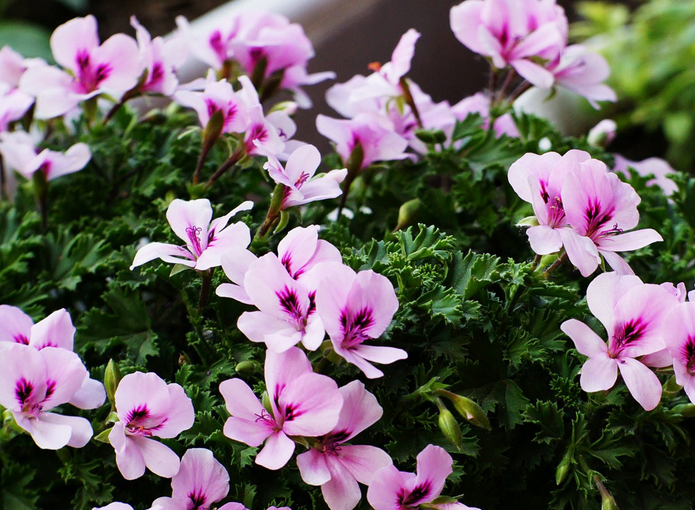
The geranium is absolutely a charming beauty: trailing, upright, large-flowered…… there is always one that is your type.
Although geraniums are lovely in every way, they have one annoying flaw: they fear heat! (Just like me.) On a scorching day, even people can be steamed into salted fish, let alone flowers. How heat-intolerant are geraniums? Let's put it this way: they have an imposing nickname, "certain death in summer." (Fuchsia begs to differ. All right, I'll talk about fuchsia in a couple of days.)
Geraniums like warmth, moisture, and plenty of sunlight; they fear cold, high temperatures, and waterlogged soil.
In the hot summer, in what way will your geranium make its tragic last stand?
1. Death by thirst
Geraniums like moisture. Although summer watering is less than in the spring and autumn growing seasons, you still cannot go long without watering. The soil should be kept moist but on the dry side.
2. Death by waterlogging
Although geraniums like moisture, they fear waterlogged soil. In summer you can water less; too much water easily suffocates the roots.
They can't take drought and they can't take waterlogging, so how exactly should you manage the water?
Adjust watering frequency according to the breathability of the pot and soil medium. Water slightly more often with good breathability, and less often with poor breathability. Stretch the watering interval a bit longer than in spring and autumn, water a little less, keep the soil on the dry side, and truly follow the watering principle of "don't water until dry, and when you water, water thoroughly."
Pots with better breathability: wooden pots, clay pots, ceramic pots, purple clay pots, etc.
Pots with poorer breathability: plastic pots, glazed pots, porcelain pots, iron pots, etc.
Watering time: early morning or evening; avoid watering at noon.
Watering method: water the soil, gently and slowly; don't water until dry, and when you water, water thoroughly.
Many people like to spray the leaves and soil with a spray bottle and think they have watered. This is a big misconception. Watering only counts when water flows out of the drainage holes at the bottom. However, when the soil is too dry and the root ball has shrunk so that cracks appear between it and the pot wall, or when the soil medium is compacted and drains poorly, just a little water will run out the bottom. At this point it is not thoroughly watered, and the water has not been absorbed by the soil. So watering needs to be slow, seeping in bit by bit. For soil that drains poorly, you can poke a few holes with a toothpick to help water seep through. When the root ball is excessively dry, you can choose the soaking method to water.
3. Death by suffocation
This probably needs no explanation. Damp, stuffy heat means the grim reaper is not far off for geraniums. In summer, they must be placed somewhere with good air circulation, sheltered from rain, and kept dry and comfortable, which can reduce infection by pathogens.
4. Death by sunscald
In midsummer, geraniums are best given appropriate shade. Move them to a semi-shaded spot at noon or pull a shade net, avoiding the highest temperature of the day. Let them receive light in the morning, but do not shade them all day.
To distill the key points: if you want your geranium to get through summer safely, you must learn:
Controlled watering, ventilation, shading, rain shelter ·
Finally, a word on pruning and fertilizing:
Pruning: Geraniums have strong regrowth ability; even if you hard-prune them down to not a single leaf left, they can still come back at full strength. But hard pruning is not suitable in midsummer. We only need to remove some yellowed and diseased leaves to ensure ventilation between plants; no drastic measures are needed.
Fertilizing: Because geraniums are in a semi-dormant state in summer, avoid heavy fertilizer. If you want to supplement nutrients, you can apply a light, thin fertilizer, and it is best to make it even more diluted than the concentration required on the instructions.
Geraniums are very hard to grow in summer. You still need to pay attention, otherwise your geraniums really do have thousands of ways to die.
What is the flower language of geraniums? The flower language and legend of geraniums / beautiful love
The geranium is an extremely ornamental plant, and when it blooms, it is at its most beautiful. Generally, beautiful flowers also come with their own flower language. What is the flower language of geraniums? In fact, geraniums of different colors have different flower languages. As for what exactly the flower language and legend of geraniums are, you can find the answers in the text below. Let's read on together.
1. What is the flower language of geraniums? / Representing love
The geranium is a colorful plant with many colors. Regarding the flower language of geraniums, each color has a somewhat different meaning. But they also share something in common: they are all related to love, only representing different aspects of love.
1. Chance encounter
The flower language of the white geranium represents a chance encounter, representing the beginning of a beautiful love. Before people even notice, happiness appears by your side. As for the definition of happiness, using the geranium to represent it is more fitting than anything.
2. Longing, devotion
Longing is what the flower language of the red geranium represents. Red gives a vivid impression, leaving a deep impact at a single glance. This also well represents the impression of her (or him) that lingers in your mind, symbolizing longing and devotion in love.
3. Companionship
Companionship is the flower language of the pink geranium, a symbol of beautiful, happy moments and of being together. We are intimate lovers, and every moment spent together is the most beautiful. I am happy to accompany you, and I hope to keep walking with you all the way.
Note: The above three colors of geraniums are the ones people see more commonly, so their flower languages are widely known. Of course, geraniums of other colors also have their own flower languages, only few people know them. Among them, the yellow geranium represents an unexpected meeting, the silver-leaf geranium represents recollection, the dark-colored geranium represents depression, the trailing geranium represents a wedding gift, and the wild species of geranium represents piety and steadfastness.
2. The flower language and legend of geraniums
Long, long ago, legend has it that Muhammad, the founder of Islam, encountered many difficulties on the road while fleeing pursuit, with obstacles and dangers at every turn. In the end he was utterly exhausted, so he collapsed by a riverbank. When he regained consciousness, he was surrounded on all sides by a kind of fresh flower.
It was a beautiful, vivid sea of flowers, with a fresh fragrance that refreshed the heart and mind, sweeping away the loneliness and fatigue of Muhammad and instantly making him feel clear-headed and invigorated. These flowers were geraniums. In ancient times, geraniums were used by people to drive away demons and evil forces.
As for the question of what the flower language of geraniums is, I believe everyone will have no more doubts after reading the above. In fact, all colors of geraniums share one thing in common: their flower languages are all related to love. That is all for the flower language and legend of geraniums. I hope this article can resolve the doubts in everyone's mind.
What are the uses of geranium essential oil? The benefits of geranium essential oil / promoting blood circulation
Geranium essential oil is extracted from the geranium plant and is greatly beneficial to the human body. As for what the uses of geranium essential oil are and what benefits geranium essential oil has, there are detailed introductions in the text below. You can read on together with me.
1. Uses of geranium essential oil
1. Adjusting the atmosphere
Geranium essential oil naturally carries the fragrance of the plant itself and can be used as incense. Its scent can make people more relaxed, so it can be called an essential excellent product for adjusting the atmosphere. Using it for get-togethers with friends or dates with your girlfriend is more suitable than anything.
2. Caring for hair
After washing your hair, you can prepare a basin of warm water and add an appropriate amount of geranium essential oil to care for it. This not only conditions the hair but also gives your hair a faint, clear fragrance, effectively increasing one's charm.
3. Caring for skin
Skin care is one of the more commonly used uses of geranium essential oil. It has the benefits of balancing skin oil secretion and sterilizing, and is greatly beneficial to people's skin. Its scent is also very pleasant, with a faint fresh fragrance, so it is also loved by many women.
2. Benefits of geranium essential oil
1. Removing athlete's foot
When soaking your feet, if you drip a few drops of geranium essential oil into the water, it will have the effect of removing athlete's foot, and can also help invigorate the blood and meridians. Friends troubled by athlete's foot can try this method.
2. Removing blackheads
Geranium essential oil also has a great effect on removing blackheads. You can directly add geranium essential oil to facial cleanser according to the international ratio, stir it evenly, then when washing your face, wash your nose for two extra minutes, and the blackheads will naturally come out. The geranium can be called a natural stain remover.
3. Promoting blood circulation
Geranium essential oil has the benefit of promoting blood circulation in the human body, which can make people's skin more rosy and vibrant. It also has great therapeutic effects on conditions such as herpes, chilblains, and burns. It can be said to have many benefits.