How to Select Lucky Bamboo and Tell Whether It Is Sick
Everyone loves growing lucky bamboo. It is very auspicious and very easy to grow. You just buy it and grow it in water, and it can grow very well. If you want lucky bamboo to grow well, you first need to know how to select lucky bamboo, and you also need to know how to tell whether lucky bamboo is sick:
How to select lucky bamboo:
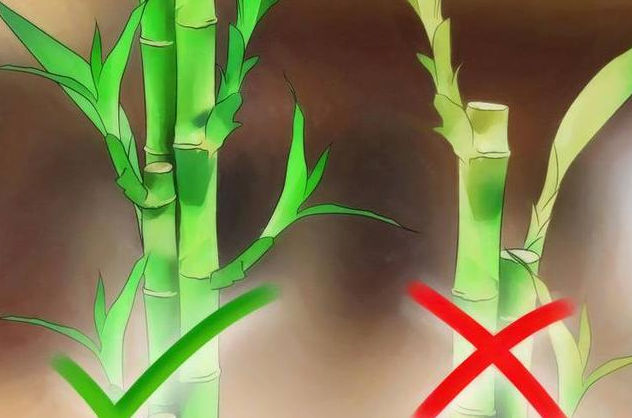
When buying lucky bamboo at a flower shop or flower market, you cannot just pick any random ones. You need to choose robust ones free of disease. First, check the stems and leaves for flaws, whether the leaf tips have changed color, and whether there are spots. Dark green ones are healthier, while tender yellow ones are quite delicate.
Choosing a vibrant, dark green lucky bamboo is still quite important (do not choose the one on the right in the picture above). It can also adapt quickly when moved to a new environment, right? If you buy a diseased lucky bamboo, or a thin and weak plant, then caring for it is even harder, and for beginners it is simply torture.
You should choose a bamboo that looks greener, with no flaws, scratches, or signs of yellowing.
It is best if the color is consistent from the rhizome to the top. If the upper part is yellowing and the lower part is emerald green, then do not buy it either.
Try not to buy ones with yellow spots or flaws on the leaf tips, and check the undersides of the leaves carefully!
How to tell whether lucky bamboo is sick:
Healthy lucky bamboo has no smell at all when grown. If as you grow it you catch a sour smell, then it is sick. You need to take the diseased plant out, disinfect and sterilize it, and clean up the diseased parts. Of course, it is best if the pruning tool is also sterilized to prevent secondary infection.
That is all for the methods of selecting lucky bamboo and how to tell whether lucky bamboo is sick. Growing lucky bamboo is all about constantly summing up experience so you can grow it even better.
How to Grow Lucky Bamboo, How to Grow Lucky Bamboo in Water
This article mainly introduces how to grow lucky bamboo and how to grow lucky bamboo in water. Lucky bamboo, also known as green leaf immortal, longevity bamboo, and green leaf bamboo banana, is a perennial evergreen shrub. Lucky bamboo likes warm, humid, and shaded environments, likes scattered light, and avoids harsh sun exposure. It is suited to loose, fertile soil. Lucky bamboo can be grown in pots or in bottles in water. Now I will introduce the specific water-growing method to everyone.
For home water growing in a transparent glass bottle, in the clear water the old and new roots alternate yellow and white, making it look even more full of life. To grow lucky bamboo in a bottle in water, you need to master the following key points: remove the leaves from the base and cut the base at a slant. Before putting it in the bottle, remove the leaves from the base of the cutting, and use a sharp knife to cut the base at a slant. The cut surface should be smooth to increase the area for absorbing water and nutrients. Every 3 to 4 days, change the clear water once. You can put in a few small pieces of charcoal to prevent rot. Within 10 days, do not move the position or change the direction. After about 15 days, silvery white fibrous roots will grow.
Change water to adding water: after rooting, it is not suitable to change the water. After the water evaporates, you should only add water in time. Frequent water changes easily cause yellow leaves and wilted branches. The water added is best well water. If using tap water, first store it in a container for one day. The water should remain clean and fresh. Do not use dirty water, hard water, or water mixed with oil, otherwise the roots rot easily. Fertilize in time: to grow lucky bamboo in water and prevent leggy growth, do not apply chemical fertilizer. It is best to inject a few drops of brandy into the bottle about every 3 weeks and add a small amount of nutrient solution; you can also use 500 grams of water to dissolve half a tablet of aspirin crushed into powder or one tablet of vitamin C, and drip in a few drops when adding water. This can keep the leaves emerald green. Avoid wind: do not place lucky bamboo next to a TV or in places often blown by air conditioners or electric fans, to avoid dry leaf tips and leaf edges. If lucky bamboo in water is not managed well, it easily produces yellow leaves. During care, pay attention to the following issues:
1 During the care process, it should be placed in a bright and ventilated environment. Too little light easily makes the branches and leaves turn yellow.
2 Urban tap water should be left standing for two days to reduce the chlorine content in the water. Only after impurities settle can it be used for growing.
3 Once it turns yellow, cut off a section from the base with a sharp knife, and cut the base at a slant with a sharp knife. The cut surface should be smooth to facilitate the absorption of water and nutrients, and then insert it again.
4 In summer high temperatures, the oxygen content in water is low and it easily deteriorates. You should lower the concentration of the solution and change the water frequently. Within 10 days, do not move the position or change the direction. After about 15 days, silvery white fibrous roots can grow.
How to Grow Lucky Bamboo in Water, Water Growing Methods for Lucky Bamboo
This article introduces how to grow lucky bamboo in water and water growing methods for lucky bamboo. When growing it in a bottle in water, you should choose a robust growing plant, make sure the leaves are intact, the stems are straight, and the terminal buds are intact. Cut the base into a 45-degree slant with a sharp blade, and grow it in a straight glass container. The water depth should be about 5 to 10 cm. Change the clear water once every 3 to 4 days. Within 10 days, do not move the position or change the direction. After about 15 days, it can root. After rooting, stop changing the water. When the water decreases, just add more in time. Frequently changing the water instead easily causes yellow leaves and withering. After rooting, give a small amount of light and drip in a small amount of compound nutrient solution (if the flower market does not have it, consider using high-nitrogen compound fertilizer soaked in water). After that, apply nutrient solution once every 3 weeks.
Cutting or division propagation of lucky bamboo is best carried out during the period from April to September. When taking cuttings, choose robust branches, cut them into several sections, keep 3 to 4 nodes per section, and insert them into moist sand. They root very easily. After rooting, move them into pots. After moving into pots, water them sufficiently.
If lucky bamboo in water is not managed well, it easily produces yellow leaves. During care, pay attention to the following issues:
1 During the care process, it should be placed in a bright and ventilated environment. Too little light easily makes the branches and leaves turn yellow.
2 Urban tap water should be left standing for two days to reduce the chlorine content in the water. Only after impurities settle can it be used for growing.
3 Once it turns yellow, cut off a section from the base with a sharp knife, and cut the base at a slant with a sharp knife. The cut
surface should be smooth to facilitate the absorption of water and nutrients, and then insert it again.
4 In summer high temperatures, the oxygen content in water is low and it easily deteriorates. You should lower the concentration of the solution and change the water frequently. Within 10 days, do not move the position or change the direction. After about 15 days, silvery white fibrous roots can grow.
5 After rooting, it is best to change the water less. Only add water in time after the water evaporates and decreases. Frequent water changes easily cause yellow leaves and wilted branches.
6 After rooting, apply a small amount of compound chemical fertilizer or culture solution in time, and the leaves will be glossy green and the stems sturdy. If no fertilizer is applied for a long time, the plant grows thin and weak, and the leaf color easily turns yellow. However, fertilizer should not be applied too much, to avoid "burning the roots" or causing leggy growth. In spring and autumn, applying compound chemical fertilizer once a month is enough.
7 Be careful not to place lucky bamboo next to a TV or in places often blown by air conditioners or electric fans, to avoid dry leaf tips and leaf edges. When the weather is dry, spray water appropriately on the leaf surface to keep the leaves spread out and the leaf color emerald green.