Oncidium: Growing Methods and an Introduction to Its Other Names
The flowers of the Oncidium are small and yellow, and from a distance they look a little like Phalaenopsis blooms. What are the growing methods for Oncidium? And what other names does it have?
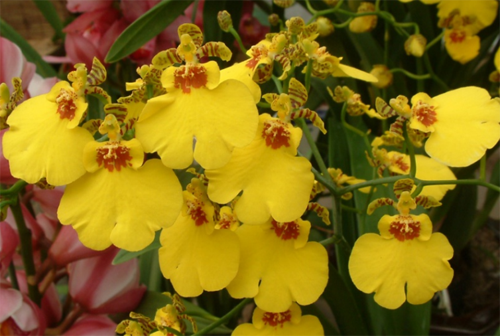
Growing methods for Oncidium:
1. Soil: Oncidium is suited to growing in soil that is airy and free-draining. It is usually made up of materials such as fern roots, charcoal, moss, volcanic ash, broken brick pieces and bark chunks. Fine fern roots, peat soil, charcoal, vermiculite (perlite) and broken brick (crushed stone pieces) can be mixed in a 4:1:2:2:1 ratio. It is best to add 1/3 broken stone (broken brick) at the bottom of the pot to aid drainage and airflow.
2. Temperature: The suitable growing temperature is 12-33°C. Thick-leaved varieties like warmth, with an optimum temperature of 18-25°C; thin-leaved varieties like cool conditions, with an optimum temperature of 10-22°C. Plants stop photosynthesis below 12°C, and the winter temperature should not drop below 10°C; exposure for more than 6-8 hours will cause damage and death. In summer, temperatures above 33°C are likewise bad for growth. During the flowering period, the temperature can be lowered as appropriate to extend the flowering time.
3. Sunlight: Oncidium tolerates partial shade. Except in winter, it must not receive direct sunlight in the other seasons. In summer, 40-50% shade is needed to avoid slowing growth or even sunscald and death. In spring and autumn the sunlight is relatively less intense, so 30% shade can be used. Pay attention to controlling the amount of shade; too much will leave the plant with insufficient light, thereby affecting flower bud differentiation, development and blooming.
4. Water: It likes a humid environment. During the growing period, not only should the potting soil be watered morning and evening, but the leaves and the ground should also be sprayed to increase the moisture in the air and promote the growth of the flower stems. In winter, when temperatures are low, there is no need to water. Of course, different varieties have very different water needs; for example, Oncidiums without pseudobulbs are not drought-tolerant and need frequent watering, topping up whenever the soil looks dry.
5. Ventilation: All Oncidiums need ventilation, especially the lines with pseudobulbs and thin leaves, which are prone to disease when it is too stuffy. In the hot summer, not only is watering and spraying the plant and its surroundings needed, but ventilation must also be increased to help lower the temperature.
6. Fertiliser: Fertilising should be carried out according to the variety and growth stage. For base fertiliser, a little slow-release fertiliser can be used. Apply a 1500-2000 times diluted liquid water-soluble quick-acting fertiliser once every 2-3 weeks, or a solid fertiliser can be used. Outside the flowering period, a compound fertiliser with balanced nitrogen, potassium and phosphorus can be applied. As the flowering period approaches, supplementing with phosphorus and potassium fertiliser helps flower bud differentiation and blooming. When flower stems appear or the temperature is below 10°C, stop fertilising. Resume fertilising after the flowering period. Do not fertilise in winter. Apply light fertiliser frequently.
7. Pests and diseases: Oncidium generally suffers from pests such as scale insects, snails and whitefly. Especially in the rainy season, snails are frequently on the move, and lime powder can be scattered around regularly. For scale insect damage, spray 800-1000 times diluted Supusha or Sujieling to deal with it, and 3000 times diluted Supufengya or Yashixiao can kill whitefly.
The main disease is yellow leaf disease. Keep things as hygienic as possible and spray pesticide thoroughly; the undersides of leaves, corners and the ground must all be sprayed. Disinfect the greenhouse once a month.
The uses of Oncidium:
Oncidium is small and compact in form, with abundant flowers and leaves. A single flower stem can bear dozens to hundreds of flowers. The flower shape is unusual, appearing like golden butterflies dancing, full of dynamic beauty, and the flowering period is long, making it highly ornamental. It can be used as a cut flower and as a potted flower, placed in a vase at home or in the office. It can also be used to make bouquets, flower baskets and so on, using it as the main material, paired with hanging lobster claws, asparagus fern, wood lily and American trumpet creeper, green anthurium for wall arrangements, full of festivity and joy; paired with delphinium, anthurium, asparagus and lily for basket arrangements, it can serve as a holiday gift.
Other names for Oncidium:
Oncidium is also called lumpy-lipped orchid, dancing orchid, dancing-lady orchid and golden butterfly orchid. It is a plant in the Orchidaceae subfamily Epidendroideae, originally from American countries such as Mexico, Colombia, Peru, the United States and Guyana.
It is a general category, with more than 750 native species, and there are also many commercial hybrids. Common ones include the leopard-spotted Oncidium, the wavy Oncidium, the small golden butterfly orchid and the large-flowered Oncidium. It is a major category of cut flowers and potted flowers.
That is all for the growing methods of Oncidium and what its common names are. Growing flowers can cultivate a person's patience.
Growing methods for Oncidium? The flower meaning of Oncidium
Oncidium, also known as auspicious orchid, dancing orchid, dancing-lady orchid, golden butterfly orchid and lumpy-lipped orchid, is the general name for the genus Oncidium in the Orchidaceae family. There are more than 750 native species, distributed across tropical regions of Central and South America such as Mexico, Brazil and Jamaica. Oncidium has a unique flower shape and high ornamental value. Its inflorescence branches well, the flower shape is graceful and the flower colour is bright. Close up, the form resembles the Chinese character "ji", which is why it is also called auspicious orchid.
Growing methods for Oncidium
Oncidium likes a cool climate. The suitable growing temperature for thick-leaved Oncidium is 18-25°C, and the winter temperature should not fall below 12°C. The suitable growing temperature for thin-leaved types is 10-22°C, and the winter temperature should not fall below 8°C.
Oncidium likes humid and partially shaded environments. Besides watering to increase the substrate's moisture, spraying the leaves and the ground is even more important; increasing air humidity is more beneficial for the growth of the leaves and flower stems. Hard-leaved varieties have strong drought tolerance and moderate light requirements; they are afraid of direct strong light. They can go a long time without watering in winter without drying out and dying, so their tolerance is very strong. Large-scale production requires shade netting, with a shading rate of 40%-50% being suitable. In winter, full sunlight is needed and shade netting is usually not used, which is beneficial for blooming. For pot culture or growing beds using fern roots, moss, volcanic ash and bark chunks, thin-leaved species have thinner, slightly leathery leaves, and most whole plants grow robustly, making them suitable for growing in intermediate-temperature greenhouses; thick-leaved species have strong drought tolerance and, when grown in a greenhouse in winter, will not die from drought even without watering for dozens of days; sword-leaved species are smaller in plant form and suitable for home growing.
Oncidium has many other names, such as auspicious orchid, dancing orchid, dancing-lady orchid, golden butterfly orchid and lumpy-lipped orchid. It mostly has 1-3 leaves, and according to differences in leaf thickness it can be further divided into thin-leaved species, thick-leaved species and sword-leaved species. Oncidium is the general name for plants in the genus Oncidium; it does not refer to a single plant. It has more than 750 forms. The flower shape of Oncidium is extraordinarily unusual, with extremely high ornamental value. It has now become a flower with wide commercial use and enjoys a high reputation in the flower-arranging world, being a representative flower among the "five beauties" of cut flowers. When it blooms, its petals look like the Chinese character "ji", so people also call it auspicious orchid.
The flower meaning of Oncidium
Flower meaning: hidden love, silent waiting, silent longing. The Oncidium plant is light and elegant, with slender, drooping flower stems and strange, lovely flowers. The flower colours are mainly yellow and brown, and there are also green, white, red and magenta, among others. Some are extremely small, like mini Oncidiums, while some are extremely large.
Oncidium prices
1. Cymbidium Oncidium with a strong fragrance, an ornamental orchid for indoor office desktops, chocolate dancing perfumed Oncidium. Reference price: 35.00
2. Hongyue desktop potted orchid with a perfume scent, mini Oncidium dancing orchid seedlings with flower buds. Reference price: 40.00
3. Flowering) miniature fragrant mini Oncidium, densely fragrant dancing-lady orchid, Mengxiang orchid, double plant. Reference price: 16.00
How to grow Oncidium: growing methods for Oncidium
Oncidium is also known as dancing orchid, dancing-lady orchid and golden butterfly orchid. Its flowers are unusual, closely resembling golden butterflies in flight. Many novice flower lovers do not know how to grow Oncidium. Next, Xiao Qi introduces the growing methods for Oncidium.
1. How to grow Oncidium
Oncidium is generally not very demanding about its environment, but the winter temperature should not be below 15°C, and the air humidity should be around 80% in all four seasons. In spring, summer and autumn it needs a partially shaded environment, and in winter it can be given full sunlight, but it must never be exposed to the scorching sun of high summer. Oncidium is mostly propagated by division. Generally, right after division do not water immediately; when it is slightly dry, spray some water on the leaves, and once new roots have grown, water it, then spray some balanced fertiliser, but the concentration must not be too high, generally 0.6% to 0.8%. During care, do not water too much, as this easily causes root rot, and pay attention to ventilation and light transmission. If there are diseased plants, they should be destroyed promptly and sprayed with some fungicide. During the flowering period, the temperature and humidity should not be too high or too low, as this will affect the lifespan of the flowers, shorten the flowering period, and even cause bud drop or premature withering.
2. Growing methods for Oncidium
1. Soil: Because it is an epiphytic orchid, it likes a planting substrate that is loose, airy and holds water well. It can be made from materials such as vermiculite, perlite, peat soil, charcoal, broken brick and crushed fern roots.
2. Temperature: It likes warmth, and the suitable growing temperature is 18-26°C. It is not cold-tolerant; below 12°C photosynthesis stops, and prolonged low temperatures of 6-8°C will cause cold damage to the plant. The overwintering temperature should be kept above 13°C. It is also not heat-tolerant; above 33°C normal growth is affected.
3. Light: It likes a partially shaded environment, and direct strong light will scorch the plant. In summer, 50%-70% of the light should be shaded; in early spring and late autumn, 20%-30% should be shaded; in winter, no shading is needed. When the light is too strong, plant growth is inhibited and the plant appears stunted, and sunscald develops, with leaves becoming smaller and yellow, and in severe cases turning greyish-white. But it should not be too shady either, otherwise the leaves grow leggy, weak and drooping, and flower bud differentiation is affected.
4. Watering: It likes a moist soil environment. During the growing period, water generously to keep the potting soil moist; but avoid waterlogging, as overly wet potting soil very easily causes root rot. In late autumn and early winter, gradually reduce watering, which can help with normal blooming. In winter, when temperatures are low, watering must be controlled; it is enough to keep the potting soil slightly moist.
5. Humidity: It likes relatively high air humidity, with 60%-80% being suitable. An environment that is too dry is bad for plant growth, so normally spray water on the leaves and the surrounding environment more often. But it should not be too humid either; when the humidity is too high the plant is prone to disease, so good ventilation should be maintained.
6. Fertilising: During growth, apply fertiliser once every half month. At the seedling stage, nitrogen fertiliser is the main type, and for mature plants, phosphorus and potassium fertiliser is the main type. The root system's ability to absorb fertiliser is poor, so fertiliser should be applied thinly, and concentrated fertiliser must be avoided. Fertiliser that is too concentrated will make the leaves turn yellow and thin, and even cause root rot and withering. During the flowering period, winter and summer, fertilising should be stopped.
The above isOncidium growing methodsintroduced. Friends who like Oncidium can follow the above growing methods and try growing some.