How to grow marguerite daisies and how they differ from daisies
The marguerite daisy is a kind of princess flower, very beautiful to look at, but it looks so much like the daisy that when you put them together, you simply cannot tell them apart. How do you grow marguerite daisies? And where exactly lies the difference from daisies?
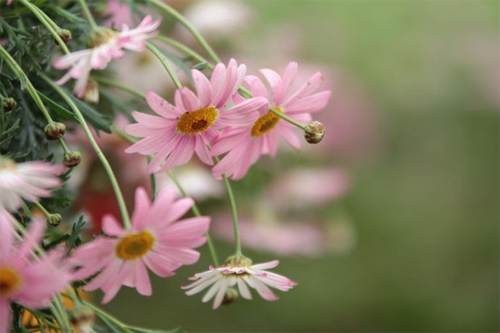
How to grow marguerite daisies:
1. Watering
Marguerites like a warm, moist environment. Apart from the hot summer and the freezing winter, keep the soil slightly moist at all other times. Of course, it must not become waterlogged, and this goes even more for plants grown in the ground.
2. Temperature
High summer temperatures make it drop its leaves, and freezing in winter can easily kill it, so be sure to shade it during hot summer weather, and keep it warm in winter by simply moving it indoors. What about friends who have no heating and are cold? Then the only option is to cover it with plastic film.
3. Light
Except during the high heat of summer, it should get plenty of light, and long daylight hours are also necessary. Shade it during the high heat of summer.
How marguerite daisies propagate:
Marguerites are generally grown from seed, though of course cutting a healthy piece of rhizome for cuttings also roots very easily. Soak bought seeds in room-temperature clean water for 3-4 hours.
After soaking, the seeds should be dried, then sown in slightly moist sandy soil, covered with plastic film, and the seedling tray placed in a cool, airy spot, keeping the soil slightly moist, with three hours of ventilation each day (you can also just poke a few holes in the plastic film).
The difference between marguerite daisies and daisies:
Daisy
Marguerite daisy
The stem of the daisy is extremely shortened, and all the leaves grow from near the soil surface, which is called basal foliage; the flower is hemispherical, and the petals are thin, round tubes. The marguerite's stem is long and spreading, its leaves have many lobes, its flower is disc-shaped, and its petals are flat and sheet-like.
Their leaves are also very easy to tell apart. The daisy's leaves are fairly rounded with smooth lines, while the marguerite's leaves spread out like sunflower leaves, so a single comparison makes them easy to recognize.
After reading all this, can you tell the difference between daisies and marguerite daisies? Hurry up and grow one yourself!
English daisy. English daisy illustrated guide: how to grow English daisies / how to propagate English daisies
English daisy profileEnglish daisy
Other names: spring chrysanthemum, marlan head flower, marguerite
Classification: herbaceous flower
Family and genus: Plantae, Angiosperms, Dicotyledons, Asterales, Asteraceae, Bellis
Peak flowering period: spring
The English daisy is called daisy in English. A small white flower, it is called the little sunflower and has a faint fragrance. The daisy is native to Europe and is also known as the everlasting daisy. It is a perennial herbaceous plant in the Asteraceae family and is the national flower of Italy. Its Chinese name comes from its resemblance to the chrysanthemum: chrysanthemum petals are long and curled and glossy, while the spring chrysanthemum's are short, small and straight, just like an unformed chrysanthemum. Hence the name daisy. The daisy represents purity. This book tells of an innocent girl who accidentally saves a mafia boss; later the two fall in love, and then she skips class for this person, takes a leave of absence from school, turns her back on her parents, runs away from home, and in the end...... This novel was later made into a...
How to grow English daisies and points to note. An introduction to the English daisy
The English daisy is called daisy in English. A small white flower, it is called the little sunflower and has a faint fragrance. The daisy is native to Europe and is also known as the everlasting daisy. It is a perennial herbaceous plant in the Asteraceae family and is the national flower of Italy. Its Chinese name comes from its resemblance to the chrysanthemum: chrysanthemum petals are long and curled and glossy, while the spring chrysanthemum's are short, small and straight, just like an unformed chrysanthemum. Hence the name daisy. The daisy represents purity. This book tells of an innocent girl who accidentally saves a mafia boss; later the two fall in love, and then she skips class for this person, takes a leave of absence from school, turns her back on her parents, runs away from home, and in the end...... This novel was later made into a TV drama called (The Outsiders, starring: Guo Pinchao, Ady An, Lan Cheng-lung). People from two different worlds can be friends, can be enemies, can pass each other by, but if they fall in love, the only ending is destruction. It is like a flying bird falling in love with a fish, trying desperately to stay together, yet only harming the other and destroying itself.
Morphological characteristics of the English daisy
The English daisy is a perennial or annual scapose herbaceous plant, about 10 cm tall.
Leaves
The leaves of the English daisy are basal, herbaceous, spoon-shaped, with rounded blunt tips, tapering at the base into a stalk, and the upper half of the margin has sparse blunt teeth or wavy teeth.
Flowers
The English daisy has a solitary capitulum, 2.5-3.5 cm in diameter, with the scape covered in hairs; the involucre is hemispherical or broadly bell-shaped; the involucral bracts are in nearly 2 layers, slightly unequal in length, oblong, with blunt tips, covered with soft hairs on the outside. The ray florets are in one layer, female, with white ligules tinged with pink, spreading, entire or with 2-3 teeth; the center has numerous bisexual florets, all of which set fruit, tubular, with a long limb and 4-5 lobes.
The flowering period of the English daisy is spring.
Fruit
The achene of the English daisy is flattened, with marginal veins, and the two faces have no veins or 1 vein. The pappus is absent or fused into a ring and united with the corolla tube or the achene.
Ecological habits of the English daisy
The English daisy prefers a cool climate and dislikes heat. It likes light and also tolerates partial shade, and has no strict requirements for the soil of the growing site. The optimum temperature for seed germination is 22-28°C, and the optimum temperature for growth is 20-25°C. The southwestern region is suitable for growing medium- and small-flowered single or semi-double varieties. Medium- and large-flowered double varieties grow weakly and set seed poorly.
Cultivation techniques for the English daisy
The English daisy tolerates transplanting fairly well, and transplanting can make it send out more roots. It does not need plant-shape pruning or pinching to control the flowering period.
Sowing and raising seedlings
English daisy seeds are very small, with 4900-6600 seeds per gram, mostly sown in September. In the Zhejiang region, however, sowing generally begins in late July, mostly from late July to mid-August. Sown at this time, New Year's Day is the peak flowering period.
For sowing, choose a loose, breathable medium. The medium should be sterilized, and it is best to cover it with a thin layer of vermiculite, just enough to hide the seeds. Because English daisy seeds are very small, they are not suitable for spot sowing, so broadcast sowing is generally used. When the seedlings have 2-3 true leaves, they can be transplanted once. The suitable pH of the sowing medium is 5.8-6.5, and the suitable EC value is 0.5-0.75. After sowing, keep the temperature at 18-20°C and the humidity at 80-90%, and they germinate in 5-8 days. In the Jiangsu-Zhejiang area, spring sowing is also possible, but the seedlings grow and flower less well than autumn-sown seedlings. So spring sowing is generally not used.
Stage one
After sowing, keep the temperature at 18-22°C and the humidity at 80-90%. The radicle emerges in 5-8 days. After germination, the medium should still be kept moist, no fertilizer spraying is needed, and light should be provided, but the light at germination must not be too strong, and appropriate shading is still needed. In July-August, shade is still needed around midday to lower the temperature.
Stage two
At this stage the humidity is 70-80%, which allows the roots to grow into the medium and absorb nutrients to support the expansion of the cotyledons. Keep the temperature at 16-20°C. Once the first pair of true leaves has unfolded, fertilization can begin, mainly with a 50 ppm water-soluble fertilizer of 20-10-20. After this stage, transplanting can begin using 288- or 128-cell trays.
Stage three
This stage is the rapid growth period of the seedlings. Prevent the medium from becoming too wet, and apply a 50 ppm fertilizer alternately of 20-10-20 and 14-0-14 special flower fertilizer. Depending on the temperature and the amount of transpiration, generally apply liquid fertilizer once every 2-3 days instead of watering. This is a relatively scientific method of water and fertilizer management in seedling production. If using the traditional method of applying fertilizer once at intervals, the concentration is relatively increased to 70-100 ppm. But between waterings or fertilizations, the medium should be allowed to dry slightly, using alternating wet and dry conditions to promote seedling growth and root development. When the seedlings have 2-3 pairs of true leaves, are 3-100px tall, and the root system is basically fully developed, they can proceed to the next stage of hardening off.
Stage four
At this stage the seedling root system is already well developed, with 3 pairs of true leaves. The hardening-off process before potting up can be considered. The temperature is the same as the previous stage, and the humidity is slightly reduced. Water control at this stage is especially important. Apply a 14-0-14 water-soluble fertilizer, otherwise the seedlings very easily become leggy. So there should be plenty of sunlight, enhanced ventilation, and control of temperature and humidity to prevent them from becoming leggy.
Field management
Transplanting and potting up
After hardening off, the seedlings can be potted up. At this point the seedlings already have 3 pairs of true leaves. If plug-tray seedlings are used, the root system has already filled the tray. For potting up, 300px-diameter nutrient pots are mostly used. After potting up, there is no need to repot. A compound fertilizer can be added as a base fertilizer when potting up. After potting up, water thoroughly in time to settle the roots. Light regulation: the English daisy also likes sunlight, both during the growth period and the flowering period. Sufficient light can promote plant growth, make the leaves tender green, and increase the number of flowers.
Temperature control
After potting up, move them to a protected area to overwinter, which can prevent the potted flowers from suffering cold damage in winter. English daisies can overwinter safely above 5°C, and maintaining a temperature of 18-22°C is most suitable for forming good plants. In practice, however, this is hard to achieve. English daisies can flower normally at 10-25°C. When the temperature is below 10°C, growth is relatively slow, the plant shape shrinks, and flowering is delayed. If the temperature is above 25°C, the flower stems elongate, and both growth vigor and flowering decline. In May-June, as the temperature rises, growth vigor and flowering are less than ideal, so autumn-sown seedlings are generally used to avoid the rising temperatures after May.
Water and fertilizer
English daisies like fertile soil, and the base fertilizer in the medium alone cannot meet their growth needs. So topdress once every 7-10 days, using either flower fertilizer or compound fertilizer applied in spots or dissolved in water for irrigation, at a concentration of 200-250 ppm. But spot application of compound fertilizer is not as quick-acting as irrigation. So where conditions allow, water-soluble flower fertilizers can be used alternately. In winter, however, the amount of flower fertilizer used should be reduced, and before applying liquid fertilizer the medium should be allowed to dry slightly, moist but not wet. Because it has basal leaves in clusters, if there is no ventilation, the basal leaves very easily rot and become infected with pathogens. Giving sufficient water and fertilizer during the growing season makes it grow lushly and also prolongs the flowering period.
Propagation methods for the English daisy
The English daisy can be propagated by division, cuttings, grafting, sowing and many other methods. Grafting and sowing have high technical requirements, and the propagation process is relatively cumbersome. Without superb cutting and grafting skills, plus the selection of good varieties, artificial pollination and other techniques, it is very difficult to propagate successfully. These two propagation methods are also used only when large numbers of seedlings are needed, in nurseries. For home chrysanthemum growing, division and cuttings are generally used for propagation.
Seed propagation
In the south, sowing is mostly done in autumn in August-September, and spring sowing is also possible, but growth is often poor in summer. In the north, sowing is mostly done in spring, and autumn sowing is also possible, but in winter the seedlings need to be moved into a greenhouse for cultivation and management. Because English daisy seeds are relatively small, broadcast sowing is usually adopted. But seed-grown seedlings often cannot retain the characteristics of the mother plant. Before sowing, apply enough decomposed organic fertilizer as base fertilizer, and plow deeply and harrow finely to make flat beds. Mix the seeds evenly with fine sand and broadcast sow, then cover with fine soil about 0.5 cm thick. After sowing, cover with a shade net and water thoroughly. After sowing, keep the temperature at around 28°C, and in early spring when it is cold and rainy, cover with plastic film to maintain soil moisture and temperature. Watering should be done with a fine spray to prevent the soil surface from crusting. After about 10 days the seedlings emerge; remove the shade net or plastic film, and when the seedlings have 2-3 leaves they can be transplanted to the field. Chrysanthemum greens can be direct-sown. In southern China they can be sown in February, while in cold northern regions they can only be sown in early April, with about 0.2 kg of seed per mu.
Division propagation
Because seedlings grown from seed vary greatly, division can be used to propagate some superior varieties, but their growth vigor is not as good as seed-grown seedlings, and they set seed poorly. In mid-to-late March, the old chrysanthemum greens can be dug up to expose the root crown, and the lateral buds that already have roots can be cut off together with the old roots and transplanted into the field. Division propagation is more suitable when new shoots are sprouting.
Cutting propagation
Cutting propagation can be carried out throughout the growing season, with the highest survival rate for cuttings taken from April to June. The seedbed is best made with new soil mixed with composted, decomposed organic fertilizer. Cut branches with 3-5 nodes and a length of 8-10 cm, remove the basal leaves, and insert them to a depth of 1/3-1/2 of the cutting length. After cutting, keep the bed moist, avoid waterlogging, provide shade in hot seasons, and when the temperature is lower, build a plastic film arch to keep warm and moist. Generally, they can be transplanted to the field after 15 days.
Disease control for the English daisy
The main diseases of the English daisy are leaf blight, damping-off at the seedling stage, gray mold, brown spot, anthracnose and downy mildew (chlorothalonil at 800-**** times and 1000-1500 times dilution can be used for control); pests include chrysanthemum longhorn beetle, cotton aphid, Qichao, cutworm, green leafhopper, aphids and so on.
Leaf blight
Leaf blight mostly infects from the leaf margin and leaf tip. The spots go from small to large and irregular, red-brown to gray-brown. The spots merge into large blighted patches, with the withered area reaching 1/3-1/2 of the leaf. At the edge of the spots there is a band darker than the spot, and the boundary between diseased and healthy tissue is distinct. Later, some small black particles are produced on the spots. Examples include osmanthus leaf blight (also called blight spot disease), wintersweet leaf blight, and China aster leaf blight (also called spot blight). Diseased leaves first turn yellow, and the yellow part gradually turns brown and necrotic. It spreads from local areas to the entire vein, showing brown to red-brown leaf-margin spots, with wavy margins and a darker color. The boundary between diseased and healthy tissue is distinct, and the outer edge sometimes has a light yellow band of varying width. Subsequently, the spots gradually extend toward the leaf base until the entire leaf turns brown to gray-brown. Then black fuzzy material or small black dots appear on the back or front of the diseased leaves.
Damping-off at the seedling stage
The disease can occur before the seedlings emerge or after they emerge. If it occurs before emergence, the embryonic stem and cotyledons rot; if seedlings are affected after emergence, the base of the young stem first shows water-soaked spots, then turns brown and constricts into a line, and the seedling falls over and dies. At death the cotyledons have not yet wilted and are still green. Under high temperature and high humidity, a layer of white cottony mycelium can grow on the surface soil near the diseased plants.
Gray mold
Gray mold affects seedlings, which become pale in color; the leaves and petioles show gray-white, water-soaked lesions, and the tissue softens and rots, with gray mold growing on the surface under high humidity. The young stem mostly first develops irregular water-soaked spots at the base of the petiole, quickly becomes soft and rots, constricts or bends over, and finally the diseased seedling rots, wilts and dies.
Brown spot
A fungal disease, it starts on the lower leaves and gradually spreads upward. In the early stage the spots are round or oval and purple-brown, and later black, 5-10 mm in diameter, with clear boundaries. In severe cases the spots can merge into patches, causing the leaves to wither and yellow and drop off, affecting flowering.
Anthracnose
This disease infects English daisy leaves. In the early stage of the disease, small chlorotic spots appear on the leaves, gradually enlarging to form round, semicircular or oval spots. The spots are light brown to gray-white, with a red-brown ring around the edge. Under moist conditions, pale pink acervuli appear on the spots. Anthracnose occurs from April to June. The pathogen overwinters in fallen diseased leaves as acervuli and spreads by wind and rain.
Control methods
For pests and diseases, prevention should be the main approach. Spray targeted pesticides plus New High Lipid Film, which greatly increases the effective rate of the pesticide's active ingredients, is not afraid of evaporation under strong sunlight, can regulate water absorption, and prevents drought and rain damage. When cultivating, avoid dense planting, and try to maintain cool environmental conditions with ventilation, breathability and sufficient light, otherwise the plants will become thin and weak and leggy. Keep things clean. When infected plants or leaves are found, they must be removed and cleaned up at any time. When disease occurs, take pesticide control measures immediately.
Distribution range of the English daisy
The English daisy is native to Europe and is cultivated in gardens across China as an ornamental flowerbed plant.
Medicinal or dietary therapy value of the English daisy
The medical information and health dietary therapy information on Hugarden Flower Network is for reference only and cannot be used as a basis for diagnosis or medical treatment. Any health problem should be consulted with professional medical personnel, and any treatment of disease should follow a doctor's advice.
Ultimate flower-protecting task: to love yourself, start from reality and strictly follow a doctor's advice. For illness, do not be careless, do not delay, do not give up hope. Face it bravely, use love to warm the silent world, and use your heart to care for the flower field within.
Medicinal value
The English daisy is also called dried chrysanthemum and white chrysanthemum, and has very high medicinal value. It also contains volatile oil, amino acids and various trace elements. Among them, the brass content is 32% to 61% higher than that of other chrysanthemums, and the tin content is eight to fifty times higher than that of other chrysanthemums.
The agronomist Zhang Lüxiang once wrote in his work Supplement to the Agricultural Book: "White chrysanthemum is sweet and warm in nature, and taking it over a long period is most beneficial. The ancients ate the shoots in spring, the flowers in summer, and the roots in winter, and there was a reason for this. Plant one or two plants at each field ridge, take the flowers, and it can reduce half of the tea. The tea, bitter and cold in nature, is brewed together with bitter chrysanthemum.
Garden uses and ornamental value of the English daisy
The leaves of the English daisy are spoon-shaped and grow in a rosette, dense and low-growing, and emerald green in color. Flower scapes are drawn out from between the leaves, one flower per scape, arranged in a scattered way, with a simple, antique appearance, delicate and exquisite flowers, and harmonious colors. Flower scapes are drawn out from between the leaves, one flower per scape, arranged in a scattered way, with a simple, antique appearance, delicate and exquisite flowers, and harmonious colors. It blooms in early spring, full of vitality, with the bearing of a gentleman and a carefree, innocent charm.
Horticultural value
1. The English daisy has strong growth vigor and is easy to cultivate.
2. The English daisy's flower stems are moderate in height, the flowers are neat, and the colors are bright and plain. It can be pot-grown to beautify courtyards and balconies, and can also be used for garden viewing, in pots, flower borders, cut flowers and so on.
3. It has a long flowering period and strong cold resistance, and is the first choice for early-spring groundcover flowers.
4. As a groundcover flower for street green spaces, the English daisy has strong appeal and can be planted together with pot marigold, pansy, rhododendron, Berberis thunbergii f. atropurpurea and so on.
Cultural background of the English daisy: origin of the name
Its Chinese name is daisy because it is very like a chrysanthemum, with linear petals. The difference is that chrysanthemum petals are slender and curled and glossy, while daisy petals are short, small and straight, just like an unformed chrysanthemum. Hence the name daisy.
Literary works
In Hamlet, England's Shakespeare describes the scene in which the Danish king's daughter-in-law Ophelia goes mad and drowns herself. Ophelia sings songs she has made up while weaving a garland, and among those four kinds of flowers, one is the daisy. "There's rosemary, that's for remembrance; pray you, love, remember. And there is pansies, that's for thoughts. There's fennel for you, and columbines. There's rue for you. There's a daisy. I would give you some violets, but they withered all when my father died." She places rosemary and pansies on Hamlet's seat, hands fennel and columbines to the queen, gives rue, that is, the herb of grace, to the king and herself, her brother gets the daisy, and the violets are offered to her dead father.
Divining love
Since ancient times in Western countries, daisy flowers have often been used to divine love. Pluck the petals of a daisy one by one, and with each petal plucked, silently say in your heart: loves me, loves me not. Until the last petal, which represents the beloved's feelings. Another way to divine marriage is: if you want to know at what age you will marry, just casually pull up a bunch of flowers and see how many daisy flowers are among them; the number of daisy flowers is the number of years until your wedding day.
National flower and city flower of the English daisy: the national flower of Italy
The English daisy's flowers are small, delicate and lovely, with a simple, antique appearance, delicate and exquisite flowers, and harmonious colors. It blooms in early spring, full of vitality, and has high ornamental value. Italians are very fond of the clear, lovely daisy, considering it to have the bearing of a gentleman and a carefree, innocent charm, and therefore made the daisy the national flower.
The flower language of the English daisy
The flower language of the English daisy is innocence, peace, hope, pure beauty, and love hidden deep in the heart.
English daisy pictures
An introduction to pictures of marguerite daisies
In life, many people like to grow some flowers and plants, because this can cultivate the temperament, and each flower has its own flowering period and habits. Today the editor will introduce a very cute flower called the marguerite daisy. At first hearing the name of this flower, perhaps many friends will think it is a very noble flower introduced from abroad, but actually it is not. This is a very common flower for us, only it was once named after a foreign princess called Marguerite. Next, the editor will take everyone to have a look at this flower.
The marguerite belongs to the Asteraceae family as a perennial herbaceous plant, with a plant height of fifteen to forty-five centimeters. The leaves are mostly alternate, finely pinnately lobed, with many branches and many flowers. The flowers are divided into single and double forms; single forms have smaller flowers but a large number of flowers, while double forms have larger flowers but fewer blooms.
Scientific name: Marguerite (Chrysanthemum frutescens)
Other names: crown daisy, woody spring chrysanthemum, Oriental chrysanthemum, French chrysanthemum, small ox-eye daisy (also known as: maiden flower)
English name: Marguerite de Valois
Classification: Asteraceae Argyranthemum
Season: Every year from October to May of the following year
Native to Australia and southern Europe
The marguerite has a very long flowering period, able to bloom from early spring to autumn. Because its stem easily becomes woody, it is named woody spring chrysanthemum, and because the plant gives off a special fragrance similar to crown daisy (that is, garland chrysanthemum), it is also called crown daisy. In the West, the marguerite also has other names such as French chrysanthemum and small ox-eye daisy. Wild marguerites are mostly white varieties, mainly distributed in the central mid- and high-altitude mountain areas, such as: Yushan, and horticultural cultivation also includes pink and yellow varieties.
Origin:
The marguerite was originally called crown daisy or woody spring chrysanthemum. In the sixteenth century, because the Norwegian princess Marguerite was very fond of this fresh, refined little white flower, she named the flower after herself. In the West, the marguerite also has the other name "maiden flower" and is loved by many young girls. One reason may be that the marguerite is a flower that can predict love. Legend has it that as long as you hold a marguerite and pluck the petals one by one while saying "loves me, loves me not, loves me, loves me not..", when you count to the last petal, you can divine the outcome of the romance.
Meaning:
The flower language of the marguerite daisy is predicting love, secret love, and nobility.
Flower language:
Anticipated love; please miss me Also: the marguerite daisy is also called the "life-extending daisy."
Daisy (life-extending daisy): joy, happiness, purity, innocence, peace, hope, beauty, love buried deep in the heart
Key tips:
When choosing a marguerite daisy, it is best to pick one with straight, upright petals, leaves that are not yellowing or drooping, and no rotting at the base of the stem.
Legend says that if you prepare a bottle, and on every moonlit night gently say a blessing to a dried marguerite daisy flower, then put it into the bottle, and after the flowers fill the bottle, have one person drink a cup of tea brewed from these flowers every day, then when he has finished drinking the whole bottle of dried flowers, he will enjoy eternal health, and even if he falls ill he will eventually recover.
After reading this introduction, do you find it novel, and do you also want to use this flower to divine your own love life like Princess Margaret? Moreover, this flower is very easy to grow and is suitable for office workers who go to work every day. Having introduced all this, do you all want to try growing this marguerite daisy? If you want to grow this flower, be sure to look up some information! I believe you will surely grow beautiful marguerite daisies. If you want to learn about more and more beautiful flowers, be sure to follow our website.