How to grow Pilea cadierei? Care methods, precautions and flowering pictures
The leaves of Pilea cadierei have spots, and they are regular white spots, which look very beautiful. What are the care methods and precautions for Pilea cadierei? What does it look like when it blooms?
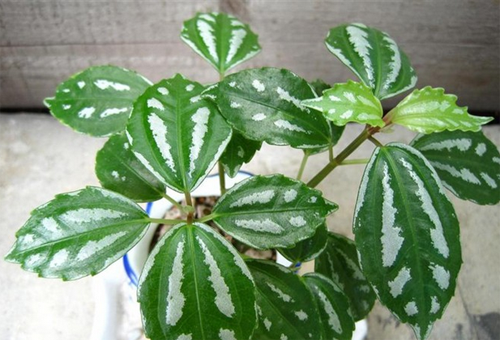
Care methods and precautions for Pilea cadierei:
Pilea cadierei, also called transparent grass, white-transparent grass, etc.; its leaves have mottled white markings, and the spots are raised, so they look very textured!
1. Pot and soil selection
For the potting soil, it is best to use leaf mold rich in humus, loose and fertile. After it warms up in spring, you can repot it (above 10°C). Before repotting, prune the plant appropriately; potted plants with poor shape can be heavily pruned.
2. Watering and humidity
It does not matter if you water a bit more frequently; it likes moisture, but just do not let the potting soil become waterlogged. Too wet is no good, and if the roots rot, do not blame me!
It likes a high-humidity environment, so when you have time, spray water on the leaves and the surrounding environment. When the air humidity is high, its leaf color is brighter green, and the patterns are even more beautiful.
3. Light
It likes shade and a bright, ventilated spot, and does not like too much sun, so if you have a balcony or windowsill at home without direct sunlight, you can choose it! (Of course, it still needs some light; it does not like harsh sun or direct sun, not that it dislikes sunlight.)
4. Fertilizing
After new leaves appear, you can begin fertilizing. Mainly use decomposed organic fertilizer; do not apply too much urea. If there is too much nitrogen fertilizer, it tends to grow leggy, which is not good for a handsome plant shape. When phosphorus and potassium fertilizer are insufficient, the markings on the leaves tend to fade.
5. Pruning
Pilea cadierei needs proper pruning. Not long after potting, pinch it back once to promote branching. When the side branches grow six leaves, pinch it back again, leaving four leaves!
The stems grown this way are more elegant and upright. Of course, how you pinch back still depends on the plant shape you like.
That is all for the care methods and precautions for Pilea cadierei. What does Pilea cadierei look like when it blooms?
How to grow Pilea cadierei: care methods and precautions for Pilea cadierei
Pilea cadierei is an evergreen foliage plant, with beautiful leaf color and pretty patterns, and it is very easy to grow, with very strong adaptability to the environment. Although Pilea cadierei is a foliage plant, it can also produce especially beautiful and eye-catching flowers. So how should Pilea cadierei be grown? Let's learn about it together below!
How to grow Pilea cadierei
1. Soil: For the potting soil of Pilea cadierei, it is best to use loam rich in humus, loose and fertile. Keep the potting soil moist, but not overly wet, otherwise the roots easily rot, and it has high requirements for air humidity. Mainly use decomposed organic fertilizer; do not apply too much urea. If there is too much nitrogen fertilizer, it tends to grow leggy, which is not good for a handsome plant shape. When phosphorus and potassium fertilizer are insufficient, the markings on the leaves tend to fade.
2. Light: Pilea cadierei is an indoor flower with very beautiful leaf color. It is very shade-tolerant, but prefers ample light, and strong direct sunlight should be avoided. In summer, place the pot by a north window; in winter, place it by a south window. If the light is too dim, the leaf color will fade. If the sunlight is too strong, the leaves will be scorched. The optimum growth temperature is 18-22°C, and the overwintering temperature should not be lower than 7°C.
3. Fertilizer and water: For Pilea cadierei, keep the potting soil dry without cracking and moist without being wet. In summer, frequently mist the leaf surface to keep the leaves clean and glossy. In winter, mist the leaves less, otherwise black spots may appear on the leaf surface, or even blackening and rotting. During the growing season, apply a 20-80 or 30-70 nitrogen liquid fertilizer about once every two weeks to promote robust growth. After autumn, increase phosphorus and potassium fertilizer to strengthen the stems and prevent lodging.
4. Pruning: Pilea cadierei tolerates pruning. After a cutting seedling is potted, pinch it back once. When the new side branches grow to 4 leaves, pinch back again leaving 2 leaves. Repeating this can form a full, hemispherical plant shape with many branches. When an old plant grows too tall, you can, when repotting in spring, leave 2-3 nodes at the base and heavily prune and shorten it. After new branches emerge, pinch back 2-3 times, and it can again form a short and compact plant shape.
5. Pests and diseases: Pilea cadierei commonly suffers from leaf spot disease, which can be prevented by spraying 200-times Bordeaux mixture. If the potting soil is too wet, root rot easily occurs, and it can be drenched with 1000-times Topsin solution. If root-knot nematodes are found, 3% carbofuran can be applied for control. If there are scale insects, spray and kill them with 1000-times 40% omethoate solution. If scarab beetles bite the leaves, you can catch them by hand or spray with 1000-times trichlorfon solution.
Care methods and precautions for Pilea cadierei
1. Pilea cadierei should be repotted at least once a year in spring. During the growing period, fertilize about once a week, applying nutrient solution once.
2. When Pilea cadierei has been cultivated for too long and its growth slows, it should be pruned in time, otherwise the ornamental effect will be reduced.
3. Pilea cadierei likes relatively strong indirect light. In summer, block more than 70 percent of the sunlight. If the sunlight is too strong, the leaves will be scorched. In winter, no shading is needed, or only slight shading.
4. When overwintering, Pilea cadierei should be kept at a temperature above 13°C. Long-term temperatures below 10°C will cause damage, but a short period at around 5°C will not cause damage.
5. Pilea cadierei likes a humid environment, so always keep the pot surface moist and the air humidity relatively high. In dry seasons, you can frequently spray water on the surrounding environment or the leaf surface.
When does Pilea cadierei bloom?
Pilea cadierei does bloom. Its flowers are actually not very showy, and it is dioecious. The inflorescences grow out from the leaf axils, bearing cyme-like flowers, small yellow-white flowers, very elegant. After Pilea cadierei blooms, it also produces fruit. Overall, both the flowers and fruits of Pilea cadierei have a certain ornamental value.
In fact, Pilea cadierei blooms in summer. Its flowering period is from June to September, and its fruiting period is from September to November.
Growth habits of Pilea cadierei
Pilea cadierei is native to valleys, stream sides or shady, damp places under forests, at an altitude of 300-1500 m. It is produced in Guangdong, Guangxi, Hunan, Hubei, Guizhou, Sichuan, southern Gansu, southern Shaanxi, southern Henan, southern Anhui, Jiangxi, Zhejiang, Fujian and Taiwan, China, and is also distributed in Japan and Vietnam.
Pilea cadierei likes a warm, humid climate and prefers loose, fertile sandy soil. The suitable growth temperature is 15°C to 25°C, and in winter it must not be low.
Pilea cadierei is a small foliage plant and takes up relatively little space. It is generally used to decorate interiors. Many people like to grow it in rooms or offices, because it is not only beautiful but can also purify the air!
Efficacy, effects and contraindications of Pilea cadierei: care methods for Pilea cadierei
Pilea cadierei is a warmth-loving plant. Whether it blooms or not, its ornamental value is very high, so many people like to keep a pot of it at home. But before growing it, most people are probably most concerned about its care methods! Let's take a look together below!
Efficacy and effects of Pilea cadierei
1. The ornamental effect of Pilea cadierei. Pilea cadierei has strong adaptability, is easy to propagate, and is relatively easy to grow. The plant cluster is small and elegant, and the leaf color is clearly green and white, with beautiful patterns. Placing it in a study or bedroom is elegant and pleasant; or hanging it in front of a window, with the green leaves hanging down, is charming and lovely. The inflorescences emerge from the leaf axils, the inflorescence stalks are light brown, semi-transparent, with terminal cymes, and looking at them lifts the mood.
2. Pilea cadierei purifies the air. Pilea cadierei absorbs harmful gases in the air and can also absorb cooking fumes, so friends with smokers at home can grow a pot of it. It can also absorb carbon dioxide while releasing oxygen, and it can increase the negative ion content in indoor air and raise indoor air humidity.
3. The medicinal use of Pilea cadierei. Pilea cadierei is not only ornamental but can also be used as medicine; the whole plant is valuable. As medicine, it has the effects of clearing heat and draining dampness, promoting fluid production and quenching thirst, and reducing jaundice and protecting the liver. It can reduce jaundice, reduce swelling and disperse nodules, and strengthen the spleen and stomach. It has good effects on damp-heat jaundice, red and white vaginal discharge, strangury and turbid urine, hematuria, summer fever in children, malarial masses, indigestion, traumatic injuries, and traumatic infections.
Contraindications for Pilea cadierei
1. When using it as medicine, you need to consult a doctor and follow the doctor's advice. Remember not to use it as medicine casually.
2. When growing it, it needs to be repotted once in spring. During the growing period, fertilize about once a week, applying nutrient solution once. In summer, block more than 70 percent of the sunlight. If the sunlight is too strong, the leaves will be scorched. In winter, no shading is needed, or only slight shading.
Care methods for Pilea cadierei
1. Soil: For the potting soil of Pilea cadierei, it is best to use loam rich in humus, loose and fertile. Keep the potting soil moist, but not overly wet, otherwise the roots easily rot, and it has high requirements for air humidity. Mainly use decomposed organic fertilizer; do not apply too much urea. If there is too much nitrogen fertilizer, it tends to grow leggy, which is not good for a handsome plant shape. When phosphorus and potassium fertilizer are insufficient, the markings on the leaves tend to fade.
2. Light: Pilea cadierei is an indoor flower with very beautiful leaf color. It is very shade-tolerant, but prefers ample light, and strong direct sunlight should be avoided. In summer, place the pot by a north window; in winter, place it by a south window. If the light is too dim, the leaf color will fade. If the sunlight is too strong, the leaves will be scorched. The optimum growth temperature is 18-22°C, and the overwintering temperature should not be lower than 7°C.
3. Fertilizer and water: For Pilea cadierei, keep the potting soil dry without cracking and moist without being wet. In summer, frequently mist the leaf surface to keep the leaves clean and glossy. In winter, mist the leaves less, otherwise black spots may appear on the leaf surface, or even blackening and rotting. During the growing season, apply a 20-80 or 30-70 nitrogen liquid fertilizer about once every two weeks to promote robust growth. After autumn, increase phosphorus and potassium fertilizer to strengthen the stems and prevent lodging.
4. Pruning: Pilea cadierei tolerates pruning. After a cutting seedling is potted, pinch it back once. When the new side branches grow to 4 leaves, pinch back again leaving 2 leaves. Repeating this can form a full, hemispherical plant shape with many branches. When an old plant grows too tall, you can, when repotting in spring, leave 2-3 nodes at the base and heavily prune and shorten it. After new branches emerge, pinch back 2-3 times, and it can again form a short and compact plant shape.
Propagation methods for Pilea cadierei
1. Cutting propagation method.
Cutting time: Cuttings can be taken in both spring and summer. When the summer temperature is relatively high, it is not suitable for cuttings. Cuttings can also be taken in winter, but the indoor temperature is relatively low and growth is relatively slow. Usually, cuttings can be taken at temperatures between 18-20°C.
Cutting stems: Select healthy, robust branches of Pilea cadierei, cut 5-8 cm of stem and leaves from the front end, retain a few leaves at the front end, and insert them directly into a sand bed with vermiculite or plain sand as the substrate, or insert them into potting soil mixed with peat and soil. The insertion depth should not exceed 2 cm. Place in a semi-shady place, keep the soil temperature at 18-20°C, and when dry, spray water with a watering can. They will root in about 2-3 weeks, and after 1-2 months they can be transplanted or potted.
2. Division propagation.
Pilea cadierei has a very strong clumping habit. When repotting and changing the soil, you can take the plant out of the pot, divide it into several layers, and at the same time shorten the old stems, keeping 2-3 nodes of the stem portion, and plant them separately in pots. After they survive, new shoots and buds will soon sprout.
Growing Pilea cadierei at home allows you to enjoy it, purify the air, and also use it as medicine, so it is a plant with strong effects. However, there are many points to pay attention to when growing it. The above has introduced them in detail, and I hope it will be helpful to everyone.