Is Variegated Periwinkle Poisonous? Growing Methods and Flowering Period Explained
Variegated periwinkle blooms with blue flowers that are very beautiful, and many people want to grow it. How do you grow variegated periwinkle? Can it be grown hydroponically? For plants kept at home, you still need to determine whether they are poisonous. How long is the flowering period?
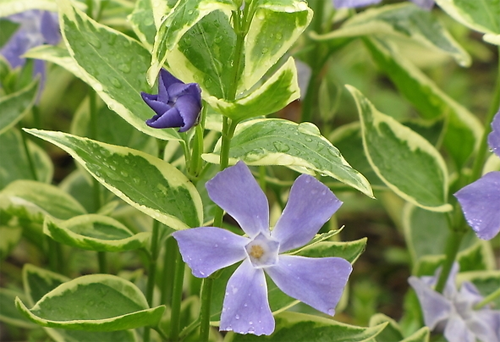
How to grow variegated periwinkle:
1. Light
It likes places where sunlight is not too intense. A balcony or yard with scattered light is most suitable for growing it. It can also grow healthily in semi-shade, but its yellow markings will not be as obvious or attractive!
It is worth noting that this plant cannot be exposed to scorching sun, otherwise the leaves will burn, and then it will not look good!
2. Soil selection
Although it can grow even when planted in a yard, fertile and slightly moist soil is more suitable for its growth. Variegated periwinkle grown in overly dry places will not look good!
For potted care, you can choose loose, breathable, and well-draining sandy soil, and it will grow very well!
3. Watering and fertilizing
It relatively likes a slightly moist environment, as long as there is no water accumulation. Apart from watering less during the cold winter, normally give plenty of water and keep the potting soil slightly moist.
Fertilizing once a month is generally enough, usually with liquid fertilizer, so that its yellow-marked leaves can be even more glossy and vivid!
Propagation methods for variegated periwinkle:
The simplest propagation methods are division and cuttings. Division is the easiest: when repotting in spring, separate the small plants and plant them in slightly moist sandy soil, then care for them in a cool, semi-shaded place!
Cuttings can be done throughout the year. The cutting soil just needs to be loose, breathable, and well-draining. A temperature of 15°C to 25°C is more suitable for cuttings. Choose robust, thick branches for cuttings, and a length of about 10 cm is most suitable. Before inserting the cuttings, remove the lower leaves and keep only a few upper leaves. Do not worry about having no leaves; it grows very quickly.
Pest and disease protection for variegated periwinkle:
1. Diseases
Variegated periwinkle also has relatively few pests and diseases. Occasionally, fusarium wilt, canker, and leaf spot may occur, and Bordeaux mixture can be sprayed for prevention and control.
2. Pests
Occasionally there may be scale insects and root-knot nematodes. For scale insects, spray 25% phosmet; for root-knot nematodes, spray 3% carbofuran. This is all about treating the symptoms accordingly.
Flowering period of variegated periwinkle:
The flowering period is March to May
Is variegated periwinkle poisonous?
Variegated periwinkle is not poisonous. It can be grown indoors and can also purify the air. Variegated periwinkle can also be grown hydroponically.
How to grow variegated periwinkle? Is variegated periwinkle poisonous?
Variegated periwinkle blooms with a kind of small blue flower. It is very beautiful and very lovely, making people unable to resist growing it as soon as they see it. Undoubtedly, variegated periwinkle also sells very well on the market. Variegated periwinkle is also a very good purifying plant and can have an air-purifying effect. So, how do you grow variegated periwinkle? Is variegated periwinkle poisonous? Friends who want to grow it will all consider these things. So today, the editor of Shengduoduo Decoration Network will introduce variegated periwinkle to everyone.What is the flower language of variegated periwinkle?
Flower language of variegated periwinkle: pleasant memories, eternal youth, and the meaning of steadfastness.
Variegated periwinkle is a rooting plant, and its ability to adapt to the environment is very strong. Therefore, some people call its flower language "adaptation." People born under the blessing of the variegated periwinkle flower do not fear adversity and have the heart to face harsh environments, and facing one or two breakups is not much of a big deal.
How to grow variegated periwinkle? Environment
Variegated periwinkle is deep green all year round, with variegated edges, very elegant. It is an excellent vertical foliage plant and groundcover plant. It is often used as a potted plant or hanging basket placed indoors and outdoors in various locations, and can also be used as bonsai or cut-flower material. Variegated periwinkle grows quickly, with spring and summer as the peak growing seasons. Its long vines can hang more than one meter below the pot. If supported with a trellis, it can also be shaped into various forms, very beautiful.How to grow variegated periwinkle? Habits
Variegated periwinkle is native to the Mediterranean coast, India, and tropical America. It likes a warm, sunny growing environment, and is also drought-tolerant, cold-tolerant, and shade-tolerant. Variegated periwinkle is not strict about soil and can grow in most soils, but it grows more luxuriantly in fertile, moist sandy soil, with greener leaves and brighter flowers, and more gloss.
How to grow variegated periwinkle? Soil
When variegated periwinkle is grown as a potted ornamental, it should be pinched back regularly to encourage better branching. During the growth period of variegated periwinkle, attention should be paid to keeping the potting soil moist, but there must be no water accumulation; it is best to water when dry and let it dry somewhat between waterings. Fertilizing is generally best once every half month. Variegated periwinkle should be pruned in summer and autumn to control vine growth and maintain its appearance.
How to grow variegated periwinkle? Propagation
Variegated periwinkle is commonly propagated by division, layering, and cuttings. Division is generally carried out every spring, digging up the stems and leaves together with the creeping stem nodes for separate planting. Cuttings are best done during the plum rain season in June to July each year. Cut robust 10-cm-long branches of variegated periwinkle, select 1-2 internodes, and insert them into leaf mold soil. In about 20 days, they can take root.
Is variegated periwinkle poisonous?
Variegated periwinkle is not poisonous. It can be grown indoors in pots or hydroponically. If potted, it should be cared for in semi-shade, and in summer it is best to give bright scattered light, avoid direct sunlight, and appropriately spray water to lower the temperature and increase humidity. During the growing period, water must be sufficient, and apply cake fertilizer 2-3 times per month. When winter arrives, move it indoors. As long as it is placed in an environment with a temperature not lower than 0°C, it can overwinter safely.
Related articles
Variegated periwinkle specifications, variegated periwinkle planting, variegated periwinkle price, is variegated periwinkle poisonous
Variegated periwinkle
Variegated periwinkle is a variety of the periwinkle Vinca major in the genus Vinca of the dogbane family Apocynaceae. It is distributed in Jiangsu and other places in mainland China, and has not yet been introduced and cultivated artificially. It is low-growing, with trailing branches and creeping growth, reaching more than 2 m in length. The leaves are elliptical, opposite, with petioles, bright green, glossy, and with creamy yellow leaf margins. The leaf edges are white, with yellow-white spots. It is cultivated in Jiangsu, Fujian, Guangxi, Guangdong, Hubei, Hunan, and other provinces.Variegated periwinkle price
1. Variegated periwinkle 50 cm tall 0.14 yuan
2. Variegated periwinkle 80 cm tall 0.2 yuan
3. Variegated periwinkle 40 cm tall 0.45 yuan
4. Variegated periwinkle 45 cm tall 0.45 yuan
Is variegated periwinkle poisonous?
If you are only admiring it, there is no problem. It is best not to touch it, especially its sap, which is somewhat toxic.
Variegated periwinkle specifications
Cuttings can be taken before bud break in spring, during the plum rain season, and from September to October. Cutting method: choose robust branches from the current year or one-year-old branches, cut them to about 10 cm long, with 2-3 pairs of buds, and insert them for cuttings. The plant and row spacing is 10 cm x 10 cm. After insertion, water thoroughly, build a shed and cover it with a shade net to protect from sun, and keep the soil moist. After surviving, they can be transplanted to the field. Potted variegated periwinkle should be pinched back in time to promote branching. During the growing period, keep the potting soil moist and fertilize once every half month. In summer and autumn, prune appropriately to control vine growth. When planted in the open ground, it is generally green and evergreen all year round.
Variegated periwinkle planting
Propagation is best carried out in spring. At this time, cut off the old branches from the previous year, dig out the plants and separate them, replant them separately, and water thoroughly. Layering propagation is carried out during the growing season.
Cultivation management: It likes warm and sunny environments, and is also shade-tolerant, cold-tolerant, and relatively drought-tolerant, but in more shaded places, the yellow patches on the leaves become lighter, so it is suitable for planting under sparse woods. It likes relatively fertile, moist soil. Periwinkle cultivation requires loose, humus-rich sandy loam. For potted plants, a mixture of leaf mold soil, garden soil, and river sand can be used as the substrate. Multiple plants can be planted in each pot at the same time, and timely pinching back can quickly form a full shape. To promote more branching, pinching back can be done multiple times during the growing season. Piling soil at the nodes can grow more adventitious roots and promote vine growth. Water should be given during drought, and attention should be paid to drainage during the rainy season.
Because variegated periwinkle grows quickly, it needs sufficient watering during the growing period to keep the potting soil moist, and at the same time apply liquid fertilizer 1-3 times per month to ensure rapid vine growth and dark green, glossy leaf color. It is suitable for bright light environments. But in midsummer, avoid direct strong light to prevent burning the leaves; appropriate shading is necessary, and a semi-shaded environment is best. Although periwinkle growth prefers warmth, it is also cold-tolerant, and in winter it can tolerate low temperatures of around 0°C. Periwinkle has strong adaptability and grows quickly, maintaining good color all year round except in severe cold, so it is easy to cultivate and widely used. When planted in the open ground, it is generally green and evergreen all year round. Fusarium wilt, canker, and leaf spot often occur, and equal parts Bordeaux mixture can be sprayed for prevention and control. Pests include scale insects and root-knot nematodes. For scale insects, spray with 25% phosmet emulsifiable concentrate at 1000 times dilution; for root-knot nematodes, use 3% carbofuran granules for control.
Related encyclopedia
Pocket scale non-woven bag rush pith crab claw red rice note3 ykk zipper ybs zipper large mountain cherry creeping wall plum wild senna winter plum green pine wristwatch Omega Longines famous watch children's building blocks flint azalea orchid curling iron soursop