Areca Palm Pest and Disease Control Methods and How It Differs from Bambusa Multiplex
The areca palm looks a lot like bamboo, but it can also get sick. How do you control the pests and diseases of the areca palm? And how is it different from Bambusa multiplex?
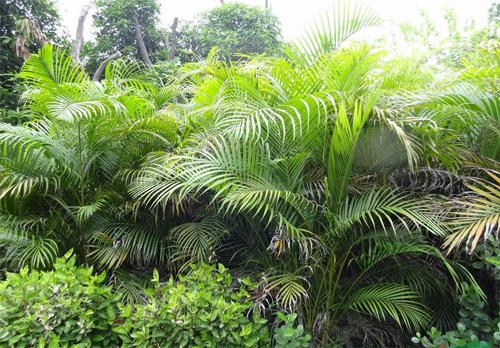
Areca palm pest and disease control:
Leaf spot disease, the leaf tips and leaf margins are most susceptible, causing drying and curling. In the early stage of the disease, spray with a 500-fold dilution of 50% captan wettable powder for control. In addition, there may be damage from scale insects, which can be killed by spraying with a 1500-fold dilution of 40% omethoate emulsifiable concentrate. In the high-temperature summer season, the plant should be placed in a spot with diffused light indoors or under a shade shed, avoiding direct sunlight. In northern regions in late September, when outdoor temperatures gradually drop, potted flowers placed outdoors should be promptly moved indoors to a spot with sufficient light, taking care to keep them warm and protect them from the cold. Indoor temperatures must not fall below 1O°C.
During this period, attention should be paid to reducing the frequency of supplemental watering and moisture, so as to avoid root rot and yellow leaves caused by low temperature and high humidity.
1. Leaf blight
Areca palm leaf blight is a common disease caused by fungal infection. It has a great impact on the growth of the areca palm. In mild cases, it causes the leaves to dry up; in severe cases, it can cause the entire plant to die.
Control methods:
Strengthen ventilation, and avoid rain and spraying during the disease period; promptly prune the affected branches and leaves to stop further infection. After pruning, apply Daconil ointment to the wounds for treatment; if disease occurs, spray with an 800-fold dilution of 70% thiophanate-methyl or a 1000-fold dilution of 75% chlorothalonil, applying once every 7-10 days, for 3 to 4 consecutive applications, which can effectively control the condition.
If the environment is dry and ventilation is poor, red spider mites and scale insects are likely to occur, so regular spraying with an 800-fold dilution of omethoate for control is advisable.
2. Control of root rot
The main reasons for the drying and scorching of the leaf tips and leaf margins of the areca palm during the growth period:
1. The air is too dry
The areca palm prefers relatively high air humidity. When the air is too dry, it will cause scorched tips and scorched margins on the leaves. Throughout the entire growth period, water should be sprayed on the leaf surface and the surrounding environment 3-4 times a day to increase air humidity. However, watering should be stopped after the dormant period.
2. Sunlight is too strong
The areca palm prefers a semi-shaded environment from May to September. When exposed to direct sunlight, phenomena such as yellowing of the leaves and scorched tips and scorched margins will occur. During this period, it should be placed under a shade shed or a large tree to avoid direct sunlight.
3. The potting soil is too dry
During the growth period, the areca palm needs a sufficient supply of water. When the potting soil is dry for a long time, because the plant's growth cannot obtain the sufficient water it needs, the leaf tips and leaf margins of the areca palm will become dry and scorched.
4. The potting soil is too wet
It is not that as long as there is water in the potting soil, the plant can absorb and use it. When the potting soil is too wet, because it affects the respiration of the plant roots, it thereby affects the root system's absorption of water and leads to water deficiency within the plant, causing scorched tips and scorched margins on the leaves.
5. Fertilizer is too concentrated
Too concentrated fertilizer will cause reverse osmosis in the plant root cells, causing the plant to lose water. In mild cases, it will cause scorched tips and scorched margins on the leaves; in severe cases, it will cause root rot and death. Growth stops at 10°C, and it enters the dormant period. Below 6°C, it needs to be moved indoors for cold protection and warmth, and the room temperature should be kept above 8°C. After being moved indoors, it should be placed in a spot with light. If the room is equipped with an air conditioner or other heater, it should be kept some distance away.
Differences between the areca palm and Bambusa multiplex:
Areca palm:
Also called yellow coconut and purple palm, it is an evergreen small shrub or small tree of the palm family, Areca genus. Its rhizome is smooth, generally yellow-green, and its leaves are relatively smooth and slender, of course in the shape of a spread-out tail.
It likes a warm, humid, ventilated, semi-shaded environment and is not cold-tolerant. It can be seen in various places in the south. In the north it is an indoor green plant. It is quite shade-tolerant, but cannot handle exposure to strong sun!
Bambusa multiplex:
A variant bamboo of Bambusa multiplex, it has become more compact and low, with graceful green leaves, and of course more charm. Its leaves are in strings, just like a phoenix's tail, and the leaves are very small and fine. Its ornamental value is still quite good!
Seeing this Bambusa multiplex, I only then realized that Bambusa multiplex is not areca palm. It truly is an ornamental bamboo, not a plant of the palm family.
It generally grows in southern China. It likes warm and humid conditions. It can be kept in a bright light spot, and it is also relatively shade-tolerant. It is just not cold-tolerant and does not like strong sun exposure. The potting soil for its care must have good drainage; sandy soil is fine!
In winter, if the temperature is below 0 degrees, it is easy for it to die. It looks very fresh and elegant, and is still a great small bonsai for courtyards and indoors.
That is all for the introduction to pest and disease control of the areca palm, and the differences from Bambusa multiplex have also been introduced. Have you already clearly distinguished the differences between the two?
Differences between the areca palm and Bambusa multiplex, and how to grow the areca palm
Bambusa multiplex and the areca palm are both common small ornamental plants, but people often confuse the two. Below, let's talk about the differences between the areca palm and Bambusa multiplex, as well as how to grow the areca palm.
Differences between the areca palm and Bambusa multiplex
Areca palm
The areca palm is also known as yellow coconut and purple palm. It is a clustered evergreen shrub or small tree of the palm family, Areca genus. The stem is smooth, yellow-green, without prickles, covered with a waxy powder when young, with obvious leaf scars, in ring-like patterns. The leaf surface is smooth and slender, pinnately parted throughout, 40-150 cm long, the petiole slightly curved, with a soft tip.
The inflorescence is borne beneath the leaf sheath, in a panicle form, about 0.8 m long, with 2-3 orders of branching, the branch inflorescences 20-30 cm long, bearing 8-10 spikelet rachises, 12-18 cm long; the flowers are small, ovoid, golden yellow, spirally arranged on the spikelet rachis; the male flower has 3 sepals and 3 petals, with striped veins on the surface, 6 stamens, the anthers more or less versatile; the female flower's sepals and petals are slightly similar to those of the male flower, the ovary 1-loculed, with a short style and a thick stigma.
The fruit is slightly top-shaped or obovoid, about 1.5-1.8 cm long, 0.8-1 cm in diameter, earthy yellow when fresh, purple-black when dry, the exocarp smooth, the mesocarp with reticulate fibers. The seed is slightly obovoid, with uniform endosperm, a narrow and long cavity in the center, and the embryo lateral. The flowering period is May, and the fruiting period is August.
Bambusa multiplex
The plant type is short, with fine, dense, graceful green leaves, elegant and unrestrained, like a phoenix tail. The branches are slender, and the upper end of the bamboo culm is thin due to luxuriant branches and leaves. The branches and culms are dense, slender, and curved downward. The leaves are small, about 3 cm long, usually 20 arranged on both sides of the branch, resembling a feather shape. Those whose bamboo culms and branches are solid or nearly solid are called "Guanyin bamboo," while those that are hollow are called "Bambusa multiplex."
Bambusa multiplex is native to southern China. It likes a warm, humid, and semi-shaded environment. Its cold tolerance is somewhat poor, it is not tolerant of strong light exposure, and it fears waterlogging. It is suitable for fertile, loose, and well-drained loam, and the winter temperature should not be lower than 0°C. Bambusa multiplex has dense clumps, short bamboo culms, and beautiful branches and leaves. It can absorb formaldehyde and purify the air. It is often used for potted ornamental display, embellishing small courtyards and rooms, and is also often used to make bonsai or as low hedge material.
Differences
The areca palm and Bambusa multiplex belong to different types. The areca palm is a shrub, and its maximum height can reach 7 or 8 meters. Its stem is very smooth and often appears golden yellow. Its leaves are slender and in ring-like patterns, with a maximum length of up to 150 cm, and the leaf surface is bright green.
Bambusa multiplex is a lignified plant. Its main culms grow relatively densely, and the stems are all hollow. Its maximum height can only reach about 3 m, and its leaves are fine, dense, and graceful. Some leaves are as fine as needles, shaped like a phoenix tail. Its branches and leaves are very luxuriant and often weigh down the stems, forming a natural downward-drooping state.
How to grow the areca palm
1. Propagation methods
1. Sowing method
The seeds used for sowing propagation are mostly imported from abroad. It is difficult to collect mature areca palm seeds domestically. Sowing is commonly done in pots, with a soil covering depth of 1 times the seed. Keep the potting soil moist. When the seedlings are 8-10 cm tall, they can be divided and planted.
2. Division method
Division propagation of the areca palm can be done in all four seasons. Around April, in conjunction with repotting, select plants with many tillers at the base, remove part of the old potting soil, and use a sharp knife to divide them from the connection point at the base into several clumps. The wounds need to be coated with plant ash or sulfur powder for disinfection. Each clump should not be too small; it must have 2-3 plants, and the root system should be well retained. For newly planted areca palms, because the root system has not yet developed well, long exposure to strong light should be avoided. Water appropriately, and spray water on the leaves several times a day to keep the leaves moist. Care for it at a temperature of 20-25 degrees, and it will recover and take shape relatively quickly. Generally, after 1-2 years of care, it can become a potted commercial product. Otherwise, after division, the areca palm grows slowly and its ornamental value is affected. After division and planting, place it in an environment with relatively high humidity and temperature, and spray water frequently to facilitate the recovery of growth.
2. Cultivation management
1. Humidity
The areca palm is native to tropical regions and likes high-temperature environments. It has very strict requirements for winter temperature. When it is below 10°C, growth slows and it begins to enter a semi-dormant or dormant state; when it is below 5°C, it cannot safely overwinter; in summer, when the temperature reaches above 35°C, it can also endure it, but the growth of the areca palm will be temporarily hindered. The most suitable growth temperature is 18-30°C.
2. Light
The areca palm is not strict about light. It likes sufficient sunlight and is also tolerant of semi-shade, but it grows better when there is sufficient light.
3. Fertilizer and water
For potted areca palms, in addition to adding organic fertilizer when potting, appropriate fertilizer and water management should also be carried out during usual care. In spring, summer, and autumn, these three seasons are the peak growth seasons for the areca palm, and the interval is about 1-4 days. On sunny days or during high temperatures, the interval is shorter; on rainy days or during low temperatures, the interval is longer or no watering is done. During the winter dormant period, the main task is to control fertilizer and water well, with an interval of about 3-7 days. On sunny days or during high temperatures, the interval is shorter; on rainy days or during low temperatures, the interval is longer or no watering is done. For field-planted areca palms, in spring and summer, depending on drought conditions, apply fertilizer and water 2-4 times: first dig a small trench in a circle 30-100 apart from outside the root collar (the larger the areca palm, the farther from the root collar), with the trench width and depth both 20 cm. Spread 25-50 jin of organic fertilizer into the trench, or 1-5 liang of granular compound fertilizer (chemical fertilizer), then water thoroughly. After winter begins and before spring begins, apply fertilizer once more according to the above method, but no watering is needed.
4. Pruning
The areca palm does not need pruning. Its beauty lies in the graceful and varied forms of its leaves, just like a young girl, pure and bright. If you do not like the shells wrapped around the base, it is fine to peel them off; otherwise, there is no need to peel them, because they will naturally fall off after a certain time. If there are many areca palms, diluted compound fertilizer can be applied.
3. Pest and disease control
1. Leaf spot disease
The leaf tips and leaf margins of the areca palm are most susceptible, causing drying and curling. In the early stage of the disease, spray with a 500-fold dilution of 50% captan wettable powder for control. In addition, there may be damage from scale insects, which can be killed by spraying with a 1500-fold dilution of 40% omethoate emulsifiable concentrate.
2. Whitefly
It can be controlled by spraying with a 200-fold dilution of Caltex Trounce. Both the leaves and roots of the areca palm should be sprayed. If good ventilation can be maintained regularly, the areca palm is not likely to suffer from whitefly. If the environment is dry and ventilation is poor, red spider mite damage may also occur, which can be controlled by spraying with a 3000-5000-fold diluted solution of 20% pyridaben wettable powder.
Differences between the areca palm and Bambusa multiplex: an expert teaches you to see through them at a glance
Many people confuse the areca palm with Bambusa multiplex, and combined with the boasting of some merchants on the market, it is often very difficult for everyone to distinguish them. So here the editor teaches everyone the simplest method of distinction, so that you can see through the differences between the areca palm and Bambusa multiplex at a glance.
Differences between the areca palm and Bambusa multiplex
Areca palm: alias yellow coconut, family and genus palm family, Areca genus. Shrub or small tree, in its place of origin it can reach 3-8 meters tall. The stem is smooth without prickles, with obvious leaf scars, in ring-like patterns, with many tillers at the base, growing in a clustered form. The leaf surface is smooth and slender, pinnately compound, 40-150 cm long. The leaflets and petiole are slightly curved, with a soft tip. The leaflets are lanceolate, 20-25 cm long, asymmetrical on the left and right sides, with a ridge on the middle part of the leaf rachis. The leaf surface is bright green, and the slender petiole and stem are golden yellow.
Bambusa multiplex: alias Guanyin bamboo, a perennial lignified plant of the grass family, Bambusoideae, Bambusa multiplex genus. The culms are densely clustered, short and slender but hollow. The culm height is 1-3 m, diameter 0.5-1.0 cm. The leaves and branchlets of Bambusa multiplex droop, with 9-13 leaves per branchlet. The leaf blades are small, linear-lanceolate to lanceolate, 3.3-6.5 cm long, 0.4-0.7 cm wide. The plant is clustered, with fine, slender, soft leaves, curved and drooping, just like a phoenix tail.
The difference between the areca palm and Bambusa multiplex is not great. The leaves look about the same, so you need to look at the rhizome part. The rhizome part of Bambusa multiplex is similar to bamboo, growing upward as a single stem, and in segments, only separating after reaching a certain height. The areca palm begins to spread apart from the rhizome part, making it very easy to identify.
How to grow the areca palm
1. Soil: The areca palm is not strict about soil requirements, but loose soil rich in humus is suitable. For potted areca palms, leaf mold soil, peat soil plus 1/3 river sand or perlite and base fertilizer can be used to prepare the culture soil.
2. Watering: Usually keep the potting soil often moist. During the high-temperature period in summer and autumn, also often maintain relatively high air humidity around the plant, but absolutely avoid water accumulation in the potting soil, so as to avoid causing root rot.
3. Sunlight: It is not strict about light. It likes sufficient sunlight and is also tolerant of semi-shade, but it grows better when there is sufficient light. When cultivated indoors for ornament, it is suitable to place it in a spot with relatively strong diffused light; it can also tolerate a relatively dark environment, but it should be regularly moved outdoors to a spot with better light for care, so as to facilitate recovery and maintain a relatively high ornamental state.
4. Temperature: The areca palm is native to tropical regions and likes high-temperature environments. It has very strict requirements for winter temperature. When it is below 10°C, growth slows and it begins to enter a semi-dormant or dormant state; when it is below 5°C, it cannot safely overwinter; in summer, when the temperature reaches above 35°C, it can also endure it, but growth will be temporarily hindered. The most suitable growth temperature is 18-30°C.
5. Fertilization: May-October is its vigorous growth period, and relatively sufficient water and fertilizer conditions must be provided. Generally, apply decomposed liquid fertilizer or compound fertilizer once every 1-2 weeks to promote vigorous growth of the plant and dark green leaf color. In autumn and winter, fertilizer can be applied less or not at all, while maintaining the dry and wet state of the potting soil.
6. Pruning: In winter, when the plant enters the dormant or semi-dormant period, the weak, diseased and insect-damaged, dead, and overly dense branches should be cut off.
7. Pests: Leaf spot disease, the leaf tips and leaf margins are most susceptible, causing drying and curling. In the early stage of the disease, spray with a 500-fold dilution of 50% captan wettable powder for control. In addition, there may be damage from scale insects, which can be killed by spraying with a 1500-fold dilution of 40% omethoate emulsifiable concentrate.
That is all for the introduction to the differences between the areca palm and Bambusa multiplex, as well as how to grow the areca palm. I believe that when you go to the market to buy these two plants in the future, you will no longer confuse them. I hope it is helpful to everyone. Please continue to follow us.
For home decoration, we can choose different plants. Appropriate plant arrangement has a very good embellishing effect on our homes and can make our homes look more natural and more beautiful. If we want to make our homes more beautiful, we can try to improve our home decoration style! We can apply for Tubatu's free measuring service. Professional designers will come to your door for free to measure, and the designers can provide multiple free design plans based on the characteristics of our floor plan for us to choose from!