Osmanthus pest and disease control methods: what to do when it won't bloom or smell fragrant?
The osmanthus we usually encounter is in residential complexes; you can smell it when passing by, but rarely do we actually see the osmanthus tree. Osmanthus also gets bugs and gets sick. How should osmanthus pests and diseases be controlled? Why won't a potted osmanthus grown at home bloom, and why isn't it fragrant either?
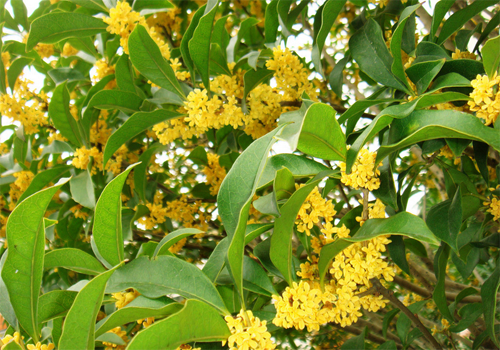
Osmanthus pest and disease control:
1. Brown spot disease
Small yellow spots appear on the leaves and slowly turn into a large grayish-brown patch. The disease generally occurs from April to October, and old leaves are prone to it.
Remove the diseased leaves promptly and spray chlorothalonil!
2. Dieback spot disease
Small brown spots appear on the leaves and slowly turn dark brown. High temperature, high humidity, and poor ventilation make the plant prone to the disease.
3. Anthracnose
Small grayish-green spots appear on the leaves and gradually worsen. Damp environments make the plant prone to the disease!
Control: Diseased leaves of osmanthus should be removed promptly; during care, ensure ventilation and more light, and appropriately prune weak and dense branches.
Gardeners who spray chemicals can choose Bordeaux mixture, carbendazim, and benomyl, judging the dosage themselves. Before planting, the potting soil and seedlings can be soaked and disinfected with potassium permanganate.
Pest control:
Generally, controlling red spider mites is about enough. When you see them, spray mite killer and aphid-mite killer, covering both the front and back of the leaves, once a week for 2-3 consecutive times.
Potted osmanthus won't bloom?
Insufficient light, lack of fertilizer, overwatering, potting soil that is too alkaline, or smoke and dust pollution - all these can cause your osmanthus not to bloom!
Osmanthus blooms but isn't fragrant?
What you're growing is probably Four Seasons Osmanthus, which blooms all year round but simply isn't fragrant! It's a matter of variety!
That's all for the introduction to osmanthus pest and disease control and the problems encountered during its blooming period. Come and grow a pot of osmanthus that will bloom and be fragrant! And healthy too.
What to do when potted osmanthus gets bugs: osmanthus pest and disease control (spraying different chemicals for different pests and diseases)
Any plant can get bugs, and of course osmanthus is no exception. With advances in potting techniques, osmanthus can now be grown at home too. Osmanthus is one of the flowering plants that easily gets bugs, so what should you do when osmanthus gets bugs? There are many kinds of pests that affect osmanthus, and the control methods for each are different. Follow the editor below to take a look at osmanthus pest and disease control.
1. What to do when potted osmanthus gets bugs: spray chemicals to kill the pests
Any flowering plant can suffer from pests and diseases, and potted osmanthus naturally cannot avoid the problem of getting bugs. What should you do when potted osmanthus gets bugs? Don't panic. First, look carefully at what kind of bug your osmanthus has. Common pests include scale insects, whiteflies, red spider mites, and so on. The chemicals sprayed for different pests are also different. Below we will explain osmanthus pest and disease control one by one.
2. Osmanthus pest and disease control
1. Scale insects
The adult body is 5-7 mm long. The female is oval, orange-red, flat on the ventral side, and raised on the back. Before laying eggs, she secretes a white egg sac at the rear of the abdomen. The male has a slender whole abdomen, about 3 mm long, with a black thorax and an orange-red abdomen. Most female adults cluster and fix themselves in one place, secreting a white waxy egg sac at the end of the abdomen. The egg-laying period lasts more than 30 days, and each female can lay several hundred to 2000 eggs. After hatching, the larvae disperse and move about, then migrate from tender shoots and the undersides of leaves to the branches and trunk, where they gather and cause damage, sucking the tree's sap and excreting honeydew, which induces sooty mold. Because pests and diseases cause overlapping damage, they often lead to yellowing leaves and withered shoot tips in osmanthus plants.
Control methods: Usually use less pesticide and protect natural enemies. When a small number of insects are found, wipe them off and crush them to death promptly. In winter, spray 0.3-0.5 degrees Baume lime sulfur mixture to kill overwintering pests; at the peak of egg hatching, spray with 1000x Zhongjie solution, or 1000x Jieqing solution, or 800x Kuangshajie solution.
2. Whiteflies
The whitefly pests that harm osmanthus mainly include whitefly, black whitefly, orange-yellow whitefly, and so on. They mainly use the mouthparts of adults and larvae to pierce into the leaf mesophyll on the underside of leaves and suck sap, causing osmanthus leaves to curl, lose green color and turn yellow, and even dry up. The large amount of honeydew they excrete seriously contaminates the branches and leaves of osmanthus and can trigger sooty mold, causing poor growth of osmanthus, thereby affecting the plant's normal blooming and display value.
Control methods: Whiteflies have strong pesticide resistance. When choosing pesticides for control, pay attention to the principle of alternating and mixing use. For example, you can alternately use 1000x Feisao solution, 2000x 10% imidacloprid wettable powder, 1500x 40% omethoate emulsifiable concentrate, 1000x Yashi Landai solution, and so on.
3. Red spider mite
The red spider mite, commonly known as the fire dragon, is one of the most common pests of osmanthus. Its individual body is very small, less than 1 mm long, round or oval, orange-yellow or red-brown. Do your best to defend against red spider mites, so the growing environment must be well ventilated with suitable humidity, and avoid dryness and stuffiness as much as possible.
Control methods: What to do when osmanthus gets bugs? In dry weather, pay attention to irrigation and combine it with fertilization to promote robust plant growth and enhance pest resistance. When applying chemical pesticides, pay attention to frequently rotating them, because after the application of certain highly toxic pesticides, resistance will develop. You can spray with 1000x Manke solution or 1500x 40% dimethoate emulsifiable concentrate for good control results.
4. Carmine spider mite
The adult carmine spider mite is 0.5-0.6 mm long. The female mite is oval, vermilion to rust-red, or dark brown to black-brown; the male mite is slightly diamond-shaped, pale yellow, slightly smaller, with a body length of 0.3-0.4 mm. Hot and dry seasons are most favorable for its major outbreaks, causing the leaves of an entire plant or a whole osmanthus grove to turn grayish-yellow, seriously affecting the growth, blooming, and display value of osmanthus.
Control methods: Protect natural enemies, such as Stethorus punctillum, Orius minutus, Scolothrips takahashii, Chrysopa sinica, Chrysopa septempunctata, and so on; in winter, clear away weeds under the trees and burn them, and use 0.3-0.5 degrees Baume lime sulfur mixture to kill overwintering adult mites, nymphs, and eggs; use 1000x Manke or 800x abamectin-pyridaben. Now you know what to do when osmanthus gets bugs. Below let's look at its disease control.
3. Osmanthus disease prevention
1. Brown spot disease
In the early stage of the disease, small yellow spots appear on the leaves and gradually expand into circles with a diameter between 2 mm and 10 mm. The spots are yellow-brown to gray-brown, with a yellow halo around them. It generally occurs frequently from April to October each year.
2. Dieback spot disease
Dieback spot disease mostly invades from the leaf margin and leaf tip, occurring at the edges and tips of the leaves. In the early stage, small light brown spots appear on the osmanthus leaves and gradually expand into round or irregular spots with dark brown edges. It mostly occurs between July and November.
3. Anthracnose
Osmanthus anthracnose infects osmanthus leaves. In the early stage, small chlorotic spots appear on the osmanthus leaves and gradually enlarge to form round, semicircular, or oval spots. The spots are light brown to grayish-white, with a red-brown ring around the edge. Under humid conditions, pale pinkish sticky acervuli appear on the spots. Anthracnose occurs from April to June. The above is what to do when osmanthus gets bugs and the methods for osmanthus pest and disease control. Below let's look at how to treat the diseases.
Control methods for osmanthus diseases:
1. For the control of the following diseases, first reduce the source of infection. For example, thoroughly clear away diseased fallen leaves in autumn, and promptly remove diseased leaves from potted osmanthus.
2. Strengthen the management of osmanthus trees. Choose fertile, well-drained soil or substrate for planting osmanthus; apply more organic fertilizer and potassium fertilizer; the planting density should be appropriate so as to allow ventilation and light penetration, reduce leaf surface humidity, and decrease the occurrence of diseases.
3. In the early stage of the disease, spray 1:2:200 Bordeaux mixture, after which you can spray 1000x 50% carbendazim wettable powder or 1000-1500x 50% benomyl wettable powder.
4. In severely affected areas, when seedlings leave the nursery, soak them in 1000x potassium permanganate solution for disinfection. The above is brought to you on osmanthus pest and disease control and what to do when potted osmanthus gets bugs. We hope it can help everyone.
Classification of osmanthus and control of osmanthus pests and diseases
Osmanthus has a rich floral fragrance and an enticing scent, making it an ideal flowering plant for indoor growing. Moreover, today's osmanthus has undergone artificial cultivation, forming many varieties for everyone to choose from. But potted osmanthus often blooms very little or is slow to bloom, and we need to pay more attention to the threat of pests and diseases. Below is an introduction to the classification of osmanthus and the control of osmanthus pests and diseases.
Classification of osmanthus
Through long periods of artificial cultivation, natural hybridization, and artificial selection, osmanthus has formed rich and diverse cultivated varieties. After extensive investigation of osmanthus resources and varieties in major cities across the country, on-site recording of osmanthus flowering traits, analysis and comparison of the traits of various types of osmanthus, selection of relatively stable genetic traits, and using traditional classification methods and applications in landscape production, four cultivar groups of osmanthus have been identified and organized.
1. Four Seasons Osmanthus cultivar group
This cultivar is a clumping shrub with a low tree form, short and dense branches, and a round spherical crown. New leaves are dark red, while mature leaves are green or yellow-green; the leaves are elliptic broadly ovate, with entire margins or sparsely serrate, and the leaf margin undulation is not obvious; the leaf texture is relatively thin, the mesophyll on the leaf surface is slightly raised, and the reticulate veins are relatively obvious. The petiole averages about 1 cm long. The important feature is that the angle between the main vein and the lateral veins is very large, approaching a vertical state.
The flower buds of Four Seasons Osmanthus are usually solitary or stacked in groups of 2-3, blooming in batches from September each year to the following March. The flower color is relatively pale, from milky yellow to lemon yellow, and the fragrance is not as rich as that of Silver Osmanthus, Golden Osmanthus, or Red Osmanthus. Varieties include Large-leaf Four Seasons Osmanthus and Small-leaf Four Seasons Osmanthus. It blooms in all four seasons, with varieties such as 'Yueyuegui', 'Rixianggui', 'Daye Fodingzhu', and 'Chiye Four Seasons Osmanthus'.
2. Red Osmanthus cultivar group
An evergreen shrub, dioecious, with a round spherical crown. The bark is light gray, relatively smooth, with sparse lenticels. The leaves are leathery, long elliptic or elliptic, 6-12 cm long and 2.5-5 cm wide; the leaf surface is relatively flat, the leaf margin is revolute, entire, occasionally sparsely toothed at the tip, and broadly cuneate at the base; the apex is obtuse-acute or short-acute; there are 8-10 pairs of lateral veins, and the reticulate veins are obvious on both sides; the petiole is 8-10 mm long. The flower color is orange-red, the corolla is slightly incurved; the fragrance is light.
The flowering period is from late September to early October. It blooms in autumn, with relatively deep flower colors ranging from orange-yellow and orange-red to vermilion, a rich scent, and thick leaves. Varieties include 'Dahua Red Osmanthus', 'Chi Red Osmanthus', 'Zhusha Red Osmanthus', and 'Kuanye Hong'.
3. Golden Osmanthus cultivar group
An evergreen small tree with a round spherical crown; the tree vigor is strong, the branches are upright and very dense. The bark is gray, and the lenticels are round or oval. The spring shoots are relatively thick, with an average length of 15.9 cm; the leaves are dark green, leathery, and glossy; the leaves are elliptic, the leaf surface is uneven, the leaf margin is slightly wavy and obviously revolute; the margin is entire, occasionally with serrations at the tip; the flower color is yellow, with a strong fragrance, and it does not set fruit.
It blooms in autumn, with flowers from pale lemon yellow to golden yellow. Varieties include 'Dahua Golden Osmanthus', 'Daye Huang', 'Huangchuan Golden Osmanthus', 'Wan Golden Osmanthus', 'Yuanye Golden Osmanthus', Xianning Late Osmanthus, Qiu Osmanthus, Yuanbian Golden Osmanthus, Liuye Su Osmanthus, Jinshi Osmanthus, Boye Golden Osmanthus, and other varieties.
4. Silver Osmanthus cultivar group
An evergreen small tree with a round spherical crown, large branches spreading, dense branches and leaves, and good growth vigor. The bark is light gray, and the lenticels are numerous and large, shaped like snowflakes, and very obvious. The average length of spring shoots is 15.5 cm, and the new shoots are brown-red, very eye-catching. The leaves are green or dark green, thickly leathery, and glossy; long elliptic or elliptic; the leaves are relatively broad and thick; the leaf surface is relatively flat; the leaf margin is slightly wavy, revolute, entire, and occasionally sparsely toothed at the tip; it blooms in early to mid-September, the corolla spreads obliquely, the lobes are ovate, the flower color is milky yellow to lemon yellow, and the fragrance is rich; it does not set fruit after flowering.
It blooms in autumn, with flower colors of pure white, milky white, yellow-white, or pale yellow. Varieties include Broad-leaf Seed Silver Osmanthus, Willow-leaf Silver Osmanthus, Hard-leaf Silver Osmanthus, 'Seed Silver Osmanthus', 'Jiulong Osmanthus', 'Early Silver Osmanthus', 'Late Silver Osmanthus', 'Baijie', 'Pure White Silver Osmanthus', 'Qingshan Silver Osmanthus', and other varieties.
Control of osmanthus pests and diseases
Osmanthus brown spot disease, osmanthus dieback spot disease, and osmanthus anthracnose are common leaf diseases of osmanthus. These diseases can cause early leaf drop in osmanthus, weaken plant growth vigor, and reduce osmanthus flower yield and ornamental value.
1. Brown spot disease
In the early stage of the disease, small chlorotic yellow spots appear on the leaves and gradually expand into nearly round spots with a diameter of 2-10 mm, or become irregular spots because the expansion of the spots is restricted by leaf veins. The spots are yellow-brown to gray-brown, with a yellow halo around the outside. Brown spot disease generally occurs from April to October, and old leaves are more susceptible than tender leaves. The pathogen overwinters as mycelium on diseased fallen leaves, and in the following spring produces conidia for primary infection. The conidia are spread by airflow and raindrops.
2. Dieback spot disease
The pathogen of this disease mostly invades from the leaf margin and leaf tip, occurring at the leaf margin and leaf tip. In the early stage, small light brown spots appear on the leaves and gradually expand into round or irregular spots, later enlarging into nearly round or irregular large gray-brown spots with dark brown edges. Dieback spot disease occurs from July to November, and can occur year-round in greenhouses with poor environmental conditions. The pathogen spreads and infects via conidia carried by wind and water. High temperature, high humidity, and poorly ventilated environments favor the disease. When plants are weak, and on old leaves after overwintering and leaves in the lower part of the plant, the disease is more severe.
3. Anthracnose
This disease infects osmanthus leaves. In the early stage, small chlorotic spots appear on the leaves and gradually enlarge to form round, semicircular, or oval spots. The spots are light brown to grayish-white, with a red-brown ring around the edge. Under humid conditions, pale pinkish sticky acervuli appear on the spots. Anthracnose occurs from April to June. The pathogen overwinters in diseased fallen leaves as acervuli and is spread by wind and rain.
4. Control measures
First, reduce the source of infection. Thoroughly clear away diseased fallen leaves in autumn. Promptly remove diseased leaves from potted osmanthus.
Second, strengthen cultivation management. Choose fertile, well-drained soil or substrate for planting osmanthus; apply more organic fertilizer and potassium fertilizer; the planting density should be appropriate so as to allow ventilation and light penetration, reduce leaf surface humidity, and decrease the occurrence of diseases.
Use chemicals scientifically for control. In the early stage of the disease, spray 1:2:200 Bordeaux mixture, after which you can spray 1000x 50% carbendazim wettable powder or 1000-1500x 50% benomyl wettable powder.
In severely affected areas, when seedlings leave the nursery, soak them in 1000x potassium permanganate solution for disinfection.
5. Pest control
The main pest of osmanthus grown at home is mites, commonly known as red spider mites. Once an infestation is found, it should be dealt with immediately. You can use mite killer, aphid-mite killer, and azocyclotin for foliar spraying. Spray both the front and back of the leaves evenly. Once a week for 2-3 consecutive times, and it can be cured.