Cultivation Methods, Propagation Techniques, and Alias Introduction for Solanum jasminoides
What does Solanum jasminoides look like? It looks like it came from outer space. Solanum jasminoides belongs to the same genus as the eggplant, but it is much more attractive than the eggplant. What are the cultivation methods for Solanum jasminoides? How do you propagate it? What are its aliases?
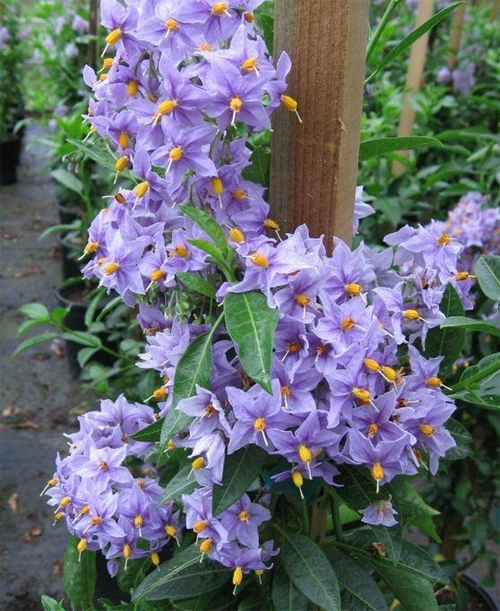
Cultivation Methods for Solanum jasminoides:
For the potting soil, choose a sandy soil that drains well and is loose and breathable. It grows even better in neutral or slightly alkaline soil, and the more fertile the soil, the more flowers it produces.
Planting in spring or autumn both work. Be sure to maintain a warm and moist environment, and water when the soil is dry. It is somewhat drought-tolerant, so once it has established itself a bit, it does not matter much if you occasionally forget to water it.
Its drought tolerance and cold tolerance are both fairly good. Of course, below 0 degrees you need to protect it from the cold and prevent frost. Another thing to note is not to plant it in a spot that is exposed to blazing sun year-round. In weather like that, it easily gets sunburned!
For planting, it is best to plant it on the south or west side of a wall. Sufficient light will encourage it to climb along the wall. You can also give it some supports. They can grow to over 6 m long, so do not plant them in a narrow place!
After flowering, carry out appropriate pruning, remove overly dense branches and leaves, and maintain a certain amount of ventilation, which will help it bloom again next time!
Propagation Methods for Solanum jasminoides:
This plant can be grown from seed. You can look up where its seeds are sold. Of course, if you buy cuttings, they are even easier to grow. Simply take softwood cuttings directly in early spring or summer.
In autumn and winter the shoots become hardwood, and at that time cuttings do not root as easily. However, summer cuttings also need protection from the sun. Take cuttings in a shaded, ventilated place now, keep them slightly moist, and only gradually expose them to light after they have rooted.
What are the aliases of Solanum jasminoides?
Its name is Solanum jasminoides, also called star flower, star potato vine, and Chilean potato vine. It is a very exotic flower that can be grown as a climbing plant. From a distance, you might think it is a patch of clematis.
It can climb on trellises, walls, or various supports. It stays emerald green all year round, though it will drop its leaves if the environment is too cold. It is better suited to cultivation in the south! Growing it in pots in the north is no problem either.
The cultivation methods and propagation methods of Solanum jasminoides are introduced here. Do you feel an urge to grow it right away?
Brodiaea Brodiaea califorinica Brodiaea Guide: How to Grow Brodiaea / How to Propagate Brodiaea
Brodiaea ProfileBrodiaea Brodiaea califorinica
Aliases: California brodiaea, brodiaea, California king flower, creeping brodiaea
Classification: Shrub flower
Family and Genus: Plantae, Angiosperms, Dicotyledoneae, Liliaceae, Brodiaea
Full bloom period: Summer
Brodiaea is the national flower of Azania. It is a shrub plant native to California, United States. It is generally planted in autumn, with a covering of 30-15 cm of soil. It is easy to cultivate and requires only extensive management. Brodiaea likes sufficient sunlight and loose sandy loam. The flowering period is June. There are 15 species in the same genus. Commonly cultivated ones also include Brodiaea stellaris (B. stellaris) and Brodiaea coronaria (B. coronarla), among others.
Cultivation Methods and Precautions for Brodiaea, Introduction to Brodiaea
Brodiaea is the national flower of Azania. It is a shrub plant native to California, United States. It is generally planted in autumn, with a covering of 30-15 cm of soil. It is easy to cultivate and requires only extensive management.
Brodiaea likes sufficient sunlight and loose sandy loam. The flowering period is June. There are 15 species in the same genus. Commonly cultivated ones also include Brodiaea stellaris (B. stellaris) and Brodiaea coronaria (B. coronarla), among others.
Morphological Characteristics of Brodiaea
Brodiaea has an underground corm, and the corm is covered with a fibrous membrane. The leaves are linear, emerging from the base, with 2-3 leaves per plant. The flower stem is 45-60 cm long. The umbel bears 2-12 small flowers. The tepals spread outward and are fused at the base into a tube. The flowers are pale purple to violet.
Brodiaea is generally planted in autumn, with a covering of 30-15 cm of soil. It is easy to cultivate and requires only extensive management.
The flowering period of Brodiaea is June.
Ecological Habits of Brodiaea
Brodiaea likes sufficient sunlight and sandy loam. The flowering period is June. It is propagated by division of corms or by seed, and autumn planting is preferable.
Brodiaea likes a warm, slightly dry, and sunny environment. It is not cold-tolerant, prefers well-drained soil, and dislikes waterlogging. It requires loose, acidic soil with good drainage. It can grow from 0 m above sea level up to 1500 m in the mountains.
Cultivation Techniques for Brodiaea
The soil for Brodiaea seedlings needs good drainage. During the growing period, it needs a cool, dry climate in summer, and appropriate shading during intense sun.
In winter it needs a warm environment with sufficient sunlight and slightly higher air humidity. During the flowering period and the peak growing period, water appropriately.
Apply fertilizer once each in spring and autumn. This can transform the plant's vegetative growth function into reproductive function, inhibit excessive growth of the main shoot, promote flower bud differentiation, produce more flowers and more fruit set, and promote development. It improves nutrient transport. It prevents flower drop, fruit drop, mummified fruit, and deformed fruit.
Propagation Methods for Brodiaea
Brodiaea is commonly propagated by division of corms or by seed.
Seed Propagation
This is often done in autumn. Sow seeds treated with New High Lipid Membrane seed dressing. After sowing, keep the soil moist. After seedlings emerge, do not keep it too wet; keep it slightly dry. When 1 pair of true leaves appears, transplant into pots and place them in a ventilated spot with sufficient light for care.
Cutting Propagation
Select a mother Brodiaea plant and cut branches above the semi-lignified position as cuttings, keeping 4-6 leaves. Use a substrate mixed from peat and perlite at a volume ratio of 4:6, adjusted to pH 5.5-6.5, with an EC value less than 0.5. Soak the base of the cuttings in a 1000 ppm indole-3-butyric acid solution for 15 minutes, then air-dry immediately. The insertion depth is 1/3-1/4 of the cutting length. After insertion, manage according to conventional techniques, and transplant to the field after the seedlings emerge.
Disease and Pest Control for Brodiaea
Brodiaea commonly suffers from leaf spot disease, and pests include scale insects and whiteflies. Spray multiple targeted pesticides in rotation to avoid resistance. Add New High Lipid Membrane to the pesticide to enhance the control effect.
Variety Classification of Brodiaea
There are 15 species in the same genus. Commonly cultivated ones include Brodiaea stellaris (B. stellaris) and Brodiaea coronaria (B. coronarla), among others.
Distribution Range of Brodiaea
Brodiaea is distributed throughout South Africa and is the most beloved and widely planted flower among the public. It can adapt to different soil types, from sea level to mountains at 2000 m.
Uses and Ornamental Value of Brodiaea
Different climatic conditions and geographical environments can cause great changes in Brodiaea's leaves, flower shape, flower color, and flowering time.
Brodiaea has lush branches and leaves, large flowers, upright bracts and petals, exceptionally beautiful colors, and a long ornamental period. It is suitable for potted ornamental display and is also an excellent cut flower and dried flower material.
Landscape Uses of Brodiaea
Brodiaea is suitable for planting in flower beds or rock gardens.
The magic number combination of the corolla: The combination pattern is an additive life spiral. The corolla magic number is 34. The petal count of all varieties is 34 or a multiple of 34.
Cultural Background of Brodiaea, the Title of King of Flowers
In South Africa, Brodiaea is even revered as the national flower. Brodiaea stands out with its huge flower heads, brilliant colors, and elegant form, and is known as the king of flowers.
Brodiaea's National Flower, City Flower, National Flower
Brodiaea is the national flower of Azania. Azania is a country, and Brodiaea is its national flower. Azania is South Africa.
Flower Language of Brodiaea
Flower language of Brodiaea: victory, perfection, wealth, and good fortune.
Brodiaea Pictures
Annual phlox Annual phlox Annual Phlox Guide: How to Grow Annual Phlox / How to Propagate Annual Phlox
Annual Phlox ProfileAnnual phlox Annual phlox
Cultivation Methods and Precautions for Annual Phlox, Introduction to Annual Phlox
Annual phlox is an annual herb. It is not cold-tolerant, likes warmth, and dislikes extreme heat. Its flowering period is relatively long. It is propagated by seed. When sowing, the soil covering should not be too thick; slight light exposure is best. The optimum germination temperature is 15-20°C. Annual phlox has a rich variety of flower colors, dense flowering, and a long flowering period, with relatively extensive management, so it is a main planted variety for basic flower beds. Potted cultivation also works very well. The plant height is 15-30 cm, mixed colors, and the growing period is 4-6 months. It has many flower colors and is suitable for pots and flower beds.
Annual phlox (Phlox drummondii) belongs to the Polemoniaceae family, Phlox genus. Aliases include herbaceous oleander and five-color plum. Annual phlox is an annual or biennial herbaceous flower. It likes light, is cold-tolerant, likes a mild and humid climate, and is not tolerant of severe heat or hot weather. It likes well-drained, light soil, is not drought-tolerant, dislikes waterlogging, and dislikes saline-alkaline soil. Its flowering period is June-September, and it is an excellent material for landscaping.
Morphological Characteristics of Annual Phlox
Annual herb, plant height 15-45 cm. Stems erect, much branched, with glandular hairs. Leaves alternate, basal leaves opposite, broadly ovate, oblong, or needle-shaped, 2-7.5 cm long, apex acute or abruptly pointed, base gradually narrowed or slightly stem-clasping, margin entire, with soft hairs on the upper surface, and soft hairs only on the lower surface. Leaves sessile. Cymes terminal, with short soft hairs; bracts and bracteoles linear; calyx tubular, lobes linear, with soft hairs outside; corolla salverform, diameter 2-2.5 cm, lobes 5, rounded, stamens not exserted. The original flower color is rose red. Flowering period May-June. Capsule elliptical or nearly round, with persistent sepals. Seeds obovate or elliptical, with a raised back and flat ventral surface, brown. Seed germination capacity can be maintained for two years, and the 1000-seed weight is 1.55 g.
Ecological Habits of Annual Phlox
It likes warmth, is slightly cold-tolerant, and dislikes severe heat. In the North China area it can overwinter in a cold frame. It prefers well-drained, loose loam, is not drought-tolerant, and dislikes waterlogging. It is commonly propagated by sowing. Sow in autumn in warm regions, and in spring in cold regions. The optimum germination temperature is 15-20°C. Seed viability can be maintained for 1-2 years. When sown in autumn, after 1 transplanting, the seedlings can be transplanted to a cold frame to overwinter in early to mid-October, then moved to field beds in early spring, fertilized in time, and planted out in mid-April. The flowering period is relatively long. Capsules mature unevenly. To prevent seeds from scattering, cut off the inflorescence when most capsules turn yellow, then dry and thresh.
Phlox paniculata is a perennial herbaceous plant with semi-lignified rhizomes and thick, erect stems, with a plant height of 30 to 100 cm. Leaves are simple and opposite, ovate-lanceolate. The panicle is terminal, with 5 petals, resembling plum blossoms. There are many horticultural varieties and rich flower colors, including bright red, peach red, pink, rose red, and pure white. The flowering period is July to September. Native to North America, it likes a cool climate and is low-temperature tolerant. In the Beijing area it can overwinter outdoors. The suitable growth temperature is 15°C to 25°C. It is suitable for growing in loose sandy loam. It can be propagated by sowing, cuttings, and division, and tissue culture can also be used for rapid seedling propagation. After the first batch of flowers fades, promptly pinch the tips to encourage new branch growth, which can make annual phlox bloom again. After pinching, apply 1-2 topdressings to make the second bloom of annual phlox more abundant.
Variety Classification of Annual Phlox
By flower color: (1) Single color: white, goose yellow, various shades of red-purple, and light purple and deep purple. (2) Bicolor: including inner and outer bicolor, tube and limb bicolor, throat with spots, limb with stripes, and a white five-pointed star-shaped patch in the middle of the limb, etc.; (3) Tricolor: such as rose red with white at the base and a yellow center, or purple-red with a white center and blue spots, etc. By petal type: (1) Round-petal type (var. rotundata): corolla lobes large and broad, making the shape round; (2) Star-petal type (var. stellaris, var. cuspidata): corolla lobe margins with three teeth, the middle tooth 5 times as long as the lateral teeth; (3) Fringed-petal type (var. fimbriata): corolla lobe margins finely toothed; (4) Radiate type (var. radiata): corolla lobes lanceolate-oblong, apex pointed. In addition, there are dwarf type (var. nana) and large-flowered type (var. gigantea). Varieties include star-flowered annual phlox (var. stellaris) and round-flowered annual phlox (var. rotundata). Annual phlox variety: 'Palona' is a dwarf variety suitable for small-pot cultivation. The plant shape is neat and round, with strong branching ability at the base, low and trailing.
Cultivation Techniques for Annual Phlox: SowingAt the end of March and the beginning of April, carry out the first batch of seedling raising in the greenhouse. Because this is hybrid seed production, at this time you can first sow the female parent and the first-phase male parent, then sow the second-phase male parent one month later. This ensures the quality of pollination in the later stage. First disinfect the prepared bed soil, using potassium permanganate, formalin, dexon, etc., prepared into an appropriate proportion of aqueous solution and sprayed on the seedbed. The bed soil should be passed through a fine sieve, the bed leveled, and enough bottom water poured. After the water seeps down, evenly broadcast the seeds on the seedbed. There are 750 seeds per gram. It is best to carry out pregermination treatment before sowing. After the seeds are broadcast, evenly sieve the prepared sandy soil onto the seedbed, with a soil covering thickness of 0.3 cm, then cover with plastic film in an arched shed style. After about 7-10 days they can germinate and become seedlings.Seedling Stage Management
After the seedlings emerge, manage them carefully. At this time the greenhouse temperature is relatively high, so pay attention to water control and avoid excessive seedling growth. When the seedlings grow to 6-7 cm tall, transplant them into nutrient pots. When the seedlings grow to 10 cm, they can be directly planted in the seed production shed. The entire seed production process is carried out in protected plastic greenhouses. Before planting, apply sufficient base fertilizer. A compound fertilizer of N, P, and K is best. Plant at a spacing of 30 x 30 cm. Use high-ridge planting, which helps drainage, ventilation, and air permeability, and avoids disease and pest occurrence. One mu of planting land can hold 6000 seedlings. A parent ratio of 1:2 is more suitable, which provides abundant yield and also reasonably uses the male parent flowers. After planting, pay attention to management such as watering, fertilizing, ventilation, and disease and pest control. Watering varies according to the different seedling stages, and the amount should depend on the soil condition. Topdressing begins one month after planting, with a small amount of compound fertilizer; farmyard manure is even better. Ensure strong seedling growth. Annual phlox seedlings are susceptible to damping-off and root rot. To avoid disease and pest occurrence, spray once a week, mostly to prevent fungal infections, commonly using Bordeaux mixture, carbendazim, and chlorothalonil. 3. Hybrid Pollination First emasculate. Since annual phlox is a bisexual flower, to avoid self-pollination of the female parent, remove all stamens before the female parent stigma splits. There are two pollination methods: one is to take the male parent flower and use small tweezers to place 5 pollen grains onto 4-5 pistil stigmas respectively. This is more labor-intensive, but the seed-setting rate is better and the yield is higher, with a yield of over 6 kg per mu. The other pollination method is the tube pollination method. This must be done under the condition that the male parent is shedding pollen, emasculating and pollinating at the same time, removing the corolla before the stigma splits, leaving the base of the flower as a full tube (flower tube) with the pollen-bearing part exposed. Use the pollen-bearing part to contact the stigma for pollination. This method saves labor, has a high seed-setting rate, and is fast, but the yield is somewhat lower than the previous method. During hybridization, avoid excessively high temperatures. Above 30°C affects fruit set and seed content. Pollination can be carried out all day, and the pollen amount is sufficient. After pollination, remove one sepal from the flower to identify it when collecting seeds later. 4. Seed Harvest Have a dedicated person responsible for timely harvesting. Seeds can be harvested about 4-5 weeks after flowers are hybridized. Seeds that fall to the ground should preferably be discarded to avoid mixing. After harvesting, label the seeds with the variety name. The container for storing seeds must be clean. When drying seeds, keep the varieties at a certain distance to avoid mixing caused by wind. Place harvested seeds in a cool place to dry.CultivationSowing and Seedling Raising: The seeds are relatively small, about 550-600 per gram. They can be sown directly in seedling trays using a lightweight sowing medium. After sowing, cover lightly with soil, often using fine vermiculite, which helps maintain moisture, and spray fungicide at the same time to prevent seedling disease. The optimal germination temperature is 20-22°C. Soil temperature has a great influence on seed germination and should be controlled especially carefully. Generally, seedlings emerge in 7-14 days. Pay special attention that seedlings are not tolerant of transplanting. The time for sowing and seedling raising varies by region. In northern regions, sowing can be done in early February, and flowering begins after May.
ManagementAnnual phlox is not strongly cold-tolerant, is not drought-tolerant, and does not like severe heat. It is not strict about soil, but grows better in fertile and moist soil. It is mainly propagated by sowing, and sowing is mainly done in autumn. Sow in early September in open-ground seedbeds or pots. The optimum germination temperature is 15 to 20°C. Seedlings emerge in about one week, and germination is uniform. At high temperatures, the seeds remain dormant and do not germinate. Seedlings grow slowly. Transplant when the seedlings have three or four true leaves. Seedlings need added cold protection to overwinter. When the seedlings are about 10 cm tall, they can be planted out at a spacing of 20-30 cm. During cultivation, frequently hoe and weed, and apply fertilizer once or twice. Pay attention to irrigation. If overwintering in the planting site, cover the roots with straw for cold protection. After the first batch of flowers in the following spring, pinch the tips to encourage new buds and allow it to bloom again. If sown in a greenhouse in early spring, it can also bloom in September to October, but due to poor growth in severe heat, the plant clump is small and development is poor, so the ornamental value is not high. Annual phlox can be propagated by cuttings from new stems in April to May, and rooting is easy. In addition, it can also be propagated by division. Capsules mature unevenly and can split open on their own when mature, scattering seeds. Therefore, when most capsules turn yellow, cut them off at the peduncle, dry them, and thresh. It is more suitable for growing in fertile and moist soil.
Summary of Key Maintenance Points for Annual PhloxIt needs a cool climate in summer. In the middle and lower reaches of the Yangtze River and areas to the south, due to hot summers, autumn sowing is often used, and seedlings overwinter above 0 degrees, so they can bloom in spring.Transplanting/PottingAnnual phlox seedlings are not tolerant of transplanting, so it is better to do it earlier rather than later, and try to keep the seedling root system intact. Pot them within 4 weeks after emergence. The variety 'Palona' should use a small pot of about 10 cm and a potted medium that drains well and is loose and breathable.Temperature RegulationThe temperature when seedlings emerge is relatively high and can be 22°C. In the early stage after potting, it is best to maintain 18°C. Once the root system extends, it can be grown at about 15°C. In this way, they can bloom in about 9-10 weeks. Maintaining a lower temperature can form a good plant shape. Annual phlox can tolerate a low temperature of around 0°C, but its growth period is relatively longer.CareAnnual phlox is best grown under conditions of sufficient sunlight and a cool climate, so there is no need to use chlormequat to control plant shape. When environmental conditions are not ideal, spraying chlormequat 1-2 times can prevent excessive growth. During cultivation, good plant and row spacing must be maintained to prevent crowding from affecting plant shape and causing disease and pests. The plants are dwarf, and the branches and leaves are hairy, so when watering and fertilizing, avoid contaminating the leaf surface to prevent branch and leaf rot. The entire growth and development period is 10-14 weeks, related to pot size, light conditions, and seedling raising time.UsesAnnual phlox plants are short and have rich flower colors. They can be used as plant material for flower beds, flower borders, and rock gardens, and can also be potted for indoor decoration. Taller varieties can be used as cut flowers.
Summary of Disease and Pest Control for Annual PhloxMain Diseases and Pests and Their ControlBrown SpotSymptoms: Mainly damages leaves, pedicels, and stems. In the early stage of leaf infection, there are round spots with brown rings at the edges, slightly raised and gradually expanding outward. Sometimes the lesions merge with each other into patches, causing the leaves to dry up. On stems, long streaks form. On pedicels, infection causes flowers to yellow and wilt. Sometimes black mold layers appear on the lesions. Control: (1) Control the medium and air humidity, do not let them be too high, and strengthen ventilation and light transmission. At planting time, pour with a 2000-fold carbendazim solution for prevention; (2) In the early stage of disease, spray the whole plant with 50% benomyl at 1500-2000 times. 2. Phytophthora blight Symptoms: This disease can occur in both seedlings and adult plants. The main stem and branch diseased parts first appear water-soaked, then gradually darken. The plant's vascular tissue is damaged and the plant dies, sometimes lodging. Control: (1) Control the humidity of the cultivation environment, and ensure ventilation and light transmission. Use facility cultivation as much as possible. Open-field cultivation should avoid the rainy season, or avoid pot medium splashing onto stems and leaves from rainwater. (2) The cultivation medium should be thoroughly disinfected before use. (3) After transplanting, water with a 1500-fold thiophanate-methyl solution or a 2000-fold dexon solution once every 10 days. (4) In the early stage of disease, the following pesticides can be sprayed for control: 69% dimethomorph-mancozeb 1500-fold solution, 58% metalaxyl-mancozeb 1000-fold solution, 64% oxadixyl-mancozeb 1500-fold solution, 50% chlorothalonil smoke agent fumigation at 1000 g/mu. 3. Bacterial spot disease (bacterial disease) Symptoms: Occurs on leaves, flowers, and stems. The center of the lesion is grayish brown, elongated, surrounded by brown lines. Sometimes under high humidity a white liquid appears on the lesion. Lesions often merge into patches, causing leaves to yellow and die. The stem also gradually dries and dies. Control: (1) Reduce humidity, do not overwater, and reduce water accumulation on plants and leaves. (2) Enhance plant resistance and cultivate strong seedlings. Do not overapply nitrogen fertilizer, which weakens plant disease resistance. (3) In the early stage of disease, spray the whole plant with streptomycin sulfate at 2000-2500 times.White Spot Disease [Symptoms]White spot disease, also called leaf spot disease, is a relatively common and seriously damaging leaf spot disease of annual phlox. At first, the disease starts on the lower leaves of the plant, with red water-soaked round spots appearing on the leaves, 2-4 mm in diameter. Later they become dark brown, and the center of the lesion is light gray.[Pathogen and Disease Pattern]The disease is caused by fungi of the genus Septoria. The pathogen overwinters on fallen leaves and spreads through wind and rain. During the growing season, plants can be infected multiple times.
After rain or when air humidity is high, milky white thread-like substances can be squeezed out from the small black dots on the lesions, namely the spores of the pathogen.[Control Methods]1. Strengthen cultivation management: In autumn of the same year, carefully remove diseased leaves from the plants and thoroughly destroy them to reduce the infection source for the following year. The cultivation environment should be well ventilated, and soil moisture should be moderate, neither too dry nor too wet. 2. Chemical control: During the disease period, spray 75% chlorothalonil wettable powder at 800-1000 times, or spray 1:0.5:200 Bordeaux mixture. When raising seedlings, pour potassium permanganate solution onto the seedbed soil to disinfect and sterilize it.Leaf BlightName: Annual phlox leaf blight Symptoms: The main feature of this disease is that the lower leaves of the plant first turn yellow and dry, and gradually develop upward until the entire branch dies.
This disease occurs severely on old plants, but does not affect seedlings and cuttings with new roots. Pathogen and disease pattern: The pathogen of annual phlox leaf blight is a non-biological factor, that is, this disease is a non-infectious physiological disease. The cause is that new branches sprouting from old stems in spring cannot get enough water supply, causing the lower leaves to wither and die first. Control methods: Targeting the cause, when old stems sprout new branches in spring, increase sprinkler irrigation to raise soil water content and air humidity, so as to reduce plant transpiration and alleviate the condition, but generally it cannot return to normal. Category: Disease
Other Flowers in the Same Genus as Annual Phlox
1. Phlox paniculata (P. paniculata L.): Aliases sky-blue hydrangea, summer phlox, herbaceous oleander, perennial phlox. Perennial herb, robust, erect, plant height 60-120 cm, smooth or with soft hairs on the upper part, stems usually unbranched. Leaves opposite, thin, oblong-lanceolate to ovate-lanceolate, upper leaves sometimes partly stem-clasping, margins with fine stiff cilia. Pyramidal panicle terminal, rose-purple, flower diameter 2.5 cm, tube length 3.5 cm, covered with soft hairs. Flowering period July-August. Varieties include white and various shades of red-purple, and there are also dwarf types. Native to eastern North America. Can be used as flower border material, potted plants, or cut flowers. Propagation can use division, layering, and cuttings. Cuttings include root cuttings, stem cuttings, and leaf cuttings. (1) Root cuttings: In early spring when repotting or dividing, cut a 3 cm section of root, bury it flat in sandy soil and keep it moist, and it can root; (2) Stem cuttings: In early spring or after flowering, take plump short branches arising from the base of the plant as cuttings; (3) Leaf cuttings: Take a 2 cm long leaf node with leaves and axillary buds and insert it in sandy soil, and it can also root. It likes fairly moist soil. As long as the soil can be kept moist regularly, it can grow well in either heavy soil or fertile light soil. 2. Moss phlox (P. subulata L.): The plant grows in carpet-like clumps. Leaves numerous and dense, awl-shaped, mostly only 1.2 cm long. Flowers numerous, stalked, exceeding the leaf clumps, about 2 cm in diameter, flower colors include white, pink, and snow blue, corolla lobes obcordate, deeply notched. Flowering period April-June. Native to eastern North America. Can be propagated by division or cuttings. Suitable as flower bed edge material or rock garden material. It likes sunny, well-drained light loam, and the soil must not be too wet in winter.
Annual Phlox Pictures