Cordyline fruticosa growing methods and propagation techniques, and what are its other names?
The Cordyline fruticosa plant is quite remarkable: the more the leaves are toward the inside, the redder they become, and the more beautiful they look. If there is a large patch of Cordyline fruticosa, then it is truly something else, turning half the sky red. What are the growing methods for Cordyline fruticosa? How do you propagate it? What are its other names:
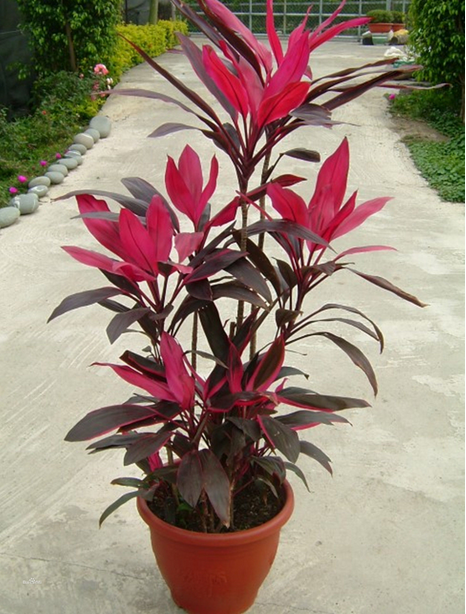
Growing methods for Cordyline fruticosa:
It likes a warm and moist environment and is also fairly shade-tolerant (otherwise how could it be used as an indoor green plant). Potted plants must not be exposed to harsh sun. The biggest drawback of this plant is that it is not cold-tolerant; if the care environment is too dark, the leaves will also turn yellow.
Its root system is relatively large and fairly deep, so potted plants should use a slightly deep and wide flower pot. For the soil, mixing peat soil with fine sand is enough. Plant it in slightly moist soil; this soil can also be used for cuttings. A mixing ratio of 7:3 is about right!
A gardening enthusiast's potted Cordyline fruticosa was planted when it was 20 cm tall. Fertilize once a month in spring, summer and autumn. The main stem grows taller and taller, and the leaves at the base gradually turn yellow and fall off.
You can cut off a section for cuttings, so that Cordyline fruticosa grows more side branches and the crown also becomes more beautiful.
In the stuffy heat of summer, the leaves can be sprayed with water frequently to keep the stems and leaves growing fresh and luxuriant. Pay attention to indoor ventilation to reduce pest and disease damage. Repotting is generally done once every 2-3 years.
1. Temperature
Cordyline fruticosa relatively prefers a warm environment; if it is too cold, it is prone to cold injury. Potted plants must not be exposed to harsh sun, while ground-planted ones can be exposed freely. The suitable growing temperature is 18-30 degrees; in winter, above 5 degrees allows safe overwintering. Of course, there are also some individual cold-tolerant varieties, and some can adapt to around 0 degrees!
2. Water and humidity
It likes a warm and moist environment. When yellow leaves appear during indoor care and watering is normal, it is generally caused by dry air, so spray water more often, as long as the pot soil does not become waterlogged. Spraying onto the leaf surface or the surrounding area is both fine!
3. Light care
Cordyline fruticosa likes sufficient light and is fairly shade-tolerant. With light it will grow a bit better and faster. In summer, potted plants should be properly shaded, especially from the harsh midday sun; harsh sun makes the leaves scorch!
4. Pot soil selection
The pot soil should of course be fertile, loose and well-draining. Sandy soil or humus soil are both fine. You can use a mix of leaf mold, garden soil and fine sand!
Propagation methods for Cordyline fruticosa:
Cordyline fruticosa is a plant very suitable for cuttings, generally done in summer and autumn. Cut a section of rhizome about 10 cm long, remove the leaves from the lower part of the rhizome, let the cut dry slightly, then insert it into slightly moist sandy soil.
The suitable cutting temperature is around 25 degrees. Spray water frequently to keep the pot soil slightly moist. Generally, roots can form after 3 weeks.
Cordyline fruticosa actually slightly prefers acidic soil. Saline-alkaline soil in the north is the least suitable for it. If the yellow leaves are not due to lack of water or harsh sun, then the soil may have become saline-alkaline!!
When the weather is dry, you can spray water on the leaves to increase humidity. In winter, place it indoors in a spot with sufficient light, reduce watering, and keep it dry rather than wet. In a poorly ventilated environment, Cordyline fruticosa is prone to scale insects, so pay attention to prevention and control.
Layering propagation:
In May-June, aerial layering is commonly used. Select a robust main stem, at 20 cm from the top, perform ring barking with a width of 1 cm, cover with moist moss, and wrap with plastic film. Keep the room temperature above 20°C. Roots form after about 40 days, and after 60 days cut it off and pot it.
Seed propagation:
Cordyline fruticosa seeds mature in September. The seeds are relatively large. Commonly sown in shallow pots by dibbling. The suitable germination temperature is 24-27°C. After sowing, they germinate after 2 weeks, and when the seedlings are 4-5 cm tall they are transplanted into 4 cm pots.
Precautions:
After cutting, the branches can be wrapped with plastic film. The plastic film should not touch the branches. It can preserve moisture and warmth, with the temperature at around 30 degrees. Roots can form in 2-3 weeks.
You can also use the buried-stem cutting method: cut a mature branch 5 cm to 10 cm, remove the leaves, bury it horizontally in clean river sand, with the upper part slightly exposed above the sand surface.
For potted care, in May-June you can use a wide-mouth transparent bottle for water cuttings, and roots will form in about 3 weeks.
Other names for Cordyline fruticosa:
It is called Qiannianmu, Hongzhu, Zhuzhu, Hongtianshu, etc. The green Qiannianmu and it are actually the same type of plant, just differing in variety. Both are small shrubs of the Agavaceae family, with many rhizomes and beautiful, elegant leaf colors. They are very common in landscape greening!
It can bloom. It flowers easily when grown outdoors. The flowers are strings of purple and quite ornamental. The flowering period is November to March, so it can only be seen in winter!
That is all for the introduction to the growing methods, propagation methods and other names of Cordyline fruticosa. Do you feel like you have fallen in love with this plant?
Growing methods and precautions for Cordyline fruticosa
Chinese scientific name: ZhujiaoLatin scientific name: Cordyline fruticosa (L.) A. Cheval.Other names: Zhuzhu, Tieliancao, Hongye Tieshu, HongtianshuBinomial name: Cordyline fruticosaKingdom: PlantaeDivision: AngiospermsClass: MonocotyledoneaeOrder: LilialesSuborder: LiliineaeFamily: AgavaceaeGenus: CordylineSpecies: Cordyline fruticosaDistribution area: distributed in South China; also produced in India and tropical Pacific islandsClassification system: Engler system, 1964Flower language: eternal youth, fresh and pleasing to the eyeCordyline fruticosa, other names: Tieshu, Zhuzhu, Tieliancao, Hongye Tieshu, Hongtianshu. Latin scientific name: Cordyline fruticosa (L.) A. Cheval. It is a shrub plant of the Agavaceae family and the genus Cordyline. Its underground part has well-developed creeping rhizomes and is prone to producing suckers, which differs from Dracaena species. Its main stem is upright, with a stem height of 1-3 m, unbranched or sparsely branched. The flowers are pale red to blue-purple, sometimes pale yellow. It is distributed in the tropical regions of southern China. It is mostly cultivated in gardens and is a foliage plant. Cordyline fruticosa has a beautiful plant shape and splendid, elegant colors, with good ornamental value. Cordyline fruticosa is also a medicinal plant. Its flowers, leaves and roots can all be used as medicine. In Guangxi, China, folk people once used it to treat hemoptysis, hematuria, bacillary dysentery and other conditions.1. Morphological characteristics
Shrub-like, upright, 1-3 m tall. Stem thick 1-3 cm, sometimes slightly branched. Leaves clustered at the upper end of the stem or branches, oblong to oblong-lanceolate, 25-50 cm long, 5-10 cm wide, green or with purplish red, petiole grooved, 10-30 cm long, base widened, stem-clasping.Panicle 30-60 cm long, lateral branches with large bracts at the base, each flower with 3 bracts; flowers pale red, blue-purple to yellow, about 1 cm long; pedicels usually very short, rarely up to 3-4 mm; the lower half of the outer tepals closely appressed to the inner whorl to form a perianth tube, the upper half recurved or reflexed when in full bloom; stamens born at the throat of the tube, slightly shorter than the perianth; style slender. Flowering period November to March of the following year.
2. Growth habits
It likes a high-temperature and humid climate and is a semi-shade plant. It can neither endure the scorching sun of northern regions, nor does it do well in fully shaded places where the leaves easily turn yellow. It is not cold-tolerant. Except in Guangdong, Guangxi, Fujian and other places, it is only suitable for potted ornamental cultivation in greenhouses, and is widely planted in warm regions of Asia. It is distributed in the tropical regions of southern China. It requires acidic soil rich in humus and well-draining, and avoids alkaline soil. When planted in alkaline soil, the leaves easily turn yellow and new leaves lose color. It is not drought-tolerant.3. Geographical distribution
Commonly cultivated in Guangdong, Guangxi, Fujian, Taiwan and other provinces and regions for ornamental purposes. Place of origin: tropical Asia and various Pacific islands. It is now widely planted in warm regions of Asia.4. Subspecies types
Aichiaka: leaves broad and needle-shaped, bright red, leaf margins dark red.Baptistii: leaves broad, dark green, with pale red or yellow stripes.
Amabilis: leaves bright green, with pink stripes and beige leaf margins.
BabyTi: leaves lanceolate, dark copper-green, leaf margins red.
CalypsoQueen: leaves small, dark brown-red, center pale purple. Dolly: dwarf variety, leaves oval, clustered, dark red, leaf margins red.
Goshikiba: leaves oval, green, with irregular red blotches, leaf margins red.
HawaiianFIag: leaves green, with pink and dark red markings. Hakuba: leaves broad-lanceolate, dark green with white longitudinal stripes.
LordRobertson: leaves broadly lanceolate, with yellowish-white oblique stripes, leaf margins red. Negri: leaves lanceolate, brown-copper, nearly black.
RedEdge: leaf margins red, center with alternating pale purplish red and green oblique stripes. It is a mini-type Cordyline fruticosa, with a plant height of only 40 cm.
Tricolour: leaves with green, yellow, red and other colored stripes, the cut surface of the root white. KiWi: leaves lanceolate, leaf margins red, with bright yellow-green longitudinal stripes in the center.
Biological characteristics
It likes high temperature and high humidity. The critical low-temperature line in winter is 10°C, and in summer it requires semi-shade. It avoids alkaline soil.Propagation methods
Commonly propagated by cuttings, layering and sowing.Growing methods for Cordyline fruticosa / Qiannianmu
Cordyline fruticosa
Other names: Tieshu, Qiannianmu.
Family and genus: Agavaceae, genus Cordyline.
Characteristics: evergreen shrub. The plant can reach about 2.8 m tall. The stem is single, usually unbranched or sparsely branched. Leaves leathery, broadly band-shaped, clustered at the top of the stem, green or purplish red.
Native to: China, India and tropical Pacific islands.
Habits: It likes a warm, humid and semi-shade environment, is not cold-tolerant, and is suitable for loose, fertile, well-draining slightly acidic soil. It avoids strongly alkaline soil and is not drought-tolerant.
Propagation: Cordyline fruticosa is mainly propagated by cuttings and tillering. Cuttings are done after late spring and early summer when the temperature steadily rises again. Use terminal branches about 9 cm long, cut off the lower leaves, insert them into a moist sand bed, and maintain moisture and a temperature of 24-29°C. Roots can form in about 30 days. You can also use a wide-mouth bottle for water cuttings in June-July, and roots will form in 3 weeks. Tillering is mostly done in summer. Dig up the small seedlings sprouting near the stem base with roots and propagate new plants separately.
Cultivation: For potting, use a culture soil made by evenly mixing peat soil, leaf mold and river sand in equal amounts. Cordyline fruticosa is relatively shade-tolerant and can be kept indoors in half-light all year round, or placed outdoors for a period in spring and autumn. It needs shading at noon on sunny days and in summer. During the growing season, watering should be sufficient. In dry seasons and during the hot summer weather, in addition to daily watering, spray water on the leaf surface 1-2 times, so that the leaves appear moist and elegant. During the peak growing season, apply a thin fertilizer solution or compound flower fertilizer once every half month. In winter, move the flower pot indoors to a bright spot, reduce watering and stop fertilizing, and keep it in a sunny place. It can overwinter safely as long as the room temperature is not lower than 11°C.
Value: Cordyline fruticosa is upright and elegant, with large, flexible leaves and a simple, antique color, very brilliant and beautiful. It is also fairly shade-tolerant, making it an excellent potted foliage flower suitable for decorating halls, living rooms, office buildings, meeting rooms and other places. Red plants are especially suitable for placing in front of shops to seek good business.