A Detailed Guide to Hollyhock Propagation Methods, Pest and Disease Control, and Seed Prices
Hollyhock used to grow in Sichuan, which is how it got the name "Shu hollyhock." How is hollyhock propagated? If you want to grow several more plants at home, what pests and diseases are commonly encountered during cultivation? What is the price of hollyhock seeds?
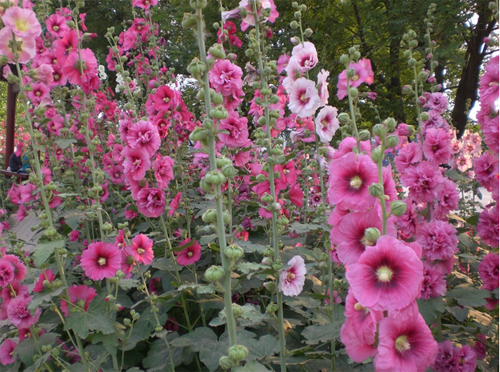
Hollyhock propagation methods:
1. Sowing season
Once the seeds mature in August and September, they can be sown immediately, and they will bloom the following year (autumn sowing works much better); spring sowing rarely produces blooms the same year. A temperature of 17-25°C is suitable. Seedlings emerge 7 days after sowing. When winter arrives, add a light covering to protect against the cold.
After the seeds mature, they can be sown. The germination capacity of hollyhock seeds can be maintained for 4 years. Sow directly in open ground or raise seedlings in pots. Transplant when there is suitable overcast and rainy weather, or simply thin the seedlings directly. It is a perennial.
2. Division propagation
Division is generally carried out in autumn. On an overcast day, dig out the clustered roots of a perennial hollyhock and use a sharp knife to cut them into several small clusters, making sure each cluster has two or three buds. Then plant and establish them separately.
3. Cutting propagation
Cuttings can be taken any time from after flowering until before winter. Take side shoots sprouting from the base of old hollyhock stems as cuttings, about 8 cm long. They can be inserted in a sand bed or in pots.
After inserting, cover with plastic film to retain moisture (be careful to leave a few small holes for ventilation), and move to a shaded place until roots form. Around winter, keep them warm and increase humidity to speed up the production of new roots.
Hollyhock pest and disease control:
1. Rust
The plant's leaves turn yellow or die, and brown patches can be seen on the undersides of the leaves.
Treatment: In spring and summer, spray the plants with Bordeaux mixture. Before sowing, the seeds must be disinfected. At the early stage of the disease, spray with triadimefon, or thiophanate-methyl, chlorothalonil, etc., once every 7-10 days, for 2-3 consecutive sprays.
2. Red spider mites (mite pests)
During the growing period, red spider mites cause damage as tiny red dots. They can be controlled with abamectin or pyridaben.
Do not use dichlorvos to kill mites, and do not use pyrethroid pesticides; they are basically ineffective against mites.
3. White spot disease
Also called leaf spot blight. Brown spots appear on the leaves at the early stage of the disease, gradually expanding into irregular lesions with grayish-white centers and reddish-brown outer edges.
Treatment: Promptly remove diseased leaves, pay attention to stem and branch density, and maintain ventilation and light penetration. Chlorothalonil, carbendazim, or thiophanate-methyl can be sprayed for control, once every 10 days, for 3-4 consecutive sprays.
Hollyhock seed prices:
Hollyhock seeds are still a bit expensive, selling for more than 30 yuan per jin, and there are even more expensive ones. When buying hollyhock seeds, you still need to be careful, so that the seeds you bring home do not simply fail to germinate.
Hollyhock Cultivation Management and Pest and Disease Control
Hollyhock (scientific name: Althaea rosea (Linn.) Cavan.), also known as yizhanghong, dashuji, and rongkui. It is a biennial upright herb, up to 2 m tall, with stems and branches densely covered in bristles. The flowers are terminal racemes, single or double, in colors such as purple, pink, red, and white; the flowering period is from June to August. The fruit is a capsule, and the seeds are flat and round, kidney-shaped. It likes full sunlight and tolerates partial shade, but dislikes waterlogging.
It is native to Sichuan, China, and is now widely distributed in China, including East China, Central China, and North China. Because it originated in Sichuan, China, it is named "Shu hollyhock." It is also called "yizhanghong" because it can reach about one zhang in height and its flowers are mostly red. It blooms around June when the wheat matures, which is why it is also called "damai shu."
It is usually propagated by sowing, and can also be propagated by division and cuttings. The seeds mature in August and September, and can be sown immediately after collection, blooming the following year; spring sowing rarely produces blooms the same year, and seedlings emerge after 7 days. When the seedlings grow 2-3 true leaves, they should be transplanted once, with increased spacing between plants and rows. When winter arrives, add a light covering (straw or leaves) to protect against the cold, and they can be planted out when they sprout the following spring. For small-scale hollyhock planting, direct sowing in spots is possible; after the seedlings emerge, appropriately pull out the weak ones. Division propagation is carried out in spring. After hollyhocks are planted, water them in a timely manner. Before flowering, apply topdressing 1-2 times in combination with cultivating and weeding. In early spring when the old roots sprout, water appropriately. Generally, renew them once every 4 years. Hollyhocks are susceptible to leaf rollers, aphids, and red spider mites, and old plants and dry weather make them prone to rust, so timely control is needed.Hollyhock propagation methods
Hollyhock propagation methods: sowing method
After the seeds mature in August and September, they can be sown, and they will bloom the following year. If sown in spring, they rarely bloom the same year. In the south, autumn sowing is often used, while in the north, spring sowing is the main method.
Depending on the number of seeds, you can choose to sow in an open-ground seedling bed and then transplant, or sow directly into the soil without transplanting. The soil is generally leaf mold and field soil. Before sowing, the soil must be disinfected to prevent pests and diseases.
Under normal conditions, they germinate in 7 days. When 2-3 leaves have grown, transplant them. It is best to transplant on overcast and rainy days, and thinning can be done, which is extremely beneficial to plant growth.
The germination capacity of hollyhock seeds can be maintained for 4 years, but sown seedlings decline in growth after two or three years, and young seedlings are very prone to damping-off, so management of the seedling bed must be strengthened, and appropriate medication can be added to the soil.
Hollyhock propagation methods: division method
Division of hollyhocks is generally carried out in autumn. Dig the perennial hollyhock out of the soil, use a sharp blade to divide the stem buds into several small clusters, ensuring each cluster has two or three buds.
Then plant them separately in a growing medium, generally a fertile, well-drained sandy soil. After planting, immediately water thoroughly once, and they can bloom the following year.
Hollyhock propagation methods: cutting method
Cuttings can be taken from after the flowering period until winter.
Generally, side shoots sprouting from the base of old hollyhock stems are selected as cuttings, about 8 cm long, and the medium is generally sandy soil.
After cutting, cover the seedling bed with plastic film to maintain a certain humidity, and place it in a shaded place until roots grow.
For cuttings taken in winter, a heating device needs to be laid at the bottom of the seedling bed to increase ground temperature, maintain the temperature of the seedling bed, and accelerate the growth of new roots.