Osmanthus cultivation methods and precautions: can it be grown in the north?
When osmanthus blooms, fragrance is everywhere, it is very fragrant, but not pungent. Many people like to grow osmanthus. What are the cultivation methods for osmanthus? What precautions are there? Can it be grown in the north? What should be done if it freezes?
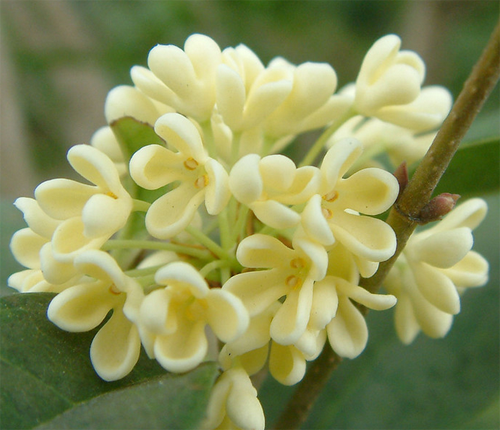
Osmanthus cultivation methods and precautions:
1. Soil selection:
Growing osmanthus is not picky about soil; most soils will do, but overly sticky yellow soil or alkaline soil will not work, and soil with poor drainage will not work either. Deep, loose, fertile, well-drained slightly acidic sandy soil is best.
2. Planting time
Generally plant in spring or autumn. Planting on cloudy or rainy days is best. Plant in a ventilated, well-drained and warm place. Usually plant first in a semi-shady environment, then gradually move it to a place with plenty of sunlight.
3. Light and temperature
South of the Yellow River, overwintering in the open ground is no problem. Potted plants can be moved indoors in winter, and they should also get plenty of sun. A temperature of 5°C is enough, but temperatures above 10°C are also unsuitable. If it does not bloom the next year, it is because it was kept indoors too warm in winter.
4. Watering and fertilizing
Add base fertilizer before planting in the ground, generally using organic fertilizer, and water thoroughly after planting.
Keep it moist before new shoots emerge, and do not fertilize during this period.
Apply fertilizer once each in spring and summer. Before winter begins, apply organic fertilizer once. Do not use concentrated fertilizer.
5. Pruning
Properly cut off overly dense branches and leaves, leggy branches and leaves, and diseased or weak branches and leaves. If it grows too tall, cut off 1/4 of the upper branches. You can apply plant ash or similar to the pruning cuts to help the wounds heal.
Can osmanthus be grown in the north?
You can grow some more cold-tolerant varieties, such as Hong Shuangxi, Zhusha Dangui and Xiaoye Sijigui, which are considered cold-tolerant, but you still need to know how to grow them.
What should be done if osmanthus freezes?
You can wrap a potted osmanthus with waste newspaper several layers (three or four layers) together with the pot, without damaging the branches and leaves, avoid direct sun exposure and leave it for a day, then after it warms up gradually expose it to light!
In winter, for young osmanthus trees, water once with antifreeze water after winter begins, bank up some soil at the base of the tree to protect the roots, and also wrap the trunk and branches with more than 7 layers of thick newspaper. Even in the Beijing area, it can overwinter in the open air. Those who find it troublesome to move it indoors can learn this method. After three years, it can overwinter safely even without care!
Other names for osmanthus:
Yangui, Muxi, rarely called this. It likes a ventilated environment with plenty of light. It is not tolerant of waterlogging or cold, and of course it cannot tolerate heavy smoke and dust either, otherwise it will not bloom! If watered too much, the roots will rot, the leaf tips will dry out, the leaves will wither and turn yellow, and it is only natural for it to die!
The cultivation methods for osmanthus and some problems that arise during cultivation are introduced here. When growing osmanthus, you must pay attention to these issues.
How to grow osmanthus? Osmanthus cultivation methods and precautions
It is autumn now, also the best period for osmanthus fragrance to spread everywhere. Everyone knows osmanthus is very suitable for courtyard planting. When growing osmanthus in pots, you should choose cutting seedlings or grafted seedlings with a short plant type and compact branches and leaves. Osmanthus can also be used to make snacks, brew tea, and so on, and is very popular in daily life. So how should osmanthus be grown? Below is the osmanthus cultivation method compiled by the editor!
Many flower lovers want to know how potted osmanthus should be managed. Today Lanyao will tell you about the precautions and common problems in potted osmanthus cultivation.
1. Cultivation methods for potted osmanthus:
1. Pot soil selection: When potting osmanthus, the pot soil can be prepared with mountain soil/leaf mold : garden soil : sand at 5:3:2, or with garden soil : manure : river sand at 1:1. When potting, add decomposed organic fertilizer, bone meal, etc. as base fertilizer.
2. Flower pot selection: When potting osmanthus, it is recommended to use a breathable clay pot for planting. Place a tile at the bottom to help drainage.
3. Potting time: The planting time for osmanthus should preferably be chosen in late autumn from November to early December, or in spring from February to early March. For seedlings, try to choose spring potting to avoid freezing damage in winter. After potting, water thoroughly, place in a ventilated place to recover, and after 1 week move to a sunny place for care.
4. Water management: Potted osmanthus should just keep the pot soil moist. In rainy seasons, pay attention to drainage to prevent root rot caused by too much water. When blooming in autumn, avoid overly wet pot soil, otherwise flower drop and bud drop are likely to occur.
5. Fertilizing: When sprouting in spring, apply cake fertilizer water at 30@ once every 10-15 days. After July, while applying cake fertilizer water, add monopotassium phosphate or superphosphate to promote flower bud differentiation.
6. Pruning: After flowering in autumn, carry out overall pruning, cut off dead branches, thin and weak branches, and diseased and pest-damaged branches, so that each side branch evenly retains thick short branches. Also, during the growing period, remove sprouting branches in time to avoid excessive consumption of nutrients.
7. Pest and disease control: Osmanthus is prone to anthracnose, brown spot disease, sooty mold, whitefly, scale insects and leafhoppers, etc. Pay attention to timely control.
2. Four taboos in osmanthus cultivation
1. Avoid alkaline soil: Osmanthus prefers slightly acidic soil, with pH 5.5-6.5 being suitable. If planted in alkaline soil, it can cause leaves to wither and yellow, and even the whole plant to die.
2. Avoid half-watering: If watering is not thorough, the surface soil is wet and the lower half is dry, the roots cannot get enough water, causing leaves to dry out and wither, and even leaf drop.
3. Avoid water accumulation: Water accumulation in the soil easily causes root rot and leaf drop. Over time, the root system will rot, causing the plant to die. Be sure to pay attention to drainage in the rainy season.
4. Avoid overwintering at high temperatures: Osmanthus is relatively cold-tolerant. South of the Yangtze River it can overwinter in the open ground, and in the North China area it overwinters indoors, with room temperature of 2~4°C being suitable. If the room temperature is too high, dormant buds will sprout in winter or early spring, wasting nutrients, and the plant will develop poorly. In the north, early spring is dry and windy, so potted osmanthus should not be moved outdoors too early, otherwise new branches will be damaged by strong winds; osmanthus is also afraid of smoke and dust, so it should not be planted near factories and mines.
3. Common problems in osmanthus cultivation:
1. Why does potted osmanthus bloom little and have weak fragrance?
This is more or less caused by insufficient nutrition or insufficient light. Osmanthus likes fertilizer. In addition to base fertilizer, timely topdressing is needed during the growing period, before flowering and after flowering; osmanthus likes sunlight, so light must be sufficient. It should be planted in a place with plenty of sunlight and good ventilation, and pruned in time.
2. What should be done if potted osmanthus does not bloom easily?
Potted seed-grown osmanthus takes about 8-10 years to bloom, cutting seedlings need about 4 years, and division and grafted seedlings can mostly bloom the next year. If potted osmanthus has reached blooming age but does not bloom, it is mainly due to improper care. For example, improper watering, water accumulation, alkaline soil, overwintering temperature too high, smoke and dust damage, insufficient light, etc. can all cause osmanthus not to bloom. In addition, if potted osmanthus is often not repotted and fertilized insufficiently, it will also affect flowering.
3. How can osmanthus be made to bloom every year?
To make osmanthus bloom every year, care is very important. First, ensure sufficient light. Second, attach importance to fertilizing. As the saying goes: If you want osmanthus fragrance, always keep a pig manure vat. This shows that osmanthus very much likes fertilizer. In winter, apply enough base fertilizer. During the growing period, mainly use nitrogen fertilizer, and during flower bud differentiation, increase phosphorus and potassium fertilizer.
4. How to prevent severe leaf drop in osmanthus in winter?
In cold areas in winter, potted osmanthus should be moved indoors to a place with plenty of light to avoid leaf drop caused by freezing damage. After flowering in autumn, apply thin nitrogen fertilizer as topdressing. Before winter begins, apply base fertilizer. In winter, cover the base with sandy soil and water with clean water.
5. Why do osmanthus leaf tips scorch and dry?
To address scorched and dry osmanthus leaf tips, first rule out disease. If osmanthus has diseases such as anthracnose, it will show scorched and dry leaf tips. Usually strengthen ventilation, do not water too much, clean up dead leaves in time, and when diseased leaves are found, cut them off in time and burn them.
When the pot soil becomes alkaline, scorched and dry leaf tips can also appear. Osmanthus is a flower that likes acidity, so attention should be paid to keeping the soil slightly acidic.
If it is moved indoors too early in winter, or the overwintering temperature is too high, causing buds to sprout early, then when moved outdoors in spring, after drought and wind, dead shoot tips are also likely to appear.
There are many varieties of osmanthus. The tree is evergreen through the four seasons, the flowers are beautiful and the fragrance spreads everywhere. It is a greening seedling very suitable for planting along streets and in courtyards, so friends who love flowers should quickly look at the above osmanthus cultivation methods and precautions!
Cultivation methods and precautions for Sijigui osmanthus
Sijigui osmanthus has a cultivation history of more than a thousand years. The fragrant Sijigui osmanthus has very good ornamental value. Today let us look at the cultivation methods and precautions for Sijigui osmanthus.
Cultivation methods and precautions for Sijigui osmanthus1. Cultivation methods for Sijigui osmanthus -- planting
Sijigui osmanthus is suitable for cultivation in August and September. Before planting, make sure to loosen the soil. Soft soil can help improve fertility and has better air permeability, which is more beneficial for the later cultivation of Sijigui osmanthus. Better soil permeability can also be more conducive to the absorption of nutrients and nourishment.
2. Cultivation methods for Sijigui osmanthus -- fertilizing
What Sijigui osmanthus needs is organic fertilizer. Using some calcium phosphate as fertilizer is more suitable. For annual Sijigui osmanthus cultivation, the fertilizer amount per mu can be reduced to 10 kg. When fertilizing, it should be even, so that the soil can absorb nutrients evenly. Keep the bottom of the water ditch smooth per mu so that water can flow smoothly.
3. Cultivation methods for Sijigui osmanthus -- irrigation
Sijigui osmanthus needs to keep water flowing in the ditch regularly. The size of the water flow should be related to the growth stage and season. Northern areas need more water, while southwestern areas need less water. In cold weather, the water amount can be increased, and in warm weather the water amount should be reduced. The water amount should be changed on rainy or sunny days.
4. Cultivation methods for Sijigui osmanthus -- topdressing
Sijigui osmanthus likes fertilizer, and some fertilizer can be used as soon as it just sprouts. After that, during the growth process, fertilize about once every seven days.