Aloinopsis schooneesii, also known as Silver Light Jade: Detailed Guide to Cultivation Methods and Flowering Key Points
Aloinopsis schooneesii grows in a very cute way, somewhat like a living stone, and it also has a lovely name, Silver Light Jade. It can even bloom. What are the cultivation methods for Aloinopsis schooneesii? What points should be noted? What other aliases does it have? What do its flowers look like?
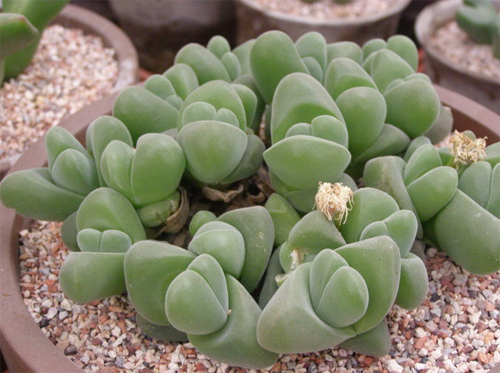
Cultivation methods for Aloinopsis schooneesii (Silver Light Jade):
Sowing introduction:
The optimal temperature for sowing Aloinopsis schooneesii is 15~25°C. Once autumn temperatures drop below 30°C, sowing can begin.
To prevent the seedlings from lacking light after sowing, which would cause leggy growth, check the 7-day weather forecast. Only sow with confidence once a week of clear, sunny weather with no cloudy or rainy days is forecast.
1. Preparation
Use the substrate formula commonly used for sowing most Aizoaceae plants, namely mix peat moss + small-particle kanuma soil (1~2 mm) at a ratio of 5:1 evenly, then fill pots and set aside.
2. Potting soil disinfection
To prevent weed seeds and harmful pathogens carried in the soil, it must be disinfected. On the evening before sowing, place the soil-filled pot into a potassium permanganate solution to soak, with the liquid level not higher than the pot rim.
To prevent killing all beneficial bacteria in the soil and affecting normal seedling growth, the concentration of the potassium permanganate solution must not be too high; a deep pink solution is suitable.
The next morning, the potting soil will have been thoroughly soaked by the potassium permanganate solution. Remove the pot and let it dry in the sun; by noon it is ready for sowing.
3. Sowing
Before sowing, water the potting soil thoroughly. Aloinopsis schooneesii seeds are very tiny. Pour them onto white paper, fold the paper crosswise so the paper trough faces the pot at an angle, and gently tap the paper trough with tweezers so the seeds slide evenly onto the soil surface.
After sowing, no soil covering is needed. Carefully spray with 1000-times diluted carbendazim water until water leaks from the bottom of the pot.
The carbendazim concentration must not be too high, otherwise it is unfavorable for seed germination. When spraying, the mist should be fine and the motion gentle to prevent spraying the seeds into the soil. Afterward, cover the sowing pot with plastic wrap and place it in a spot with sufficient light.
4. After sowing
After sowing, open a small gap in the plastic wrap every day and ventilate for about 2 hours, spray some water, then cover again. To prevent bacterial growth caused by high humidity, spray a fungicide once every 3 days. You can use 1000-times diluted carbendazim and chlorothalonil, alternating the two to prevent bacteria from developing resistance.
5. Seedling-stage care
After 7 days, the seedlings sprouted. After sprouting, gradually uncover the plastic wrap and give the seedlings sufficient light to prevent leggy growth. After 1.5 months, the seedlings begin their first skin shedding. At this time, strictly control water; when the potting soil is too dry, a small amount of misting can be used to increase humidity.
As the seedlings grow taller, they tend to flop over. Sprinkle small-particle kanuma soil evenly around the seedlings to both straighten them and ensure the root collar is not sunburned.
After 2 months, the "little rabbits" gradually grew plump and turned into round little "heart shapes"!
After 4 months, Aloinopsis schooneesii begins its second skin shedding, but unlike the first time, the old leaves it sheds not only do not wither, but grow more and more robust.
Then 10 days later, it undergoes a third skin shedding, and before a week passes, a fourth skin shedding. As with the second time, the old leaves do not wither but continue to maintain vigorous growth.
The small pot soon can no longer contain these frantically growing plants.
After 5 months, they can be transplanted into a larger pot to make their growth even more vigorous.
In summer they go dormant and store nutrients; when autumn arrives, they can bloom with their most brilliant flowers!
Precautions for Aloinopsis schooneesii:
Aloinopsis schooneesii likes a warm, sunny environment. It is drought-tolerant but not cold-tolerant, and fears waterlogging. It is suitable for growing in culture soil containing coarse sand. Generally, use a mix of leaf mold + garden soil + granular soil + coarse sand; the ratio can be 4:2:2:2.
The growing temperature for Aloinopsis schooneesii is 18~24°C. In summer, high temperatures cause dormancy, so shading and ventilation are essential, with no watering or only a small amount of water.
Aloinopsis schooneesii does not need frequent watering. During the growing season, water according to the principle of "water when dry, stop when wet" (no watering in summer, controlled watering in winter). In winter, when temperatures are above 10°C, move it indoors. If the temperature is suitable, water appropriately; if the temperature is poor and there is no heating, then cut off water.
Aliases of Aloinopsis schooneesii:
Silver Light Jade, Hump Flower
Flowering of Aloinopsis schooneesii:
The flower color is generally pink, sometimes white; other colors are rare. Generally, the maximum size is 2~3 cm, and it blooms in autumn.
Its flowers emerge directly from the hump, producing small pink flowers. One small hump can only produce one flower.
It can only fully open with sufficient sunlight. It is most brilliant in the afternoon, closes at night, and can bloom continuously for 7 days!
On cloudy and rainy days and with insufficient light, it cannot bloom, or it blooms briefly and then withers!
This small succulent requires cross-pollination. Friends who want to pollinate should take note. Moreover, Aloinopsis schooneesii plants tend to cluster easily and can be propagated by division.
That concludes the introduction to the cultivation methods and precautions for Aloinopsis schooneesii. Although its flowers are not especially showy, they are delicate and endearing. Hurry and add some of these little cuties to your home!
How is the petite, round Aloinopsis (Silver Light Jade) grown into clusters?
The succulent Aloinopsis, Silver Light Jade, is native to the Little Karoo Plateau of South Africa. It is a perennial herb, very succulent, and grows in clusters. The opposite leaves are united at the base into a fleshy sheath, with a rounded-convex leaf surface, approximately egg-shaped, and the fleshy leaves are slightly asymmetrical. The leaf epidermis is thin, and the surface is smooth. The egg-shaped leaves are 1~3 cm large, united at the base. Young plants are solitary, while older plants grow densely in clusters. The leaf color is light green to light gray-green. Flowers emerge from the middle slit between the two leaves, pink flowers with slightly curved petals, about 3-5 cm in diameter. Generally, each plant produces only one flower; when clustered, the flowering is very spectacular.
‘
Aloinopsis (Silver Light Jade) opens in the afternoon with sufficient sunlight and closes at night. This day-open, night-closed pattern lasts about 7 days. If there is cloudy and rainy weather or insufficient light at the cultivation site, it is difficult for it to open. The plant is cross-pollinated. Silver Light Jade plants tend to cluster easily. Each year, 1 head splits into 2. If grown into a very large cluster, the number of heads produced by skin shedding the following year will decrease, becoming 1 splitting into 1. At this point, the plant can be divided: separate it into small clusters one by one, so that nutrients can be supplied adequately again, and head splitting will gradually return to normal. However, clustered plants still look better and are more spectacular.
Aloinopsis (Silver Light Jade) goes dormant in summer and grows in other seasons. Silver Light Jade's skin-shedding period is relatively long and can extend through the entire growing season. During the skin-shedding period, provide more sun and less water, while also being careful not to sunburn it. Silver Light Jade sheds its skin as the outer old skin slowly dries up and provides nutrients to the new plant. The new plant's leaves and the old leaves can grow at the same time.
For planting Aloinopsis (Silver Light Jade), the growing medium should be mainly permeable and breathable. This variety is not sun-tolerant, so shading is essential in summer. During Silver Light Jade's skin-shedding period, appropriate supplemental water can be given. This variety should be watered once the soil dries completely; otherwise, new leaves are prone to sunburn or withering. The semi-woody stem supports the entire leaf body, forming a beautiful old stump. Water when dry; water from above rather than soaking the pot. Shade throughout summer and place in a bright, ventilated spot with scattered light. In summer, give only a small amount of water; too much will cause rot.
After autumn temperatures drop, watering can be resumed, gradually and step by step. If the plant is plump, no supplemental water is needed. If the opposite leaves are found to be somewhat wilted, water can be given immediately. In winter, avoid frost damage from temperatures that are too low; when the potting soil is dry, minus 3°C is no problem at all. Differences between north and south are relatively large, so growers should cultivate according to their own environment. Propagation can be by sowing or division. Conophytums need to cluster to be beautiful.
Succulent Aloinopsis schooneesii cultivation methods, habits, and propagation methods
Aloinopsis schooneesii, also called Silver Light Jade, belongs to the Aizoaceae family, genus Aloinopsis (also called Hump Flower genus). It is native to the Little Karoo Plateau of South Africa. Aloinopsis schooneesii is also called Hump Flower because its top resembles a camel's hump. Because it looks like a "cute rabbit" when young, Aloinopsis schooneesii gives a very cute impression.Characteristics of Aloinopsis schooneesii: perennial succulent herb, low-growing, with clustered leaves united into an oval shape, the top hump-shaped, and a saddle-shaped notch dividing the plant into two unequal united halves. The leaf surface is smooth, pale green, the tip triangular, and the back of the leaf arc-shaped, curving inward into a chin-like form. Flowers are light pink, stalked and without bracts, 2--3 cm large. When young, Aloinopsis schooneesii looks a bit like a little rabbit, and when slightly larger it looks somewhat like a heart shape.Growth habits of Aloinopsis schooneesii: Aloinopsis schooneesii likes a warm, sunny environment. It is drought-tolerant but not cold-tolerant, and fears waterlogging. It is suitable for growing in culture soil containing coarse sand. Choose a mix of leaf mold plus garden soil plus granular soil or coarse sand.
The suitable growing temperature for Aloinopsis schooneesii is about 18-24°C. In summer, high temperatures cause dormancy, so shading and ventilation are needed.
Plants of this family all require restrained watering. During the growing season, water according to the principle of "water when dry, stop when wet." In winter, when temperatures are above 10°C and heating is good, a moderate amount can be given; otherwise, cut it off.Cultivation methods for Aloinopsis schooneesii: For cultivation preparation, use the substrate formula commonly used for sowing most Aizoaceae plants, namely mix peat moss and small-particle kanuma soil (1~2 mm) at a ratio of 5:1 evenly, then fill pots and set aside. To prevent weed seeds and harmful pathogens carried in the soil, it must be disinfected: on the evening before sowing, place the soil-filled pot into a potassium permanganate solution to soak, with the liquid level not higher than the pot rim. To prevent killing all beneficial bacteria in the soil and affecting normal seedling growth, the concentration of the potassium permanganate solution must not be too high; a deep pink solution is suitable. The next morning, the potting soil will have been thoroughly soaked by the potassium permanganate solution. Remove the pot and let it dry in the sun; by noon it is ready for sowing.Sowing: Before sowing, water the potting soil thoroughly. Aloinopsis schooneesii seeds are very tiny. Pour them onto white paper, fold the paper crosswise so the paper trough faces the pot at an angle, and gently tap the paper trough with tweezers so the seeds slide evenly onto the soil surface. After sowing, no soil covering is needed. Carefully spray with 1000-times diluted carbendazim water until water leaks from the bottom of the pot. The carbendazim concentration must not be too high, otherwise it is unfavorable for seed germination. When spraying, the mist should be fine and the motion gentle to prevent spraying the seeds into the soil. Afterward, cover the sowing pot with plastic wrap and place it in a spot with sufficient light.
Management after sowing: After sowing, open a small gap in the plastic wrap every day and ventilate for about 2 hours, spray some water, then cover again. To prevent bacterial growth caused by high humidity, spray a fungicide once every 3 days. You can use 1000-times diluted carbendazim and chlorothalonil, alternating the two to prevent bacteria from developing resistance.
After 7 days, the seedlings sprouted. After sprouting, gradually uncover the plastic wrap and give the seedlings sufficient light to prevent leggy growth. After 1.5 months, the seedlings begin their first skin shedding. At this time, strictly control water; when the potting soil is too dry, a small amount of misting can be used to increase humidity. As the seedlings grow taller, they tend to flop over. Sprinkle small-particle kanuma soil evenly around the seedlings to both straighten them and ensure the root collar is not sunburned. The appearance of Aloinopsis schooneesii after its first skin shedding looks exactly like a "little rabbit"? After 2 months, the "little rabbits" gradually grew plump and turned into round little "heart shapes"!
After 4 months, Aloinopsis schooneesii begins its second skin shedding, but unlike the first time, the old leaves it sheds not only do not wither, but grow more and more robust. Then 10 days later, it undergoes a third skin shedding, and before a week passes, a fourth skin shedding. As with the second time, the old leaves do not wither but continue to maintain vigorous growth. The small pot soon can no longer contain these frantically growing plants. After 5 months, for the healthy growth of the Aloinopsis schooneesii, they can be transplanted into a larger pot to make their growth even more vigorous?
Propagation methods of Aloinopsis schooneesii: Aloinopsis schooneesii is mainly propagated by sowing and division.
Aloinopsis schooneesii is generally divided in spring together with repotting.