How to grow the silk tree flower, and how is it different from mimosa?
Many people love growing the silk tree flower (Albizia julibrissin). It is not only ornamental but can also be used to treat insomnia. So how do you grow it? Why do the seedlings look so much like mimosa when young, and how do you tell them apart?
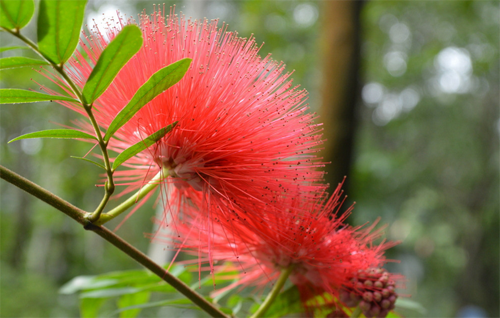
How to grow the silk tree flower:
The red-flowered silk tree is relatively cold-tolerant and drought-tolerant, and can adapt to all kinds of environments, because there are quite a few varieties, and some have slightly different flower shapes, but they are all much the same! They are generally propagated by seed and can self-sow!
Collecting your own seeds is also fine; wait until the pods mature and take them home yourself. Sowing can be done in spring or autumn. Before sowing, soak the seeds in 35°C warm water for 24 hours, sow them in shallow pots in holes, cover with 1--2 cm of soil, water by the bottom-soaking method, and keep moist.
At 15--20°C, seedlings emerge after 7--10 days; pot them up when the seedlings are 5 cm tall.
When collecting seeds, choose robust mother plants, strengthen management, and during the fruiting period collect as they ripen, because the pods split open on their own when mature. There are no special requirements for care and management.
It can be grown in ordinary soil. It does not need much fertilizer during the growing period; applying dilute liquid fertilizer 2--3 times is enough. Do not over-fertilize; as long as the leaves are green and the growth is robust, that is fine. Do not let it grow leggy.
The growing technique for the silk tree flower is simple; just grow it roughly, and it basically needs no management at all.
It is not strict about climate, sunlight or soil, but fertile, loose sandy loam is best; it likes a warm, humid environment.
Differences between the silk tree flower and mimosa:
Sometimes in some places in Guangdong and Guangxi or Hainan you see small seedlings all over the ground that look very much like mimosa; in fact, they are seedlings of Leucaena leucocephala (white popinac).
Mimosa closes as soon as you touch it with your hand, while the seedlings of the silk tree flower seem to close only under strong stimulation! Of course, generally touching them a few times will not make them close!
Leucaena leucocephala has a well-developed root system and is very drought-tolerant; it can still survive several months without rain. It is not tolerant of waterlogging, and grows poorly with prolonged standing water.
Other names for the silk tree flower:
Night-closing tree, velvet flower tree, etc. It blooms during the day and closes at night.
Colors of the silk tree flower:
White and red.
The white silk tree is also called Leucaena leucocephala (white popinac). It originated in tropical regions and likes warm, humid climatic conditions. The optimum temperature for growth is 25—30°C; growth is slow at 12°C; growth stops below 10°C and above 35°C; below 0°C the leaves are damaged and fall off.
That is all for how to grow the silk tree flower and how it differs from mimosa. Which color of silk tree flower to grow still depends on your own preference; different people really do like different colors.
Growing techniques for the silk tree flower
The silk tree, also known as velvet flower tree, night-closing tree, or Persian silk tree, is a deciduous tree. It originated in the Yellow River basin of China and areas to the south. In summer it bears pale red flowers shaped like velvet balls, with a refreshing fragrance. Its leaves close at sunset and open at sunrise. The leaf shape resembles that of mimosa, slender and feathery, and the flowers and leaves are elegant and unusual. The silk tree has a beautiful form, with shade like an umbrella and clusters of red flowers. It can be planted beside courtyard ponds or used as a shade tree or street tree; it is a beautiful ornamental greening tree species. The silk tree, a flowering plant with such a lovely name and appearance, let us look at its growing techniques.
The silk tree flower usually blooms in June to July. After flowering, the main axis of its inflorescence can continue to extend upward, constantly producing bracts and flower buds, like a monopodial branch, so it is also called a monopodial inflorescence. Red and pink are the most common, occasionally white. The shape looks like a fan, fluffy, very similar to a dandelion.
1. Propagation method: propagate by sowing seeds. Sowing can be done in spring or autumn. Before sowing, soak the seeds in 35°C warm water for 24 hours, sow them in shallow pots in holes, cover with 1-2 cm of soil, water by the bottom-soaking method, and keep moist. At 15-20°C, seedlings emerge after 7-10 days; pot them up when the seedlings are 5 cm tall. When collecting seeds, choose robust mother plants, strengthen management, and during the fruiting period collect as they ripen, because the pods split open on their own when mature.
2. Water and fertilizer management: the silk tree flower is drought-tolerant and not tolerant of waterlogging, so do not water too much during the care period, to avoid waterlogging and damage to the root system. The silk tree flower can be managed extensively; its requirements for water and fertilizer are not very high, and it may grow very vigorously even in poor areas. But note that it dislikes noise and dust, so when growing it you need to keep a good check on these.
3. Shaping and pruning: only with dense planting can the trunk of the silk tree be kept straight. During the seedling stage, prune side branches in time. When you find side branches, remove them by hand from the base of the branch as early as possible, because cutting side branches with a knife or shears is often incomplete, causing the side buds to sprout again. For small seedlings with a leaning trunk, in the second year you can cut the stem back to ground level to encourage a thick, straight main trunk. Transplanting small seedlings should be done before budbreak; when transplanting large seedlings, bring enough soil ball. When planting for greening projects, remove the side branches and leaves and keep only the trunk to ensure survival, and set up supports to prevent wind from blowing them over.
4. Pest and disease control: the silk tree flower is mainly harmed by canker disease. When the disease occurs, spray with 2000-3000 times dilution of Junke, 800-1000 times dilution of Bijunsha, or 800 times dilution of 50% Tuijunte. Pests include longhorn beetles and psyllids. To kill longhorn beetles, use 1 kg of kerosene plus 50 g of 80% dichlorvos emulsifiable concentrate. For psyllid damage, spray with 1500-2000 times dilution of 25% buprofezin or 1500 times dilution of 40% dimethoate emulsifiable concentrate.
The seeds of the silk tree can be pressed for oil, and the bark and flowers can be used medicinally, with effects of calming the mind and relieving depression, promoting blood circulation and relieving pain, and stimulating appetite and regulating qi. The extract cream is used externally to treat fractures, painful abscesses, swelling and pain, and other conditions. The silk tree has strong resistance to hydrogen chloride and nitrogen dioxide, and some resistance to sulfur dioxide and chlorine gas. The silk tree also has distinct yin and yang, and is called a sensitive plant; it has been listed as a preferred tree species for earthquake observation.
What varieties of mimosa are there, and the variety classification of mimosa
Mimosa is a common home-grown plant. Mimosa has strong vitality, so in many countries it is also grown as a weed. The leaves of mimosa are very sensitive; as soon as they are touched they droop and contract, as if shyly lowering their head, hence the name mimosa. So what varieties of mimosa are there? Today let us learn about the variety classification of mimosa.
What varieties of mimosa are there
Mimosa is a dicotyledonous plant in the Mimosoideae subfamily, with about 56 genera and 2,800 species, native to tropical, subtropical and temperate regions worldwide. In China, including introduced cultivated ones, there are 17 genera and about 63 species, mainly produced in the south and southwest.
Because its ability to adapt to growing environments is extremely strong, there is basically no difference among varieties. However, by appearance they are generally divided into thorny mimosa and thornless mimosa.
Thorny mimosa: that is, some small white fuzz grows from the neck of the mimosa, and there are small, slightly hard thorns at the forks of the branches and leaves.
Thornless mimosa: the stem is smooth, with no fuzz, and there are no thorns at the forks of the branches and leaves.
Variety classification of mimosa
Mimosoideae: Zhixiucao (Dichrostachys genus), Adenanthera genus (peacock bean genus), Mimosa genus, Albizia genus, Pithecellobium genus (monkey earring genus), Acacia genus, Entada genus, Prosopis genus (mesquite genus), Cylindrokelupha genus, Parkia genus, Enterolobium genus, Leucaena genus, Samanea genus, Calliandra genus (American albizia genus), etc., with Acacia, Adenanthera, Albizia and Calliandra being the most commonly seen. The most common varieties are Calliandra, Mimosa pudica, and Adenanthera.
Now that we understand the variety classification of mimosa, let us get familiar with the growth habits of mimosa.
Mimosa originated in Central and South America and has now spread to many parts of the world. Mimosa has strong adaptability, likes light rainy days, and grows well in moist, fertile soil. It is not demanding about soil, is not cold-tolerant, likes light, but can also tolerate partial shade. It is now mostly kept as an ornamental plant in homes. It generally grows in mountain shrub forests and in moist places beside roads.