Is oleander poisonous? A detailed guide to growing it
Oleander is very beautiful, with pink flowers that are extremely lovely, and many people love growing it. What are the methods for growing oleander? Is oleander poisonous?
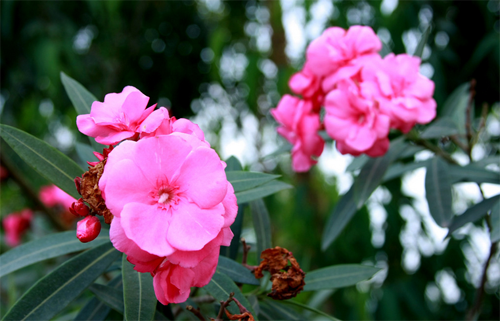
Methods for growing oleander:
1. Planting
When growing oleander in the north, it is generally taken outdoors in mid-to-late April. Before taking it out, repot it (repotting once every 2-3 years is fine). When repotting, cut off rotten roots and overly dense roots. For the potting soil, use 5 parts garden soil, 4 parts sandy soil, and 1 part cake fertilizer powder, or use a mixed growing medium of 4 parts leaf mold, 2 parts garden soil, 2 parts decomposed manure soil, and 2 parts sandy soil, and place bone meal in the bottom of the pot as a base fertilizer. After repotting, water thoroughly and place it in a ventilated, sunny spot to grow.
2. Fertilizing
Oleander likes fertilizer. From the time it is taken outdoors until the flowers fade (Frost's Descent), apply a thin liquid fertilizer once every 20 days or so. After the Start of Autumn, oleander grows rapidly; at this time, apply fertilizer water once every 15 days or so until just before it is brought indoors.
3. Watering
Although oleander likes water, it is afraid of waterlogging. On consecutive rainy days, promptly pour out any standing water in the pot to prevent root rot. If watered too much, the leaves turn yellow and fall off in large numbers, affecting flowering the following year. In spring and autumn, water according to the principle of watering when dry and letting it dry out between waterings, keeping the potting soil moist as appropriate.
Summer is exactly when oleander grows vigorously and blooms, so it needs more water. It is best to water once each morning and evening, and pay attention to frequently spraying and washing the branches and leaves to keep the leaf surface fresh and emerald green. Bring it indoors in mid-October. After bringing it indoors, control watering, and by no means use too much water, otherwise it is prone to root rot and leaf drop, affecting growth the following year.
4. Temperature and light
Oleander likes sunlight, so during the growing period it needs to be kept in a sunny place, otherwise there will be fewer flowers and the color will be pale.
In winter, an indoor temperature no lower than 0°C is sufficient. If the temperature is too high, it consumes nutrients, which is unfavorable for growth and flowering the following year.
5. Shaping and pruning
Oleander leaves grow in whorls of 3, and it is a typical three-forked brancher. Each time it is pruned, 3 new shoots grow from the stem nodes. People often use this branching characteristic to carry out shaping and pruning, so that each plant retains 3 main branches on the trunk, and each main branch retains 3 more branches, which is what people commonly call the "three forks and nine tops" tree shape.
After potted oleander has established, for the first pruning, generally according to plant height and personal preference, select and retain a trunk of 30-40 cm and pinch off the top to encourage side branches to sprout. When the new shoots grow to 4-6 cm long, select 3 appropriately positioned thick, strong branches and remove the rest. At this time, strengthen fertilizer and water management.
For the second pruning, depending on the plant's growth, it is best done in July. Leave 10-15 cm on each side branch and pinch off the top, and retain 3 branches on each side branch. After such pruning, it becomes the popular "three forks and nine tops" tree shape.
After pruning, it can be planted in the ground in summer, and then moved into a flowerpot after autumn begins. In this way, by the time it blooms abundantly the following year, the flowers will be evenly distributed and the crown neat and beautiful.
6. Propagation
Oleander often does not set fruit after flowering, so it is commonly propagated by cuttings. Hardwood cuttings are taken in early April, and softwood cuttings are best taken in June-July.
Cut healthy 1-year-old branches into stem sections 15-20 cm long, remove the upper leaves, and first soak them in clean water to encourage rooting, with the water depth reaching 1/3 of the cutting. Change the clean water once every 2 days; soak the cuttings in water for about 10 days, and when small white dots appear on the soaked bark, insert them into plain sandy soil. After about half a month they will root, and after 1 month they can be transplanted.
Is oleander poisonous?
Oleander is one of the most poisonous plants. Its stems, leaves, and flowers are all toxic, containing multiple toxins, some of which are even fatal. The milky white sap it secretes contains a toxic substance called oleandrin. Ingesting it by mistake causes poisoning, so its stems and leaves can be made into insecticide.
Given oleander's toxicity, it is not suitable for indoor planting, and households with pregnant women and young children are even less suited to growing it.
Oleander flowering period:
Oleander leaves are like willow and bamboo, and its red flowers are brilliant, even surpassing peach blossoms. There are now also several varieties such as white, yellow, and red. It has a special fragrance and a long flowering period, from June to October, and is a famous ornamental flower.
The methods for growing oleander are introduced here. Oleander is poisonous, so do not grow it if there is a pregnant woman at home.
Oleander - oleander pictures | is oleander poisonous | methods for growing oleander
Oleander
Oleander, with the Latin scientific name Nerium indicum Mill, is also known as willow-leaf peach, half-year red, and jiazi peach. It originated in India, Iran, and Afghanistan, and has a long history of cultivation in our country, spreading throughout urban and rural areas in both north and south. Oleander likes ample light and warm, humid climate conditions. Its flower colors include red and white.Methods for growing oleander
1. Watering: Although oleander likes water, it is afraid of waterlogging. On consecutive rainy days, promptly pour out any standing water in the pot to prevent root rot. If watered too much, the leaves turn yellow and fall off in large numbers, affecting flowering the following year. In spring and autumn, water according to the principle of watering when dry and letting it dry out between waterings, keeping the potting soil moist as appropriate. Summer is exactly when oleander grows vigorously and blooms, so it needs more water. It is best to water once each morning and evening, and pay attention to frequently spraying and washing the branches and leaves to keep the leaf surface fresh and emerald green. Bring it indoors in mid-October. After bringing it indoors, control watering, and by no means use too much water, otherwise it is prone to root rot and leaf drop, affecting growth the following year.
2. Light: Oleander likes sunlight, so during the growing period it needs to be kept in a sunny place, otherwise there will be fewer flowers and the color will be pale.
3. Temperature: Oleander should be planted in a wind-sheltered, sunny spot. In winter, bring it indoors to prevent freezing; an indoor temperature no lower than 0°C is sufficient. If the temperature is too high, it consumes nutrients, which is unfavorable for growth and flowering the following year. Where outdoor winter temperatures are high, soil can be banked up around it to protect it from the cold.
Is oleander poisonous?
Is oleander poisonous? The entire oleander plant is highly toxic. Symptoms after poisoning include nausea, vomiting, lethargy, and irregular heartbeat. In severe cases, loss of consciousness or even death is possible. So when faced with oleander, just admire it, and do not touch it!
When does oleander bloom?
It originated in India and Iran and is now widely planted in subtropical and tropical regions. Its introduction into our country began in the Song and Yuan dynasties, and it is cultivated in all provinces and regions. It likes light and warm, humid climates, is not cold-tolerant, dislikes waterlogging, and tolerates a certain degree of air dryness. It is suitable for growing in well-drained, fertile neutral soil, and can also adapt to slightly acidic and slightly alkaline soil. Oleander has a strong ability to absorb dust and toxic gases.
The flower language of oleander
The flower language of peach-colored oleander: cursing, beware of danger;
The flower language of yellow oleander: deep friendship.
The legendary story of oleander
A princess fell in love with her own retainer. Because her family opposed it, the fragile princess chose to die together with her sweetheart. She had always naively believed that her lover would absolutely stay with her forever, but she only thought so simply herself; her retainer did not truly like her, and merely played this role for his own interests. The sorrowful princess committed suicide beneath an oleander. Only her blood alone soaked into the flowers, and from then on oleander bore pink and snow-white flowers.
Zhang Yueran's "The Narcissus Has Ridden the Carp Away" describes oleander - the favorite flower of the heroine Jing. She filled the residence on Taoli Street with this flower, perhaps hinting at Jing's hatred for Man. A flower symbolizing revenge, symbolizing Jing's resoluteness and endurance.
Characteristics of oleander
1. Morphological characteristics: An evergreen large shrub, up to 5 m tall, hairless. Leaves in whorls of 3-4, opposite on the lower part of the branches, narrowly lanceolate, entire, leathery, 11-15 cm long and 2-2.5 cm wide, light green beneath; lateral veins flat, densely arranged and parallel. It blooms in summer, with peach-red or white flowers in terminal cymes; calyx upright; corolla deep red, fragrant, double-petaled; corona scale-like, apex torn. Follicles oblong, 10-23 cm long, 1.5-2 cm in diameter; seeds with yellow-brown seed hairs at the apex. Stem upright and smooth, typically three-forked branching. Leaves in whorls of three, rarely in whorls of four or opposite in pairs, linear-lanceolate to oblong-lanceolate, entire, leathery, leaf surface glossy, lateral veins pinnate and horizontal. Cymes terminal, corolla funnel-shaped, in red, yellow, and white, single-petaled, semi-double, or double, fragrant, follicles long-columnar. Flowering period June-October, fruiting period December to January of the following year. Common cultivated varieties include: white-flowered oleander, with white single-petaled flowers; double-petaled oleander, with red double-petaled flowers; pale yellow oleander, with pale yellow single-petaled flowers. The entire oleander plant is highly toxic.
2. Growth characteristics: Likes light, likes warm, humid climates, not cold-tolerant; strong drought tolerance, not demanding about soil, and can also grow in alkaline soil.
The uses of oleander
Uses of oleander: 1. Ornamental. Oleander leaves are like willow and bamboo, and its red flowers are brilliant, even surpassing peach blossoms. The corolla is pink to deep red or white, with a special fragrance, and the flowering period is June to October. It is a famous ornamental flower.
Uses of oleander: 2. Purifying air. Oleander has the ability to resist smoke, resist dust, resist toxic substances, purify air, and protect the environment. Oleander leaves are toxic to humans and have a strong resistance to harmful gases such as sulfur dioxide, carbon dioxide, hydrogen fluoride, and chlorine. According to measurements, potted oleander at 40 m from a pollution source suffers only mild damage, and at 170 m it is basically unharmed and can still bloom normally. The sulfur content of its leaves is more than 7 times higher than that of unpolluted ones. Even if the whole oleander plant is covered with dust, it can still grow vigorously, and people call it the "guardian of environmental protection."
The medicinal value of oleander
Oleander is the leaf of the Apocynaceae plant oleander. This product belongs to the cardiotonic class of traditional Chinese medicine. Bitter in taste, cold in nature, toxic, and enters the heart meridian. Its main functions are strengthening the heart and promoting diuresis, eliminating phlegm and relieving asthma, relieving pain, and removing blood stasis. In modern clinical use, this medicine is used to treat heart failure, wheezing and coughing, epilepsy, traumatic injuries, amenorrhea, and alopecia areata. Cardiotonic effect, diuretic effect, sedative effect, insecticidal effect, and so on.
Related encyclopedia
Pocket scale non-woven bag rush pith bamboo shoot crab claw red rice note3 ykk zipper ybs zipper Prunus sargentii climbing rose wild senna wintersweet green pine wristwatch Omega Longines famous watch children's building blocks flint crested coralroot curling iron soursop
Methods for growing oleander, is oleander poisonous, appreciation of oleander pictures!
Oleander gets its name because its stems resemble bamboo and its flowers resemble peach blossoms. Oleander flowers are suitable for growing in warm subtropical regions. They originated in India, Iran, and Afghanistan, and were introduced into our country in the 15th century, with a long history of cultivation. Oleander flowers are gorgeous and fragrant and are widely planted for ornament, and it is also an excellent Chinese herbal medicinal plant. Today I will briefly introduce the methods for growing oleander and whether oleander is poisonous.
Methods for growing oleander
Oleander likes a sunny, warm, and humid environment. Although not cold-tolerant, it has strong adaptability. It can be cultivated in the open ground in central and eastern China. Oleander is not demanding about soil and can adapt to slightly acidic and slightly alkaline soil, but loose and fertile soil is preferable. For potted oleander, it is best to use a mix of 3 parts leaf mold or 3 parts compost soil, 3 parts dried manure soil, and 4 parts sandy soil. Oleander grows quickly, so it should be repotted once each year when it is moved outdoors in late April.
In addition to changing the potting soil, a small amount of hoof and horn should also be applied as a base fertilizer. Move the potted oleander outdoors, and when the flowers fade in September-October, apply a dry fertilizer of fermented sesame residue once a month. The amount of fertilizer can be determined by the size of the flowerpot; for example, use 50 grams for a 20 cm pot and 200 grams for a 50 cm pot. Watering oleander follows the principle of watering thoroughly once the soil is dry. If the potting soil is too dry and the leaves have already begun to wilt, first water lightly, and after the leaves recover, water thoroughly.
Potted oleander should be shaped and pruned once every year. When pruning, generally retain 3 main branches on each trunk, and retain 3 more branches on each main branch. Each branch should be cut off at 20-30 cm from the base. This is the commonly used "three forks and nine tops" shaping and pruning method, which will also make it covered with flower branches. Oleander is easy to propagate and can be cuttings-planted in both spring and summer. The cuttings do not carry leaves, and propagation can also be carried out in high-temperature, high-humidity air, where rooting is relatively easy.
Is oleander poisonous?
The entire oleander plant contains highly toxic substances, and the toxins remain even after it dries out, so it can be said to be one of the most poisonous plants, containing multiple toxins, some of which are even fatal. If oleander is ingested by mistake and causes poisoning, symptoms such as nausea, vomiting, lethargy, and irregular heartbeat will appear, and in severe cases even death may occur.
Someone once used oleander branches as chopsticks, and as a result swallowed the toxic sap in the branches and was poisoned. In Hong Kong, China, there have also been cases of death caused by using oleander branches to stir cooked food or porridge. So it is best for us not to touch oleander, and simply admire its beauty from a distance.
The legend of oleander
According to legend, in ancient times, a beautiful girl named Tao fell in love with a strong-willed young hired laborer named Zhu. Because of her father's prejudice about family status, Zhu was beaten to death. After Zhu died, Tao also died for her beloved. When their souls reached heaven, the heavens were moved by their true love and promised to grant them one request. Tao said that in her whole life she had only loved the purity of peach blossoms, while Zhu hoped to retain his toughness like bamboo. Thus, in this world there came to be a plant with leaves like bamboo and flowers like peach blossoms - oleander.