Garlic Vine Care and Propagation Methods: Does It Drop Leaves in Winter?
The garlic vine is extraordinarily beautiful and can climb walls. Its flowers are especially lovely, like little trumpet flowers. What are the care methods for garlic vine? How do you propagate it? Does it drop leaves in winter?
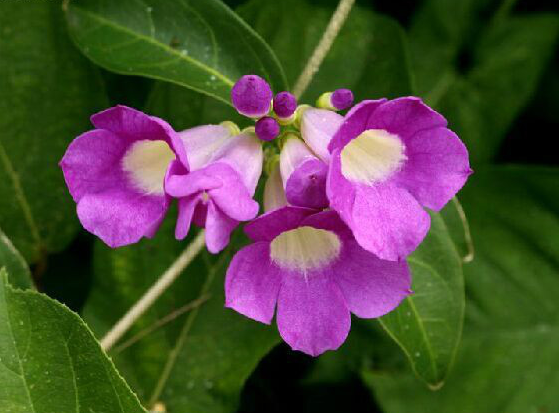
Garlic vine care methods:
1. Light and temperature
Garlic vine loves light and warm, hot climates. During the growing season, water and fertilizer must be sufficient. The optimal growing temperature is 18-35°C. When winter temperatures drop below 5°C for a short time, it will partially shed leaves, but it can still overwinter safely.
It must be planted in a spot with ample light, otherwise it will bloom sparsely or not at all. A full-sun environment is best.
2. Soil
It has no particular requirements for soil quality and can be grown in pots or in the ground. It grows as a climbing vine, so of course we need to train it as it grows. Prune it every year after it finishes blooming in spring.
Spring and summer are its peak growing seasons. Growth stops at low winter temperatures, so reduce watering in winter.
Precautions for garlic vine:
After the flowers and leaves of the garlic vine are rubbed, they give off a strong garlic fragrance. Is there any flower lover who doesn't like it?
It has tendrils and swollen nodes. The leaves are opposite, dark green on the upper surface and green on the underside.
Its flowers are numerous and vivid. The corolla is funnel-shaped, usually pink or pink-purple. When in full bloom, the flowers form dense, colorful clusters.
Looking at the flowers, I really wouldn't have guessed that it can also replace garlic as a kitchen seasoning!
We just need to give it a spot with ample light. Unfortunately, it is not cold-tolerant, and cold winds blowing on it will affect its growth.
It is best planted in a sunny, sheltered spot with loose, fertile, slightly acidic sandy soil.
Gardeners in the north can grow it in pots. The soil can be a mix of garden soil, wood shavings and peat soil at 1:1:1:1 as the growing medium.
Garlic vine propagation methods:
Garlic vine can be propagated by seed, cuttings or layering. Cuttings are generally the main method.
Spring, summer and autumn are all suitable times for cuttings, with March to July being the best.
When taking cuttings, cut mature branches. Each cutting should be about 15 cm long. Remove the lower 1/3 of the leaves on the cutting and keep the upper leaves. The cut at the lower end of the cutting should be close to the lower part of a node. Perlite or moist river sand can both be used as the medium.
Insert the cutting to a depth that keeps the stem from falling over, with spacing that keeps the leaves from being crowded or touching, ensuring air reaches the roots and the leaves get ventilation and good light. With routine care, roots will form in about 3-4 weeks, and the rooting rate can reach over 85%.
After about 7 weeks, once the root system is fully developed, it can be transplanted.
Garlic vine flowering period:
The leaves have a garlic scent. With suitable temperatures, it can bloom year-round, with the most blooms in autumn and winter (September to December). Sometimes it blooms twice a year.
Does garlic vine drop leaves in winter?
Garlic vine does not drop leaves in winter. After the flowers fade, the leaves remain very green, so you can grow it with confidence.
That's all for the garlic vine growing methods and precautions. Why not hurry up and grow one of these playful plants?
Garlic Vine Pseudocalymma alliaceum Sandw. Garlic Vine Guide: How to Grow Garlic Vine / How to Propagate Garlic Vine
Garlic Vine ProfileGarlic Vine Pseudocalymma alliaceum Sandw.
Garlic Vine Care Methods and Precautions: An Introduction to Garlic Vine
When the garlic vine is in full bloom, it looks as if clusters of pastel hydrangeas are hanging down. It is a climbing plant with great ornamental value, and it is vigorous and rarely troubled by pests or diseases. It is suitable for growing into a flower corridor, or for climbing on flower trellises, walls and fences.
Garlic vine, also known as Zhang's trumpet vine and purple bell vine, is an evergreen climbing shrub native to the West Indies to Argentina. Garlic vine is a species in the genus Pseudocalymma under the family Bignoniaceae. Its flowers are purple, and it is mostly used as a horticultural ornamental plant. Its fruit is winged.
Garlic vine leaves have a garlic scent, hence the name. In Taiwan, China, it blooms sporadically throughout the year, but the full-bloom period for the whole plant is around autumn and winter (September to December). Sometimes it blooms fully twice a year.
Morphological characteristics of garlic vine
Garlic vine is an evergreen climbing shrub with opposite compound leaves, 2 leaflets, and tendrils present or absent. The leaflets are 6-10 fen long and 2-5 cm wide, oval, with pointed tips. The cymes are axillary, and the flowers are large and light purple. Both the flowers and leaves have a garlic scent. It is suitable for beautifying flower corridors, flower trellises, fence walls or shade arbors.
Garlic vine is native to tropical America. The plant is trailing and has tendrils. Its leaves are two-parted compound leaves, dark green, oval and glossy. The flowers are axillary in cymes, with a tubular corolla opening into five lobes. When the flower first opens, it is pink-purple, then slowly turns pink, then white before falling. The flowering period is from spring to autumn, but spring and autumn are the peak bloom seasons. Because the flowers and leaves give off a garlic odor when rubbed, it was named garlic vine.
Opposite compound leaves, 2 leaflets, tendrils present or absent. The leaflets are 6-10 fen long and 2-5 cm wide, oval, with pointed tips. Cymes are axillary, the flowers are large and light purple, and both the flowers and leaves have a garlic scent. It is suitable for beautifying flower corridors, flower trellises, fence walls or shade arbors.
Ecological habits of garlic vine
Garlic vine loves light and warm, hot climates. During the growing season, water and fertilizer must be sufficient. Garlic vine likes a warm, humid climate and a sunny environment. The optimal growing temperature is 18-35°C. When winter temperatures drop below 5°C for a short time, it can overwinter safely in subtropical regions aside from some leaf loss.
Garlic vine is not particular about soil and is suitable for both pot cultivation and ground cultivation. The growing site must have ample light, otherwise it will bloom sparsely or not at all. A full-sun environment is best. Because the plant is trailing, if it is allowed to stretch freely, the branches easily become messy. It is recommended to prune it every year after it blooms in spring. It likes high temperatures, with an optimal growing temperature of about 21-28°C. Spring and summer are the vigorous growth periods, and growth stops at low winter temperatures, so watering should be reduced in winter.
Cultivation techniques for garlic vine
Garlic vine is not particular about soil and is suitable for both pot cultivation and ground cultivation. The growing site must have ample light, otherwise it will bloom sparsely or not at all. A full-sun environment is best.
Because the plant is trailing, if it is allowed to stretch freely, the branches easily become messy. It is recommended to prune it every year after it blooms in spring.
Garlic vine likes high temperatures, with an optimal growing temperature of about 21-28°C. Spring and summer are the vigorous growth periods, and growth stops at low winter temperatures, so watering should be reduced in winter.
Garlic vine care methods
Garlic vine is a perennial evergreen vine flower in the genus Pseudocalymma under the family Bignoniaceae. After its flowers and leaves are rubbed, they give off a strong garlic fragrance, hence the name. It has tendrils and swollen nodes. The leaves are opposite, oval, with entire margins, dark green on the upper surface and green on the underside. The flowers are numerous and dense, in axillary or terminal cymes. The corolla is funnel-shaped with five lobes at the tip, pink or pink-purple. When in full bloom, the flowers form dense, colorful clusters. The flowering period lasts all year, and it can bloom multiple times a year, generally blooming most abundantly in late summer and early autumn from September to October. The capsule is flat and elongated.
Ecological adaptability
Garlic vine is native to Guyana and Brazil in South America. It likes a warm, humid climate and a sunny environment, with an optimal growing temperature of 18-28°C. When winter temperatures drop below 5°C for a short time, it can overwinter safely in subtropical regions aside from some leaf loss; prolonged temperatures below 5°C can cause frost damage to the aboveground parts. It requires full-sun cultivation.
Cultivation management
Garlic vine requires ample light and a warm climate during cultivation. It is not cold-tolerant, and long periods of cold wind will affect its growth. It is generally planted in a sunny, sheltered spot with loose, fertile, slightly acidic sandy loam. For open-ground cultivation, watering is only needed during dry summers. For pot cultivation, water once a day in summer and once every 3-4 days in winter. Garlic vine prefers natural organic fertilizer. When planting, apply decomposed fertilizer in the planting hole. After the plant matures, apply a nitrogen, phosphorus and potassium compound fertilizer once a month. For open-ground cultivation, choose a well-drained site. For potting soil, you can use garden soil, wood shavings and peat soil at one part each to prepare the growing medium. Because the flowers and leaves have a strong garlic fragrance, insects refuse to eat them, and no obvious pests or diseases have been found in cultivation.
Propagation methods
Garlic vine can be propagated by seed, cuttings or layering. In production, cuttings are generally the main method. Spring, summer and autumn are all suitable times for cuttings, especially March to July. When taking cuttings, cut mature branches. Each cutting should be about 15 cm long. Remove the lower 1/3 of the leaves on the cutting and keep the upper leaves. The cut at the lower end of the cutting should be close to the lower part of a node. Perlite or river sand can both be used as the medium. Insert the cutting to a depth that keeps the stem from falling over, with spacing that keeps the leaves from being crowded or touching, ensuring air reaches the roots and the leaves get ventilation and good light. With routine care, roots will form in about 3-4 weeks, and the rooting rate can reach over 85%. After the cuttings take root and grow new leaves, you can apply 0.5%-1.0% urea along with spraying water to promote the growth of the cuttings. After about 7 weeks, once the root system is fully developed, it can be transplanted.
Development prospects
The branches and leaves of garlic vine are well spaced, and the flowers are numerous and colorful. It can be planted in the ground or in pots, and can also be used to beautify fences and walls or decorate pavilions and trellises. It can also be used as a climbing flower or hanging flower for balconies. In addition, because garlic vine has a rich garlic fragrance, it can be used as a substitute for garlic in cooking. Its roots, stems and leaves can all be used as medicine to treat respiratory diseases such as colds, fever and sore throat. Garlic vine has wide ecological adaptability and is relatively easy to propagate, giving it broad development prospects.
Propagation methods of garlic vine
Garlic vine can be propagated by sowing or cuttings, generally mainly by cuttings.
For garlic vine, simply cut healthy branches and insert them into soil, and they will root in about 1 month. For fertilization, apply a base fertilizer in spring, then apply appropriate topdressing in spring and summer, once every 2 weeks.
Distribution area of garlic vine
Garlic vine is native to the West Indies to Argentina. Also known as Zhang's trumpet vine and purple bell vine, it is a perennial vine plant in the family Bignoniaceae, native to tropical America.
The garlic vine plant is trailing and has tendrils. Its leaves are two-parted compound leaves, dark green, oval and glossy. The flowers are axillary in cymes, with a tubular corolla opening into five lobes. When the flower first opens, it is pink-purple, then slowly turns pink, then white before falling. The flowering period is from spring to autumn, but spring and autumn are the peak bloom seasons.
Landscape uses of garlic vine
When the garlic vine is in full bloom, it looks as if clusters of pastel hydrangeas are hanging down. It is a climbing plant with great ornamental value, and it is vigorous and rarely troubled by pests or diseases. It is suitable for growing into a flower corridor, or for climbing on flower trellises, walls and fences.
Uses and functions of garlic vine: ornamental value
When the garlic vine is in full bloom, it looks as if clusters of pastel hydrangeas are hanging down. It is a climbing plant with great ornamental value, and it is vigorous and rarely troubled by pests or diseases. It is suitable for growing into a flower corridor, or for climbing on flower trellises, walls and fences.
Related studies show that because garlic vine leaves and flowers contain organic sulfides such as diallyl disulfide and diallyl trisulfide, they have a garlic fragrance. These two organic sulfides have multiple biological activities and are both effective components of garlic oil. Diallyl disulfide has strong antioxidant activity, has a certain effect on delaying aging, and has a killing effect on liver cancer cells; diallyl trisulfide can significantly reduce high blood lipids and arterial lipid deposition and inhibit gastric carcinogens from causing gastric cancer. Therefore, garlic vine is an excellent ornamental plant that also has health-preserving and health-care functions.
Mosquito-repelling effect
The branches and leaves of garlic vine are well spaced, and the flowers are numerous and colorful. It can be planted in the ground or in pots, and can also be used to beautify fences and walls or decorate pavilions and trellises. It can also be used as a climbing flower or hanging flower for balconies. Because it has a strong garlic fragrance, insects refuse to eat it, and no obvious pests or diseases have been found in cultivation. In addition, it can also be used as a substitute for garlic in cooking. Its roots, stems and leaves can all be used as medicine to treat respiratory diseases such as colds, fever and sore throat. For people who like the garlic fragrance, it can also serve as a stylish mosquito-repelling plant.
Cultural background of garlic vine: origin of the name
The scientific name of garlic vine is also known as purple bell vine. It is an evergreen vine-like shrub in the family Bignoniaceae. Because the flowers and leaves give off a garlic odor when rubbed, it was named garlic vine.
Garlic vine has tendrils and swollen nodes. The leaves are opposite, oval, with entire margins, dark green on the upper surface and green on the underside. The flowers are numerous and dense, in axillary or terminal cymes. The corolla is funnel-shaped with five lobes at the tip.
When the flower first opens, the color is deeper, and it gradually fades afterward. Each flower can last about 5-7 days. It can bloom multiple times a year. Whenever the flowers are in full bloom, the strings of blossoms are quite rich and magnificent. Generally speaking, older plants bloom more and more densely than new plants.
On the eve of Qixi this year, it was exactly the season when the garlic vines in the Xishuangbanna Tropical Botanical Garden were blooming most luxuriantly. A faint garlic fragrance drifted around, awakening long autumn thoughts and further stirring in people's hearts the longing of missing one another.
Garlic vine pictures