How to Grow a Chinese Fringe Flower (White-Flowered Loropetalum) Bonsai and Price Guide
I used to see white-flowered Chinese fringe flower often by the roadside; it is extremely beautiful and very attractive, with flowers like tassels, and red as well. The white-flowered Chinese fringe flower can also be made into a bonsai. Let's take a look at how to grow a white-flowered Chinese fringe flower bonsai and how much it costs.
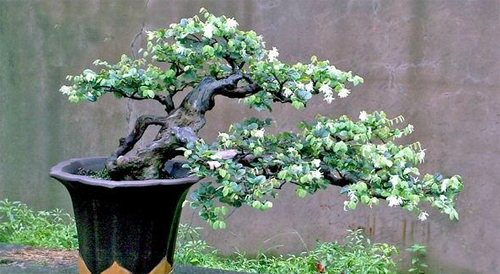
How to grow a white-flowered Chinese fringe flower bonsai:
The red-flowered Chinese fringe flower (Loropetalum chinense var. rubrum) likes light and tolerates slight shade (it can also be kept in a shaded spot as a potted plant), but in shade the leaf color tends to turn green.
It is very adaptable and drought-tolerant. It likes warmth, tolerates cold, has strong budding and branching ability, and tolerates pruning. It tolerates poor soil, but grows best in fertile, moist, slightly acidic soil.
1. Fertilizing
During the growing season, apply a diluted neutral foliar fertilizer to the red-flowered Chinese fringe flower as a foliar feed, spraying 2 to 3 times a month to promote new shoot growth. Of course, if the soil is fertile enough, there is no need to bother at all!
Summer tips:
In the plum rain season in the south, keep drainage good. In hot, dry seasons, water once each in the morning and evening, and spray water at noon to cool the plant down;
In the north, where the soil and air are dry, water promptly to keep the soil moist. In autumn, winter and early spring, spray water to keep the leaves clean and moist.
2. Pruning
Because the red-flowered Chinese fringe flower buds strongly and tolerates pruning, carry out light to moderate pruning in growing seasons such as early spring and early autumn. With normal water and fertilizer management, it can bloom in about 1 month, concentrating the flowering period.
This method can promote new branches and new leaves, make the tree shape more beautiful, prolong the red-leaf period, and can promote or control the flowering period. It is especially suitable for red-flowered Chinese fringe flower bonsai entered in flower exhibitions and trade fairs, as it can enhance the display effect and promote product sales.
3. Leaf removal and shoot tipping
During the growing season, remove the mature leaves and branch tips of the red-flowered Chinese fringe flower. After normal care for about 10 days, tender shoots will sprout again and bright red new leaves will grow.
4. Sunlight
Choose a sunny environment for growing the red-flowered Chinese fringe flower, or thin out plants positioned to its southeast and above, so that it grows healthily in ample sunlight, making the flower color and leaf color more brilliant and thus enhancing its ornamental value.
Common diseases of the white-flowered Chinese fringe flower:
The common ones are anthracnose and mosaic disease.
1. Anthracnose:
Diseased spots on the leaves appear as black round spots. It is most damaging in the rainy season from July to August. Once diseased, promptly remove diseased leaves and burn them in a centralized way to reduce the source of infection. Prune appropriately and improve light and ventilation conditions.
For severe cases, spray thiophanate-methyl and chlorothalonil. If spraying multiple times, use them alternately to prevent resistance.
2. Mosaic disease
Old and new leaves show alternating white and green patches. Mosaic disease is caused by a virus, and virus A or other antiviral agents can be used.
How much does a white-flowered Chinese fringe flower bonsai cost?
If it is only a sapling, the price is about 0.8 yuan per plant. This depends on whether you need a pot and whether you need someone to shape it.
How to grow Chinese fringe flower and things to note
Chinese scientific name: Chinese fringe flower (Chinese fringe flower)Latin scientific name: Loropetalum chinensis (R. Br.) Oliv.Also known as: white-flowered Chinese fringe flowerKingdom: PlantaeFamily: HamamelidaceaeGenus: LoropetalumSpecies: Loropetalum chinenseDistribution: distributed across the provinces and regions of East China, South China and Southwest China.Chinese fringe flower is usually a shrub, rarely a small tree, up to 12 m tall and 30 cm in diameter; the branchlets have rust-colored stellate hairs. It is produced in the middle and lower reaches of the Yangtze River and areas to the south and north of the Tropic of Cancer. It is also distributed in northern India. It mostly grows in mountain wilds and hilly thickets. The roots, leaves, flowers and fruits can all be used as medicine, and can relieve fever, stop bleeding, unblock meridians and activate collaterals, astringe and stop bleeding, clear heat and detoxify, and stop diarrhea. Wood characteristics: the wood is fine, hard and tough, suitable for making handles for woodworking tools: hammer handles, axe shafts, saw noses, plane bodies and so on. However, because this tree is dioecious, tools made from female plant material are generally better.1. Introduction
Chinese species name: ji mu (Chinese fringe flower), habitually written as ji mu, zhi mu, zhi mu. It is an evergreen shrub or small tree. Aliases: Xuancheng dialect ji liu mao; Chinese fringe flower (illustrated reference), zhi mo hua, ci mu hua, zhi mu chai, ji mu chai, ji chai (Zhejiang, Jiangxi, Hunan), ji jia gu (Fujian), jie jie man (Anhui), ji ji (Jiangxi, Hunan), jian qi (Qunfang Pu), jian qi, ci qi (Zhejiang), zhi wei mu (Guangdong), ju zi tiao (Sichuan), ju mu ya (eastern Sichuan), yu gu le (Jiangxi), yu gu chai (Guangdong and Guangxi), qing ming hua (Fujian), bai hua shu (Guangdong), man shan bai, jin li qi, jin qian qi (Zhejiang)2. Morphological characteristics
Shrub, sometimes a small tree, much branched, branchlets with stellate hairs. Leaves leathery, ovate, 2-5 cm long, 1.5-2.5 cm wide, apex acute, base obtuse, unequal-sided, upper surface slightly rough-hairy or glabrous, dull dark green when dry, lower surface covered with stellate hairs and slightly grayish white, lateral veins about 5 pairs, prominent above, raised below, margin entire; petiole 2-5 mm long, with stellate hairs; stipules membranous, triangular-lanceolate, 3-4 mm long, 1.5-2 mm wide, early deciduous. Flowers 3-8 clustered, with short pedicels, white, opening before the new leaves or at the same time as the tender leaves, inflorescence stalk about 1 cm long, hairy; bracts linear, 3 mm long; calyx tube cup-shaped, covered with stellate hairs, calyx teeth ovate, about 2 mm long, falling after flowering; petals 4, ribbon-like, 1-2 cm long, apex rounded or obtuse; stamens 4, filaments very short, connective protruding into a horn-like shape; staminodes 4, scale-like, alternating with the stamens; ovary completely inferior, covered with stellate hairs; style very short, about 1 mm long; ovule 1, pendulous from the inner upper corner of the carpel. Capsule ovate-round, 7-8 mm long, 6-7 mm wide, apex rounded, covered with brown stellate tomentum, calyx tube 2/3 the length of the capsule. Seeds round-ovate, 4-5 mm long, black, shiny. Flowering period March-April.Evergreen or semi-deciduous shrub to small tree, buds without scale-like bracts. Leaves alternate, leathery, ovate, entire, slightly oblique, with short petioles, stipules membranous. Flowers 4-8 arranged in heads or short spikes, bisexual, 4-merous; calyx tube obconical, adnate to the ovary, outer side covered with stellate hairs, calyx teeth ovate, deciduous; petals ribbon-like, white, curled inward in bud; stamens perigynous, filaments very short, anthers with 4 pollen sacs, opening by valves, connective protruding; staminodes scale-like, alternating with the stamens; ovary half-inferior, 2-loculed, covered with stellate hairs, styles 2; ovules 1 per locule, pendulous. Capsule woody, ovate-round, covered with stellate hairs, dehiscent in the upper half into 2 valves, each valve 2-cleft, the lower half enclosed by and completely fused with the persistent calyx tube, fruit stalk very short or absent. Seed 1, long-ovate, black, glossy, hilum white; seed coat horny, endosperm fleshy.
3. Species distribution
4 species and 1 variety, distributed in the subtropical regions of East Asia. China has 3 species and 1 variety, and another species is in India4. Growth habits
A shade-loving plant, but it does not reject sunlight. It is often used as landscaping stock, such as hedges and green belts.5. Taxonomy
The red-flowered Chinese fringe flower can be divided into 3 major categories, 15 types and 41 cultivars, described as follows:First category: Tender-leaf Red
Commonly known as single-face red, the third generation of red-flowered Chinese fringe flower, belonging to an early cultivated type. Main features: leaves medium-sized, leaf length 1 to 6 cm, width 0.8 to 4.6 cm, petiole 2 to 5 mm long, new leaves purplish red, old leaves green year-round, leaf surface with much hair covering and poor gloss. The phloem and xylem of new shoots are light green. Fibrous roots brownish green. It flowers 3 times a year; the spring flowering is early, beginning in early February, with full bloom from mid-March to mid-April, and it flowers 75 to 95 days in total for the year. Within this category, based on different leaf characteristics, 4 types are further divided: Long-leaf Green, Round-leaf Green, Pointed-leaf Green and Fine-leaf Green. Within each type, based on flower color, petal shape and other characteristics, 9 cultivars are divided. Compared with the other two categories, this category has poorer flower and leaf ornamental value and has gradually been eliminated in production, but it has strong ecological adaptability, especially strong resistance to high temperature, cold and poor soil, and can be used as original material for cultivar breeding.
Second category: Bone-Penetrating Red
Commonly known as the fourth generation of red-flowered Chinese fringe flower, it is a variant cultivar selected from the first category using asexual breeding techniques. Main features: leaves small, 0.8 to 4.5 cm long, 0.8 to 3 cm wide, petiole 2 to 4 mm long, new leaves purplish red, old leaves blackish green intermingled with purple on the upper surface and powdery green intermingled with purplish red on the underside, leaf surface with less hair covering than the first category and glossy. The red-leaf return-to-green period in summer is long. Branches dense, the phloem and xylem of new shoots both purplish red. Fibrous roots purplish red. It flowers 3 to 4 times a year; the spring flowering is intermediate, beginning in mid-February, with full bloom from late March to late April, and it flowers 105 to 130 days in total for the year. Within this category, based on leaf size, branch density, flowering period and other characteristics, 7 types are divided: Long-leaf Bone-Penetrating Red, Dense-branch Bone-Penetrating Red, Sparse-branch Bone-Penetrating Red, Fine-leaf Bone-Penetrating Red, Variegated-leaf Bone-Penetrating Red, Winter Beauty Bone-Penetrating Red and Prostrate Bone-Penetrating Red. Within each type, based on flower color, petal shape and other characteristics, 25 cultivars are divided. This category has the longest flowering period, rich flower forms, the most brilliant flower colors, dense branches and easy shaping, and can be used to create color sculptures and small to medium-sized shrub balls. The two cultivars Fine-leaf Purple Red and Fine-leaf Bright Red are especially suitable for cultivating miniature bonsai and for grafting to cultivate large tree stumps. The Winter Beauty Red type is the only cultivar that blooms in winter and has very high ornamental value.
Third category: Double-Face Red
Commonly known as large-leaf red, the fifth generation of red-flowered Chinese fringe flower, a variant cultivar type selected from the second category using asexual breeding techniques. Main features: leaves largest, 3 to 9 cm long, 1.5 to 5 cm wide, petiole 2.5 to 4 mm long, new leaves purplish red, old leaves purplish black on the upper surface and purplish red on the underside, leaf surface with little hair covering, red, bright and glossy, and the red-leaf return-to-green period in summer is short. Branching intermediate, the phloem and xylem of new shoots purplish red with high fiber content. Fibrous roots purplish black. It flowers 3 times a year; the spring flowering is late, beginning in late February, with full bloom from early April to early May, and it flowers 78 to 95 days in total for the year. Within this category, based on leaf size and shape, branching angle and other characteristics, 4 types are divided: Large-leaf Red, Pointed-leaf Red, Prostrate Red and Curled-leaf Red. Within each type, based on flower color, petal shape and other obvious characteristics, 7 cultivars are divided. This category has large, red and glossy leaves and very high ornamental value. The 4 cultivars with moderate branching and relatively fast growth, 'Large-leaf Red', 'Large-leaf Rose Red', 'Pointed-leaf Red' and 'Large-leaf Curled-petal Red', are suitable for cultivating large color sculptures and shrub balls.