How to Grow a Rockspray Cotoneaster Bonsai and Its Flowering Period
The fruit produced by the rockspray cotoneaster is extremely beautiful, pink, just like little pearls. This plant itself grows on mountains, but rockspray cotoneaster can also be made into bonsai. How do you grow a rockspray cotoneaster bonsai? How long is the flowering period?
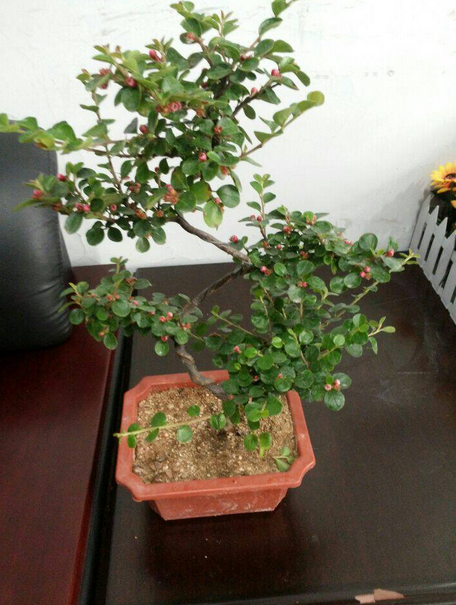
How to grow a rockspray cotoneaster bonsai:
1. Water and fertilizer management
Repot before budding in early spring, once every 1—2 years. Use fertile, loose leaf mold or sandy soil mixed for the potting soil. After planting, water thoroughly, cut off some old roots and branches and leaves, and place in a bright spot. In normal care, keep the potting soil moist, and apply cake fertilizer water once a month during the growing season. In summer, spray water on the leaves to increase humidity, and provide shade. In winter, move indoors for care.
2. Temperature and light
Rockspray cotoneaster likes a warm climate environment and requires growing in a semi-shaded environment with dry soil. In summer it needs a certain semi-shaded environment, while in the other three seasons, spring, autumn and winter, sunlight exposure can be increased.
Rockspray cotoneaster likes warmth, but can also tolerate cold. The average temperature of the coldest month is 1-2°C, the average temperature of the hottest month is 20-26°C, the annual average temperature is 15-18°C, and the annual accumulated temperature is 4500-5000°C,
The frost-free period is 210-250 days. Under such temperature conditions, the rockspray cotoneaster stays emerald green all year round (the leaves turn bright red in autumn), and has high ornamental value
3. Propagation methods
Mainly by sowing and cuttings. After the fruit matures, harvest it, soak it and rub off the fruit skin, then sow immediately in autumn; sowing in the following spring has a low germination rate. Cuttings are taken during the plum rain season, and roots can form in about 40—60 days.
The flowering period of rockspray cotoneaster:
A flowering branch has 1~2 flowers, pink, flower diameter 5~7mm, nearly stalkless; petals upright, obovate. The fruit is nearly spherical, 4~6mm in diameter, bright red, often with 3 small pyrenes. It flowers in May~June, and the fruit matures in September~October.
Deciduous or semi-evergreen prostrate shrub, branches spreading horizontally in neat 2 rows, just like a centipede. Leaves nearly round or to obovate, 5~14mm long, apex acute, base broadly wedge-shaped, surface dark green, hairless, underside sparsely covered with flat appressed fine hairs.
That covers how to grow a rockspray cotoneaster bonsai and its flowering period. I remember eating this fruit on the mountain as a child; it tasted sweet and sour, just like hawthorn, and I still miss it a bit now.
How to Grow a Rockspray Cotoneaster Bonsai: Teaching You the Growing Methods for Rockspray Cotoneaster
Rockspray cotoneaster is a semi-evergreen prostrate shrub that grows on mountain slopes, in ridge thickets or in rock crevices above 1000 m in elevation. With dense branches, small leaves and brilliant red fruit, it is now often cultivated in various places, and is suitable for garden ground cover and making bonsai, etc. What the editor shares with everyone today is how to grow a rockspray cotoneaster bonsai. Let's take a look.
Introduction to rockspray cotoneaster
Rockspray cotoneaster (scientific name: Cotoneaster horizontalis Decne.): a semi-evergreen prostrate shrub, height below 0.5 m. Branchlets arranged in two rows, covered with strigose hairs when young. Leaves nearly round or broadly elliptic, rarely obovate, apex acute, base wedge-shaped, entire, hairless above, sparsely appressed pubescent beneath; petiole pubescent; stipules subulate, early deciduous. Flowers 1-2, terminal or axillary, nearly stalkless, petals pink, obovate, apex rounded obtuse; stamens about 12; apex of ovary pubescent, free. Fruit nearly spherical, bright red. Flowering period May-June, fruiting period September-October.
Rockspray cotoneaster grows on mountain slopes, in ridge thickets or in rock crevices above 1000 m in elevation. It is distributed in China's Anhui, Hubei, Hunan, Sichuan, Guizhou, Yunnan, Shaanxi, Gansu and other provinces. It is often cultivated in various places. With dense branches, small leaves and brilliant red fruit, it is suitable for garden ground cover and making bonsai, etc.
I. Morphological characteristics
Branches: Rockspray cotoneaster is a deciduous or semi-evergreen prostrate shrub, height not exceeding 0.5 m, branches spreading horizontally in neat two rows; branchlets cylindrical, covered with strigose hairs when young, shedding when old, dark brown.
Leaves: The leaves of rockspray cotoneaster are nearly round or broadly elliptic, rarely obovate, 5-14 mm long, 4-9 mm wide, apex mostly acute, base wedge-shaped, entire, hairless above, sparsely appressed pubescent beneath; petiole 1-3 mm long, pubescent; stipules subulate, early deciduous.
Flowers: Rockspray cotoneaster has 1-2 flowers, nearly stalkless, 5-7 mm in diameter; calyx tube bell-shaped, sparsely short-pubescent outside, hairless inside; sepals triangular, apex acute, slightly short-pubescent outside, margin pubescent inside; petals upright, obovate, apex rounded obtuse, about 4 mm long, 3 mm wide, pink; stamens about 12, shorter than petals; styles usually 3, sometimes 2, free, shorter than stamens; apex of ovary pubescent.
Fruit: The fruit of rockspray cotoneaster is nearly spherical, 4-6 mm in diameter, bright red, usually with 3 small pyrenes, rarely 2 small pyrenes.
The flowering period of rockspray cotoneaster is May-June, and the fruiting period is September-October.
II. Ecological habits
Rockspray cotoneaster likes a warm and humid semi-shaded environment, tolerates dry and barren land, does not tolerate damp heat, has a certain cold tolerance, and is afraid of waterlogging.
How to grow a rockspray cotoneaster bonsai
1. Management
Keep the temperature inside the shed at around 28°C and the humidity above 90%. Spray water once each day at 8:00-9:00 and 16:00-17:00, but do not make the soil too wet; keeping the leaf surface moist is appropriate. To prevent fungal infection, spray 0.2% carbendazim solution once on the 7th day after cutting for comprehensive disinfection. Start hardening the seedlings after 40 days, and they can be transplanted after 5-6 days of hardening.
2. Humidity
It likes a humid or semi-dry climate environment, and requires the relative air temperature of the growing environment to be 50-70%. When the relative air humidity is too low, the lower leaves turn yellow and fall off, and the upper leaves lose their luster.
3. Temperature
Because rockspray cotoneaster is native to subtropical regions, it has very strict requirements for winter temperature, and stops growing when the ambient temperature is below 8°C.
4. Light
It has strong adaptability to light. When kept indoors, place it in a place with bright light as much as possible. After keeping it indoors for a period (about one month), move it outdoors to a shaded place (with insulation conditions in winter) for a period (about one month), and alternate like this.
5. Fertilizer and water
For potted plants, in addition to adding organic fertilizer when potting, appropriate fertilizer and water management should also be carried out during normal care. During the winter dormant period, the main task is to control fertilizer and water, with an interval of about 3-7 days; the interval is shorter on sunny days or during high temperatures, and longer or no watering on rainy days or during low temperatures. For plants grown in the ground, apply fertilizer and water 2-4 times in spring and summer according to drought conditions: first dig a small circular trench 30-100 cm outside the root crown (the larger the plant, the farther from the root crown), with the trench width and depth both 20 cm. Sprinkle 25-50 jin of organic fertilizer into the trench, or 1-5 liang of granular compound fertilizer (chemical fertilizer), then water thoroughly. After winter begins and before spring begins, apply fertilizer once more in the same way as above, but without watering.
6. Pruning
In winter, when the plant enters dormancy or semi-dormancy, cut off thin and weak, diseased and pest-infested, dead, and overly dense branches. You can also organize the branches in combination with cuttings.
7. Repotting
As long as it is cared for properly, it will grow very fast. When it grows to a certain size, consider giving it a larger pot so it can continue to grow vigorously. For the potting soil and component ratio used for repotting, you can choose one of the following: vegetable garden soil: cinder = 3:1; or garden soil: medium-coarse river sand: sawdust (mushroom residue) = 4:1:2; or one of paddy soil, pond mud, and leaf mold.
Place the flower to be repotted on the ground, first tap the sides of the pot lightly with your palm to make the root system vibrate and separate from the pot wall, then turn the flower pot upside down on your left hand, gently clamp the plant between the index and middle fingers of your left hand, brace the wrist and fingertips against the pot rim, tap the bottom of the pot with your right hand, then use your thumb to push the root soil downward from the bottom hole to let the plant come out. After it comes out, gently pat the potting soil with both palms to let excess soil fall off.
Choose a flower pot of appropriate size. Cover the bottom hole of the pot with two pieces of tile or thin foam pieces, ensuring both that the potting soil is not washed out by water and that excess water can drain out in time. On top of the tile or foam, place a layer of ceramsite or crushed red bricks as a drainage layer, about 2-3 cm thick. On the drainage layer, place organic fertilizer, about 1-3 cm thick. On the fertilizer, place a thin layer of substrate, about 2 cm thick, to separate the root system from the fertilizer. Finally, put the plant in, fill with nutrient soil, and leave about 2-3 cm from the pot rim.
Propagation methods of rockspray cotoneaster
Rockspray cotoneaster is commonly propagated by cuttings and seeds. Cuttings can be taken in spring and summer, and softwood cuttings in summer have a high survival rate.
1. Sowing propagation
Seeds are sown in autumn or stored in wet sand and sown in spring. Fresh seeds can be sown immediately after collection, while dry-stored seeds should be sown in early spring from January to February. Transplanting is best done in early spring, and large seedlings need to be moved with a soil ball.
2. Cutting propagation
Prepare a cutting bed 2.0 m wide, 10 m long and 40 cm high in advance. Spread a 20 cm thick layer of sweet potato stone on the bottom of the cutting bed, and spread a 20 cm thick layer of fresh river sand, vermiculite or perlite on top as the cutting substrate. Use 0.3% carbendazim solution or 0.3% potassium permanganate solution to disinfect the substrate. Then set up an arched shed, cover it with plastic film, and firmly erect a shade net. Water to keep the cutting substrate moist.
From mid-June to early July, select current-year semi-lignified, robustly growing, pest-free leafy softwood branches with plump axillary buds, and cut them into 10-15 cm cuttings. When cutting the cuttings, make the lower cut 0.5-1 cm below a leaf or axillary bud, and the upper cut 0.5-1 cm above a leaf or axillary bud. You may also retain the terminal bud. Keep 2-3 leaves on the upper part of each cutting. The upper cut should be flat, and the lower cut should be horseshoe-shaped. The cuts should be smooth without splitting or torn bark. Put them promptly into 0.3% carbendazim solution for disinfection. To prevent the softwood from wilting, it is best to collect cuttings in the morning or on rainy days, and insert them as soon as they are collected.
Before cutting, at room temperature away from sunlight, quickly dip the lower 2 cm of the cuttings in 0.1% ABT No. 1 solution. To prevent injury to the base of the cuttings, use a wooden peg slightly thicker than the cutting to make the insertion hole before cutting, with a plant spacing of 5-10 cm and insertion depth of 8-10 cm. Insert the cuttings and press firmly with your hand.
On the 15th day after cutting, callus tissue begins to form; on the 23rd day, adventitious roots begin to form; on the 30th day, the callus formation rate is 99%, the rooting rate is 84%, the average number of roots per plant is 5-7, and the average root length is 8.5 cm.
How to Grow Rockspray Cotoneaster: Precautions for Rockspray Cotoneaster Care
Rockspray cotoneaster is also called ground-covering centipede, little-leaf cotoneaster, dwarf red cotoneaster, etc. It is a semi-evergreen prostrate shrub of the genus Cotoneaster in the Rosaceae family. As an excellent material for arranging rock gardens, courtyards, green spaces, wall edges and corners, it can be used as ground cover and made into bonsai. Its fruiting branches can also be used for flower arranging, and it can also be used for foundation planting or making bonsai. Let's take a look at the growing methods for rockspray cotoneaster!
Growth habits of rockspray cotoneaster
Rockspray cotoneaster likes a warm and humid semi-shaded environment, tolerates dry and barren land, does not tolerate damp heat, has a certain cold tolerance, and is afraid of waterlogging. It is distributed in China's Shaanxi, Gansu, Hubei, Hunan, Sichuan, Guizhou and Yunnan, growing in shrub thickets or on rocky slopes at 2000~3500 m in elevation. It is also distributed in Nepal.
Propagation methods of rockspray cotoneaster
1. Sowing: Rockspray cotoneaster is commonly propagated by cuttings and seeds. Seeds are sown in autumn or stored in wet sand and sown in spring. Fresh seeds can be sown immediately after collection, while dry-stored seeds should be sown in early spring from January to February. Transplanting is best done in early spring, and large seedlings need to be moved with a soil ball.
2. Cuttings: Rockspray cotoneaster cutting propagation can be carried out in spring or during the plum rain season. Spring cuttings require insulation and moisture retention, using mountain soil or peat soil as the substrate. Cuttings during the plum rain season especially require a substrate with good air permeability, and softwood cuttings in summer have a high survival rate.
Growing methods for rockspray cotoneaster
1. Transplanting: Keep the temperature of the rockspray cotoneaster seedling shed at around 28°C and the humidity above 90%. Spray water once each day at 8:00~9:00 and 16:00~17:00, but do not make the soil too wet; keeping the leaf surface moist is appropriate. To prevent fungal infection, spray 0.2% carbendazim solution once on the 7th day after cutting for comprehensive disinfection. Start hardening the seedlings after 40 days, and they can be transplanted after 5~6 days of hardening.
2. Humidity: Rockspray cotoneaster likes a humid or semi-dry climate environment, and requires the relative air temperature of the growing environment to be 50~70%. When the relative air humidity is too low, the lower leaves turn yellow and fall off, and the upper leaves lose their luster.
3. Temperature: Rockspray cotoneaster is native to subtropical regions, so it has very strict requirements for winter temperature, and stops growing when the ambient temperature is below 8°C.
4. Light: Rockspray cotoneaster has strong adaptability to light. When kept indoors, place it in a place with bright light as much as possible. After keeping it indoors for a period (about one month), move it outdoors to a shaded place (with insulation conditions in winter) for a period (about one month), and alternate like this.
5. Fertilizer and water: During normal care of potted rockspray cotoneaster plants, appropriate fertilizer and water management should also be carried out. During the winter dormant period, the main task is to control fertilizer and water, with an interval of about 3~7 days; the interval is shorter on sunny days or during high temperatures, and longer or no watering on rainy days or during low temperatures.
6. Pruning: In winter, when rockspray cotoneaster plants enter dormancy or semi-dormancy, cut off thin and weak, diseased and pest-infested, dead, and overly dense branches. You can also organize the branches in combination with cuttings.
7. Repotting: As long as rockspray cotoneaster is cared for properly, it will grow very fast. When it grows to a certain size, consider giving it a larger pot so it can continue to grow vigorously. For the potting soil and component ratio used for repotting, you can choose one of the following: vegetable garden soil: cinder = 3:1, or garden soil: medium-coarse river sand: sawdust (mushroom residue) = 4:1:2, or one of paddy soil, pond mud, and leaf mold.