Can Lobelia be sown in spring? Detailed planting methods
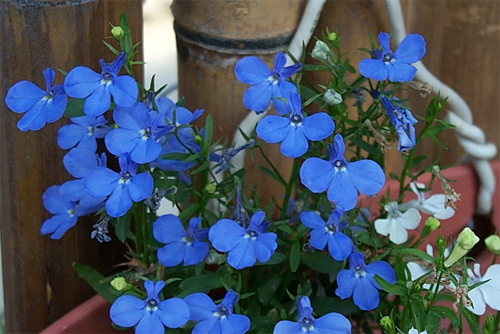
The flowers of lobelia are small blue blooms, and they look extremely beautiful. Keeping one at home can lift your mood. What are the planting methods for lobelia? Can it be sown in spring?
Lobelia planting methods:
1. Seedling-stage care
When dividing seedlings, the potting soil should not be too dry. If the soil is somewhat compacted, the roots are easily damaged during seedling division.
First take the seedlings out of one cell of the seedling tray, then separate them according to the situation, gradually pulling the small seedlings apart. Weak and small plants can be removed.
Give appropriate scattered light a few days before transplanting, and increase it gradually. If the seedling roots are only slightly damaged, they can be exposed to sunlight for a longer time; if the roots are badly damaged, they need a longer recovery time, so they can be exposed later, and right after transplanting they should be cared for very carefully.
During the growth of the pricked-out seedlings, promptly pinch off the growing tips. The frequency of fertilizing the seedlings does not need to be too high. At this time the temperature is generally 10-20 degrees, which is suitable for the growth of small seedlings. Use Biwang at 1:800-1000 and water once every 7-10 days, and that is very good. Watering should follow the principle of watering thoroughly only after the soil has dried out.
To control the reproduction of mold, consider combining one watering with the use of some fungicide for prevention.
2. Pinching and branching
Use pinching to adjust the plant shape of lobelia. The pinching height is usually 4-5 cm. Pinching can very effectively promote the sprouting of lateral buds, thereby obtaining more branches. In this way, more flower buds will differentiate later, and the effect will be better. Planting out and pinching do not conflict. For planting out, once the roots have developed well, the plant can go into a pot; pinching is determined by the growth situation, and this work must be done from time to time.
Maintain a certain height and pinch appropriately to promote the sprouting of lateral buds, and the spread will also become larger.
3. Transplanting and care
After a period of growth, once the root system has developed well, you can consider potting and planting out.
You may consider giving some base fertilizer appropriately, but it is not recommended to give a lot (as little as possible, little, little). Later, liquid topdressing can be used to supplement.
For potting and planting out, choose a time when the medium humidity is kept at 30%-50%. After potting, water thoroughly to settle the roots. For later watering, it is recommended to water thoroughly only after the soil has dried out.
Basically, in winter, very little fertilizer is applied, or fertilization is stopped when the temperature is low, waiting until the temperature warms up again before fertilizing.
Do not plant densely. A full plant shape depends on later pinching regulation and water and fertilizer management. From pricking out to planting out, the plants are in a low-temperature environment, so growth is relatively slow, but do not worry.
Small tip: For root development, the medium should be pressed down appropriately. Doing so keeps the soil ball of the seedlings in the container from falling apart, and damage to the roots later is especially small, so after planting the transplant-shock period can be ignored.
4. Fertilizing
Arrange the number of seedlings in a pot according to the container size. A 15 cm pot is enough for 2-3 plants. An appropriate amount of base fertilizer is fine, just a little compound fertilizer; too much harms the roots.
Once the seedling roots are stable (after one month), you can start fertilizing. The concentration of fertilizer used depends roughly on the temperature. When it is colder in winter, use it more dilute, 1:1000; when the temperature is higher, use it more concentrated, 1:500-800. When the temperature is below 5 degrees, stop fertilizing.
In the cold season, it is recommended to stop fertilizing. Growth itself is very slow, and the absorption of nutrients is very little.
When the spring breeze blows across the land, lobelia will grow rapidly. Because the branches developed under cold growing conditions, they will be relatively dense and compact. After it fills the pot, stop applying compound fertilizer and switch to fertilizer that promotes flowering.
5. Pinching
The whole growth process actually looks very simple, but pinching control is indispensable. Before flower buds differentiate, pinching runs through the entire growth process.
6. Preventing frost damage
The entire growth process of autumn-sown seedlings is very long, and they need to get through the severe winter. When the outdoor temperature is 0 degrees, move them indoors, although they can tolerate a low temperature of minus 3°C. In weather such as snow or hail, they must be moved indoors to avoid it; leaves are easily frostbitten after contact with water.
Precautions for lobelia:
The seeds are tiny, so when sowing you can mix in some fine sand before sowing (you can also first soak them in room-temperature water for three hours), or first raise seedlings until they have 6-8 true leaves and then transplant them into pots or cultivate them in flower beds; and use a fine-holed spray bottle to water. The force must never be too strong, to prevent the seeds from being washed away.
During the seedling stage, pay attention to loosening the soil and weeding. After planting, apply 1 application of dilute human waste; after harvesting in summer, apply 1 topdressing of livestock manure or ammonium sulfate, urea, etc.; in winter, apply decomposed fertilizer or compost.
In dry seasons, water more to keep the soil moist, and growth will be better. When planting out, add a slow-release fertilizer at the same time, then topdress again about every three weeks. Before the flowering period arrives, you can supplement more phosphorus fertilizer to favor flowering.
In lobelia cultivation, when the leaves begin to become pointed and strip-shaped, the flower buds are beginning to appear.
In the later growth stage, flower buds differentiate on the seedlings. If you are not satisfied with the plant shape, you can remove some flower buds and at the same time apply a growth fertilizer to adjust the plant's growth hormones.
For seedlings whose flower bud differentiation is inconsistent, you can still continue to use shaping techniques to handle them, until, reviewing it from multiple angles, you are relatively satisfied. At this point, you basically do not need to manage it much anymore; just wait for the joy of harvest.
In the early flowering stage, you can apply a little flowering-promoting fertilizer at a concentration ratio of 1:500-800, and at the same time use one application of fungicide and insecticide.
Fungicides prevent the reproduction of fungal diseases, and the insecticide is best one that prevents red spider mite damage.
The flowering season of lobelia is exactly between April and May. After the temperature rises, mold and pests reproduce relatively quickly, so of course you should take preventive measures.
After the flowers open, avoid heavy water directly splashing on the flowers; spray watering is enough.
Can lobelia be sown in spring?
Yes, it can be sown in spring. Sow from January to March, and it blooms after July; sow from August to October, and it blooms the next year. After sowing at a temperature of 22 degrees Celsius, the seeds can germinate in 20 days.
Other names for lobelia:
Cuiediehua, mountain lobelia, flower lobelia, South African lobelia;
Also known as mountain lobelia, in the Campanulaceae family, genus Lobelia. Although it is a perennial herbaceous plant, it is often cultivated as an annual. Keeping it for only one year is too short!~ I quite like its petals, like small butterflies spreading their wings. The flower colors include red, peach red, purple, violet blue, white, and other colors.
Lobelia needs a long-day, low-temperature environment to bloom, but its cold tolerance is not strong. It dislikes intense heat and prefers loose loam rich in humus.
That is all for the introduction to lobelia planting methods. Hurry and plant it at home! Give your eyes plenty of enjoyment.
When to sow lobelia and how to grow it so it blooms
Lobelia is about 12-20 cm tall, with fine, dense stems and branches. The upper leaves on the stem are smaller and lanceolate, while the leaves near the base are slightly larger and broadly spoon-shaped; the leaves are alternate. Flowers are terminal or axillary, with the corolla tip split into five lobes, the lower 3 lobes larger, shaped like a butterfly spreading its wings. The flower colors include red, peach red, purple, violet blue, white, and other colors. It can be used as medicine.
When to sow lobelia
1. Autumn sowing
The best sowing time is September, and no later than November, because too low a temperature affects the seed germination rate. When sown in August, the seedlings take shape very early and bloom roughly between February and March of the following year. However, due to the influence of the growing environment, it is hard to guarantee sunlight, temperature, and so on, so the flowering effect is not very good.
2. Spring sowing
Spring sowing is generally done between January and March. At this time the temperature gradually warms, plants grow faster, and the climate conditions are pleasant, making it more suitable for plant growth. However, spring sowing also has disadvantages. As the temperature gradually rises, plants grow faster, and the time left for pinching control will be relatively short. To get a good shape, you need to pinch in time. But precisely because it is the season suitable for growth, the flower-viewing time is relatively long.
3. Sowing precautions
Whether sowing in spring or autumn, one point to pay attention to when sowing is that the seeds and the soil medium must be pressed firmly together, otherwise the seeds have no moisture and cannot germinate. Furthermore, compacted soil can ensure close combination with the plant roots, and when we plant out, the soil ball is not easy to loosen.
How to grow lobelia so it blooms
1. Conditions for lobelia to bloom
When growing lobelia, you need to maintain a long-day and low-temperature environment so that lobelia blooms better. After the growing environment conditions for lobelia are satisfied, it will gradually mature, the leaves will begin to become pointed and strip-shaped, and flower buds will begin to appear; at this point it is about to prepare to bloom.
When lobelia flower buds begin to differentiate, if its overall shape is still not satisfactory, it can still continue to be adjusted. At this time you can remove some flower buds and fertilize to make it grow, then gradually bring lobelia to the ideal plant shape, so that flowering will also be more ornamental.
If lobelia shows uneven flower bud differentiation, shaping methods can also be used to make it bloom more and better.
2. Care during the flowering period of lobelia
In the early flowering stage of lobelia, you can apply one flower fertilizer to make flowering better, and be careful not to use too high a concentration. You also need to prevent pests and diseases by spraying some fungicides and insecticides to prevent the occurrence of pests and diseases. In this way, you can prevent pests and diseases from appearing during flowering and bringing unnecessary trouble.
When lobelia is flowering, be careful to avoid rain. Rain will have a bad effect on the overall shape of the flowers, and it is also bad for the growth of the plant.
When to sow lobelia seeds (which month) and the sowing method for lobelia
The growth state and overall performance of a plant will change with the plant's sowing time, so the sowing time of a plant is key to the entire plant's growth. Different species have certain differences in growth habits, so the sowing time for planting lobelia should be determined according to lobelia's growth needs.
When to sow lobelia seeds
1. Autumn sowing
The best sowing time is September, and no later than November, because too low a temperature affects the seed germination rate. When sown in August, the seedlings take shape very early and bloom roughly between February and March of the following year. However, due to the influence of the growing environment, it is hard to guarantee sunlight, temperature, and so on, so the flowering effect is not very good.
2. Spring sowing
Spring sowing is generally done between January and March. At this time the temperature gradually warms, plants grow faster, and the climate conditions are pleasant, making it more suitable for plant growth. However, spring sowing also has disadvantages. As the temperature gradually rises, plants grow faster, and the time left for pinching control will be relatively short. To get a good shape, you need to pinch in time. But precisely because it is the season suitable for growth, the flower-viewing time is relatively long.
Sowing method for lobelia
Lobelia seeds are very small, and sowing them one by one is very laborious, so broadcast sowing is recommended. First prepare a little sand, sift it, mix a small amount of sand with the seeds, evenly broadcast them over the ground, cover with a thin layer of soil, very thin is enough, and use a spray bottle to spray water onto the ground. Never wash it directly with a relatively large stream of water, as that will wash the seeds away.
You can also use hole sowing. You can use folded paper to help distribute the seeds, sowing about 10 seeds per cell tray, approximately, and one seed per hole is also fine. Dividing into pots later is also convenient, but it tests patience and eyesight relatively much.
Lobelia growing methods and precautions
1. Light
Lobelia is not shade-tolerant and must grow under full light to grow normally. When caring for it at home, it must be placed in a place where sunlight can shine directly. If there is insufficient light, try to take lobelia to a place with ample light every day for three to four hours of exposure. It can bloom normally only in a long-day, low-temperature environment.
2. Temperature
Lobelia is a cool-season flower, but its cold tolerance is not strong, and it cannot overwinter outdoors in the north. It dislikes intense heat, and enters a dormant state when the temperature is high in summer.
3. Soil
It prefers loose, fertile soil rich in humus.
4. Water
Watering should be based on the care environment, pot soil size, and growth condition. Under normal circumstances, just keep the potting soil moist. When watering, water thoroughly.
5. Fertilizer
Fertilize selectively according to need. Fertilize more during the growing season, and stop fertilizing in winter when the temperature is low.
6. Pinching and pruning
Pinching and pruning is a simple method to control the plant shape of lobelia. Pinching during the growth period promotes the growth of lobelia's lateral buds. With more branches, there are also more flower buds.
7. Pests and diseases
During the growth period of lobelia, you need to frequently observe the growth condition of the lobelia plant. Use some fungicides and insecticides to prevent damage from mold or red spider mites, so that lobelia grows healthily.
The flowering period of lobelia
Lobelia is a very important flowering plant. It generally blooms in spring, in February and March. The flowers are mainly terminal or axillary, and look somewhat like butterflies.
The flower colors of lobelia are also relatively rich, including red, peach red, purple, white, and other colors. The distinctive blue lobelia is a common flowerbed plant in spring.
Lobelia can be divided into spring sowing and autumn sowing, and spring sowing is one of the better planting times, as we can enjoy a longer flowering period. So the editor here suggests that you had best choose spring sowing. However, if the season is inconvenient, choosing autumn sowing is also the next-best optimal choice.