How to Propagate Ixora and How Long Is Its Blooming Period
Ixora is extremely beautiful, so if you want to grow several more plants at home, how should you propagate it? There is another reason people like growing ixora: its long blooming period. So exactly how long is the blooming period of ixora?
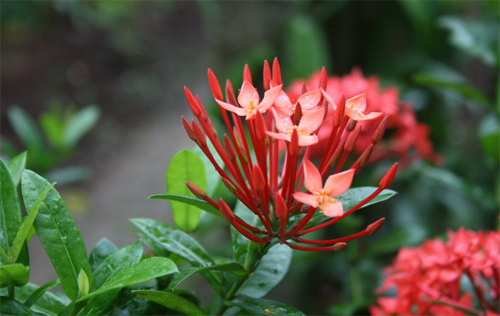
Propagation methods for ixora:
Ixora can be propagated by seeding, layering, or cuttings, with cuttings being the main method; stem cuttings, bud cuttings, and root cuttings can all take root.
The best time for cuttings is spring and autumn; you can also select and take softwood cuttings in June, taking care to provide shade and keep moisture, at a temperature of 20-25°C, with rooting in about 20 d.
1. Seed propagation
Seed propagation is carried out in spring at a temperature of 24°C, with germination in about 10 d; however, seeds are not easy to obtain, so artificial pollination should be used.
Collect seeds in winter and sow in spring the following year; the optimum germination temperature is 22-24°C. Sow in indoor seedling trays, with germination in about 20-25 days.
When 3-4 pairs of true leaves have grown, the seedlings can be moved into 8 cm pots. The young seedlings should promptly be potted in acidic humus soil mixed with sand; the drainage holes at the bottom of the pot should be enlarged, and a drainage layer should be made.
During the rainy season, pay attention to tipping the pot to drain water. During cultivation, it must not be too wet; excessive moisture is unfavorable for flowering and may even cause leaf drop and root rot.
In the early growth stage, pinching can be done to make the plant's shape rounded, with more branches and more flowers; it can also be tied to trellises and various supports for the branches and vines to climb. To ensure relatively high air humidity, water can be sprayed on the leaves regularly, and the air in the cultivation environment should be fresh.
2. Cutting propagation
After the weather warms each spring, cutting propagation can be carried out from March to October. Select robust one-year-old branches (too tender ones are not easy to survive, and old branches with black bark and spots are not easy to root), cut them into 10-15 cm sections, remove the lower leaves, and insert them into a sand bed.
After insertion, water to keep the soil moist; roots will emerge in about 50 days. About ten days after rooting, they can be transplanted or potted, placed in a semi-shaded place for care, and after rooting and surviving, moved to a place with sufficient sunlight for care.
Before cutting, soak the base of the cuttings in 0.5% indolebutyric acid solution for 3-5 seconds, which can shorten the rooting period and make the root system especially well developed.
3. Layering propagation
Carry this out in early spring. When there are many dense branches, make a ring cut 20 cm from the tip, bind it with peat and film, and it can heal and root in about 2 months or more.
For newly propagated young seedlings, after potting they should be placed in a semi-shaded place for care. After they survive and send out new shoots, apply a light fertilizer once every 10-15 days. In dry weather, pay attention to spraying water to increase humidity. When the young seedlings grow to about 15 cm, pinch them to promote side branches and make the plant shape full.
How long is the blooming period of ixora:
The plant is low and dwarf, with elegant flowers and leaves and rich flower colors, including red, orange, yellow, white, and bicolor. Ixora has a relatively long blooming period and can bloom from March to December each year. It blooms 4 to 5 times a year.
That is all for the propagation methods and blooming period of ixora. Ixora is the national flower of Myanmar, so going to Myanmar to admire it is also possible.
The Flower Language of Ixora and How to Grow Ixora
Ixora is a common flowering plant for us. Today we will talk about the flower language of ixora and how to grow ixora.
How to grow ixora:
1. Soil: Fertile, loose, and well-drained acidic sandy loam is best. For potted plants, use a mixed soil of culture soil, peat soil, and coarse sand, with a pH of 5-5.5 being suitable.
2. Watering: Ixora likes moisture and fears dryness. During the growth period of stems and leaves, sufficient water is needed; keeping the potting soil moist is beneficial for bud sprouting and leaf growth. However, being too moist for a long time can easily cause part of the root system to rot, affecting growth and flowering. If the soil is too dry or alternately dry and wet, and water is not supplied in time, leaf drop will occur.
3. Sunlight: Ixora needs sufficient sunlight, especially during the growth period of stems and leaves. Under sufficient sunlight, the leaves are emerald green and glossy, which is beneficial for inflorescence formation, neat flowering, and vivid flower colors. It can also grow in a semi-shaded environment, but the leaves are light green and lack luster, with fewer flowers and lighter flower colors. However, proper shading during strong summer light can prolong the viewing period of the flowers.
4. Temperature: The suitable growth temperature for ixora is 15-25°C, from March to September it is 24-30°C, and from September to March of the following year it is 13-18°C. The winter temperature should not be lower than 0°C; if too low, it is prone to frost damage. On the contrary, ixora is tolerant of high temperatures and still grows normally above 32°C. Overall, ixora has relatively strong adaptability to temperature.
5. Fertilization: During the growth period, apply once every half month a liquid fertilizer made by mixing nitrogen, phosphorus, potassium, ferrous sulfate, and horseshoe pieces in a ratio of 1:1:1:2:3, adding water, and fermenting until decomposed.
6. Pruning: Pruning is mostly carried out after the plants are moved outdoors in spring, mainly to properly thin the branches of the plant to facilitate ventilation and light penetration. In addition, proper pinching during the blooming period can make it produce more buds and flowers.
7. Pests: Ixora is often harmed by leaf spot disease and anthracnose, which can be sprayed with a 1000-fold dilution of 10% antibacterial agent 401 acetic acid solution. For pest damage, there is scale insect harm, which can be killed by spraying a 1500-fold dilution of 40% omethoate emulsifiable concentrate. Sometimes aphids harm young tender stems and leaves; spray with a 1200-fold dilution of 2.5% derris extract emulsifiable concentrate to kill them.
The flower language of ixora:
The flower language of ixora: vying to be first.
Because ixora has a relatively long blooming period, people call it hundred-day red. Before ixora blooms, it looks like slender hairpins piercing straight into the blue sky. After ixora blooms, its four petals spread flat into a cross. In ancient times, the cross pattern was a talisman to ward off evil spirits and drive away pestilence. Therefore, during the Dragon Boat Festival each year, in order to ward off evil spirits, drive away pestilence, and seek good fortune, ordinary people inserted ixora together with calamus and mugwort on dragon boats, and over time, ixora got its name for this reason.
How to grow ixora
Ixora likes warmth, moisture, and relatively sufficient sunlight. It is an indicator plant of acidic soil and must be cultivated in acidic soil, requiring loose soil with good drainage. During the growth period, pay attention to fertilization and pinching to promote branching. Ixora likes a warm, moist, and sunny environment. It is not cold-tolerant, tolerates semi-shade, and does not tolerate waterlogging or strong light. The suitable growth temperature for ixora is 15-25°C, from March to September it is 24-30°C, and from September to March of the following year it is 13-18°C. The winter temperature should not be lower than 0°C; if too low, it is prone to frost damage. Ixora likes moisture and fears dryness.
Ixora needs sufficient sunlight, especially during the growth period of stems and leaves. Under sufficient sunlight, the leaves are emerald green and glossy, which is beneficial for inflorescence formation, neat flowering, and vivid flower colors. It can also grow in a semi-shaded environment, but the leaves are light green and lack luster, with fewer flowers and lighter flower colors. However, proper shading during strong summer light can prolong the viewing period of the flowers.
Ixora can be propagated by seeding, layering, or cuttings. Cuttings can be taken during the growing season, especially in June-July. Take 2-3 nodes of plump one-year-old branches. Layering is carried out in early spring. For newly propagated young seedlings, after potting they should be placed in a semi-shaded place for care. After they survive and send out new shoots, in dry weather, pay attention to spraying water to increase humidity. When the young seedlings grow to about 15 cm, pinch them to promote side branches and make the plant shape full. It is best to do this in June to July. Select semi-mature branches and insert them into a sand bed; after insertion, they root in 40-50 days. Soak the cuttings in 0.5% indolebutyric acid solution for 3-5 seconds, which can shorten the rooting period. Collect seeds in winter and sow in spring. The optimum germination temperature is 22-24°C; after sowing, they germinate in 20-25 days, and when 3-4 pairs of true leaves have grown, the seedlings can be moved into 8 cm pots. For ixora plants with many dense branches, make a ring cut 20 cm from the tip, wrap with peat and film, and they can heal and root in more than 2 months.