What are the other names for Ixora? A complete guide to growing methods and precautions
People really love Ixora. Just like hydrangeas, a single flower looks so big that you just want to take these flowers home. What are the growing methods and precautions for Ixora? What are its other names?
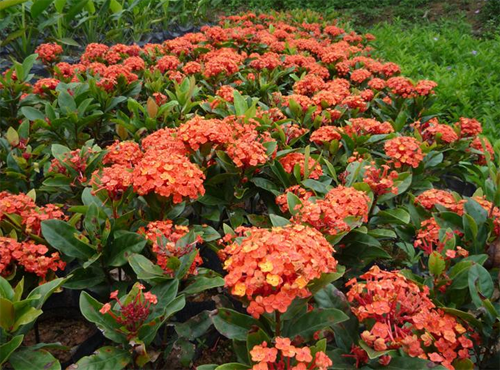
Growing methods for Ixora:
1. Suitable temperature
Ixora likes a warm, humid environment with plenty of sunlight. It is not cold-tolerant, tolerates partial shade, and does not tolerate waterlogging or strong light. The optimal growth temperature for Ixora is 15-25°C, from March to September it is 24-30°C, and from September to the following March it is 13-18°C.
In winter, the temperature should not drop below 0°C; if too low, it is prone to frost damage. On the contrary, Ixora is heat-tolerant and grows normally above 32°C.
2. Water
Overall, Ixora has fairly strong adaptability to temperature. Ixora likes moisture and fears dryness. During the stem and leaf growth period, it needs sufficient water to keep the potting soil moist, which benefits shoot sprouting and leaf growth.
However, if it stays too wet for a long time, it easily causes some roots to rot, affecting growth and flowering. If the soil is too dry or alternates between dry and wet, and water is not supplied in time, leaf drop will occur.
3. Light
Ixora needs plenty of sunlight, especially during the stem and leaf growth period. Under sufficient sunlight, the leaves are emerald green and glossy, which benefits inflorescence formation, neat flowering, and vivid flower color.
It can also grow in a semi-shaded environment, but the leaves will be pale green and lack gloss, with fewer flowers and lighter flower color. However, providing proper shade during strong summer sunlight can extend the viewing period of the flowers.
4. Potting soil
For cultivating Ixora, fertile, loose, well-drained acidic sandy loam is best. For potted plants, use a mixed soil of culture soil, peat soil, and coarse sand, with a pH of 5-5.5 as suitable.
Precautions for Ixora:
During cultivation of Ixora, repot and change the soil once a year, add base fertilizer, and then apply liquid fertilizer 2-3 more times during the growth period. During the flowering period, use equal amounts of the three major nutrients, with a concentration of 0.2%, fertilizing once a week.
When autumn turns cool, it should be placed in a high-temperature greenhouse for care, allowing it to receive more sunlight, with watering controlled and fertilization stopped. In a greenhouse above 8°C, it can be kept dormant and overwinter safely. When repotting in spring, the upper branches should be cut back to encourage new branch growth. After being moved outdoors, it should be placed in a lightly shaded area; when light is insufficient, it will cause vine-like growth and fail to bloom.
What are the other names for Ixora:
Ixora is also called Yingdan, Xiandan flower, Bairihong, Shandan, Yingdan flower, water hydrangea, and Bairihong. It has a beautiful plant shape, dense flowering, and rich flower colors, with flowers to enjoy all year round. It is an important potted woody flower and is the national flower of Myanmar.
That is all for the introduction to Ixora. If you want to grow Ixora well, it really is not easy at all. It turns out that Ixora is also the national flower of Myanmar. This time I have learned something new again.
Potted cultivation methods for Ixora. Introduction to Ixora
Potted cultivation methods for Ixora
Ixora (scientific name: C. kaempferi) is also known by other names such as red Ixora, crazy woman flower, crazy woman, May flower, scholar's red, red flower, and drum flower, and its English name is Scarlet Glorybower. The leaf blade is broad, 5-18 cm long and 4.5-16 cm wide, with a sharp or shortly acuminate apex, a deeply cordate base, and entire or coarsely 3-5 toothed margins. It is an evergreen shrub and is often confused with Ixora chinensis (scientific name: Ixora chinensis). Ixora is also a traditional Chinese medicinal material, and its flower colors include red and white.
Ixora is also called Yingdan, Xiandan flower, Bairihong, Shandan, Yingdan flower, water hydrangea, and Bairihong. It has a beautiful plant shape, dense flowering, and rich flower colors, with flowers to enjoy all year round. It is an important potted woody flower and is the national flower of Myanmar. The plant is low-growing, with elegant flowers and leaves and rich flower colors, including red, orange, yellow, white, and bicolor. Ixora has a relatively long flowering period and can bloom from March to December every year.
Ixora likes a warm, humid environment with plenty of sunlight. It is not cold-tolerant, tolerates partial shade, and does not tolerate waterlogging or strong light. The optimal growth temperature for Ixora is 15-25°C, from March to September it is 24-30°C, and from September to the following March it is 13-18°C. In winter, the temperature should not drop below 0°C; if too low, it is prone to frost damage. On the contrary, Ixora is heat-tolerant and grows normally above 32°C.
Overall, Ixora has fairly strong adaptability to temperature. Ixora likes moisture and fears dryness. During the stem and leaf growth period, it needs sufficient water to keep the potting soil moist, which benefits shoot sprouting and leaf growth. However, if it stays too wet for a long time, it easily causes some roots to rot, affecting growth and flowering. If the soil is too dry or alternates between dry and wet, and water is not supplied in time, leaf drop will occur.
Ixora needs plenty of sunlight, especially during the stem and leaf growth period. Under sufficient sunlight, the leaves are emerald green and glossy, which benefits inflorescence formation, neat flowering, and vivid flower color. It can also grow in a semi-shaded environment, but the leaves will be pale green and lack gloss, with fewer flowers and lighter flower color. However, providing proper shade during strong summer sunlight can extend the viewing period of the flowers.
For cultivating Ixora, fertile, loose, well-drained acidic sandy loam is best. For potted plants, use a mixed soil of culture soil, peat soil, and coarse sand, with a pH of 5-5.5 as suitable.
Ixora has a beautiful plant shape, dense flowering, and rich flower colors, with flowers to enjoy all year round. It is an important potted woody flower and is the national flower of Myanmar. The plant is low-growing, with elegant flowers and leaves and rich flower colors, including red, orange, yellow, white, and bicolor. Ixora has a relatively long flowering period and can bloom from March to December every year.
Ixora likes a warm, humid environment with plenty of sunlight. It is not cold-tolerant, tolerates partial shade, and does not tolerate waterlogging or strong light. The optimal growth temperature for Ixora is 15-25°C, from March to September it is 24-30°C, and from September to the following March it is 13-18°C. In winter, the temperature should not drop below 0°C; if too low, it is prone to frost damage. On the contrary, Ixora is heat-tolerant and grows normally above 32°C.
Overall, Ixora has fairly strong adaptability to temperature. Ixora likes moisture and fears dryness. During the stem and leaf growth period, it needs sufficient water to keep the potting soil moist, which benefits shoot sprouting and leaf growth. However, if it stays too wet for a long time, it easily causes some roots to rot, affecting growth and flowering. If the soil is too dry or alternates between dry and wet, and water is not supplied in time, leaf drop will occur.
Ixora needs plenty of sunlight, especially during the stem and leaf growth period. Under sufficient sunlight, the leaves are emerald green and glossy, which benefits inflorescence formation, neat flowering, and vivid flower color. It can also grow in a semi-shaded environment, but the leaves will be pale green and lack gloss, with fewer flowers and lighter flower color. However, providing proper shade during strong summer sunlight can extend the viewing period of the flowers.
For cultivating Ixora, fertile, loose, well-drained acidic sandy loam is best. For potted plants, use a mixed soil of culture soil, peat soil, and coarse sand, with a pH of 5-5.5 as suitable.
Propagation methods
Ixora can be propagated by sowing, layering, or cuttings, but cuttings are generally used most often.
Collapsible: Cuttings
It is best done in June to July. Select semi-mature branches, 10-15 cm long, insert them into a sand bed, with an optimal temperature of 24-30°C, and they will root 40-50 days after insertion. Soaking the cuttings in a 0.5% indolebutyric acid solution for 3-5 seconds can shorten the rooting period.
1. Environmental factors affecting rooting
The suitable bed temperature for rooting of cuttings is 25-35°C, and the air temperature is slightly lower than the bed temperature, about 23-35°C. The best cutting time is late spring and summer. Under normal circumstances, natural light can basically meet the rooting needs of cuttings, but during the high-temperature period of tropical summer, because cuttings easily wilt, it is best to use mist propagation, and shade treatment should be taken within the first few days after cutting, gradually decreasing from an initial shading rate of 50%-60% to 40%-50%. After rooting, the shading material should be removed.
2. Cutting selection
The quality of the cuttings not only affects the quality of the seedlings but also affects their subsequent growth. For high-quality cuttings, softwood cuttings are taken in spring and summer, when the plant produces many young shoots. Wait until they grow to 8-12 cm and have not yet produced flowers before cutting. The best time is the evening of a clear day, choosing robust, disease-free branches with uniform cutting size. Generally, cuttings have a fresh weight of 3-5 grams, a length of 10-14 cm, and a cutting diameter of more than 3 mm. The cutting site should be semi-hardened branches, generally side branches or main branches cut during heavy pruning.
3. Treatment of cuttings
Ixora varies in rooting difficulty depending on the variety. Generally, small-leaved dwarf varieties are easy to root, and the cuttings can root well and quickly without treatment. For large-leaved tall varieties, which generally are more difficult to root, treatment before cutting with growth hormones such as indolebutyric acid (IBA) or naphthaleneacetic acid (NAA) can significantly promote rooting. During treatment, either a low-concentration rooting promoter can be used for a long soak or a high concentration for a brief dip.
4. Soil for cuttings
Correctly selecting the soil for cuttings is extremely important to the rooting rate and nursery output rate of the cuttings. The standards for cutting soil are water retention, strong permeability, and cleanliness. At present, the substrates used for Ixora cuttings include perlite, vermiculite, river sand, and others. The above materials can be used alone or mixed. River sand has good permeability but poor water retention, so it is generally mixed with perlite. If used alone, it is suitable for intermittent mist propagation. Perlite alone is suitable in dry summers with strong sunlight. In Hainan, it is best to use a mixture of river sand and perlite at a ratio of 1:1, or use river sand as the bottom layer and spread a 2-3 cm thick layer of perlite on the sand surface.
Collapsible: Sowing
Collect seeds in winter and sow in spring. The optimal germination temperature is 22-24°C, germination occurs 20-25 days after sowing, and when 3-4 pairs of true leaves have grown, the seedlings can be transplanted into 8 cm pots.
Collapsible: Layering
For plants with many and dense branches, perform ring barking 20 cm from the top, wrap with peat and plastic film, and they can heal and root in more than 2 months.
Cultivation techniques
Collapsible: Soil
The cultivation soil for Ixora is best as well-drained, slightly acidic sandy loam or humus loam rich in organic matter. Before transplanting, deeply plow the soil layer, break up large clods of soil, and according to the soil structure, mix in river sand and organic fertilizer soil and stir thoroughly to achieve soil conditions suitable for Ixora growth. For the nutrient soil of potted plants or bagged seedlings, fully mix 1 part garden soil, 1 part river sand, and 1 part organic fertilizer soil, or prepare it with pond mud, river sand, and coconut coir at a ratio of 1:1:0.5.
Collapsible: Transplanting
After the cuttings root, they must be transplanted. Generally, when the roots are within 2 cm long, they should be moved away from the cutting bed. If the roots are longer than 2 cm, the roots are easily broken when taking out the seedlings, affecting the seedlings' recovery and early growth. For potted Ixora, pots with a diameter of 10-20 cm are commonly used, depending on the size of the seedlings and the number of plants to be potted. Potted plants must be neat, with consistent flower color. Potted plants should be repotted once every 1-2 years, with shaping and pruning, cutting out diseased and weak branches. Whether potted or planted in the ground, a place with sufficient sunlight must be chosen. For ground planting of Ixora, in order to form blocks and take effect quickly, 1-3 year old potted seedlings or bagged seedlings are generally chosen, and planting can be done in all four seasons, in places with deep soil layers. When potted indoors in winter, Ixora must be kept above 15°C and can continue to grow; if the temperature is too low, leaf drop will occur.
Collapsible: Water and fertilizer
Ixora likes moisture and fears dryness. During the stem and leaf growth period, it needs sufficient water to keep the potting soil moist, which benefits shoot sprouting and leaf growth. However, if it stays too wet for a long time, it easily causes some roots to rot, affecting growth and flowering. If the soil is too dry or alternates between dry and wet, and water is not supplied in time, leaf drop will occur.
Spring, summer, and autumn are the growth and flowering periods of Ixora, so water and fertilizer management should be strengthened, fertilizing about once every 30-40 days. Various organic fertilizers or inorganic compound fertilizers are ideal. For cultivation in northern regions, apply "Huiyou" 21-7-7 acid fertilizer once every half month. If the leaves are found to be pale green, thinner, and lacking gloss, with fewer flowers and lighter flower color, then it is insufficient light, not a lack of fertilizer or water.
Pest and disease control
Collapsible: Leaf spot disease
This disease is caused by Fusarium. The pathogen overwinters on diseased flowers or falls into the soil with diseased leaves, and is spread by wind and rain or watering the following year.
Control methods:
(1) Horticultural control: meet the growing conditions of Ixora, which likes light, a warm and humid climate, and loose, fertile acidic soil.
(2) Chemical control: start spraying at the early stage of the disease. The agents can be selected as 50% thiophanate-methyl and sulfur suspension concentrate at 800 times dilution; or 50% carbendazim wettable powder at 500 times dilution; or 10% antibacterial agent 401 acetic acid at 1000 times dilution for spraying.
Collapsible: Anthracnose
This disease mainly harms leaves. The pathogen overwinters on diseased parts or diseased leaf residues. When conditions are suitable, it spreads by wind and rain, invades through wounds, and causes initial infection.
Control methods:
(1) Horticultural control: remove diseased leaves to reduce the source of infection. Appropriately space flower pots or plants to ensure good ventilation and light transmission.
(2) Chemical control: spray before the disease occurs. The agents can be selected as 1:1:200 Bordeaux mixture; or 50% carbendazim wettable powder plus 75% chlorothalonil wettable powder at 800 times dilution; or 25% carbon special wettable powder at 500 times dilution. The above agents should be sprayed once every 10 days or so, with continuous control 3-4 times.
Collapsible: Scale insects
Once scale insects occur, the damage is very great. Prevention should mainly be relied upon. Once scale insects are found, they should be controlled promptly and not delayed. Scale insects not only hinder plant growth and trigger other diseases, but also affect its ornamental value.
Control methods:
(1) Horticultural control: prohibit bringing in or taking out seedlings with insects, and apply organic fertilizer and compound fertilizer in a timely manner to strengthen seedling vigor and improve insect resistance.
(2) Chemical control: apply systemic granular agents to the roots, such as 3% carbofuran granules, with an amount of 0.5-1 gram buried in flower pots within 20 cm in diameter, increased as appropriate for large pots, and the efficacy period can reach 40-60 days. Spray promptly at the peak hatching period of eggs. The agents can be selected as 40% omethoate emulsifiable concentrate at 1500 times dilution plus 50% menazon emulsifiable concentrate at 1000-1500 times dilution.
Collapsible: Aphids
When aphids harm young stems and leaves, spray with 2.5% derris extract emulsifiable concentrate at 1200 times dilution to kill them.
Growing methods and precautions for Anthocephalus chinensis
Chinese scientific name: TuanhuaLatin scientific name: Anthocephalus chinensisKingdom: PlantaePhylum: AngiospermsClass: DicotyledonsFamily: RubiaceaeGenus: AnthocephalusDistribution area: Philippines, Malaysia, Indonesia. Also distributed in Yunnan and Guangxi, ChinaAnthocephalus chinensis, alias: Huangliangmu, scientific name: Anthocephalus chinensis, Rubiaceae, genus Anthocephalus. It is an evergreen large tree and a fast-growing timber species. Because it grows especially fast, it was called the "miracle tree" at the 7th World Forestry Congress in 1972. Tuanhua is also one of the traditional decorative patterns of the Han ethnic group. It is a round clustered decorative pattern, mostly radial or spiral. The pattern content can be flowers, grass, birds, insects, animals, and so on.1. Tuanhua Ixora
Tuanhua Ixora (Ixora cephalophora Merr.)Rubiaceae
Shrub, 1-2 m tall, entirely glabrous. Leaves opposite, papery, oblong, oblong-lanceolate, 10-25(-30) cm long, 4-6(-8) cm wide, apex acuminate and blunt, base cuneate, olive-green above, somewhat pale beneath; lateral veins 9-10 on each side, slender and sparse, slightly convex above, transverse veins slightly obvious; petiole 1-2 cm long, with slender longitudinal striations; stipules nearly broadly ovate, apex aristate, 3-5 mm long. Cymes dense, arranged in a trichotomous corymbiform inflorescence, without a peduncle or with a very short peduncle, first branching 1-1.2 cm long; flowers fragrant, lateral ones with short pedicels, central ones sessile, with nearly membranous, lanceolate, 2.5-4 mm long, 1.5 mm wide, apex acuminate bracteoles; calyx tube 1.5-2 mm long, calyx limb lobes longer than the calyx tube, nearly membranous, oblong-lanceolate to lanceolate, 4-5 mm long, 1.5-2 mm wide, apex acuminate; corolla white, tube slender, 2-2.5 cm long when fully open, throat glabrous, apex 4-lobed, lobes elliptic or oblong, 5-6 mm long, 2.5-4 mm wide, apex obtuse; filaments very short (about 1 mm), anthers exserted, narrowly oblong, 3 mm long, apex acuminate, base hastate; style slightly exserted beyond the corolla tube, about 3 cm long, stigma 2, initially appressed, diverging when fully open. Fruit nearly elliptic, slightly compressed, 11 mm long, 9 mm in diameter, crowned at the top with the persistent calyx limb, red-yellow to red when mature. Flowering in May, fruiting in September.
2. Origin
Produced in Hainan, Guangxi (Shiwandashan), Yunnan, and other provinces and regions. It grows in low-altitude jungles or shaded mixed woods, and sometimes also on open sandy soil. Distributed in Indochina and the Philippines.Produced in Guangdong. It grows in shaded mixed woods or beside forest valleys and streams. The root is a formula medicine for treating excessive postpartum bleeding.
A traditional symbolic pattern. A round decorative pattern that is radial or swirling around the edge. There are large tuanhua and small tuanhua, and the latter is also called "ball flower." Some connect two tuanhua into one pattern, called "double ball flower." In ancient bronzes, ceramics, woven and embroidered goods, and some modern craft products, tuanhua are used as decoration.
3. Morphological characteristics
Deciduous large tree, up to 30 m tall; trunk straight, base slightly buttressed; bark thin, gray-brown, fissured and rough when old; branches spreading, young branches slightly flattened, brown, old branches cylindrical, gray. Leaves opposite, thinly leathery, elliptic or oblong-elliptic, 15-25 cm long, 7-12 cm wide, apex shortly acute, base rounded or truncate, young leaves of epicormic branches 50-60 cm long, 15-30 cm wide, base shallowly cordate, glossy above, glabrous or densely shortly pubescent beneath; petiole 2-3 cm long, stout; stipules lanceolate, about 12 mm long, folded, deciduous. Capitulum solitary and terminal, 4-5 cm in diameter excluding the corolla, peduncle stout, 2-4 cm long; calyx tube 1.5 mm long, glabrous, calyx lobes oblong, 3-4 mm long, pubescent; corolla yellow-white, funnel-shaped, glabrous, corolla lobes lanceolate, 2.5 mm long. Infructescence 3-4 cm in diameter, yellow-green when mature; seeds nearly triangular, wingless. Flowering and fruiting period June-November.4. Origin and habitat
Produced in Guangdong, Guangxi, and Yunnan; grows beside valley streams or under mixed woods. Abroad, it is distributed in Vietnam, Malaysia, Myanmar, India, and Sri Lanka.5. Uses
This species is a famous fast-growing tree species. The wood is used for construction and board making.