Can wreath chrysanthemums be grown in an air-conditioned room? Plus planting methods
There are many kinds of chrysanthemum plants, and here we are talking about the wreath chrysanthemum. This wreath chrysanthemum is very brightly colored and very beautiful. What are the planting methods for wreath chrysanthemum? Can it be grown in an air-conditioned room?
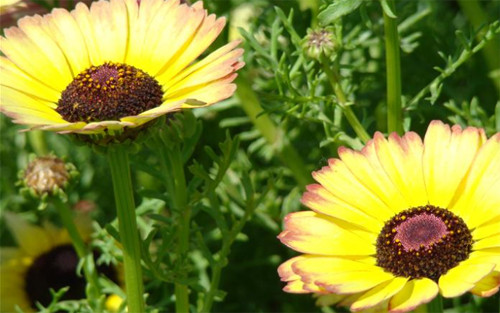
Planting methods for wreath chrysanthemum:
1. Temperature
The most suitable growing temperature for wreath chrysanthemum is 15~30°C. Its growing period requires a relatively high temperature, while the flowering period requires a slightly lower temperature (potted plants can be moved to a cooler place), which can extend the flowering period.
2. Light
Wreath chrysanthemum is a small flower that relatively likes sunlight, but it is also fairly shade-tolerant. When indoor potted plants do not get enough sunlight, lighting can be used to increase light.
3. Soil
The soil must be loose and well-drained. Sandy soil is best. For potted plants, peat soil + leaf mold + fine sand at 4:4:2 can be used.
4. Fertilizer
Whether planted in the ground or in pots, wreath chrysanthemum needs sufficient fertilizer.
At the initial stage of planting seedlings, base fertilizer should be applied. During the growing period, apply fermented organic fertilizer once every two weeks, such as soybean cake, sesame paste residue or chicken manure (fertilizer concentration 20%). A small amount of compound fertilizer can also be applied.
5. Watering
When potted, the potting soil should be kept “dry when it should be dry and wet when it should be wet.” In spring and summer, water once in the morning and once in the evening. It is best to use water that has been left to stand in the sun (tap water left to stand in the sun is best, or directly use rainwater). Generally do not water on cloudy and rainy days.
On ordinary days, spray clean water around the tricolor chrysanthemum 1~2 times to increase air humidity.
6. Propagation
It is usually propagated mostly by sowing, and can also be propagated by softwood cuttings. Sowing is generally done in September~October. Keep the potting soil slightly moist, cover with film, and provide a little light. During overwintering, a cattail mat must be added for covering.
Softwood cuttings can be done in a hotbed. The most suitable temperature is 25°C, and roots can form in 2 weeks. When the roots of the seedlings change from white to yellowish brown, transplant them.
In environments with high temperature, high humidity and poor ventilation, wreath chrysanthemum is prone to sooty mold and aphid damage, so indoor cultivation should control temperature and humidity, ventilate frequently, and outdoor cultivation should avoid planting in windless, stuffy spots.
Brief introduction to wreath chrysanthemum:
Also called tricolor chrysanthemum and garland chrysanthemum, in warm regions it is biennial, while in the north it is an annual herbaceous plant. (Flowering period April~June)
Although it needs to be planted once every year, it is so beautiful that it is still very worth planting several more times. The bright flower heads, various colored flower centers, and colorful corollas include red, pink, yellow, white, purple, and so on.
They grow relatively low, generally 60~90 cm tall, with thick, smooth stems and leaves. Leaves are alternate. The long-stalked flower heads extend high up. The ray florets come in colors such as white, yellow, orange-yellow, brown-yellow, pale red, deep red, rose red and lilac. The center part is red, white, yellow and brown-red, etc., forming two rings of color;
The center is yellow, green, red, or a mix of two colors, which is why it is called tricolor chrysanthemum. (Flowering period April~June)
Can wreath chrysanthemum be grown in an air-conditioned room?
It can be grown in an air-conditioned room, but it should not be kept in an air-conditioned room all the time. After a period of time, it still needs to be taken out for ventilation and sunlight. Only then will it not die.
Plumeria Plumeria rubra 'Acutifolia' Plumeria profile: How to grow plumeria / How to propagate plumeria
Plumeria profilePlumeria Plumeria rubra 'Acutifolia'
Plumeria cultivation methods and precautions Plumeria introduction
Plumeria, a deciduous small tree in the Apocynaceae family, also known as Burma frangipani, has pure white petals and a pale yellow center, very much like egg white wrapping egg yolk, hence its name. Every year between April and May, the dignified and elegant plumeria blooms one after another, with a rich fragrance that refreshes the heart. Its 5 petals overlap in a spiral, especially like the paper windmills children fold by hand. In fact, besides white plumeria, there are also red and yellow ones, all of which can be used to extract essence for making high-grade cosmetics, soap and food additives, at a rather high price and with great commercial development potential; the fresh flowers can also be dried for brewing tea, commonly known as plumeria tea, which has the effects of treating heat dysentery and moistening the lungs and detoxifying.
Aliases: Burma frangipani, egg-yolk flower, big season flower, Indian frangipani. In China's Xishuangbanna and some Southeast Asian countries, plumeria is designated by Buddhist temples as one of the "Five Trees and Six Flowers" and is widely planted, so it is also called "temple tree" or "pagoda tree." Its tree form is beautiful and oddly shaped, and the whole plant's stems contain milky sap. The branch tips of Burma frangipani are blunt and rounded. Once winter comes and the leaves all fall off, it looks bare like deer antlers, so Burma frangipani is also called "deer antler tree."
Morphological characteristics of plumeria
Deciduous shrub or small tree. Branchlets are thick, fleshy and succulent. Leaves are large, thickly papery, mostly clustered at the branch tips, with veins connected near the leaf margin into a marginal vein. Several flowers are clustered at the branch tips, with a tubular corolla about 5-6 cm in diameter, 5-lobed, milky white outside and bright yellow in the center, extremely fragrant. Flowering period May-October. Plumeria blooms in summer, with a delicate fragrance and elegance; after leaf fall, the bare trunk curves naturally, and its form is very beautiful. It is suitable for planting in courtyards and lawns, can also be potted, and can be used medicinally. The plumeria tree is beautiful in form, with many branches on the stem, oddly shaped and varied; the leaves resemble loquat leaves. After they fall in winter, semicircular leaf scars remain on the branch tips, quite like deer antlers dotted with beautiful spots, making it a top-choice small tree for tropical landscaping, courtyard arrangement and potted ornament. The bark is thin and grayish green, rich in toxic white sap, which can be used externally to treat scabies, redness and swelling, and other conditions. The wood is white, light and soft, and can be used to make musical instruments, tableware or furniture.
About 5 m tall, up to 8.2 m at most, DBH 15-20 cm; branches stout, fleshy, with abundant milky sap, green, hairless. Leaves thickly papery, oblong-obovate or oblong-elliptic, 20-40 cm long, 7-11 cm wide, apex shortly acuminate, base narrowly cuneate, dark green adaxially, light green abaxially, hairless on both surfaces; midvein sunken adaxially, slightly raised abaxially, lateral veins flat on both surfaces, 30-40 per side, anastomosing into a marginal vein before reaching the leaf margin; petiole 4-7.5 cm long, with glands at the base above, hairless. Cymes terminal, 16-25 cm long, about 15 cm wide, hairless; peduncle trichotomous, 11-18 cm long, fleshy, green; pedicel 2-2.7 cm long, pale red; calyx lobes small, ovate, apex rounded, about 1.5 mm long and wide, not spreading but pressed against the corolla tube; corolla white outside, the outside of the corolla tube and the left side of the outside of the lobes slightly with pale red markings, corolla yellow inside, 4-5 cm in diameter, corolla tube cylindrical, 1-1.2 cm long, about 4 mm in diameter, hairless outside, densely pubescent inside, throat without scales; corolla lobes broadly obovate, apex rounded, base overlapping to the left, 3-4 cm long, 2-2.5 cm wide; stamens inserted at the base of the corolla tube, filaments very short, anthers oblong, about 3 mm long; carpels 2, free, hairless, style short, stigma oblong, constricted in the middle, apex 2-lobed; each carpel with many ovules. Follicles paired, widely spreading, cylindrical, tapering toward the apex, about 11 cm long, about 1.5 cm in diameter, green, hairless; seeds obliquely oblong, flattened, 2 cm long, 1 cm wide, apex with a membranous wing, wing about 2 cm long. Flowering period May-October; fruiting period under cultivation very rarely sets fruit, generally July-December.
Ecological habits of plumeria
Plumeria is a strongly sun-loving flower. The more sufficient the sunlight, the more luxuriant its growth, and the more numerous and fragrant its flowers, so shading is not needed in summer. When maintained indoors in winter, it will suffer cold damage below 5°C, and below 8°C or with poor ventilation it easily drops leaves and enters a long dormant period. The following spring is when plumeria sprouts and grows leaves. Because it is a succulent plant, water should not be excessive, following the principles of not watering until dry, watering as soon as dry, watering thoroughly when watering, and never allowing waterlogging. Since plumeria likes calcareous soil, pay attention to calcium supplementation when fertilizing. Bone meal can be added, or decomposed calcium-rich organic fertilizer containing eggshells, fish bones, crushed bones, and so on can be applied.
It likes high temperature, high humidity, sufficient sunlight and well-drained environments. It is robust by nature and can tolerate drought, but fears cold and avoids waterlogging. It likes acidic soil, but is also resistant to alkalinity. For cultivation, deep, fertile, well-aerated, organic-rich acidic sandy loam is best. The suitable growing temperature is 23°C to 30°C. In summer it can tolerate extreme high temperatures of 40°C. When the temperature falls below 15°C, the plant begins to drop leaves and become dormant, until around April of the following year. In temperate zones, it easily drops leaves in winter. In southern China it can be planted in the ground and is also suitable for pots. In the Yangtze River basin and areas to its north, it can only be potted, at 80 cm to 150 cm tall. When flowering, it gives off a delicate fragrance.
Plumeria is deeply loved by people in many regions and countries. In Laos, plumeria is designated as the national flower and is highly revered; in the tropical tourist destination Hawaii, people like to string the picked plumeria into garlands as wearable decorations, so plumeria is also a holiday symbol of Hawaii; in China, plumeria is not only the city flower of Zhaoqing City, Guangdong Province, but also the best specialty dish used by the hospitable Dai people of Xishuangbanna to entertain guests.
Growth characteristics
The original species "red plumeria" (P. rubra Linn.) has bright red flowers and is relatively rare. Most are cultivated varieties. The 5-6 cm long flowers are white outside with a slight pale red tinge, and yellow at the base inside, usually described as "white crown, yellow center," shaped like egg white with egg yolk, hence the name. Every year in the August and September flowering season, it gives off a refreshing plumeria fragrance. Tourists who have visited the Seven Star Crags in Gaoyao County, Guangdong, can all taste a uniquely flavored drink - plumeria tea, which is actually tea brewed from dried plumeria flowers. The genus Plumeria has about 7 species. Plumeria is native to tropical America and is now widely planted in tropical regions. In some countries, it is often planted around temples, so it is also called "temple tree" or "pagoda tree." It is cultivated in many provinces in southern China, and plants of both flower colors exist. This tree rarely sets fruit, but cuttings root easily, so there is no need for seed propagation. Before 1778 AD, historical records already documented the cultivation of plumeria. Based on this, plumeria has had a history of several hundred years in China. This flower is brightly colored, quite like egg yolk, so it is also called plumeria or egg-yolk flower. Guangdong is in the subtropics, with long summers, short winters and sufficient sunlight, very suitable for the growth of plumeria. Therefore, plumeria is planted throughout Guangdong's urban and rural areas to green and beautify courtyards. Besides being used for garden ornament, the most important use of plumeria is brewing tea. Plumeria is yellow and pale purple in color, with a fleshy feel, elegant, plain and pure, very lovely. After picking plumeria from the tree, it can be brewed directly with boiling water, and drinking it is fragrant and smooth. Dried plumeria can be brewed into excellent tea.
Distribution area of plumeria
Origin distribution: native to Mexico in the Americas. It has been introduced and cultivated in China, with cultivation in Guangdong, Guangxi, Yunnan, Fujian and other provinces and regions, and in the mountains of southern Yunnan it has escaped and become wild. The Yangtze River basin and areas to its north require cultivation in greenhouses. Although the hometown of plumeria is far away in the region from Mexico to Venezuela in the Americas, its traces have now spread throughout tropical and subtropical regions of the world.
Variety classification of plumeria
There are two kinds of plumeria: white plumeria and red plumeria, the latter designated by Buddhist temples as one of the "Five Trees and Six Flowers." China has already introduced them and is cultivating them.
Functions, uses and application value of plumeria
Plumeria, a deciduous small tree in the Apocynaceae family, also known as Burma frangipani, has pure white petals and a pale yellow center, very much like egg white wrapping egg yolk, hence its name. Every year between April and May, the dignified and elegant plumeria blooms one after another, with a rich fragrance that refreshes the heart. Its 5 petals overlap in a spiral, especially like the paper windmills children fold by hand. In fact, besides white plumeria, there are also red and yellow ones, all of which can be used to extract essence for making high-grade cosmetics, soap and food additives, at a rather high price and with great commercial development potential; the fresh flowers can also be dried for brewing tea, commonly known as plumeria tea, which has the effects of treating heat dysentery and moistening the lungs and detoxifying. The plumeria tree is beautiful in form, with many branches on the stem, oddly shaped and varied; the leaves resemble loquat leaves. After they fall in winter, semicircular leaf scars remain on the branch tips, quite like deer antlers dotted with beautiful spots, making it a top-choice small tree for tropical landscaping, courtyard arrangement and potted ornament. The bark is thin and grayish green, rich in toxic white sap, which can be used externally to treat scabies, redness and swelling, and other conditions. The wood is white, light and soft, and can be used to make musical instruments, tableware or furniture.
Dietary therapy or medicinal value of plumeria
The medical information and health dietary therapy information on Huahua Net is for reference only and cannot be used as a basis for diagnosis or medical treatment. Any health problem should be consulted with professional medical personnel, and the treatment of any disease should follow medical advice.
Ultimate flower-protecting task: Love yourself, start from reality, and strictly follow medical advice. For illness, do not be careless, do not delay, do not give up hope, face it bravely, use love to warm the silent world, and use heart to care for the flower field within.
Both the flowers and bark of plumeria can be used medicinally, with the effects of clearing heat, detoxifying, treating dysentery, moistening the lungs, stopping cough and relieving asthma; the fresh flowers can be used to extract aromatic oil, used for blending cosmetics and high-grade soap. The flowers are fragrant and can be used to extract perfume, or dried for making beverages, and can also be used medicinally. Fresh flowers can be used to extract aromatic oil for blending cosmetics and high-grade soap, and dried flowers can be used to scent tea. Its flowers and bark can both be used medicinally, with the effects of clearing heat, detoxifying, treating dysentery, moistening the lungs and stopping cough.
1. Good edible value
Plumeria also has good edible value. Among them, drying plumeria and making plumeria flower tea is a very good leisure way to consume plumeria. Plumeria flower tea is one of the five major flower teas that Guangzhou people who love flower tea often drink during leisure after meals. It is very popular among Guangzhou friends. Plumeria tea has a light sweet taste and is very suitable for drinking in summer, with a good effect of relieving summer heat and reducing fever.
2. Very high medicinal value
After being dried in the sun, plumeria can be used as a Chinese medicinal herb. It has the effects of clearing heat and relieving summer heat, moistening the lungs and throat, and can also treat diseases such as sore throat. Plumeria is a Chinese medicinal herb with a slightly sweet and bitter taste. For treating summer heatstroke, dysentery commonly occurring in summer, abdominal pain and stomachache and other diseases, it can be used together with other Chinese medicinal herbs for treatment. It can also treat coughs after autumn turns cool, and has the effect of resolving phlegm and clearing the lungs.
Chinese medicinal properties and medicinal value
Plumeria has had a history of several hundred years in China. In Pinghu Street, Shenzhen, there is an ancient plumeria tree that has grown for more than 400 years. Both the flowers and bark of plumeria can be used medicinally. They can clear heat and detoxify, moisten the lungs and stop cough. In Guangdong, white plumeria is often dried to make herbal tea beverages, which are very popular. At the same time, the flowers can also be used to extract aromatic oil for blending cosmetics and high-grade soap. According to the latest reports, the sap of plumeria can treat a skin disease caused by HIV infection or anti-cancer drugs and electrotherapy.
Plumeria is one of the five flowers in Guangdong's famous herbal tea "five-flower tea." It is cool in nature and sweet and bland in taste; it enters the large intestine and stomach meridians, and has the effects of moistening the lungs and detoxifying, clearing heat and removing dampness, and loosening the bowels. For example, "Lingnan Collection of Medicinal Herbs" says it can "treat damp-heat dysentery, tenesmus, and can also moisten the lungs and detoxify."
[Medicinal name]: Plumeria
[Source]: The flowers of the Apocynaceae plant plumeria.
[Effects]: Clear heat and relieve summer heat, clear the intestines and stop diarrhea, stop cough and resolve phlegm.
[Indications]: Treats heatstroke, dysentery, abdominal pain, cough.
[Nature, flavor and meridian entry]: "Nanning City Drug Records": "Sweet, neutral, non-toxic." Enters the lung and large intestine meridians.
[Usage and dosage]: Internal use: decoct in water, 7.5~20 grams.
[Medication contraindications and precautions]: For all cases of summer dampness combined with cold, cold-damp diarrhea, and lung-cold cough, use with caution.
[Drug combinations]: With watermelon rind, clears heat and promotes fluid production; with purslane; clears and disinhibits heat in the qi aspect; with bamboo shavings, for lung-heat cough.
[Aliases]: Egg-yolk flower, Leichui flower ("Guangdong Chinese Medicine" II), big season flower ("Guangxi Medicinal Plant Directory"). Plumeria, also known as: Burma frangipani ("Illustrated Examination of Plant Names and Reality")
[Prescription names]: Plumeria, egg-yolk flower, Burma frangipani, big season flower.
[Distribution of animal and plant resources]: Distributed in Guangdong, Guangxi and other places.
[Collection and storage of medicinal materials]: Pick fully opened flowers in summer and autumn, and dry in the sun.
[Latin name]: Plumeria rubra L. Var. Acutifolia (Poir.) Bailey.
[Processing method]: After picking, dry in the sun.
[Textual research]: From "Lingnan Collection of Medicinal Herbs."
[Identification of raw medicinal materials]: Dried flowers, yellow-brown to brown, wrinkled, mainly 5 large spirally arranged petals. Petals obovate, about 3 cm long, about 1.5 cm wide; lower part united into a slender tube, about 1.5 cm long. Contains 5 stamens, filaments very short; sometimes small ovate ovaries can be seen. Odor mellow and fragrant, taste mild and slightly bitter. Those with clean flowers, dry, yellow-brown in color and aromatic in odor are better.
Milky sap: Contains lupeol and its acetate, etc.
[Effects]: Clear heat; promote diuresis; relieve summer heat
[Indications]: Common cold with fever; lung-heat cough; damp-heat jaundice; diarrhea and dysentery; urinary tract stones; preventing heatstroke.
[Discussions by various authors]:
1. "Lingnan Collection of Medicinal Herbs": Treats damp-heat dysentery, tenesmus, and can also moisten the lungs and detoxify.
2. "Nanning City Drug Records": Stops cough.
[Harvesting and storage]: Collect stem bark in summer and autumn, collect flowers when blooming, dry in the sun or use fresh.
[Medication contraindications]: For all cases of summer dampness combined with cold, cold-damp diarrhea, and lung-cold cough, use with caution.
[Effect classification]: Heat-clearing drugs; summer-heat-dispelling drugs
[Processing method]: After picking, dry in the sun.
[Identification of raw medicinal materials]: Traits identification: flowers mostly wrinkled into strips, or flat and triangular, pale brown-yellow or yellow-brown. After moistening and flattening, the calyx is relatively small. Corolla lobes 5, obovate, about 3 cm long, about 1.5 cm wide, arranged in a spiral; lower part united into a slender tube, about 1.5 cm long. Stamens 5, filaments very short. Sometimes ovate ovaries can be seen. Odor fragrant, taste slightly bitter. Those with complete flowers, yellow-brown color and aromatic odor are better.
[Identification of drug application]: Agastache and plumeria are important medicines for summer dampness. Agastache is slightly warm, awakens the spleen and refreshes the stomach, and has a good effect of transforming dampness and releasing the exterior; plumeria is clear and fragrant and slightly cool, clears the lungs and disinhibits the intestines, and strongly resolves phlegm and stops dysentery. For summer dampness combined with exterior patterns, Agastache is often used; for summer heat combined with dysentery, plumeria is commonly used.
[Nature and flavor]: Sweet; slightly bitter; cool in nature.
[Medicinal material source]: The flowers or stem bark of the Apocynaceae plant plumeria.
[Usage and dosage]:
Internal use: decoct in water, flowers 5~10 grams; stem bark 10~15 grams.
External use: appropriate amount, pound and apply.
[Source]: "Chinese Materia Medica"
(1) Preventing heatstroke: Plumeria 20 grams, decoct in water and take the liquid as tea.
(2) Treating bacillary dysentery: Plumeria 10 grams, kapok 30 grams, coptis 10 grams, phellodendron 10 grams, Chinese knotweed 30 grams, decoct in water, 1-2 doses per day.
(3) Treating acute bronchitis: Plumeria 10 grams, honeysuckle 30 grams, houttuynia 30 grams, add 800 milliliters of water, decoct to 200 milliliters, take in 2 divided doses.
(4) Treating acute infectious hepatitis: Plumeria 10 grams, yinchen 30 grams, qinpi 9 grams, rhubarb 12 grams, decoct in water, 1-2 doses per day.
(5) Treating indigestion: Plumeria 20 grams, coptis 10 grams, Chinese knotweed 30 grams, plantain herb 15 grams, decoct in water, 2-3 doses per day.
(6) Treating common cold with fever: Plumeria 20 grams, chrysanthemum 10 grams, honeysuckle 10 grams, mint 6 grams (added later), add 350 milliliters of water, decoct to 150 milliliters, take in 2 divided doses.
(7) Treating children's food accumulation with loss of appetite and diarrhea: Plumeria 9 grams, malt 20 grams, medicated leaven 10 grams, microcos leaf 9 grams, decoct in water, 2 doses per day.
(8) Treating dysentery and summer diarrhea: Plumeria 20-40 grams, decoct in water, 1 dose per day.
(9) Treating lung-heat cough: Plumeria 3-12 grams, decoct in water, 1 dose per day.
Modern research chemical composition
The bark contains α-amyrin, β-amyrin, β-sitosterol, plumieride, scopoletin, etc. The root contains iridoid compounds: 13-O-caffeoylplumieride, 13-deoxyplumieride, β-dihydroplumericinic acid glucosyl ester, 1α-plumieride, la-protoplumericin A, 8-isoplumieride.
Flowers: Contain plumieric acid, glycosides and volatile oil. Stem bark: Contains plumieride (C21H26O12).
Root: Contains plumericin, isoplumericin, brown plumericin, B-dihydroplumericin, B-dihydroplumeric acid.
Leaves: Contain flavonoid glycosides: kaempferol glucoside, quercetin glucoside.
Pharmacological effects
Antibacterial components such as plumericin isolated from the roots of Egyptian red plumeria (Plumeria rubra) and pink plumeria (P. rubra var. alba) have strong antifungal effects and obvious inhibitory effects on Gram-positive and Gram-negative bacteria as well as tuberculosis. Plumieride also has significant inhibitory effects on Gram-negative and Gram-positive bacteria.
In addition, plumieride also has an obvious laxative effect. The ED50 for laxation in mice is 0.12 g/kg. Patients taking 0.2-0.3 g before bed can have 1-2 bowel movements the next morning. Doses greater than 0.3 g also have a diuretic effect. Aqueous extracts of the stems, bark, leaves and peeled stems of red plumeria have local anesthetic and antispasmodic effects on rabbits, guinea pigs, cats and mice.
Garden use of plumeria: excellent ornamental value
From the flower name plumeria, we can guess its flower shape. Plumeria has thick small branches and leaves. Its flower shape is a corolla-like flower composed of 5 to 6 petals. The outer ring of the flower is pure white, and the inner ring shows the color of egg yolk, so the whole plumeria flower resembles an egg, hence the name. From the familiar dazzling array of colors to the lovely plumeria, it blooms brilliantly in summer, giving people a feeling of purity and elegant temperament, and is very suitable for careful appreciation.
Plumeria is the most beautiful flowering succulent in tropical regions. In tropical areas, its planted height can reach 4~5 m. It is an important garden plant. In the north it can only be grown in pots for ornament, usually below 2 m. When cultivated in a greenhouse, plumeria will drop its leaves in winter, which is a manifestation of its poor cold tolerance. However, after leaf fall, the bare trunk curves naturally like a bonsai and also has strong ornamental value.
Garden application
The flowers are white with a yellow center and fragrant, the leaves are large and dark green, and the crown is beautiful, so it is often planted for ornament. In Guangdong and Guangxi, people often collect its flowers, dry them in the sun and brew them as tea. It treats damp-heat dysentery and has the effects of detoxifying and moistening the lungs. Propagation methods include cuttings or layering, and they root very easily.
In gardens and courtyards, the plant height is 3 m to 5 m. The trunk is not very straight and often somewhat twisted and tilted. The branches are fleshy and thick, and young branches are slightly purplish, with branch forks long and short, like deer antlers. Leaves are alternate, thickly papery, oblong or oblong-elliptic, 20 cm to 30 cm long, 7 cm to 10 cm wide, sparsely gathered on the upper part of the branches. In summer and autumn (May to October), cymes grow from the branch tips, with several to more than ten flowers, as if flowers and colored knots were tied on deer antlers, quite interesting. The flower buds are pale red. The lower part of the corolla is tubular, and the upper part is 5-lobed. The lobes are obovate, overlapping to the left. The outside of the corolla is white with a slight reddish tinge, and fully red ones are relatively few, while the inner base is yellow. "White crown and yellow center" resembles egg white wrapping egg yolk, hence the name plumeria, also known as Burma frangipani. It is an evergreen plant in the Apocynaceae family, genus Plumeria.
Propagation methods of plumeria: grafting propagation
Red plumeria is the original species of yellow-white plumeria. The common yellow-white plumeria is actually a variety of red plumeria. Red plumeria should be able to set fruit in Hainan. Its fruit is a follicle, long-horned, purplish red, and the seeds have cilia. Sowing and raising seedlings grow relatively quickly, and one-year-old seedlings can reach 50 to 60 cm in height.
As for the method of using yellow-white plumeria as rootstock to graft and propagate red plumeria, it should be feasible. Cut grafting, cleft grafting or side grafting should be used. The problem is that more milky sap flows out from the cut wound, which will affect the survival rate of grafting to varying degrees. You can refer to the grafting methods for succulent plants such as banyan and desert rose. The time can be arranged in March to April or October. When grafting, the knife should be operated quickly, completing the cut surface in one cut, and striving to complete the alignment of the cambium between the cut surfaces of the rootstock and scion before a large amount of milky sap flows out; if more milky sap seeps from the cut surface, quickly wipe it away with a clean gauze or paper, then immediately join the rootstock and scion cuts, then tie the joint with a strip, add a plastic bag to keep moisture, and place it in half shade. After the scion survives, remove the bag, untie the binding strip, and give it normal water and fertilizer management.
Cultivation techniques of plumeria
Frangipani (Plumeria) prefers a hot and humid climate, tolerates drought, and likes to grow in limestone rocky areas; it roots very easily from cuttings. Generally, in mid-to-late May, cut branches 20-30 cm long from the base of a branch. White milky sap will flow from the cut, so the cuttings need to be placed in a cool, ventilated place for 2-3 days to let the wound form a protective film before planting; cuttings with milky sap are prone to rot. Insert them into clean vermiculite, a sand bed, or a shallow sand pot, then spray with water and place them indoors or under a shade shed outdoors, spraying water once every other day to keep the medium moist. After 15-20 days, move them to a semi-shaded place to receive weak light; they will root in 30-35 days and can be potted in 45 days. After the small cuttings have rooted and survived, transplant them promptly into pots with a diameter of 20 cm. Frangipani is not demanding about soil and is best planted in loose soil rich in humus. When planting, the roots can be slightly exposed when potting; after planting, place it indoors, expose it to weak light after 1 week, and after another half month it can be placed in a sunny spot. Frangipani grows rapidly and needs repotting once every spring, generally into a flowerpot with a diameter of 30 cm. The potting soil can be mixed from 4 parts garden soil, 4 parts horse manure soil, and 2 parts river sand, with an additional 100 g of cake fertilizer or sauce residue and 50 g of superphosphate or bone meal per pot. After repotting, water thoroughly, and move it outdoors to a sunny place around Grain Rain.
Frangipani prefers a warm, humid, sunny growing environment. In summer it does not need shading and can be placed outdoors in full sun. Summer and autumn are the periods when frangipani grows and blooms. Water it 1-2 times every evening; if it rains in summer or autumn, promptly pour out any accumulated water in the pot. From June to November, apply decomposed liquid fertilizer once every 10 days or so at a concentration of 15%. In the south, frangipani is planted in the open ground, drops its leaves in winter, and grows new leaves again the following spring. In the north, potted plants should be moved indoors to a south-facing window in mid-to-late October, taking care to provide ventilation and light. Room temperature should be above 10°C; low temperatures and poor indoor ventilation will cause the plant to drop its leaves. When indoors, water once every two weeks.
Cultivation methods: potting soil
Potted frangipani is best grown in a permeable clay pot. If using a plastic pot, place a layer of broken bricks and tiles or crushed hard plastic foam blocks at the bottom to improve air and water drainage. Its root system is relatively developed and it grows quickly. Small seedlings can be planted in a medium pot with an inner diameter of 20 cm, and as the plant grows, it can be moved into a pot one size larger. It is not very demanding about soil, and grows best in loose, fertile sandy loam. For home potting, use equal parts leaf mold and garden topsoil mixed together, then add a small amount of sand. Repot and change the soil once every spring before budding.
Water and fertilizer
Frangipani likes moisture and also tolerates drought, but is afraid of waterlogging. Therefore, watering should be moderate, following the principle of not watering when dry, watering as soon as it dries, watering thoroughly when watering, and not allowing waterlogging. In spring and autumn, water once every 1 to 2 days when the soil is dry. On sunny days in summer, water once every morning, and in the evening water again if the soil is dry. During the rainy season, be sure to pour out accumulated water in the pot to prevent root rot. In winter, water once every ten days to half a month, keeping the potting soil slightly moist but not dry. It likes fertilizer. When potting or repotting and changing soil, add 20 g to 30 g of bone meal and 50 g to 80 g of superphosphate to the growing soil (because it likes to grow in calcareous soil, attention should be paid to calcium supplementation). From May to October, apply a light, thin decomposed organic fertilizer or a nitrogen-phosphorus-potassium compound fertilizer once every 10 to 15 days. Avoid applying nitrogen fertilizer alone to prevent excessive vegetative growth. Do not fertilize in winter.
Light and temperature
Frangipani is a strongly sun-loving flower. The more sufficient the sunlight, the more luxuriant its growth and the more numerous and fragrant its flowers. Except that after potting or repotting and changing soil it needs shade for 7 to 10 days, at other times it should be placed in a sunny place. Because it originates from tropical America, it is not cold-tolerant. In temperate zones, leaf drop in winter is a manifestation of its poor cold tolerance, so it should be moved indoors for the winter. Before the minimum temperature drops to 10°C, move it indoors and place it in a sunny place, maintaining room temperature at 10°C to 15°C. Keeping it away from television radiation and air-conditioning warm air can prevent leaf drop, but if it is below 8°C or ventilation is poor, it will also drop leaves. As long as it stays above 5°C, it will not freeze to death, and it will sprout and grow leaves the following spring.
Propagation
Frangipani grown in temperate zones generally does not set seed, so cutting propagation is used. From late May to early June, cut branches about 20 cm long from the branching point as cuttings. White milky sap will flow from the cut. If planted without treatment, the cuttings are prone to rot. They can be placed in a well-ventilated, cool place, and after 2 to 3 days, once a protective film has formed at the wound, plant them, or dip the wound in plant ash or sulfur powder, and after it dries slightly, insert it into vermiculite or a plain sand pot. Place it in a well-ventilated shaded place and frequently spray the cuttings with water to maintain moisture. After 20 days, move it to a semi-shaded place where it can receive sun in the morning or evening. It can root in 30 to 40 days, with a high survival rate, and can be potted in autumn or the following spring.
Cultivation points
① It likes light and tolerates slight shade, is not cold-tolerant, and is easy to manage, but its branches are brittle and break easily. Therefore, choose well-drained, sunny, wind-protected, fertile sandy loam.
② After planting, water thoroughly and place it in a sunny place for cultivation and care to encourage flower bud formation.
③ During the growing season, keep the potting soil moist; in winter, pay attention to controlling water; in summer, spray water on the branches and leaves.
④ After the weather warms up in spring, apply a compound fertilizer once every 10-15 days until flowering.
⑤ Before winter begins, move it indoors to a sunny place, and keep the room temperature above 5°C so it can overwinter safely.
Pest and disease control of frangipani. 1. Frangipani angular leaf spot
1. Main symptoms: occurs on leaves. In the early stage, the spots are small brown spots; after expansion, the spots become polygonal to irregular, with dark black edges and dark brown centers; in the later stage, the spots dry up, and black granular substances appear on the spots in humid environments.
2. Cause of disease: a fungal disease. The pathogenic bacteria survive in the growing medium and on diseased plant residues. It occurs most often in spring, can cause repeated infection and damage indoors, and is more severe from July to August.
3. Control methods:
(1) Strengthen maintenance, repot promptly to renew the medium, increase the application of phosphorus and potassium fertilizers, and improve plant vigor.
(2) In early spring, spray 0.5% Bordeaux mixture, or 70% mancozeb wettable powder at 400 times dilution, or carbendazim at 600 times dilution once every 7-10 days.
2. Red spider mite
Control by spraying 100-200 times dilution of diesel oil emulsion.
3. Powdery mildew
A fungal disease that harms frangipani in environments with high temperature, poor ventilation, and relatively high humidity. A white powdery phenomenon appears on young leaves.
Control: Spray 50% thiophanate-methyl and sulfur suspension concentrate at 800 times dilution, or 20% triadimefon emulsifiable concentrate at 2500 times dilution, once every 10 days, for 2 to 3 consecutive times.
4. Scale insects
Can be controlled by spraying 25% buprofezin wettable powder at 2000 times dilution.
5. Rust disease
Orange-yellow pustules appear on the underside of leaves, with corresponding small light-yellow disease spots on the leaf surface.
Control: 25% triadimefon at 1500 to 2000 times dilution can be used.
Cultural background and related knowledge of frangipani
There are about 7 species worldwide. Native to the West Indies and the Americas, it is now found throughout tropical and subtropical regions of the world. In China, cultivars such as red frangipani and frangipani have been introduced and cultivated. Cultivation is common in Fujian, Guangdong, Guangxi, Yunnan, and Hainan.
National flower and city flower: It is the national flower of Laos. It is the city flower of Zhaoqing, Guangdong. One type is called yellow frangipani because its flower center is egg-yolk yellow; in Hawaii, people like to string yellow frangipani into garlands to present to distinguished guests. Another type is called red frangipani because its flowers are red. The flowering period of frangipani is from May to October. It has no mysterious legend, no elegant temperament, no noble graceful posture, yet it has a very simple appearance -- five petals form a fresh, hopeful flower meaning. It is as simple and ordinary as life, so it can always be so close to people, without distance...
Cultural symbolism
Uses: In Xishuangbanna, China, and some Southeast Asian countries, frangipani is designated by Buddhist temples as one of the "Five Trees and Six Flowers" and is widely planted, so it is also called the "temple tree" or "pagoda tree." Frangipani is the best specialty dish used by the hospitable Dai people of Xishuangbanna to entertain guests.
The flowers are fragrant and can be used to extract fragrance, or dried for making beverages and for medicinal use, with the effect of removing dampness. The wood is white, light, and soft, and can be used to make musical instruments, tableware, or furniture.
Title: It is the national flower of Laos. It is the city flower of Zhaoqing, Guangdong.
Frangipani flower meaning: nurturing hope, resurrection, rebirth. Frangipani flowering period is from May to October. It has no mysterious legend, no elegant temperament, no noble graceful posture, yet it has a very simple appearance --- five petals form a fresh, hopeful flower meaning. It is as simple and ordinary as life, so it can always be so close to people, without distance.
A Japanese delicacy name
Ingredients: 4 eggs, white vinegar, salt, a little black pepper, 2 tablespoons mayonnaise.
Instructions:
1. Put clean water in a pot and heat over high heat until boiling, add the eggs, reduce to medium heat, and cook for 10 minutes. (You can add a little vinegar, which helps the yolk solidify.) After cooking, remove and cool.
2. Peel the eggs and cut them in half, scoop out the yolks with a small spoon, and put them in a bowl.
3. Mash the scooped-out yolks, add white vinegar, salt, black pepper, and mayonnaise, mix well, then put the mixed yolk back into the egg white halves.
The flower meaning of frangipani
Nurturing hope, resurrection, rebirth. Frangipani flowering period is from May to October. It has no mysterious legend, no elegant temperament, no noble graceful posture, yet it has a very simple appearance --- five petals form a fresh, hopeful flower meaning. It is as simple and ordinary as life, so it can always be so close to people, without distance.
Frangipani pictures