A Detailed Guide to Lupine Planting Methods and Propagation Techniques
When we talk about lupines, that brings back childhood memories, and we think of the glittering tears of lupines. There really is such a plant as the lupine, and its blooms are like flower spikes, very long, and extremely beautiful. So let us take a look at what the cultivation method for lupines is like. How do you propagate them?
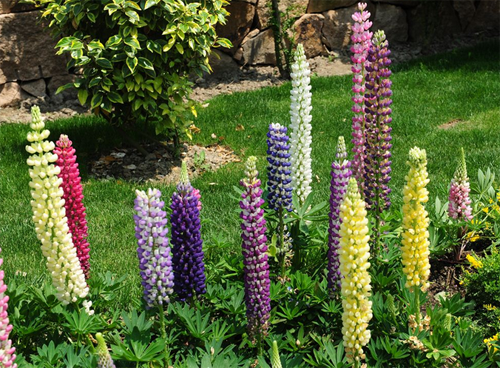
Lupine planting methods:
Lupines are relatively cold-tolerant (above -5°C), prefer a cool climate and a spot with ample sunlight, dislike heat, tolerate slight shade, and need fertile, well-drained sandy soil. They have a well-developed taproot and few fibrous roots, and do not tolerate transplanting.
They have a well-developed root system and are drought-tolerant, best suited to sandy soil, and also have a relatively strong ability to use the sparingly soluble phosphorus in phosphates.
They can still grow in rainy, flood-prone areas and in acidic soils where other plants struggle to grow; however, they grow poorly in calcareous soil or poorly drained spots. They can endure temperatures of 0°C, but freeze to death when the temperature drops below -4°C; intense summer heat also inhibits their growth.
Lupine propagation methods:
They are sowing and cuttings respectively
Propagation by sowing
It is carried out in autumn, and germination is uniform at high temperatures of 21-30°C. In lupine production, propagation is mostly by sowing, and both spring and autumn sowing are possible, with spring sowing in March; however, after spring sowing the growing period coincides with summer, and the effects of high heat can cause some varieties not to bloom or to have a low proportion of blooming plants and short flower spikes, resulting in a poor ornamental effect.
Under natural conditions, autumn sowing blooms earlier and grows better than spring sowing. Sow from early September to mid-October, and the flowering period is April to June of the following year. Sow in 72-cell or 128-cell plug trays, one seed per cell, and cover. The seedling soil should be loose and uniform, air-permeable and water-retentive; specialized seedling soil, or a mix of peat and perlite, is best.
Lupine seeds are relatively large, either plain or coated, at about 40 seeds per gram. The optimal germination temperature is around 25°C; keep the medium moist, and the seeds will emerge and germinate in 7-10 days, with a high germination rate. (I have tested this personally: before planting, it is best to rub the seeds together with sand, because the seeds are fairly hard and do not sprout easily; after rubbing, the seeds can break through the soil and emerge faster.)
Propagation by cuttings
In spring, cut shoots sprouting from the root crown into 8-10cm pieces, preferably with a bit of the root crown attached, and insert them in a cold frame.
In hot, rainy summer regions, lupines often cannot survive the summer and die, so they can be grown as biennials; plant them in the growing site in early spring, with a spacing of 40cm. Early planting means early establishment, and they bloom and set seed earlier.
After setting seed and before summer arrives, the above-ground part withers, and new plants sprout again in autumn, or the seeds can be harvested before withering. In North China, they need protection to overwinter.
Lupine alias: Lupinus.
There really is a plant with such a lovely name. Do you have the urge to plant one, to recall your childhood every day and keep a childlike heart?
The Complete Guide to Lupine Propagation Methods, How to Grow Lupines
Floral Bonsai Network introduction: Today the editors of Floral Bonsai Network will share with you an article on the complete guide to lupine propagation methods and how to grow lupines. Flower lovers, let us take a look together.
Lupinus, also known as lupine, is a genus in the Fabaceae family, mainly distributed in western North America, South America, the Mediterranean region, and Africa. Most plants in this genus are perennial herbaceous plants, about 0.3 to 1.5 m tall; there are also a few annual plants, and some are shrubs that can grow to heights of more than 3 m. Like many other legumes, lupines also participate in nitrogen fixation.
Friends who love flowers and plants all enjoy propagating them at home, but they do not have an in-depth understanding of lupine propagation methods. Below, the editor will introduce lupine propagation methods to you.
Lupine sowing methods
Method
In everyday practice, lupines are mostly propagated by sowing, either in spring or autumn, and the growth of lupines differs slightly depending on the sowing time. When sown in March, the growing period after sowing falls in midsummer, and under high-temperature conditions the growth of lupine seedlings is inhibited, which may cause some varieties not to bloom, or even to bloom sparsely with short flower spikes, affecting the ornamental effect.
Autumn sowing is better than spring sowing. Generally sow from September to October, and they will bloom from April to June of the following year. Plug trays are mostly used for sowing, one seed per cell, with loose, uniform, water-retentive, air-permeable soil for raising the seedlings.
Precautions
Lupine seeds are relatively large. To ensure the germination rate, it is best to soak them in warm water before sowing. After sowing, keep the temperature at 25°C, and they will germinate in 7-10 days.
Lupine cutting methods
Time
The best time for lupine cuttings is spring, when the flower stems have not yet emerged and the plant has ample nutrients. Do not do it in late spring, to avoid rising temperatures causing the branches to rot.
Method
In spring, cut newly sprouted shoots from the root crown, 8-10 cm long, preferably with a little of the root crown attached (this step can be combined with repotting), and insert the shoots directly into relatively cool sandy soil. Control the temperature appropriately; during hot, rainy summers, pay attention to ventilation and dryness, otherwise even if the shoots take root they will die.
How to grow lupines
Lupine is also called "Lupinus." It is an annual herbaceous plant in the Fabaceae family, native to the Mediterranean.
Lupines like a cool, well-lit environment, tolerate shade, and have a relatively well-developed root system, making them very easy flowering plants to grow.So how do you grow lupines, and what methods are there? Below, Gardener Uncle introduces the cultivation methods and precautions for lupines.
1. Soil selection:Lupines like a cool, well-lit environment, tolerate shade, and have a relatively well-developed root system. They are easy to plant in loose, fertile, well-drained acidic sandy loam.
2. Sowing time:Lupines are mostly propagated by seed, and can be sown in spring or autumn, but if sown in spring, the plant enters its peak growing period in summer, and the intense heat affects growth, causing fewer blooms and shorter flower spikes, which affects the ornamental effect. Under natural conditions, autumn sowing blooms earlier and grows better, and they will bloom in April and June of the following year.
3. Flower pot selection:Lupine seedlings take one month to become established plants. They have well-developed root systems, so when transplanting, be careful to retain the original soil to help them recover after transplanting. If growing them in pots, choose deep pots to accommodate root growth.
4. Daily management:For potted lupines, be careful to prune away spent flowers and dead leaves, control fertilizer and water well, and provide shade to ensure the lupines safely pass the summer.
Precautions for lupines:
1. Lupines are perennial plants and they themselves like cool temperatures. During the high-temperature summer season, pay attention to shading and avoid high temperature and high humidity causing the leaves to turn yellow and drop.
2. For autumn-sown seedlings, take good cold-protection measures during overwintering, keeping the temperature above 5°C to avoid frost damage to the leaves.
Lupine cultivation techniquesPrecautions
The lupine seedling stage is 30-35 days; transplant and divide the seedlings after the true leaves have fully unfolded. Lupines have well-developed root systems, so retain the original soil when transplanting to help them recover. Before final planting, they should be repotted 1-2 times depending on their growth, and it is best to choose tall bucket-shaped pots to meet the growth needs of the taproot system, and to determine a reasonable planting and placement density. For autumn-sown plantings, corresponding cold-protection measures should be taken during overwintering, with the temperature preferably above 5°C, to avoid frost damage to the leaves that would affect the early vegetative growth and ornamental effect.
Lupines like cool conditions, and since they are also perennials, special attention should be paid to their management during high summer temperatures, to prevent high temperature and excessive moisture and scorching sunlight from causing yellowing leaves, stunted plant growth, or even death.
In landscape applications, blooming lupines can also be planted directly among trees in woodland or in cool, ventilated spots to make summer management easier. After enjoying them as potted plants, promptly prune away the remaining flower spikes and dead old leaves, control fertilizer and water, and do a good job of shade protection during the high-temperature period to ensure they safely pass the summer.
Lupine disease control
The leaf spot disease of lupines has spots that are brown to black, harming the growth of leaves and stems and causing early death of the leaves. It can be sprayed with carbendazim wettable powder at 1500 times dilution, with good results.
Symptoms: The disease occurs on the leaves, first producing small brown spots, which later form lesions 5-14 mm in diameter. The lesions merge into irregular brown patches, and the tissue dies. It mostly occurs in summer and autumn. The petioles, stems, and sometimes the petals can also be affected.
The pathogen is Ceratophorum setosum Kirchner; the conidia are round or spindle-shaped, with 4-5 septa, constricted at the septa, with the cells at both ends lighter in color and the middle cells darker, measuring 64-80 x 16-16.5 micrometers. The transmission route is overwintering in the affected stems and leaves and in infected seeds.
Powdery mildew
The pathogen of lupine powdery mildew is Erysiphe polygoni (DC.)
Symptoms: In the early stage of the disease, small white powdery spots appear on the leaves. When temperature and humidity are suitable, the lesions rapidly expand, even spreading to the leaves of the whole plant. In severe cases, the leaves are covered by white mycelium, and later there are yellow-brown to black dots (fruiting bodies). The affected leaf areas thicken, and withered flowers become deformed and yellow.
Pathogen and occurrence pattern: The pathogen is Erysiphe polygoni and others. It overwinters on diseased plant residues. The following year in April-May, as temperatures rise, it produces conidia, which spread by air currents and wind and rain, and the spores can infect repeatedly. The disease can occur from April to October. When flowers are brought into greenhouses or rooms in October, the pathogen can also enter along with them, and under suitable conditions it can also cause disease indoors and become the infection source for outdoor disease the following year.
Control methods
(1) Cultivation management
Be careful to prune away overly dense and withered yellow branches to improve ventilation and light penetration; the temperature in the greenhouse in winter must not be too low; plant in sandy soil with good drainage; fertilize reasonably to enhance growth vigor and improve disease resistance.
(2) Eliminate the source of inoculum
When the disease is mild, promptly remove diseased leaves. When entering and leaving greenhouses and buildings, inspect strictly, and burn any diseased leaves found in time to avoid them becoming a source of infection.
(3) Chemical control
In the early stage of the disease, spray with agricultural antibiotic 120 or antibacterial BO-10 emulsion at 100 times dilution, or 50% Kasugamycin-copper wettable powder or 75% tridemorph emulsion at 1000 times dilution, once every 10 days; several consecutive sprays can control the occurrence and spread of the disease. It is especially effective against powdery mildew that is resistant to thiophanate-methyl and triadimefon. For some new pesticide products, refer to the instructions in detail or conduct a small trial of control first, then use them on a large scale.
Rust
The pathogen of lupine rust is Uromyces lupinicola Bubak, which mostly produces rust-brown powdery spore masses on the underside of the leaves. The uredinia mainly form on the upper side of the leaves, oval, arranged in lines, pale brown, with paraphyses. The urediniospores are oval, single-celled, pale brown, finely spiny, with 8-10 scattered germ pores, measuring 19-26 micrometers x 21-32 micrometers. The telia mainly form on the underside of the leaves, elongated, arranged in long lines, not breaking through the epidermis, with dark paraphyses. The teliospores are long club-shaped, two-celled, truncate or conical at the upper end, narrower at the lower end, chestnut brown, measuring 18-34 micrometers x 35-64 micrometers, with a short, colored stalk.
Basal rot
Symptoms: The pathogen mainly infects the root crown of seedlings, causing the affected area to turn black or constrict, and when moist, white mold-like growth appears on it. After the plant is infected, the leaves wilt and dry up within a few days, and then the whole plant dies. The pathogen Rhizoctonia solani Kuhn is called sheath blight, a fungus of the Deuteromycotina.
Transmission route: It mainly overwinters as mycelium or sclerotia in the soil or in diseased plant residues. The mycelium in the soil lives saprophytically and does not go dormant. It has been reported that in the absence of a host, the mycelium can survive saprophytically for more than 140 days. Because this fungus has a wide host range and mainly spreads by contact, that is, when the roots, stems, and leaves of a plant contact diseased soil, they are infected by the mycelium in the soil; under conditions with a water film, healthy leaves in contact with diseased parts become infected. In addition, seeds, farm tools, and contaminated compost can all spread and expand the disease.
Lupine planting methods
[Flower cultivation] Lupine, also called Lupinus, is a perennial herbaceous flower native to the Mediterranean region. It is now cultivated in China, mainly for horticultural cultivation. Below, let us look together with the editor at lupine planting methods:
Image: Lupine
[Expert answer]
●Sowing
Lupines are propagated by sowing, and both spring and autumn sowing are possible, with spring sowing in March; however, after spring sowing the growing period coincides with summer, and the effects of high heat can cause some varieties not to bloom or to have a low proportion of blooming plants and short flower spikes, resulting in a poor ornamental effect. Under natural conditions, autumn sowing blooms earlier and grows better than spring sowing. Sow from early September to mid-October, and the flowering period is April to June of the following year. Sow in 72-cell or 128-cell plug trays, one seed per cell, and cover. The seedling soil should be loose and uniform, air-permeable and water-retentive; specialized seedling soil, or a mix of peat and perlite, is best. Lupine seeds are relatively large, either plain or coated, at about 40 seeds per gram. The optimal germination temperature is around 25°C; keep the medium moist, and the seeds will emerge and germinate in 7-10 days, with a high germination rate.
●Transplanting
The lupine seedling stage is 30-35 days; transplant and divide the seedlings after the true leaves have fully unfolded. Lupines have well-developed root systems, so retain the original soil when transplanting to help them recover.
●Soil
According to the growth habits of lupines, controlling and adjusting the pH of the growing medium during cultivation is crucial for the normal growth and flowering of lupines. Generally, a relatively simple and effective adjustment method is to apply sulfur powder to the growing medium. Because sulfur needs a certain amount of time to decompose in the medium (about 40 days or more) before it takes effect, it should be applied as early as possible.
Generally, begin after transplanting when 2-3 true leaves appear, with the application rate depending on the original pH of the growing medium.
In addition, although acidic fertilizers such as ferrous sulfate and aluminum sulfate can lower the pH in the short term, excessively high salt ion concentrations can poison plant roots, so they should be used less in production.
●Repotting
Before final planting, they should be repotted 1-2 times depending on their growth, and it is best to choose tall bucket-shaped pots to meet the growth needs of the taproot system, and to determine a reasonable planting and placement density. For autumn-sown plantings, corresponding cold-protection measures should be taken during overwintering, with the temperature preferably above 5°C, to avoid frost damage to the leaves that would affect the early vegetative growth and ornamental effect.
●Disease control
The leaf spot disease of lupines has spots that are brown to black, harming the growth of leaves and stems and causing early death of the leaves. It can be sprayed with carbendazim wettable powder at 1500 times dilution, with good results. Symptoms: The disease occurs on the leaves, first producing small brown spots, which later form lesions 5-14 mm in diameter. The lesions merge into irregular brown patches, and the tissue dies. It mostly occurs in summer and autumn. The petioles, stems, and sometimes the petals can also be affected. The pathogen is Ceratophorum setosum Kirchner; the conidia are round or spindle-shaped, with 4-5 septa, constricted at the septa, with the cells at both ends lighter in color and the middle cells darker, measuring 64-80×16-16.5 micrometers. The transmission route is overwintering in the affected stems and leaves and in infected seeds.
●Precautions
Lupines like cool conditions, and since they are also perennials, special attention should be paid to their management during high summer temperatures, to prevent high temperature and excessive moisture and scorching sunlight from causing yellowing leaves, stunted plant growth, or even death.
In landscape applications, blooming lupines can also be planted directly among trees in woodland or in cool, ventilated spots to make summer management easier. After enjoying them as potted plants, promptly prune away the remaining flower spikes and dead old leaves, control fertilizer and water, and do a good job of shade protection during the high-temperature period to ensure they safely pass the summer.
[Editor's summary]
Lupines look like upside-down wisteria flowers, with slender inflorescences made up of hundreds of small flowers. Combined with their rich colors and refreshing fragrance, they are often used in horticultural planting. The editors of First Agricultural Economics have introduced lupine planting methods to you from multiple aspects in this article, and hope it is helpful to you.