Scarlet Sage Potted Planting and Cutting Propagation Methods
The scarlet sage plant blooms in strings, not one flower at a time, which is how it got its name. So what are the cultivation methods for scarlet sage? You should still keep an auspicious plant at home:
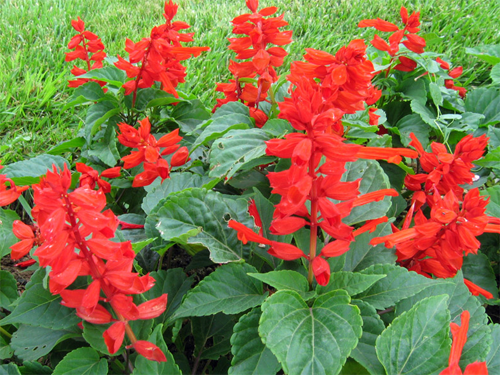
When scarlet sage seedlings grow 3 to 4 pairs of true leaves, they should be pinched, and each plant should have at least 4 side branches. When color shows at the branch tips, move them to the flower bed.
If phosphorus fertilizer is applied before flowering, the blooms will be especially fine. The calyx of scarlet sage fades over time but does not fall. When used for ornamental display, spent flowers can be removed at any time, which is what makes it look good.
1. Watering
To prevent leggy growth, water less, loosen the soil frequently, and apply topdressing.
2. Temperature and Light
The optimum growing temperature is 15-30°C. Below 12°C, growth stalls, leaves turn yellow and drop, and flowers gradually fall off.
Proper Pinching
During the growing period, pinch and shape the plant regularly to control plant height and branching, and to encourage long, plump flower spikes and neat flowering.
Those sown in spring bloom profusely from September to October. Old plants overwintered in a greenhouse also bloom from May to June, but not as abundantly as in summer and autumn. Summer is too hot; although its branches and leaves grow vigorously, flowers are sparse, so a bit of warmth is better.
Scarlet sage seeds fall easily. If autumn turns cool too quickly, the seeds cannot fully mature, making them difficult to harvest.
Scarlet Sage Seed Propagation Method:
Generally sow from March to June. The seeds are relatively large, and the optimum germination temperature is 21-23°C. They germinate 15-18 days after sowing.
Below 20°C, germination vigor drops noticeably.
After sowing scarlet sage, no soil covering is needed. Lightweight vermiculite can be scattered around the seeds, which neither affects light penetration nor fails to retain moisture. It can increase the germination rate and uniformity. It germinates very easily, unless you bought fake seeds.
Scarlet Sage Potted Cutting Method:
Keep a potted scarlet sage growing, and the next year cut new branches for cuttings; they root very easily.
In a warm bed above 15°C, cuttings can be taken at any time. The cuttings take about 10-20 days to root, and after 30 days they can be divided and transplanted. Cutting-grown plants reach flowering faster than seedling-grown plants, and plant height is easier to control.
If cuttings are taken too late, the plants will be short and grow rather weakly, but they can still bloom tenaciously, and the flowering is still abundant, which is not bad either.
Right now is its blooming time, and cuttings can be taken after flowering. Of course, the weather is hot at this time, so shade should be provided, and in rainy periods, rain protection and drainage should be attended to.
That is all for the cultivation methods of scarlet sage. Hurry and get one for your home, bright and fiery red.
Scarlet Sage Planting Methods, Scarlet Sage Cultivation and Propagation Methods
Scarlet sage blooms intensely, like leaping flames, and from a distance it is like mist and rosy clouds. It is like dazzling fireworks that can dispel the gloom in people's hearts and bring us joy. Below are the planting methods and propagation methods of scarlet sage.
Scarlet Sage Planting Methods. Scarlet Sage Planting: Soil SelectionPlanting scarlet sage requires loose, fertile, well-drained sandy loam soil, with a soil pH of 5.5-6.0. It is very sensitive to soil treated with methyl bromide and to alkaline soil.
Scarlet Sage Planting: Temperature ControlThe optimum growing temperature for scarlet sage is 20-25°C. Below 10°C, the leaves turn yellow and drop. Above 20°C, the leaves and flowers become smaller. When summer temperatures exceed 35°C or there is continuous rainy weather, the leaves yellow and drop. Therefore, during high summer temperatures, cooling or appropriate shading is needed.
Scarlet Sage Planting: Watering PrinciplesWater scarlet sage according to the principle of "dry-wet alternation," keeping the soil moist, but allowing it to dry appropriately before each watering is also necessary. Do not let it become too dry, which would cause the plant to wilt.
Scarlet Sage Planting: Sufficient LightScarlet sage likes light. Sufficient sunlight can make its flowers brightly colored and its branches and leaves emerald green. However, when summer temperatures are high and sunlight is strong, appropriate shading and cooling are needed.
Scarlet Sage Planting: Fertilization ControlDuring the growing period, scarlet sage consumes a lot of nutrients and has a relatively high demand for phosphorus and potassium fertilizers. Fertilization must be increased in time to meet its growth needs. It is best to spray a 0.2% monopotassium phosphate solution once every 10d.
Scarlet Sage Planting: PruningWhen planting scarlet sage, timely pinching and pruning are needed, which can promote branching, prevent leggy growth between stem nodes and stems becoming thin, control plant height, and increase the number of flowers and seeds. Carry out the first pinching when scarlet sage seedlings have 4-6 true leaves, the second pinching when they grow to 8-10 true leaves, and afterward as growth requires. Each pinching should preferably leave 1-2 nodes.
Scarlet Sage Planting: Pest and Disease PreventionThe main diseases of scarlet sage include seedling damping-off and gray mold, controlled with Propamocarb 800-1500 times solution and chlorothalonil 800-1000 times solution. Diseases during the growing period of scarlet sage include gray mold, Phytophthora blight, and root rot, controlled with thiophanate-methyl, dexon, and metalaxyl. The main insect pests of scarlet sage include aphids, diamondback moths, and leaf miners. Control with 1000-1500 times solution.
Scarlet Sage Propagation MethodsScarlet sage, also known as firecracker red and ivory red. Its inflorescences are slender, its color is bright red, its flowering period is long, and its adaptability is strong. It is the most commonly cultivated herbaceous flower in Chinese cities and gardens. It can be grown in pots to decorate the environment, or planted in mass for ornamental viewing. Propagation methods generally include cutting, cultivation, and sowing, 3 kinds. Below, let's learn about the specific propagation methods of scarlet sage.
1. Cutting MethodPropagating scarlet sage by cutting can be done in summer and autumn from May to August. Take plump young branches as cuttings, remove the terminal buds, and then insert them; they root easily. In hot, dry summer seasons, pay attention to shading and cooling, spray water frequently, and keep them moist. They can be transplanted in about 15 days. This is a relatively fast and simple scarlet sage propagation method.
2. Cultivation MethodScarlet sage propagation can also be done by cultivation. Planting distance is about 40 cm, and fertile, loose soil rich in humus or sandy soil is suitable. During the peak growing season, scarlet sage can be topdressed 1 to 2 times with phosphorus-containing liquid fertilizer to promote abundant flowering. Scarlet sage normally does not like heavy water; otherwise, yellowing leaves and leaf drop easily occur, resulting in large but sparse plants with few flowers. During the growing period, pinch and shape regularly to control plant height and branching. Encourage long, plump flower spikes and neat flowering.
3. Sowing MethodSowing is also a commonly used propagation method for scarlet sage. In southern regions, late March to early April is usually the best time for open-field sowing of scarlet sage. Choose a sandy soil seedbed in a wind-sheltered, sunny location with good drainage. Turn over the seedbed surface, break it up, and level it, let it sun-expose for several days, then disinfect the seedbed soil with potassium permanganate solution. Scatter scarlet sage seeds on the seedbed, then scatter an appropriate amount of carbofuran on the seedbed (this pesticide can kill ants, earthworms, and various other pests, and has no phytotoxicity to the seeds). Keep the seedbed moist normally. At 16°C-21°C, seedlings can emerge in 6-7 days, and when there are 3-4 true leaves, they can be transplanted into pots.
Scarlet sage is a widely planted and very common flowering plant. In some places, it can also be seen in roadside flower beds, a fiery red patch that is very eye-catching. That is all for the propagation methods of scarlet sage. We hope it is helpful to everyone.
Scarlet Sage Home Potted Cultivation Methods. How to Propagate Scarlet Sage
Scarlet sage, as the name suggests, looks like strings of flowers, with a very bright and vivid red color and extremely high ornamental value. It is deeply loved and sought after by everyone. Many people like to grow scarlet sage at home to add a touch of vibrant red to the room. So do you know how to plant potted scarlet sage? Let's learn about it together below!
Scarlet Sage Home Potted Cultivation Methods
1. Control Light and Temperature
After planting scarlet sage, place it in a shady spot for 3 days to recover. Then place it in sunlight to ensure sufficient light. To make it convenient to control light intensity, a simple frame can be built above the flowerpot. When light is too strong, especially at midday in summer, shade 50%. Once in a low-temperature condition, plastic film should be put on for appropriate insulation; this can usually be done at night or on cloudy and rainy days.
2. Maintain Moisture and Humidity
Scarlet sage likes a moist environment, so spray water once a day, except on cloudy and rainy days. When watering, the difference between soil temperature and water temperature must not exceed 5°C. When the temperature is relatively high, spray water around the surrounding environment frequently to lower the temperature and increase air humidity. Clean the branches and leaves regularly to improve photosynthesis, once every 15-20 days.
3. Mainly Foliar Topdressing
Soil provides an important guarantee for the growth and development of flowers, but to ensure robust plant growth, relying only on the small amount of water, fertilizer, and air in the soil is far from enough. Foliar topdressing is also needed. The specific method is as follows:
One week after potting, carry out one foliar fertilization. Then for the next three days, spray once a day with a sprayer. For fertilizer, choose a mixture of urea plus monopotassium phosphate and a small amount of superphosphate. Choose early morning and evening for spraying.
For subsequent care, combine watering with fertilization. Carry out foliar fertilization 8-12 hours after watering. Note that on windy days or when light is strong, it can be applied around the plant.
4. Control the Flowering Date
Sowing in different seasons results in different flowering times. Sown in spring, it blooms in autumn; sown in autumn in a greenhouse, it blooms from April to May the following year. During the flowering period, the following methods can be used to control the flowering period:
Cut off the branch tips with flower buds in time, which can appropriately delay the flowering period. After each flowering ends, remove spent flowers in time and strengthen water and fertilizer management. Scarlet sage can send out new branches and bloom again, extending the flowering period.
5. Prune and Pinch in Time
After potted scarlet sage survives transplanting, it needs to be topped 3 times to inhibit its growth and promote side bud germination. The plants grown this way are short and sturdy, with more flower heads.
How to Propagate Scarlet Sage
1. Sowing Large Scarlet Sage
Prepare the potting soil before planting. The usual planting time is March; in areas with lower temperatures, it can be sown indoors. Water the potting soil thoroughly and sow after leaving it for 1-2 days. Evenly scatter the seeds on the soil surface and cover with 1-2 cm of soil. No watering is needed; plastic film can be covered over the pot to increase humidity.
2. Sowing Dwarf Scarlet Sage
Usually sow outdoors in pots in August. Prepare the potting soil in advance, choose soil with good drainage that is loose and fertile, and add a small amount of organic fertilizer to the soil. Water thoroughly and set aside. Evenly scatter the seeds in the pot, cover with 1-2 cm of fine sand, and after 2-3 days, cover with another layer of fine sand. They can germinate after 6-7 days, and seedlings grow in 10 days. If rainy days occur, cover with another layer of soil to avoid rain soaking. In late September, 5-6 leaves will grow; at this point, move the plant indoors for care.
3. Cutting Propagation
Choose robust plants, cut 12-15 cm branches in June-July, and place them in a cool place. Prepare the potting soil, insert the branches into the pot, usually 1-2 branches per pot, and water and shade immediately after inserting to reduce water evaporation. Keep the temperature at about 20°C and spray water 2-3 times during the day. The branches can root and sprout in 3-5 days; at this point, gradually move them into sunlight.
When Is the Flowering Period of Scarlet Sage
Scarlet sage blooms in a fiery red display and is a relatively common holiday flower, with a very long ornamental period. Usually it can bloom from summer to autumn. Under natural conditions, the flowering period of scarlet sage is from May to November, but if reasonably controlled during cultivation, scarlet sage can have flowers in all four seasons.
Is Scarlet Sage Toxic
There are some folk beliefs that this plant is toxic. Therefore, people do not dare to put it at home, and also advise family and friends not to do so. As a result, the claim that it is toxic has spread more and more widely. In fact, this claim is wrong; it is all rumor and should not be believed. So if you want to put it at home, you can place it boldly and confidently; there will be no risk.
Through the above content, I believe everyone has gained some understanding of potted scarlet sage planting techniques. In fact, many people now like to grow all kinds of flowers at home to decorate the room. Looking at them is pleasing to the eye and makes one especially happy!