What are the other names for the Goldfish Plant? A detailed guide to growing it
The Goldfish Plant is a type of succulent. It looks extremely beautiful and even bears small yellow flowers. So what is the growing method for the Goldfish Plant? What are its other names?
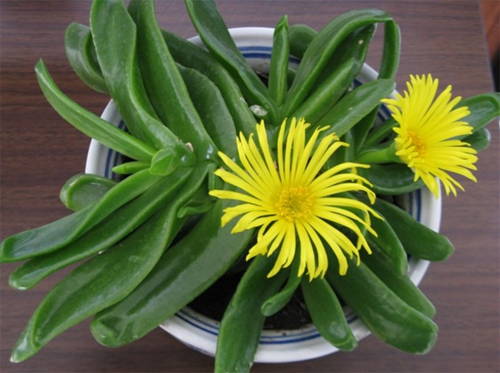
Growing method for the Goldfish Plant:
1. Temperature
Care for the Goldfish Plant requires special attention to overwintering and getting through summer.
When the ambient temperature exceeds 30°C, the plant will enter a semi-dormant state. Move the potted plant to a cool place, stop fertilizing and control watering, keep the potting soil slightly dry, make sure the environment is well ventilated, and wait until the weather cools in autumn before resuming normal water and fertilizer supply.
In winter, keep the greenhouse temperature no lower than 10°C, keep the potting soil consistently moist, switch from watering to misting, stop fertilizing, and ensure it can overwinter safely.
2. Sunlight
The Goldfish Plant should not be planted too densely. If you grow that many, it is still fairly drought-tolerant. Normally wait until the leaves wilt before watering, otherwise the leaves tend to grow leggy and fewer flower buds will differentiate.
The Goldfish Plant does not like heavy fertilizer. Usually, in summer and autumn, apply a thin liquid fertilizer once every half month.
Abundant sunlight is very important for the normal growth and development of the Goldfish Plant, especially during the low-temperature stage when it should receive full sun. The Goldfish Plant dislikes high temperatures and fears low temperatures. Its optimum growing temperature is 16-28°C, and the overwintering temperature should not be lower than 5°C. When the ambient temperature exceeds 30°C, the plant will enter a semi-dormant state.
3. Humidity and moisture
Potted Goldfish Plants should not be too dry during the growing season. Mist appropriately around them; temperatures of 15-25°C are all fine. It is best to provide no less than 4 hours of filtered light per day.
Keep the environment well ventilated, and the potting soil loose, permeable to water and air, and well draining.
4. Propagation methods
(1) Division
Usually division is used, carried out in spring together with repotting. Cut the old clump into several clumps and plant them separately in pots. During the growing season, apply a thin organic liquid fertilizer once every 2-3 weeks. In winter, control watering; the potting soil should be moist but not waterlogged.
(2) Cuttings
Cuttings are usually taken between September and October. Clean damp sand can be used as the cutting medium. Wait until the cut surface has dried, then insert it into the sand bed and maintain an optimum rooting temperature of about 20°C. Roots will form after one month; when the new roots have grown to 2 cm to 3 cm long, transplant them into pots.
What are the other names for the Goldfish Plant?
Tongue Leaf Flower, Bao Lu; it is a succulent of the genus Tongue Leaf Flower in the Aizoaceae family. Its leaves are thick and fleshy, shaped like a curled tongue, and the leaf color is emerald green, smooth and translucent. It gets its name because it resembles a Buddha's hand. In winter, during the first lunar month, it blooms with those large yellow flowers, which are truly beautiful and quite lovely.
That is the introduction to the growing method and other names of the Goldfish Plant. Hurry and grow such a cute plant at home.
Growing method for the Goldfish Plant; introduction to the effects and benefits of the Goldfish Plant
The succulent Goldfish Plant has relatively strict requirements for its growing environment; for example, it likes warmth, is fairly drought-tolerant, fears high temperatures, and cannot tolerate excessive moisture. Below, the editor of wed114 wedding website will tell everyone how to grow the Goldfish Plant, its growing method, and its effects and benefits.
Introduction to the Goldfish Plant
The Goldfish Plant is native to South Africa. Other names: Tongue Leaf Flower, Bao Lu. It is cultivated in many countries around the world. It is a perennial succulent plant. The Goldfish Plant is also called Tongue Leaf Flower, mainly because its fleshy leaves look very much like tongues, while its overall form somewhat resembles a Buddha's hand, hence the name. The stem is short or absent. The leaves are fleshy and tongue-shaped, opposite, with 2 lobes, about 7CM long, bright green, smooth and glossy, with the leaf tips slightly rolled outward. It blooms in autumn and winter. The flowers emerge from the leaf cluster, have short stalks, and are golden yellow.
How to grow the Goldfish Plant
The Goldfish Plant is a perennial herb. It opens in the sunny afternoon and closes at night, continuing this day-open, night-closed pattern for about 7 days. If there is cloudy and rainy weather or insufficient light at the cultivation site, it is very difficult for it to open. Artificial lighting can be used, and it will open normally. The plant is cross-pollinated.
Goldfish Plant plants tend to form clusters easily. Generally, after growing into a very large cluster, the number of heads produced during the next year's peeling will decrease noticeably. At this time the plant can be divided, separating it into small clusters one after another, so that nutrients can be supplied again and the production of heads will gradually return to normal. It is dormant in summer and grows in other seasons. During the peeling period of the Goldfish Plant, new leaves constantly grow while old leaves slowly dry up, providing nutrients to the new plant. The new plant's leaves and the old leaves can grow at the same time. Year-round, 3 to 4 pairs of leaves grow. New leaves begin to sprout in early spring, and old leaves slowly dry up.
The growing medium for the Goldfish Plant should be mainly permeable to water and air. This variety is not tolerant of sun exposure, so shade is essential in summer. During the peeling period of Bao Lu, appropriate watering can be given. This variety is usually watered only after it dries out somewhat, otherwise the roots rot easily. The semi-woody stem is fairly thick. During the growing season, water after it dries out; do not soak the pot. Shade throughout the summer and place it in a bright, ventilated spot with filtered light. During the summer dormancy, give as little water as possible, as too much will cause rot. After temperatures drop in autumn, watering can be resumed gradually. If the plant is plump, it does not need watering; if the opposite leaves look somewhat wilted, then it needs watering. In winter, avoid frost damage from temperatures that are too low. When the potting soil is dry, minus 3 degrees is no problem at all. There are relatively large differences between north and south, so growers should cultivate according to their own environment. The Goldfish Plant can be propagated by sowing seeds or by division.
Home propagation is usually carried out by cuttings between September and October. Clean damp sand can be used as the cutting medium. Wait until the cut surface has dried, then insert it into the sand bed and maintain an optimum rooting temperature of about 20°C. Roots will form after one month; when the new roots have grown to 2-3 cm long, transplant them into pots.
It likes warmth and is fairly drought-tolerant, but fears high temperatures and is not cold-tolerant. The optimum growing temperature is 18-22 degrees; above 30 degrees growth slows and it enters a semi-dormant state.
During the growing season, apply a thin organic liquid fertilizer once every 2-3 weeks. In winter, control watering; the potting soil should be moist but not waterlogged.
Repot every spring and remove dried leaves. During the growing season, fertilize the Goldfish Plant once every half month. In summer during high temperatures, watering must be done carefully, and the potting soil should be slightly dry. If it is hot and humid, the stems and leaves rot easily. At this time, shading and ventilation are needed, and a cool, semi-shaded location is best to get through summer safely. Growth is most vigorous in autumn, so watering should be more generous. After winter arrives and temperatures drop, growth slows and watering should be reduced accordingly. During the early spring flowering period, watering can be increased moderately. Generally, plants need to be renewed after 3-4 years of cultivation.
Growing method for the Goldfish Plant
The Goldfish Plant likes a warm winter and a cool, dry summer environment. Its optimum growing temperature is 18-22°C; when the temperature exceeds 30°C, the plant grows slowly and enters a semi-dormant state. The overwintering temperature must be kept above 10°C. It is suited to growing in fertile, well-draining sandy loam.
The Goldfish Plant is propagated by division or sowing. Division is generally carried out in spring together with repotting; cut the old clump into several clumps and plant them separately in pots. Home propagation is usually carried out by cuttings between September and October. Clean damp sand can be used as the cutting medium. Wait until the cut surface has dried, then insert it into the sand bed and maintain an optimum rooting temperature of about 20°C. Roots will form after one month; when the new roots have grown to 2-3 cm long, transplant them into pots.
The Goldfish Plant is a succulent plant. It gets its name because its fleshy leaves are about 6 cm long, the leaf surface is smooth and translucent, and the leaves tightly clasp and grow in a rosette on the short stem, closely resembling a Buddha's hand. The Goldfish Plant is propagated by division or sowing. Division is generally carried out in spring together with repotting; cut the old clump into several clumps and plant them separately in pots. The Goldfish Plant is native to southern Africa. It likes a warm, humid environment with ample light and fears cold. Its optimum growing temperature is 18°C to 22°C. It is not strict about soil, but dislikes compaction and waterlogging; well-draining sandy loam is best. It likes a warm winter and a cool, dry summer environment; the plant grows slowly and enters a semi-dormant state. It is suited to growing in fertile, well-draining sandy loam.
During the growing season, fertilize the Goldfish Plant once every half month. In summer during high temperatures, the potting soil should be slightly dry. If it is hot and humid, the stems and leaves rot easily. Growth is most vigorous in autumn, so watering should be more generous. After winter arrives and temperatures drop, growth slows and watering should be reduced accordingly. In the hot summer season, shade appropriately to create a well-ventilated, cool, semi-shaded environment so it can get through summer safely. If it grows vigorously in autumn, nitrogen fertilizer should not be too much, otherwise it easily leads to leggy growth and rotten leaves. In addition, when applying organic fertilizer, do not splash the fertilizer liquid onto the leaves, to avoid causing spots and rot.
Introduction to the effects and benefits of the Goldfish Plant
1. Purifying the air
The Goldfish Plant is also called Tongue Leaf Flower. It is native to South Africa and is cultivated in many countries around the world. The stem is extremely short, and the fleshy leaves are tongue-shaped, opposite, with 2 lobes, about 10 cm long, 2-3 wide, bright green, smooth and glossy. Succulent plants are often CAM (Crassulacean acid metabolism) plants; their stomata close during the day, and at night they exchange gases, releasing oxygen and absorbing carbon dioxide, storing it for photosynthesis during the day. The thick, fleshy leaves help store more water and air, and have the effect of purifying the air.
The Goldfish Plant has bright green leaves and a smooth, translucent leaf surface. The leaves tightly clasp and grow in a rosette on the short stem, looking very much like a Buddha's hand, so many people like to grow it at home. Placing a Goldfish Plant at home has the effect of beautifying the home environment. The Goldfish Plant is small and cute, does not take up too much space, and is convenient to grow. Growing a Goldfish Plant next to a computer can also absorb radiation, relax the eyes, and protect eyesight.
2. Medicinal value
Buddha's Hand Flower not only has high ornamental value, but also precious medicinal and economic value. Every part of the Buddha's Hand Flower is a treasure; its roots, stems, leaves, flowers, and fruits can all be used as medicine. It is pungent, bitter, sweet, warm, and non-toxic, and enters the liver, spleen, and stomach meridians. It has multiple medicinal functions such as regulating qi and resolving phlegm, relieving cough and reducing bloating, and soothing the liver, strengthening the spleen, and harmonizing the stomach. According to historical records, the root of the Buddha's Hand Flower can treat male lower consumption and aching and weak limbs; the flowers and fruits can be brewed as tea and have the effect of relieving qi; the fruit can treat conditions such as stomach disease, vomiting, dysphagia, high blood pressure, bronchitis, and asthma. According to works such as "Gui Jing," the Buddha's Hand Flower also has the effect of treating tympanites and swelling, women's leukorrhea, and sobering up after drinking, and is the main raw material for preparing Chinese patent medicines containing Buddha's Hand Flower.
Traditional Chinese medicine believes that Buddha's Hand Flower is neutral in nature and enters the liver meridian, and is used for stomach qi pain. The fruit of the Buddha's Hand Flower is rich in vitamin C and is aromatic, pungent, and dispersing. Cut the fruit into thin slices and brew with boiling water; it has the effect of strengthening the spleen and sobering up after drinking, and is especially good at soothing the liver and harmonizing the stomach and moving qi to relieve pain. It has a certain therapeutic effect on conditions such as distending pain in the ribs and hypochondrium, abdominal fullness and stuffiness, and vomiting with little food caused by liver qi stagnation and disharmony between the spleen and stomach.
3. Edible value
Bergamot 10——15 grams, japonica rice 50 grams, add 200 milliliters of water, simmer down to 100 milliliters, remove the residue, then add the japonica rice. Add about 400 milliliters of water, cook into a thin porridge, and add an appropriate amount of rock sugar to finish. Take warm twice a day. Used to treat chest tightness and qi stagnation, weak stomach in the elderly, indigestion, poor appetite, belching and vomiting, and other conditions.
1. Buddha's Hand Flower Pumpkin Chicken
Effects and benefits of Buddha's Hand Flower: tonify the center and boost qi, strengthen the spleen and nourish the stomach
Ingredients: fresh Buddha's Hand Flower 10 grams, 1 old pumpkin, young chicken 750 grams, edamame 250 grams, chopped scallion, minced ginger, refined salt, yellow wine, glutinous rice wine, monosodium glutamate, soy sauce, brown sugar, husked sorghum, Sichuan pepper, fermented bean curd juice, refined vegetable oil, rice flour, each in appropriate amounts.
Method: First wash the Buddha's Hand Flower petals. Stir-fry the husked sorghum and Sichuan pepper until cooked, then grind them together into a coarse powder. Wash the chicken and chop into pieces, mix well with chopped scallion, minced ginger, refined salt, soy sauce, brown sugar, fermented bean curd juice, yellow wine, glutinous rice wine, and monosodium glutamate, and marinate for a while, then add the rice flour and vegetable oil. Lightly rub the edamame to remove the membrane and wash clean, and mix with the same seasonings as the chicken. Scrub the pumpkin clean, cut a 7-cm square opening around the stem, remove the stem and keep it as the lid, use a long small spoon to scoop out the flesh and seeds, fill half of the edamame beans and half of the Buddha's Hand Flower through the opening, then add the chicken pieces, then add the remaining Buddha's Hand Flower and edamame beans, cover with the lid, place on a plate, and steam in a steamer until thoroughly cooked and tender.
2. Atractylodes Stomach-Harmonizing Decoction
Effects and benefits of Buddha's Hand Flower: promote digestion and harmonize the stomach, regulate qi and relieve fullness in the middle.
Indications: Food accumulation that is not digested, spleen deficiency with dampness stagnation, with symptoms of abdominal fullness and distension, little food and fatigue, nausea and acid regurgitation, dry mouth with excessive saliva, and white, slippery tongue coating.
Composition: Sun-dried Atractylodes macrocephala one qian and a half; Xinhui tangerine peel (stir-fried) one qian and a half; charred Massa Medicata Fermentata three qian; Buddha's Hand Flower five fen; Zhejiang Poria four qian; Spring Amomum (pounded) one qian, five-grain worm (rinsed clean) three qian, aged warehouse rice (wrapped in lotus leaf) three qian.
Usage of Buddha's Hand Flower: decoct in water and take orally, twice a day.
Source of Buddha's Hand Flower: "Popular Treatise on Cold Damage"
3. Four-Flower Depression-Relieving Decoction
Effects and benefits of Buddha's Hand Flower
Effects and benefits of Buddha's Hand Flower: regulate qi and relieve depression, direct qi downward and resolve phlegm; mainly treats the seven emotions binding into depression, with qi stagnation and phlegm coagulation.
Composition: Green calyx mume 6 grams, rose 6 grams, Buddha's Hand Flower 6 grams, magnolia flower 6 grams, ginger Pinellia 5 grams, white Poria 10 grams, Polygala root 10 grams, white peony root 10 grams, raw licorice 3 grams.
Usage of Buddha's Hand Flower: decoct in water and take orally, 1 dose per day, taken orally twice a day.
Source of Buddha's Hand Flower: Dai Zuming's formula.
4. Kumquat Formula
Effects and benefits of Buddha's Hand Flower: has the effects of soothing the liver and regulating qi, and harmonizing the stomach and relieving pain; suitable for chronic superficial gastritis of the liver-qi-attacking-stomach type.
Ingredients: kumquat diced pieces 60 grams, Bupleurum 10 grams, Buddha's Hand Flower and rose 6 grams each, japonica rice grams, white sugar appropriate amount
Method: Decoct Bupleurum, Buddha's Hand Flower, and rose in water and take the juice, add japonica rice and cook until the porridge is almost done, add kumquat and white sugar, mix evenly, and cook into porridge.
Usage of Buddha's Hand Flower: 1 dose per day, eaten in 2 portions.
Introduction to and growing method for the Goldfish Plant / Bao Lu succulent; how to grow the Goldfish Plant / Bao Lu succulent?
Other names: Goldfish Plant, Tongue Leaf Flower, Long Leaf Bao Lu
Family and genus: Aizoaceae, genus Tongue Leaf Flower
Place of origin: Little Karoo Plateau, South Africa
Morphological characteristics of the Goldfish Plant / Bao Lu succulent:
The Goldfish Plant / Bao Lu succulent is a perennial herb, very fleshy. The fleshy leaves grow like tongues, about 6-10 cm long, tongue-shaped and slightly curled, bright green in color, with a smooth and translucent leaf surface. The opposite leaves of the Goldfish Plant / Bao Lu succulent are united at the base into a fleshy sheath, with leaf tips slightly rolled outward and two clearly visible edges. Under strong light the fleshy leaves turn dark green. The leaf surface is smooth with no warty spots, and the base is united.
Young Goldfish Plant / Bao Lu succulents grow singly, while old plants form clusters. The leaf color ranges from light green to dark green. Flowers emerge from the middle slit between two leaves, golden yellow, with a diameter of about 3-5 cm. The petals are slightly wider than those of Dwarf Bao Lu, and the petals are also slightly shorter. Generally each plant opens only one flower, and when clustered the flowering is very spectacular.
The Goldfish Plant / Bao Lu succulent opens in the sunny afternoon and closes at night, continuing this day-open, night-closed pattern for about 7 days. If there is cloudy and rainy weather or insufficient light at the cultivation site, it is very difficult for it to open. Artificial lighting can be used, and it will open normally. The Goldfish Plant / Bao Lu succulent plant is cross-pollinated.
How to grow the Goldfish Plant / Bao Lu succulent? Growing method and cultivation key points for the Goldfish Plant / Bao Lu succulent:
Goldfish Plant / Bao Lu succulent plants tend to form clusters easily. Generally, after growing into a very large cluster, the number of heads produced during the next year's peeling will decrease noticeably. At this time the plant can be divided, separating it into small clusters one after another, so that nutrients can be supplied again and the production of heads will gradually return to normal. It is dormant in summer and grows in other seasons. During the peeling period of the Goldfish Plant / Bao Lu succulent, new leaves constantly grow while old leaves slowly dry up, providing nutrients to the new plant. The new plant's leaves and the old leaves can grow at the same time. Year-round, 3 to 4 pairs of leaves grow. New leaves begin to sprout in early spring, and old leaves slowly dry up.
The growing medium used for the Goldfish Plant / Bao Lu succulent is coal cinder mixed with a small amount of peat, also mixed with a small amount of akadama soil and orchid stone. The surface is covered with granular river sand. The medium should be mainly permeable to water and air.
This variety, the Goldfish Plant / Bao Lu succulent, is not tolerant of sun exposure, so shade is essential in summer. During the peeling period of the Goldfish Plant / Bao Lu succulent, appropriate watering can be given. This variety is usually watered only after it dries out somewhat, otherwise the roots rot easily. The semi-woody stem is fairly thick. During the growing season, water after it dries out; do not soak the pot. Shade throughout the summer and place it in a bright, ventilated spot with filtered light. During the summer dormancy, give as little water as possible, as too much will cause rot.
After temperatures drop in autumn, watering can be resumed gradually. If the Goldfish Plant / Bao Lu succulent plant is plump, it does not need watering; if the opposite leaves look somewhat wilted, then it needs watering.
In winter, the Goldfish Plant / Bao Lu succulent needs to avoid frost damage from temperatures that are too low. When the potting soil is dry, minus 3 degrees is no problem at all. There are relatively large differences between north and south, so growers should cultivate according to their own environment.
Propagation methods for the Goldfish Plant / Bao Lu succulent:
The Goldfish Plant / Bao Lu succulent can be propagated by sowing seeds or by division.