How to grow Cuphea hookeriana? Common disease control and price introduction
Cuphea hookeriana looks just like baby's breath, but its flowers are much larger than those of baby's breath. Most Cuphea hookeriana flowers are red, while most baby's breath flowers change color. How do you grow Cuphea hookeriana? What common diseases does it have? What is the price?
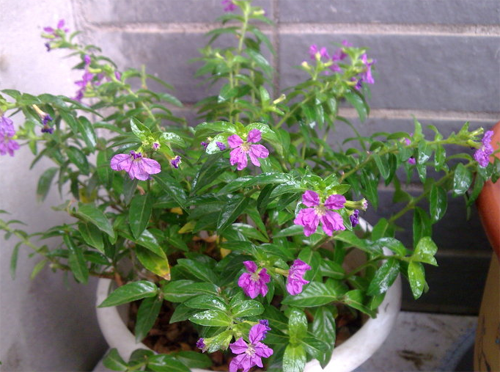
How do you grow Cuphea hookeriana?
1. Soil selection
Cuphea hookeriana is suited to growing in sandy soil, and drainage must be good. Waterlogging is a major taboo and easily causes root rot, especially in pots.
Whether the soil is fertile or not matters little; it is quite adaptable, and slight waterlogging is tolerable, but potted plants should not sit in water for long periods.
2. Sunlight
It is generally grown outdoors and cared for in full sun. It is also slightly shade-tolerant, but it only grows better with sunlight, with greener leaves and more brilliant flowers.
3. Watering
Just water when it dries out. It is fairly drought-tolerant, so watering does not need to be too frequent. For plants in the ground, aside from watering thoroughly right after transplanting, once growth is stable it can basically fend for itself.
4. Key care points
The key lies in proper pinching and pruning. Pinch once when new growth reaches just over 10 cm, and prune once when it exceeds 15 cm. Fertilize once each in spring and autumn; either organic fertilizer or compound fertilizer is fine.
For potted plants, the plant shape can be controlled by topping, and shaping can be done with proper pruning. It is fairly heat-tolerant, so there is no need to worry about sunburn unless the plants are seedlings or newly rooted cuttings.
5. Propagation introduction
It is generally propagated by cuttings, which is simple and effective. It can be done in spring, summer or autumn; of course, at a temperature of around 15 degrees it can be propagated year-round. Usually a robust one-year-old branch about 10-plus cm long is cut for rooting, the lower leaves are removed, and it is inserted into slightly moist sandy soil and kept in a bright, scattered-light, ventilated environment.
Common diseases of Cuphea hookeriana:
In spring there is occasionally damage from tussock moths, which can be controlled with decis and fenitrothion. Generally there are no pest or disease problems; they are rarely seen.
What is the price of Cuphea hookeriana?
There really is no price to be found online for this; you can only ask at places that specialize in selling seeds or saplings.
How long is the flowering period of Cuphea hookeriana?
The flowering period is from May to June.
That is all for the introduction to Cuphea hookeriana's flowering period, price, common diseases and cultivation methods. Hurry and add some different color to your home.
Cuphea hookeriana Walp. Cuphea hookeriana profile: how to grow Cuphea hookeriana / how to propagate Cuphea hookeriana
Cuphea hookeriana cardCuphea hookeriana Walp.
Cultivation methods and precautions for Cuphea hookeriana, introduction to Cuphea hookeriana
Cuphea hookeriana is a species under the genus Cuphea in the family Lythraceae. It is an upright small shrub, with plants 30-60 cm tall. The stems have sticky soft hairs or stiff hairs.
The leaves of Cuphea hookeriana are opposite, long ovate or elliptic, with acuminate tips, the midrib raised beneath, and petioles present. The flowering period runs from spring to autumn, blooming continuously as the branch tips grow. The flowers are small and numerous, covering the flowerbed at peak bloom and looking like a starry sky, hence it is also called purple-flowered baby's breath. It is suitable for use as a low hedge beside garden rocks; for planting at the edges of flower clusters and flowerbeds; in open spaces it is best planted in groups, clumps or rows. Amid the green, dotted with stars, it is very delightful.
Morphological characteristics of Cuphea hookeriana
Cuphea hookeriana is a shrub or subshrub, 30-70 cm tall, upright, rough, covered with coarse hairs and short stiff hairs; the branches are slender and densely covered with short soft hairs. The leaves are thinly leathery, lanceolate or ovate-lanceolate, rarely oblong, the uppermost ones linear-lanceolate, 2-4 cm long, 5-15 mm wide, with long acuminate tips, rounded to broadly cuneate bases, decurrent to the petiole, both surfaces appressed short coarse-hairy when young, later gradually falling off and becoming rough, with about 4 pairs of lateral veins, sunken above and distinctly raised beneath, the petiole very short, about 1 mm long. The flowers are solitary between the petioles or nearly axillary, forming few-flowered racemes; the pedicels are slender; above the base of the calyx there is a short spur, reddish, especially obvious on the back, densely covered with sticky soft hairs or tomentum; petals 6, of which the upper 2 are extra-large and prominent, oblong, deep purple, wavy, clawed, and the remaining 4 are very small, conical, sometimes absent; stamens 11, sometimes 12, of which 5-6 are longer and protrude beyond the calyx tube, the filaments tomentose; the ovary is oblong. Petals 6, purplish red, the flowering period from spring to autumn, blooming continuously as the branch tips grow.
Cuphea hookeriana is an upright small shrub, with plants 30-60 cm tall. The stems have sticky soft hairs or stiff hairs. The leaves are opposite, long ovate or elliptic, with acuminate tips, the midrib raised beneath, and petioles present. The flowers are terminal or axillary, the pedicels 2-6 (-15) mm long; the calyx 16-24 mm long, covered with sticky soft hairs or coarse hairs, with a spur at the base; petals 6, purplish red, the 2 on the back larger, nearly round, the other 4 smaller, obovate or obovate-round; the pistil slightly protrudes beyond the calyx. Much branched. The leaves are linear, linear-lanceolate or oblanceolate. The flowers are solitary in the leaf axils, the corolla tube purple, pale purple to white.
Ecological habits of Cuphea hookeriana
Cuphea hookeriana is not strict about environmental conditions and is extremely easy to cultivate and manage. Full sun and partial sun are both ideal, and it can also grow in slightly shaded places, but growth is more vigorous with ample sunlight. It is highly adaptable to soil, and grows even better in sandy loam, and is tolerant of wet conditions. After the seedlings are planted out, it is advisable to pinch or prune once to encourage branching. TheNaturePlanet reminds you: during the growth period, fertilize once every 1-2 months; organic fertilizer or nitrogen, phosphorus and potassium are all fine. If the plants are too tall or the branches and leaves are crowded, they can be pruned. It likes high temperatures, and the suitable growth temperature is 18-32 degrees Celsius.
Cultivation techniques for Cuphea hookeriana: key cultivation points
Cuphea hookeriana is a small shrub, short in stature, with upright stems and especially numerous, fine, dense branches. The opposite leaves are small, linear-lanceolate, 1.0-2.0 cm long, emerald green. The flowers are small and numerous, covering the flowerbed at peak bloom and looking like a starry sky, hence it is also called baby's breath. The flowers are solitary in the leaf axils, with a special structure: the calyx is extended into a corolla-like form, salver-shaped, with 5 teeth, and between the teeth are degenerate petals; the flowers are purple, pale purple, white.
1. Cultivation environment
Cuphea hookeriana originated in the tropics, is heat-tolerant and likes high temperatures, and is not cold-tolerant. It likes light and can also tolerate partial shade, growing normally under both full sun and partial sun conditions. It likes well-drained sandy soil. It is an excellent material for flowerbeds and low hedges.
2. Propagation and seedling raising
Cuttings are the main method, and Cuphea hookeriana is also propagated by sowing. Cuttings are best taken in spring and autumn, and can also be done year-round. Select robust shoots with terminal buds 5-8 cm long, remove the leaves on the lower 2-3 cm of the stem, insert 2-3 cm into a sand bed, and roots form in about 10 days. After rooting, grow them on in nutrient bags for 1-2 months until planting out.
3. Cultivation substrate
The substrate for bag seedlings and potted plants should be fertile and loose with good drainage. You can use 2 parts loam, 1 part peat soil and 1 part sand mixed together. For planting in the ground, pay attention to improving the soil's water permeability by adding sand and organic fertilizer.
4. Planting out
For potted Cuphea hookeriana use a 14-16 cm pot, one plant per pot. For flowerbeds and hedges, the plant spacing is 15 x 20 cm.
5. Fertilizer and water management
This is fairly extensive. After planting out, keep the soil moist; after recovery, water once every 3-5 days and apply dilute liquid fertilizer once every 10 days. After the plants are established, pay attention to fertilizer and water management.
After the seedlings are planted out, it is advisable to pinch or prune once to encourage branching. During the growth period, fertilize once every 1-2 months; organic fertilizer or nitrogen, phosphorus and potassium are all fine. If the plants are too tall or the branches and leaves are crowded, they can be pruned.
Management after cuttings
Temperature
The optimal temperature for cuttings to root is 18°C-25°C. Below 18°C, rooting is difficult and slow; above 25°C, the cut ends of the cuttings are easily infected by pathogens and rot, and the higher the temperature, the greater the proportion that rot. When low temperatures are encountered after cuttings are taken, the main insulation measure is to wrap the pot or container used for cuttings with plastic film; when the temperature is too high after cuttings are taken, the main cooling measure is to shade the cuttings, blocking out 50-80% of sunlight, and at the same time mist the cuttings 3-5 times a day. On sunny days with higher temperatures, mist more often; on rainy days with lower temperatures and higher humidity, mist less often or not at all.
Humidity
After Cuphea hookeriana cuttings are taken, the relative air humidity must be kept at 75-85%. Humidity can be increased by misting the cuttings, 1-3 times a day. On sunny days, the higher the temperature, the more often you mist; on rainy days, the lower the temperature, the less often you mist or not at all. But excessive misting makes the cuttings prone to infection by pathogens and rot, because many kinds of pathogens exist in water.
Light
Cuphea hookeriana propagation by cuttings cannot do without sunlight, but the stronger the light, the higher the temperature inside the cuttings, the more vigorous the transpiration of the cuttings, and the more water consumed, which is not conducive to the survival of the cuttings. Therefore, after cuttings are taken, 50-80% of sunlight must be blocked out.
Potting up
When potting up small seedlings, first place a 2-2 cm thick layer of coarse-grained substrate or expanded clay at the bottom of the pot as a drainage layer, sprinkle a layer of fully decomposed organic fertilizer on top as a base fertilizer, about 1-2 cm thick, then cover with a layer of substrate about 1-2 cm thick, and then place the plant in, so as to separate the fertilizer from the roots and avoid burning the roots.
For the substrate used for potting up, you can choose one of the following. Vegetable garden soil: cinder = 3:1; or garden soil: medium-coarse river sand: sawdust (mushroom residue) = 4:1:2; or one of paddy soil, pond mud and leaf mold. Or peat + perlite + expanded clay = 2 parts + 2 parts + 1 part; vegetable garden soil + cinder = 3 parts + 1 part; peat + cinder + expanded clay = 2 parts + 2 parts + 1 part; sawdust + vermiculite + medium-coarse river sand = 2 parts + 2 parts + 1 part. After potting up, water thoroughly once and keep it in a shaded environment for care.
Humidity management
Cuphea hookeriana likes a humid climate environment and requires the relative air humidity of the growing environment to be 60-75%.
Temperature management
The optimal growth temperature for Cuphea hookeriana is 18°C-30°C. It fears cold and frost, and the overwintering temperature needs to be kept above 10°C. When the winter temperature drops below 4°C it enters a dormant state, and if the ambient temperature approaches 0°C, it will die from frost damage.
In summer
1. Strengthen air convection so that the internal temperature can be dissipated;
2. Place it in partial shade, or give it 50% shade;
3. Mist it appropriately, 2-3 times a day.
In winter
1. Move it indoors to a brightly lit place for care;
2. Outdoors, you can wrap it in plastic film to overwinter, but every two days at noon when the temperature is higher, open the film to let it breathe;
Light management: it fears direct strong light and needs to be kept in partial shade for care, or given 70% shade. For those kept indoors, place them in as bright a place as possible, and every one or two months move them outdoors to partial shade or shade for a month of care, so that they can accumulate nutrients and restore their growth.
Cultivation methods for Cuphea hookeriana: cultivation matters
1. Loose soil is best
Cuphea hookeriana has low requirements for soil when cultivated; generally a well-drained slightly alkaline calcareous soil or gravelly loam is enough.
2. Water must be controlled
Cuphea hookeriana has a relatively high water requirement during the seedling stage. After pinching, sufficient water and nutrients are still needed, so that the plant can gradually change from the vegetative growth stage to the reproductive growth stage, that is, enter the bolting stage (flowering stage). Until the small flower spikes emerge and the petals grow out, water should be slightly reduced, to prevent a decline in cut flower quality and vase life, and to promote neat blooming of all the flowers. Especially in the hot and humid summer season, whether water is controlled properly is often the main factor determining the success of baby's breath cultivation.
3. The temperature must not be too high
Cuphea hookeriana grows best at a daytime temperature of 25°C. If it exceeds 30°C, and the time or number of days is too long, the probability of deformed flowers increases. The nighttime temperature is best at 10-15°C; if it is lower than 10°C, and even lower than 10°C, plus the short days of autumn and winter, it easily enters a dormant state or shows clustering.
4. Light must be sufficient
Light has an extremely profound effect on whether Cuphea hookeriana blooms, especially in winter, where it is more obvious. If Cuphea hookeriana is given 80-24 Klux of illumination in summer, all plants can bloom; the difference is that the less illumination the plants receive, the correspondingly fewer flowers they bear. In winter, plants given 58 Klux can all bloom; while those given 24 Klux cannot bloom even if given a continuous 24-hour full-light period.
5. Fertilize regularly
Cuphea hookeriana likes fertilizer but hates waterlogging. After planting out, topdress in stages, mainly with nitrogen fertilizer in the early stage and mainly with phosphorus and potassium fertilizer in the later stage. Water management must be strictly controlled; too wet and growth weakens, and waterlogging causes root rot and death. When the plants grow to 30 cm, watering must be controlled, especially during the bud stage, and it should be drier during the flowering period. In rainy areas, a shelter should be built to keep off the rain.
Propagation methods for Cuphea hookeriana
Cuttings are the main method, and Cuphea hookeriana is also propagated by sowing. Cuttings are best taken in spring and autumn, and can also be done year-round. Select robust shoots with terminal buds 5-8 cm long, remove the leaves on the lower 2-3 cm of the stem, insert 2-3 cm into a sand bed, and roots form in about 10 days. After rooting, grow them on in nutrient bags for 1-2 months until planting out.
Propagation by cuttings
Selection of cutting branches: the branches used for cuttings are called cuttings. Cut the stems into sections 5-8 cm long, each section with more than three leaf nodes; the terminal shoot can also be used as a cutting.
This refers to the nutrient soil, river sand, peat soil and other materials used for cuttings. For home cuttings, limited by conditions, it is hard to obtain an ideal cutting substrate. It is recommended to use a pre-mixed and sterilized cutting substrate; medium-coarse river sand will also do, but it must be rinsed several times with clean water before use. Do not use sea sand or river sand from saline-alkali areas; they are not suitable for the growth of flowering plants.
Planting out
For potted plants use a 14-16 cm pot, one plant per pot. For flowerbeds and hedges, the plant spacing is 15 x 20 cm.
Disease control for Cuphea hookeriana
In spring Cuphea hookeriana is harmed by tussock moths, which can be controlled with decis, fenitrothion, etc.
Pest and disease problems on Cuphea hookeriana are not commonly seen; generally there are occasionally aphids or snails. In this case, diluted essential balm or neutral laundry detergent can be sprayed, which can kill aphids. For snails, metaldehyde granules can be spread in the potting soil. Note that for root rot, waterlogging in the potting soil must be prevented, and irrigating the roots with green copper emulsifiable concentrate or 800-fold root rot remedy solution is enough.
Variety classification of Cuphea hookeriana: genus Cuphea
Description: Cuphea P.Br., genus Cuphea, Lythraceae, about 300 species, distributed in North and South America. In China, 7 species including Cuphea hookeriana Walp. have been introduced and cultivated in Beijing, Shanghai, Guangzhou and other places; in addition, Taiwan, China has 1 species, C. cartagenesis (Jacq.) Macb. Herbs or shrubs, mostly with sticky glandular hairs; leaves opposite or whorled; flowers zygomorphic, solitary or arranged in racemes; the calyx elongated and corolla-like, ribbed, spurred at the base, with 6 teeth at the apex and often the same number of appendages; petals 6, unequal, rarely 2 or entirely absent; stamens 11, rarely 9, 6 or 4; the ovary usually superior, unequally 2-loculed, each locule with several to many ovules; the capsule oblong, enclosed within the calyx.
All species: Cuphea hookeriana, Cuphea ignea, Cuphea lanceolata, Cuphea procumbens, Cuphea hyssopifolia, Cuphea balsamona, Cuphea micropetala, Cuphea viscosissima.
Distribution area of Cuphea hookeriana
Cuphea hookeriana is native to Mexico, and is now found in tropical and southern subtropical regions.
In China it has been introduced and cultivated in Guangdong, Guangxi, Yunnan, Fujian and other provinces and regions, and is widely used in landscaping. It is suitable for use as a low hedge beside garden rocks; for planting at the edges of flower clusters and flowerbeds; in open spaces it is best planted in groups, clumps or rows.
Uses of Cuphea hookeriana: ornamental value
Because purple Cuphea hookeriana has luxuriant branches and leaves, deep green and glossy foliage that stays evergreen all year round, beautiful flowers that bloom continuously year-round, is easy to shape, and tolerates pruning, it has strong landscaping functions and ornamental value. Now in China it has been introduced and cultivated in Guangdong, Guangxi, Yunnan, Fujian and other provinces and regions, and is widely used in landscaping. It is suitable for use as a low hedge beside garden rocks; for planting at the edges of flower clusters and flowerbeds; in open spaces it is best planted in groups, clumps or rows. Amid the green, dotted with stars, it is very delightful.
Commercial and medical life value
Cuphea hookeriana provides people with oil of useful value. This oil can be used to make soap, detergents, surfactants, lubricants, etc., and also has many uses in medicine, nutrition, food and so on.
Scientists in the United States found that the seeds of plants in the genus Cuphea have many characteristics and will become plants of considerable use value; Cuphea seeds contain large amounts of saturated fatty acids, such as lauric acid. Lauric acid can be used to produce soap and detergents, and other fatty acids can be used to treat diseases related to fat absorption.
Dietary or medicinal value of Cuphea hookeriana
TheNaturePlanet's medical information and health dietary information is for reference only and cannot be used as a basis for diagnosis or medical treatment. For any health problem, consult professional medical personnel, and for the treatment of any disease, follow the doctor's advice.
Ultimate flower-care mission: love yourself, and start from practical reality, strictly following the doctor's advice. For illness, do not be careless, do not delay, do not give up hope; face it bravely, use love to warm the silent world, and use your heart to care for the flower field within.
Cuphea hookeriana can also produce an oil that has uses in medicine, nutrition, food and so on.
Cuphea, of the family Lythraceae, is a wild plant growing in Mexico and Central and South America, and its seeds are rich in medium-chain triglycerides. In September 1984, many American agronomists, geneticists and economists gathered in Oregon to discuss the research, utilization and development trends of Cuphea. They predicted that in 20 years Cuphea would become a new resource for the American oleochemical industry, able to provide lauric acid and capric acid like coconut and palm to produce surfactants. Cuphea seeds contain many types of fatty acids, such as from C_8 to C_(13), which is unique in the plant kingdom.
Landscape uses of Cuphea hookeriana
Because Cuphea hookeriana has luxuriant branches and leaves, deep green and glossy foliage that stays evergreen all year round, beautiful flowers that bloom continuously year-round, is easy to shape, and tolerates pruning, it has strong landscaping functions and ornamental value. It is suitable for use as a low hedge beside garden rocks; for planting at the edges of flower clusters and flowerbeds; in open spaces it is best planted in groups, clumps or rows. Amid the green, dotted with stars, it is very delightful. Its characteristics are small purple flowers and small branches that grow straight, making it unforgettable.
Now in China it has been introduced and cultivated in Guangdong, Guangxi, Yunnan, Fujian and other provinces and regions, and is widely used in landscaping.
Planted under trees, or combined with evergreen shrubs or other flowers, it can form a beautiful landscape; it can also be planted as ground cover, which can block the spread and growth of weeds, and can also be used as a potted ornamental.
Cultural background of Cuphea hookeriana: origin of the name
The flowering period of Cuphea hookeriana runs from spring to autumn, blooming continuously as the branch tips grow. The flowers are small and numerous, covering the flowerbed at peak bloom and looking like a starry sky, hence it is also called purple-flowered baby's breath.
The flower language of Cuphea hookeriana
The flower language of Cuphea hookeriana: true liking, care, purity.
Today's famous flowers that are renowned far and wide mostly play the "leading role" in arrangements, but Cuphea hookeriana, which has been celebrated worldwide for many years, is a rare and precious "supporting role."
In the 1980s, when flower arrangement reached the pinnacle of art, Cuphea hookeriana rose to become one of the world's top ten potted flowers, and so flower enthusiasts abroad regarded it as a fair measure.
Cuphea hookeriana pictures
How to grow Cuphea hookeriana: 5 daily cultivation methods and matters
Cuphea hookeriana is not a very difficult flowering plant to grow. Flower lovers who want to grow Cuphea hookeriana must first clearly understand its growth requirements. Below are 5 basic care matters for Cuphea hookeriana.
How to grow Cuphea hookeriana 1. Soil requirementsFor the potting mix of Cuphea, it is recommended that growers use fertile, loose soil with good drainage; generally, loam and sand can be mixed in proportion.
2. Light requirementsCuphea likes plenty of sunlight, and of course it can also tolerate some partial shade. Generally, in summer care it needs appropriate shading; in other seasons it can receive full-day sunlight, so let Cuphea enjoy the sunlight fully.
3. Watering requirementsCuphea likes to grow in moist soil, so it is very sensitive to soil moisture. During the growing period, Cuphea should not be watered too little or too much; just keep the potting soil moist.
Of course, Cuphea is very afraid of waterlogging. Once the flowerpot has standing water, it is very likely to cause Cuphea's roots to rot. In summer, you can reasonably water a little more; in winter, you should begin to control the amount of watering, and it is better to let the potting soil dry out a bit.
4. Environmental humidityCuphea likes a humid environment, so the air humidity of the care environment is generally better between 50% and 60%. In summer, when the temperature is relatively high and dry, it is recommended to appropriately spray water on the ground around Cuphea to maintain air humidity.
5. Fertilization requirementsCuphea is very tolerant of poor conditions; in poor soil, Cuphea can also grow normally. Because Cuphea's branches and leaves grow quickly and it also blooms very abundantly, it is recommended that during Cuphea's growing period, fertilizer should be applied once every half a month to replenish nutrients in time.
At the same time, it is recommended that growers not use nitrogen fertilizer alone, otherwise Cuphea will grow very well but bloom very little.