Sundew Cultivation Methods and an Introduction to Common Varieties
Sundews are extremely beautiful to look at, with tiny tentacles on their leaves. That is just how magical they are - they also need a taste of meat and eat insects. Sundews look quite similar to Venus flytraps. So how do you grow sundews? And what varieties are there?
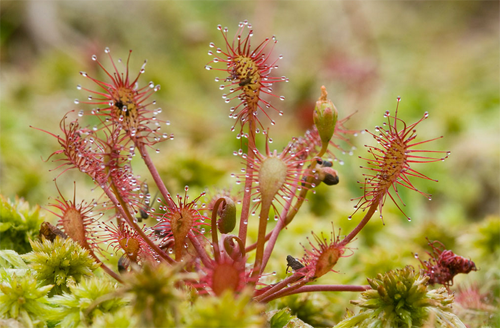
How to grow sundews:
1. Soil:
Except for tuberous sundews, other types of sundews are not demanding about soil. You can use pure sphagnum moss, or mix two parts sphagnum moss and peat with one part perlite, and you can also add one part akadama, bark, vermiculite and other substrates.
Tuberous sundews can use granular soil. If growing by the tray method, you can use a mix of 1 part peat and 1 part perlite or river sand.
2. Light:
Sundews like plenty of sunlight and tolerate full sun. They are suitable for placing on a balcony or windowsill with good light. If you can provide all-day direct light, they will show very vivid colors, and the mucus will become even stickier.
If you do not have a good light environment, you should still provide bright indirect light all day.
3. Humidity:
Sundews are not demanding about humidity, which needs to be kept at 40%-90%. Higher humidity can make the glandular hairs' “dew droplets“ larger and more ornamental. During the plum rain season, when the air humidity is not much higher, you should pay attention to increasing ventilation, as otherwise the stems and leaves of sundews may rot.
4. Watering:
Sundews are generally quite moisture-tolerant. You can use the tray method to supply water, that is, place the pot in a water tray, glass tank or other container with water, so that the water seeps into the entire pot on its own. You only need to keep about 1 cm of water in the tray to keep the substrate moist.
Sundews have relatively high water quality requirements. When watering, use soft water low in minerals such as calcium and magnesium.
5. Fertilizing:
During the growing season of sundews, use a general compound fertilizer diluted five thousand times and spray it on the leaves, 1-2 times a month.
When fertilizing, it is better to apply thin fertilizer frequently. Never use too high a concentration, to avoid the serious consequences of fertilizer burn or even fertilizer death.
If you have no experience, do not fertilize at will. It is not recommended to provide nutrients by feeding food, so as not to affect the ornamental value.
6. Pests and diseases:
Every spring and summer, the new shoots of sundews may be attacked by aphids, causing deformed or withered leaf growth.
Pests such as green caterpillars and cutworms may all chew on the leaves of sundews. When you find traces of leaves having been chewed, you should catch and kill them promptly, or you can use a broad-spectrum (general-purpose) insecticide to kill them. When using it, just spray the leaves damp; never spray heavily.
Sundew varieties:
1. Drosera natalensis (Natal sundew)
The natural habitat of Drosera natalensis is the remote mountainous areas of South Africa, where the climate is stable year-round and summer does not exceed 33 degrees. In cultivation, D. natalensis and Drosera capensis are the top choices of growers for upright sundews, but D. natalensis is more delicate and a bit more afraid of heat, so it is suitable for cultivation in an airy medium.
2. Drosera capensis (Cape sundew)
This is the most famous sundew. Its tall and imposing appearance is deeply impressed in people's minds, and its leaves curl in a very exaggerated way. In its native South Africa it is a lowland sundew and has multiple forms. In cultivation it is somewhat afraid of heat; grow it with ventilation and shade in summer, and it will be very beautiful in autumn.
3. Drosera filiformis (thread-leaved sundew)
Drosera filiformis can be roughly divided into red thread-leaved, green thread-leaved and common thread-leaved, among which the red thread-leaved is the most famous variety. In cultivation it is slightly afraid of heat; in summer, just avoid midday sun with shade. It is still an entry-level variety among temperate sundews and is worth collecting.
Other sundew varieties include Drosera berleyana, Drosera binata (fork-leaved sundew), Drosera affinis, Drosera hamiltonii, Drosera aliciae, Drosera peacock, Drosera regia (king sundew), Drosera burmannii and others.
That is all for sundew cultivation methods and variety introductions. Friends who like this slightly furry plant, hurry up and grow it.
How to grow sundews
Sundews are a type of carnivorous plant. Many growers do not know how to grow sundews. This article is a summary of growers' experience in growing sundews. First, let us talk about the varieties of carnivorous plants, mainly including Venus flytraps, sundews, pitcher plants, butterworts, bladderworts, Cephalotus, Heliamphora, Byblis, Stylidium and others.
All carnivorous plants cannot use nutrient soil or ordinary garden soil. They should be planted in substrates such as peat with perlite or sphagnum moss, and the water should be low-mineral water (rainwater, purified water, air conditioner water, etc.). Personally, I quite like sundews, especially mini sundews, so let me introduce sundews first.
Sundews are moisture-loving among carnivorous plants. Except in winter, they should be kept in the tray method at all other times. Another factor in growing sundews well is light. A large part of the reason many people's carnivorous plants are commonly said not to turn red or to grow weakly is that they dare not expose them to sun. In fact, sundews need light very much. In addition, many people think the dew droplets of sundews are produced by keeping them enclosed, so they keep growing them enclosed, and once the bag is removed the dew droplets are gone. In fact, this is not the case. The dew droplets of sundews are mainly produced by photosynthesis and have little to do with air humidity, so with good light the dew droplets will be large even without enclosure.
Sundews have many varieties, and cultivation also requires different growing methods according to different varieties. Broadly there are those that go dormant in summer (various Drosera capensis, tuberous sundews, etc.), those that go dormant in winter (Drosera filiformis, Drosera berleyana, Drosera binata, etc.), those that are not cold-tolerant (Northern Territory species), and also a special category: mini sundews (mature plants are very small and cute).
Drosera capensis has a total of 4 types: mineral red, white, broad-leaved and all-red. Among them, white D. capensis is the most afraid of heat, and all-red D. capensis is the most heat-tolerant. D. capensis will go dormant when summer temperatures are above 30 degrees. The main sign is that new leaves begin to turn pale yellow and then stop growing. If the temperature is too high, all leaves may wither. From the time you find that D. capensis is about to go dormant, you should try to avoid direct sunlight after 9 o'clock, gradually control water, stop the tray method, and keep the substrate slightly moist, until the weather turns cool in autumn, when D. capensis will sprout again (some may not grow out; this mainly depends on summer care and the size of the plant before dormancy. If it is too small, it also cannot sprout again in autumn. Personally, I feel that the autumn revival of D. capensis is equivalent to root cuttings of sundews).
For winter-dormant species, you can stop the tray method in winter and just keep the substrate from drying out. These sundews are all relatively cold-tolerant; generally minus 5 degrees is no problem. Friends in Jiangsu, Zhejiang and Shanghai can just put them outdoors in winter; they will not freeze to death. In other seasons, as long as you use the tray method and give plenty of sun, they will grow very well.
Northern Territory species are all very heat-tolerant sundews and can withstand high temperatures of over 40 degrees. The higher the temperature and the stronger the sunlight, the better they grow. They are mainly afraid of cold, and need heating when winter temperatures fall below 10 degrees. Mini sundews mainly fall into two categories (wetland species and dryland species).
Wetland species are grown the same way as general sundews, just use the tray method plus plenty of sun, while dryland species are afraid of heat. In summer you need to control water and keep the substrate airy and breathable, otherwise the roots rot easily. So wetland species are easy to grow and dryland species are hard to grow. The way to distinguish wetland from dryland is to look at the form of the winter buds (winter buds are a reproductive method unique to mini sundews, produced by stimulation from short-day conditions and low temperatures; they are a modification of leaves and function like seeds, with a germination rate of almost 100%). Wetland species have sheet-like winter buds, while dryland species have granular ones.
To sum up, to grow beautiful sundews you mainly need the tray method plus full sun (proper shading is needed in summer, and Northern Territory species need full sun). Except for Northern Territory species and some annual varieties (Drosera indica), other varieties are basically relatively cold-tolerant, and in Jiangsu, Zhejiang and Shanghai they can basically overwinter outdoors. The above is purely personal experience, for reference only.
How to grow sundews - Sundew cultivation methods
The leaves of sundews are densely covered with crystal-clear “dew droplets”, dazzling and much loved by people. So, how do you grow sundews? Today the editor will teach you the cultivation methods for sundews. If you are curious, come and take a look with the editor.
1. How to grow sundews?
1. Soil: Except for tuberous sundews, other types of sundews are not demanding about soil. You can use pure sphagnum moss, or mix two parts sphagnum moss and peat with one part perlite, and you can also add one part akadama, bark, vermiculite and other substrates. Tuberous sundews can use granular soil. If growing by the tray method, you can use a mix of 1 part peat and 1 part perlite or river sand.
2. Light: Sundews like plenty of sunlight and tolerate full sun. They are suitable for placing on a balcony or windowsill with good light. If you can provide all-day direct light, they will show very vivid colors, and the mucus will become even stickier. If you do not have a good light environment, you should still provide bright indirect light all day.
3. Humidity: Sundews are not demanding about humidity, which needs to be kept at 40%-90%. Higher humidity can make the glandular hairs' “dew droplets“ larger and more ornamental. During the plum rain season, when the air humidity is not much higher, you should pay attention to increasing ventilation, as otherwise the stems and leaves of sundews may rot.
4. Watering: Sundews are generally quite moisture-tolerant. You can use the tray method to supply water, that is, place the pot in a water tray, glass tank or other container with water, so that the water seeps into the entire pot on its own. You only need to keep about 1 cm of water in the tray to keep the substrate moist. Sundews have relatively high water quality requirements. When watering, use soft water low in minerals such as calcium and magnesium.
5. Fertilizing: During the growing season of sundews, use a general compound fertilizer diluted five thousand times and spray it on the leaves, 1-2 times a month. When fertilizing, it is better to apply thin fertilizer frequently. Never use too high a concentration, to avoid the serious consequences of fertilizer burn or even fertilizer death. If you have no experience, do not fertilize at will. It is not recommended to provide nutrients by feeding food, so as not to affect the ornamental value.
6. Pests and diseases: Every spring and summer, the new shoots of sundews may be attacked by aphids, causing deformed or withered leaf growth. Pests such as green caterpillars and cutworms may all chew on the leaves of sundews. When you find traces of leaves having been chewed, you should catch and kill them promptly, or you can use a broad-spectrum (general-purpose) insecticide to kill them. When using it, just spray the leaves damp; never spray heavily.
2. Sundew varieties
1. Drosera natalensis (Natal sundew)
The natural habitat of Drosera natalensis is the remote mountainous areas of South Africa, where the climate is stable year-round and summer does not exceed 33 degrees. In cultivation, D. natalensis and Drosera capensis are the top choices of growers for upright sundews, but D. natalensis is more delicate and a bit more afraid of heat, so it is suitable for cultivation in an airy medium.
2. Drosera capensis (Cape sundew)
This is the most famous sundew. Its tall and imposing appearance is deeply impressed in people's minds, and its leaves curl in a very exaggerated way. In its native South Africa it is a lowland sundew and has multiple forms. In cultivation it is somewhat afraid of heat; grow it with ventilation and shade in summer, and it will be very beautiful in autumn.
3. Drosera filiformis (thread-leaved sundew)
Drosera filiformis can be roughly divided into red thread-leaved, green thread-leaved and common thread-leaved, among which the red thread-leaved is the most famous variety. In cultivation it is slightly afraid of heat; in summer, just avoid midday sun with shade. It is still an entry-level variety among temperate sundews and is worth collecting.
Other sundew varieties include Drosera berleyana, Drosera binata (fork-leaved sundew), Drosera affinis, Drosera hamiltonii, Drosera aliciae, Drosera peacock, Drosera regia (king sundew), Drosera burmannii and others.
The above is what the editor introduced to you about how to grow sundews and sundew cultivation methods. If you are interested, hurry up and share it with your friends!