Kochia scoparia: Growing Methods and Alternative Names
In rural areas, Kochia scoparia is an extremely common plant. In the countryside, it is not grown for ornamental purposes but for making brooms. Oh my goodness, such a lovely plant used for making brooms! So what are the growing methods for Kochia scoparia? And what other alternative names does it have?
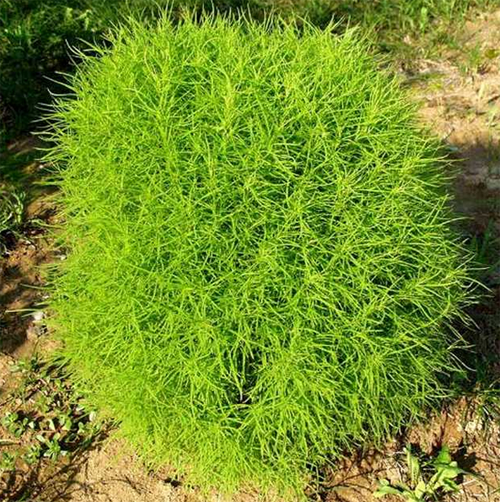
Growing methods for Kochia scoparia:
1. Soil selection
Actually, this Kochia scoparia can be planted in various places at home. If you really don't have a yard, you can also grow it in a pot! It's best to choose some fertile, loose sandy soil for planting. Ordinary potting soil mixed with some river sand will do!
2. Propagation
Kochia scoparia can also be propagated by sowing seeds. Generally, it can be sown in both spring and autumn, but it's best to plant in April. Sow in slightly moist sandy soil and keep it moist. It will sprout in less than 10 days.
After that, just give it plenty of light and water it when the potting soil is dry!
3. Temperature and watering
The growing temperature for Kochia scoparia is 10-30°C. It is relatively drought-tolerant and not strict about soil requirements. If you don't want to sow seeds, you can just buy a pot and grow it!
Water appropriately. Don't let water accumulate, and don't worry about it being too dry, because it is quite drought-tolerant. However, it does fear waterlogging. Generally, water once a week, watering thoroughly.
4. Fertilizing and sunlight
Generally, fertilizing twice a year is enough. Ordinary compound fertilizer will do. Apply light fertilizer in small amounts; its needs are not great!
More light will help it grow stronger. Potted plants need a little shading in summer. Ground-planted ones grow stronger and don't need much shading.
5. Weed removal
For ground-planted ones, weeds must be removed promptly. Potted plants basically have very few weeds, but weeds should still be pulled out promptly!
6. Pest and disease protection
Kochia scoparia is sometimes damaged by aphids. Generally, spray with 40% dimethoate emulsifiable concentrate diluted 1000-1200 times to kill them.
Ground-planted Kochia scoparia is sometimes parasitized by dodder, that kind of climbing parasitic plant. Just remove it when you see it.
The only other thing to watch out for is not to let water accumulate. Remember, it is drought-tolerant!
Alternative names for Kochia scoparia:
Broom seedling, broom vegetable. The names really aren't very appealing. The whole plant grows like a ball, normally emerald green, that tender kind of green, and in autumn it can turn red. It's really quite wonderful, especially during the period when it gradually turns red, it's even more stunning!
If you look carefully, Kochia scoparia and asparagus fern look unusually similar, and it really is very easy to mistake one for the other. That's all for the growing methods of Kochia scoparia. Hurry up and add a little greenery to your home.
What is broom vegetable? Introduction to the broom vegetable plant
[Common question] What is broom vegetable? Introduction to the broom vegetable plant
[Expert answer]
Broom vegetable, also known as Kochia scoparia, with alternative names broom seedling, iron broom, and wild spinach, is an annual herbaceous plant in the Chenopodiaceae family. Broom vegetable has strong adaptability and is widely distributed in China. It is not strict about climate, temperature, or humidity requirements, growing in open fields, mountain forests, wasteland, field edges, roadsides, orchards, and courtyards.
The plant is upright, with many branches and a compact form; leaves are alternate, linear, fine and dense, green, turning dark red after autumn; flowers are small and inconspicuous, not demanding about fertilizer and water, with extensive management, tolerant of pruning, tolerant of alkaline soil, tolerant of heat, resistant to drought, with extremely strong self-seeding ability, and the young tender stems are edible. Its seeds are also known as Kochia fruit, a Chinese medicinal material; see Kochia fruit for details.
Plant height is 50-100 cm. The stem is upright with many branches, and the overall plant shape is ovoid. Leaves are lanceolate, 2-5 cm long and 3-7 mm wide; with 3 main veins; leaves at the stem base are smaller, with 1 vein. Flowers are often clustered 1-3 together in leaf axils, forming a spike-like panicle. The perianth is nearly spherical, pale green, with triangular lobes. The utricle is flattened spherical, with a membranous pericarp, free from the seed. Seeds are black and glossy.
[Editor's review] The young tender stems of broom vegetable are edible, the seeds can be used as medicine, and after autumn the whole plant can be cut down and tied up to be used as a broom. It is a plant with a very wide range of uses. The editor of First Agricultural Economics has given you a brief introduction above. If you want to learn more about broom vegetable, you can follow the growing techniques channel on our website.
Cultivation and management of Kochia scoparia (broom grass)
Kochia scoparia (Kochia scoparia (L.) Schrad.), alternative names: Di Mai, Luo Zhou, broom seedling, broom vegetable, peacock pine.
The plant clump is compact, and the plant form is ovoid to spherical, obovoid, or elliptical, with many fine branches covered in short soft hairs, and the stem base is semi-lignified. The stem has many branches. Leaves are linear-lanceolate, simple and alternate, linear, linear or strip-shaped. Spike-like inflorescence, bearing small reddish-brown flowers; the flowers are extremely small and have no ornamental value. The utricle is flattened spherical. The plant is tender green, and the leaf color turns red in autumn. The fruit is flattened spherical and can be used as medicine, called Kochia fruit. The tender stems and leaves can be eaten, and the old plant can be used as a broom.
Cultivation methodsPropagation by sowing. Sowing is done in early April. Because Kochia scoparia has a taproot and does not tolerate transplanting, direct sowing in the open ground is used. Choose a place with sufficient sunlight, good air circulation, and good drainage, clear debris, level and rake fine, and at the same time apply decomposed and finely crushed compost or barnyard manure as base fertilizer, then rake the bed surface level and fine. When sowing, it is best to apply some superphosphate to promote strong root development. Before sowing, water the seedbed thoroughly. After the water has completely infiltrated the soil, mix the seeds with a small amount of fine sand and evenly scatter them on the seedbed, then use soil sifted through a 0.3 cm aperture sieve to evenly cover them on top, with a thickness 2-3 times the thickness of the seeds, so that the seeds are preferably not visible. Finally, evenly cover the bed surface with a layer of rice straw to reduce evaporation and loss of soil moisture and maintain a moist soil state for a longer time. Before the seeds sprout, if the surface soil dries, water promptly. When watering, pour the water onto the rice straw to prevent the seeds from being washed away. After the seeds germinate, promptly remove the rice straw to prevent the seedlings from becoming leggy due to insufficient light.
Cutting propagation can also be used. After transplanting the seedlings once, plant them out in the garden or flowerbed in early June. Because it has a taproot, planting out must be timely, otherwise the plant's growth vigor will be difficult to restore. The spacing between plants is generally 40 to 60 cm.
Cultivation management
It likes light, is drought-tolerant, not cold-tolerant, tolerant of alkaline soil, tolerant of pruning, and tolerant of hot climates. Kochia scoparia is relatively easy to cultivate and its management is also relatively extensive. Kochia scoparia is not strict about soil requirements, and can grow in ordinary soil, but if you choose well-drained, loose, and fertile soil, Kochia scoparia grows best. During the growth period, ensure the supply of fertilizer and water. Fertilizer should not be applied too heavily; generally, topdressing with liquid fertilizer 1-2 times is enough. When cultivating in summer, a certain humidity needs to be maintained. Kochia scoparia has a very strong self-seeding ability. To prevent it from self-seeding, you can cut it down promptly before the leaf color turns red. Because too much humidity and poor ventilation make it prone to damage by pests such as aphids, spray pesticides promptly for control.