Passionflower Growing Methods and Precautions, with Pictures of Flowers, Fruits and Vines
The fruit of the passionflower is unusually beautiful, shaped like a grape, round and plump, and very cute. What are the growing methods and precautions for passionflower? What do the flowers, fruits and vines look like?
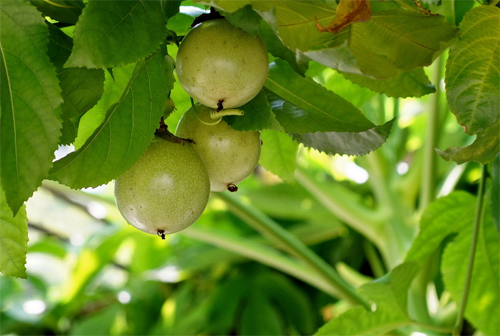
Passionflower growing methods:
1. Soil
Passion fruit is not fussy about soil; loose, well-drained, slightly acidic sandy soil is best, and of course it grows even better in slightly fertile soil!
Of course, the soil in a pot cannot be too shallow; it should be at least 70 cm deep!
2. Temperature
Passion fruit is a tropical fruit, so of course it likes a warm environment; a temperature of 20°C-30°C is best. In winter the temperature must be above 0°C; at minus 2°C it will die.
How do you judge whether you can grow passion fruit where you are? Look at the average temperature conditions of past years; generally, if the annual average temperature is above 18 degrees you can grow it. In slightly colder places it will not grow as well! (Do a good job of cold protection in winter: cover the surface with soil and cover with dry grass, etc.)
3. Watering and moisture
It likes warmth and moisture, so a year-round dry environment is not suitable. However, passion fruit is fairly cold-tolerant; it is just not suited to long-term drought, in which case you need to water it. In severe drought the branches and leaves will wither.
In the rainy season you must do a good job of drainage; waterlogging easily causes root rot.
4. Light
It of course needs plenty of sunlight and long-day care; grow it outdoors. Only with plenty of sun will it flower and fruit. In summer it does not need shading either.
5. Hand pollination
An older method is to collect the pollen sacs with tweezers, put them in a clean cup, add water and let the pollen dissolve into the water, then use a sprayer to spray the pollen water onto the stigma of the pistil to pollinate.
6. Disease control
Passion fruit has very few pests and diseases. At the seedling stage there can be damping-off, Phytophthora blight, mosaic virus disease, stem base rot, etc.
When planting, the soil should be disinfected and sterilized; either sun it or soak it in carbendazim.
For damping-off at the seedling stage, you can spray damping-off and wilt spirit or seedling fungus medicine; for mosaic virus disease you can spray Xiaoye Huangjue or Bingduling. For stem base rot you can spray carbendazim.
Precautions for passionflower:
1. Build a trellis
Passion fruit is generally planted in March to April, and generally you need to build a trellis or flower shed to let it climb and grow. For pot cultivation one plant is enough; for ground planting, plant one every 3-4 m, and do not plant too densely.
When the passion fruit has grown to 20-40 cm or more, you should remove its axillary buds. If you do not remove them it will affect flowering and fruiting; although axillary buds can grow branches, at that time they will consume too many nutrients!
3. Pruning and shaping
At the seedling stage you need to make a frame for it to climb, guiding the main vine up onto the trellis. When the main vine reaches 1 m, cut off the terminal bud so that side vines grow; keep 2 side vines on each side. When the side vines reach 2 m, cut off their tips to promote the growth of secondary side vines.
Passion fruit must not be heavily pruned. Generally, after the fruit is picked, leave 3-4 nodes on each side vine and cut it back short to promote new side vines. In summer, thin out overly dense branches to keep good ventilation.
4. Fertilizing
For passion fruit, a nitrogen-phosphorus-potassium ratio of 2-1-4 is suitable. Half a month after flowering is the period of rapid fruit enlargement, so strengthen fertilizer and water management and add potassium fertilizer.
Note:
In winter pay attention to cold and freeze protection; you can cover with straw mats, sorghum stalks, plastic film, etc. Cut off tender leaves, shorten the branches to shrink the canopy, and seal the cuts with plastic film to prevent the whole plant from freezing to death.
Pictures of passionflower flowers, fruits, vines and blooms:
1. Appreciating the flowers and fruits
It is also its flowering season now (flowering period April-July). The flowers look like a classical pendulum, like a wonderful corolla, very beautiful and very fragrant. The fruit is round and lovely, and the leaves are palmate with three leaflets. However, the leaves of passion fruit seedlings are round; only when grown do the leaves split into three leaflets.
2. Vines
As a fruiting climbing vine, passion fruit sends out some green tendrils from its leaf axils; like many melons and fruits, it twines around various objects to climb upward.
3. Flowers
The flowers of passion fruit are dioecious, so something needs to pollinate them for fruit to set. If you see butterflies or bees pollinating them, you do not need to help!
Other names for passionflower:
The fruit of the passionflower is very fragrant, and its aroma contains the flavors of banana, pineapple, lemon, strawberry, guava, pomegranate and so on, so it is called "passion fruit"; the fruit is as round as an egg, so it is also called "egg fruit." Have you ever eaten it?
That is all for the introduction to passionflower growing methods and precautions. Why not hurry up and grow one?
Passionflower Growing Methods and Precautions
Chinese scientific name: Xifanglian (passionflower)Latin scientific name: Passiflora coerulea L.Other names: egg fruit, passion fruit, Brazilian fruit, baixiangguo, vine peach, passion fruit, zhuanxinlian, zhuanzhilianBinomial name: Passiflora coeruleaKingdom: PlantaePhylum: AngiospermsClass: DicotyledoneaeSubclass: ArchichlamydeaeOrder: ParietalesSuborder: TheineaeFamily: PassifloraceaeGenus: PassifloraDistribution: native to South America. Cultivated in tropical and subtropical regions, Guangxi, Jiangxi, Sichuan, Yunnan and other placesFlowering period: May-JulyEdible value: processed into juiceMedicinal value: dispels wind and clears heat, wind-heat dizzinessUse: garden ornamental plantPassionflower (scientific name: Passiflora caerulea L.) is a perennial evergreen climbing woody vine, an aromatic and tasty fruit, and has the reputation of "king of juices." It is also known as egg fruit, passion fruit, Brazilian fruit, baixiangguo, vine peach, passion fruit, zhuanxinlian, xiuyangju, zhuanzhilian, yangsuanqie flower, and clock flower. The stem of passionflower is cylindrical with slight angles, hairless; leaves papery, base heart-shaped, palmately 5-parted deep, the middle lobe ovate-oblong, the two side lobes slightly smaller, hairless, entire; cymes reduced to only 1 flower, opposite the tendrils, flowers large, pale green; berry ovoid to nearly spherical, orange-yellow or yellow when ripe; seeds numerous, obcordate, about 5 mm long. Flowering period May-July. According to measurements, passionflower fruit contains more than 135 kinds of aromatic substances, and is most suitable for processing into juice, or mixed with other fruits (such as mango, pineapple, guava, citrus and apple, etc.) into blended juice, which can significantly improve the taste and aroma of these fruit juices; it can be used as an additive in ice cream or other foods to enhance aroma and improve quality. It is native to Brazil, and later was planted in South America, South Africa, Southeast Asian countries, Australia and various regions of the South Pacific. (Overview image reference source)1. Morphological characteristics
Herbaceous vine; stem cylindrical with slight angles, hairless, slightly covered with white powder; leaves papery, 5-7 cm long, 6-8 cm wide, base heart-shaped, palmately 5-parted deep, the middle lobe ovate-oblong, the two side lobes slightly smaller, hairless, entire; petiole 2-3 cm long, with 2-4 (-6) small glands in the middle; stipules relatively large, kidney-shaped, stem-clasping, up to 1.2 cm long, margin wavy.Cymes reduced to only 1 flower, opposite the tendrils. Flowers large, pale green, diameter large, 6-8 (-10) cm; pedicel 3-4 cm long; bracts broadly ovate, 3 cm long, entire; sepals 5, 3-4.5 cm long, pale green outside, greenish-white inside, with 1 horn-like appendage at the outer tip; petals 5, pale green, nearly as long as the sepals; outer corona filaments in 3 series, filamentous, the outer and middle series 1-1.5 cm long, sky blue at the tip, white in the middle, purplish-red in the lower part, the inner series filamentous, 1-2 mm long, with 1 purplish-red head-like body at the tip, pale green in the lower part; inner corona fringed, the lobes purplish-red, with 1 glandular ring below; with a disc, about 1-2 mm high; androgynophore 8-10 mm long; stamens 5, filaments free, about 1 cm long, flattened; anthers oblong, about 1.3 cm long; ovary ovoid; styles 3, free, purplish-red, about 1.6 cm long; stigma kidney-shaped.
Berry ovoid to nearly spherical, about 6 cm long, orange-yellow or yellow when ripe; seeds numerous, obcordate, about 5 mm long. Flowering period May-July.
2. Geographical distribution
Cultivated in Guangxi, Jiangxi, Sichuan, Yunnan and other places in China, sometimes naturalized. Native to South America. Commonly cultivated in tropical and subtropical regions.3. Growth habits
Passionflower is a tropical and subtropical fruit and likes light, sunny and warm climatic conditions. Passionflower has strong adaptability and is not strict about soil; it can be planted in front of and behind houses, on hillsides and along roadsides, but it grows best in sunny garden plots rich in organic matter, loose, with deep soil layers, good drainage and plenty of sunlight. It dislikes waterlogging and is not drought-tolerant; the soil should be kept moist.4. Main varieties
Passionflower mainly has four major varieties: yellow-fruited, purple-fruited, green-fruited, and hybrids of yellow and purple. Passionflower is mainly planted with the yellow-fruited and purple-fruited types.The fruit skin of the purple-fruited type is purplish-red, and the vine is green; it is suitable for planting in places with cool summers at an altitude of 300 to 500 m, and is not suitable for cultivation in the Pearl River Delta or areas to the south where summer temperatures are high.
The yellow-fruited type has strong adaptability, larger fruit, higher yield, excellent quality and a higher juice rate, but poorer cold tolerance. Some varieties also show self-incompatibility and need artificial supplementary pollination. Planting yellow passionflower is advocated; the main cultivars were all bred by South China Agricultural University after introducing them from around the world and then selecting and breeding them. There are mainly two types: one is the varieties that need artificial pollination, such as Huayang, Shanhuang or Changhuang, and Xuan 1; the other is naturally setting varieties, such as Xuan 511.
5. Propagation methods
Passionflower can be propagated by seeds, layering and cuttings. Because the fruit has many seeds and a high germination rate, seed propagation is mostly used in production.Seeds
Seed propagation can be carried out all year round, but sowing in spring and autumn is best. Generally, choose plants with robust growth, no pests or diseases, and high and stable yield as mother plants; collect fruit with a regular shape, slightly heavy and fully ripe, take out the seeds, wash off the residue and dry them before sowing. When sowing, mix 1 kg of seeds with 10-20 g of carbendazim for about 20 minutes, then evenly broadcast the seeds on the seedbed, cover with a thin layer of grass and water thoroughly. After sowing, water according to the weather; on sunny days spray water once in the morning and once in the evening. After about half a month they begin to emerge. When more than 80% have emerged, topdress in time; you can sprinkle dilute liquid fertilizer or dilute urea solution to cultivate strong seedlings. When the seedlings grow 4 true leaves, transplant them.Layering
Layering propagation is a kind of asexual propagation, best done in spring from February to March. It is a propagation method in which branches on the mother plant are pressed into the soil or wrapped with soil and other materials to form adventitious roots, and then the branches above the adventitious roots are separated from the mother plant to form an independent new plant. When layering, in order to interrupt the downward transport of organic matter such as sugars, auxins and other substances from the leaves and upper branches, so that these substances accumulate in the upper part of the treated area for use in rooting, ring-barking can be carried out. This method is simple, grows fast, and takes a short time to become a seedling.Cuttings
Use the cutting propagation method for raising seedlings. The cutting time is best in spring from February to March, and autumn cuttings are also possible. Choose robust, mature one-year-old vines as cutting material; cut the cuttings into pieces with 2-3 nodes, about 10 cm-15 cm long, with the lower cut 1 cm below a node and the upper cut 3 cm from a node, with 1 whole leaf on the cutting. After cutting, soak the cuttings in an aqueous solution of Abr rooting powder at 25 mg/kg for 30 minutes, then insert them into 8 cm diameter x 12 cm high nutrient bags for cultivation. The nutrient soil is best with 50% fine loess and 50% humus soil. The insertion depth reaches 2/3 of the cutting length. After inserting, arrange the nutrient bags on the seedbed and water immediately; the first watering must be thorough, and afterward water according to the weather to keep moist. The seedbed is 1.0 m-1.2 m wide, and the length depends on the terrain. Use bamboo strips to make arched supports and cover with a shade net of 50% shading. After 30 days the seedling survival rate can reach more than 85%. From cutting to leaving the nursery takes about 3-4 months.6. Cultivation techniques
Orchard establishment
Deep plowing and land preparationTo plant passionflower, the planting belt should be wide, the holes large, the topsoil sufficient, the root circle large, and the trellis height and density reasonable. The planting belt is more than 1.1 m wide, sloping inward 5 to 8 degrees, with the inner wall inclined more than 70 degrees; the planting belt and inner wall should be smooth and neat, and a 20 cm x 30 cm small ridge should be built on the outer edge of the planting belt; plant spacing 3 m x 4 m, hole mouth width 60 cm, bottom mouth width and depth each 40 cm; topsoil should be fertile and sufficient to facilitate backfilling and building the root circle; the root circle soil is 20 cm high and more than 70 cm in diameter; the climbing trellis height is 2.2 m on windward slopes and 2.5 m on leeward slopes.
Planting posts and building trellises
Common types:
① Single-wall trellis, that is, one or two wires stretched on a row of upright posts, the posts about 2 m high, post spacing 6 m, with two plants planted between them;
② T-shaped trellis, similar to the single-wall trellis, except that a crossarm is placed on top of each post and two wires are stretched at the two ends of the arm.
Support materials:
Mainly cement posts plus iron wire or aluminum wire; wooden sticks and bamboo poles can also be used.
Support spacing and quantity:
The post spacing of cement posts is 4 m, in the same direction as the passionflower plant rows, with 56 posts used per mu. The cement posts are 220 cm long, planted to a depth of 40-50 cm, with 180 cm above ground. Stretch lead wire or iron wire in two layers, the first layer at a height of 100 cm.
Planting fruit seedlings
Both bare-root seedlings and bagged seedlings can be used. Bare-root seedlings are convenient to transport and low in cost, but have a low survival rate; bagged seedlings resume growth quickly after planting, making drought-resistant planting easier, but the cost is higher.
When breeding, first soak the seeds in water for 2 to 3 days, rub off the outer gelatinous layer of the seeds by hand, mix each kilogram of seeds with 10 to 15 g of carbendazim or thiophanate-methyl, and sow after 20 to 30 hours of mixing. Keep the nursery at 40% to 50% shading. After sowing, water once every 3 days, open the shade shed for ventilation for 1 day; after 7 to 10 days the seeds germinate and some emerge; remove the covering grass and the plastic film enclosure.
Planting period
Planting can be done in all three seasons of spring, summer and autumn, with spring and autumn best.
Planting method
Mainly the upright fence type; garden cultivation can use the shed trellis type.
Cultivation density
For block cultivation the row spacing is 3 x 2 m. Plant 111 per mu.
Precautions
When planting seedlings, properly cut off old leaves; the nutrient bag must be broken open and removed and must not be buried in the soil. When setting the seedlings, mix an appropriate amount of decomposed organic fertilizer with sandy loam as planting soil or covering soil. When planting, straighten out the root system, fill soil in layers, and tread firmly and compactly. Water the roots promptly after planting. For newly dug planting holes, when planting the seedling root crown should be slightly 8-10 cm above the ground surface. After planting, tidy the tree basin and cover with a small piece of plastic film 50 x 50 cm.
Maintenance management
Reasonably intercrop short-stature crops such as peas, strawberries, potatoes, white konjac and vegetables between fruit tree rows, to make full use of land and light and heat resources and increase yield per unit area and overall benefits.Young tree care
After the small seedlings resume growth, remove buds once every 5 days to promote rapid and thick growth of the main vine. Complete orchard pruning before the end of February each year, cutting off diseased and pest-damaged branches and branches that have already fruited; dig drainage ditches before the rainy season and tidy the root circle to prevent waterlogging; during the peak flowering period from late June to early July, spray the leaves with 250 times potassium dihydrogen phosphate solution to promote flowering; during the peak fruiting period in late July, spray the leaves with 6000 times "Yunda-120" and 0.2% borax to protect the fruit. Root topdressing can also be done to promote flowering and protect fruit. Before the dry season, deep-plow the soil of the planting belt once, cut down the weeds on the protection belt and cover them on the planting belt, so as to keep warm, retain moisture and increase the organic matter content of the soil.
Shaping and pruning
When the young tree grows to 40-50 cm, set up a support in time and guide the young vine onto the trellis. Young trees mainly use the single main vine, double-layer, four-main-branch shaping method. When the main vine grows to 70-80 cm, keep 2 side vines and guide them separately onto the trellis as the first layer of main vines. When the plant grows to 150-160 cm, keep another strong side branch, which together with the extended main vine serves as the second layer of main branches, guiding them in opposite directions onto the trellis to form a double-layer, four-branch vine shape. During this period, all side branches and sprouting branches on the main vine below 80 cm and between 80-160 cm should be cut off or removed.
Shaping
① Single-vine shaping: keep one main vine per plant. When the main vine reaches the wire, let it grow with the wind, then keep one side vine and let it grow in the opposite direction;
② Double-vine shaping: keep two main vines per plant; when the main vines reach the wire, guide them to grow in two directions.
Pruning
Prune after fruit harvest, cutting back to secondary main vines or third-order vines and above. Do not prune heavily during dormancy or the inactive growth period. Do this for the yellow-fruited type in December-February, and for the purple-fruited type in August-September. When the vines cover the trellis surface, cut off the inner leaves and old non-fruiting branches, and cut back drooping branches to 15 cm above the ground. Old and diseased trees can be heavily pruned; all secondary branches are cut short at 20 cm from the main vine to stimulate the formation of new shoots.
Hand pollination
The yellow-fruited type requires hand pollination, and hand pollination of the purple-fruited type can increase yield. The method is to collect the anthers just as the flower opens, then use a brush to apply the pollen to the stigma.
Fertilizer and water management
When passionflower is first planted, base fertilizer application should be combined with digging the planting holes. Apply 10-15 kg of decomposed farmyard manure per hole, backfill the hole with soil and then plant. After fruit harvest each year, apply sufficient base fertilizer together with pruning and weeding, applying 8-10 kg of decomposed organic fertilizer per plant. Passionflower topdressing is generally carried out after the plants survive planting, once a month, first light then concentrated, preferably with dilute manure water.
After planting, irrigate and drain in good time according to the weather and the seedlings, and apply light fertilizer or foliar fertilizer 2-3 times. For foliar fertilizer, spray 400 times Maobifeng solution.
After the plants are trellised, organic fertilizer based mainly on human and animal manure plus compound fertilizer can generally be applied as a top dressing before new shoot growth, at full bloom and during the heavy fruiting stage. The fertilization method is to dig a ring trench 30-40 cm from the base of the plant, apply the fertilizer evenly, and cover it with soil to avoid damaging the roots.
Passion fruit is quite sensitive to nitrogen fertilizer; applying too much before flowering easily leads to excessive vegetative growth, so more phosphorus and potassium fertilizer should be applied as appropriate.
Irrigation
Passion fruit has strict water requirements; it fears both waterlogging and drought. Lack of water during flowering and fruiting can lead to small fruit, reduced quality and fruit drop. Therefore, drainage should be attended to during the rainy season, and timely watering is needed during drought. Normally, keep the soil from turning pale; during flowering and fruit set, it is best for the soil moisture content to approach field capacity, but without waterlogging. Sprinkler or drip irrigation is preferable. It is best to grow shallow grass or cover with plastic film between the rows to maintain soil moisture. Avoid interplanting with cucurbit crops to prevent infection by viral diseases.
Fruit Harvest
FloweringThe flower buds of passion fruit are of the current-year differentiation type; they differentiate while the shoots are growing, and it takes only about 30 days from flower bud differentiation to flowering. Cuttings planted in the current year can flower by June, and a small amount of fruit comes onto the market in August. In the second year it enters the formal fruiting period, and it can flower multiple times from March to November each year. Each node at the base of the flowering shoot can form 1 flower, and in production 4-6 normal flowers can form in succession, after which a normally developed flower can form every 2-3 nodes. It takes 18-20 days from flower bud formation to flowering, and flowering generally occurs at 10-11 a.m.
Fruiting
The time needed for fruit to mature varies with the flowering season: flowers that open in May-June mature 50-60 days after flowering, flowers that open in August-September need 70-90 days to mature, and flowers that open after October need 100-120 days to mature. Its self-pollination fruit set rate is high, and mature fruit can be picked from mid-June each year to early February of the following year, with the most concentrated harvest periods in early July and late October.
The fruit is nearly spherical or ovoid, with an average longitudinal diameter of 6.4 cm, a transverse diameter of 5.8 cm, a fruit shape index of 1.1, and an average single fruit weight of 65 g; the young fruit is green, and the mature fruit has a purplish-red rind 0.3-0.6 cm thick and somewhat firm; the flesh (aril) is orange-yellow, low in acidity, strongly aromatic and good in flavor, suitable both for fresh eating and for processing into juice, with a juice content of about 28% and a soluble solids content of 15%-16%; the seeds are small, numerous and black. After ripening the fruit falls off naturally and stores and ships well.
7. Disease and Pest Control
The main diseases and pests of passion fruit include root rot, anthracnose, mosaic disease, fruit-boring insects, termites, red spider mites, aphids and so on. Prevention should be the priority: timely pruning and leaf thinning to ensure ventilation and light penetration, along with good drainage, can reduce the occurrence of diseases and pests.Root Rot
Control methods:Spray with 70% thiophanate-methyl at 800-**** times dilution;
Anthracnose
Control methods:Use 50% carbendazim at 500 times dilution or 40% miebingwei suspension at 400 times dilution for control.
Mosaic Disease
Affected leaves appear mosaic-like, with pale yellow spots, and the leaves crinkle; the fruit shrinks and becomes deformed, the rind thickens and hardens, and the flesh is scant or absent. It is spread by aphids and occurs more often in cool, dry seasons.Control methods:
1. Cultivate virus-free seedlings;
2. Eliminate the transmission vector, aphids, and remove diseased leaves and diseased plants;
3. Strengthen cultivation management to improve plant resistance;
4. Do not plant cucurbit or solanaceous vegetables near the orchard.
Fruit-Boring Insects
Control methods:At around 8 a.m., use 90% trichlorfon at 1000 times dilution (or dichlorvos at 1500 times dilution) plus 3% brown sugar, spraying once every 4-5 days for 3-4 consecutive sprays; or hang 5-6 lantern-type insect traps (with double cotton balls) per mu to lure and kill the insects. Of the two cotton balls, one is dripped with attractant (add 2 ml every 20 days) and the other with dichlorvos (replenish the pesticide once every 10 days). This is done from after the fruit trees shed their flowers to before the fruit enlargement stage, and dead insects should be cleaned out regularly.
Termites
Control methods:1. Scatter termite poison around the roots.
2. After planting in the orchard, place 1 to 2 mothballs 1 chi from the main trunk of each tree to drive termites away.
Red Spider Mites
Control methods:1. Spray evenly with manwei at 4000-**** times dilution (each 100 ml bottle mixed with 800-**** jin of water),
2. Spray evenly with 40% dicofol emulsifiable concentrate at 1000-1500 times dilution,
3. Spray evenly with 20% mieshijing wettable powder at 2000 times dilution,
4. Spray evenly with 15% pyridaben emulsifiable concentrate at 2000 times dilution,
5. Spray with 1.8% abamectin emulsifiable concentrate at 6000-8000 times dilution, etc., all of which can achieve ideal control results.
Aphids
Control methods:1. Use 50 ml of 25% gamieqing emulsifiable concentrate,
2. Spray with imidacloprid series products at 1500-2000 times dilution,
3. 60-70 g of 10% yashijing;
4. Spray with 20% imidacloprid at 2500 times dilution;
5. Spray with 25% pirimicarb at 3000 times dilution for control.
Coffee Wood Moth
It bores into and feeds on the branches, causing all the branches, flowers and fruit above the entry hole to gradually dry up and die.Control methods:
Check regularly in ordinary times; when insect frass is found at the bore entry and below it, promptly inject 100 times dilution of dichlorvos or omethoate with a syringe, then seal the bore entry with cotton and sticky yellow clay to kill the pest.
Other Pests
Newly reclaimed orchards in some areas may be harmed by insects such as termites, scarab beetles and fruit flies, and some areas may also have scale insect damage; keep a close watch and control them promptly. The above other pests can be controlled by spraying with 45% or 50% malathion emulsifiable concentrate at 500 to 1000 times dilution, or with 50% methamidophos emulsifiable concentrate at 250 to 400 times dilution. Note that scarab beetles come out in the evening to bite and eat the leaves, so it is best to spray in the evening. In addition, the larvae of scarab beetles, known as white grubs, live underground and damage the root system of passion fruit; if found when loosening the soil and applying fertilizer, they should also be removed promptly. Take special care that methamidophos should not be used during the flowering and fruiting period to avoid pesticide poisoning of people and livestock.8. Main Value
Edible Use
According to expert analysis and testing, passion fruit contains rich protein, fat, reducing sugar, multiple vitamins and as many as 165 compounds including phosphorus, calcium, iron and potassium, as well as 17 amino acids essential to the human body. Its nutritional value is very high, among which the vitamin content is 1345 (1·U/100G), an effective anti-cancer component, and the niacin content is 1.7 mg/100G, which has a positive effect on preventing cardiovascular diseases. Ripe passion fruit has a fragrant aroma; when cut open, the fragrance fills the air and penetrates the heart and lungs, and the fruit contains a large amount of pulp and juice. It tastes sweet and sour and is pleasant to eat, promoting salivation and quenching thirst, and refreshing the mind. It is especially suitable for processing into products such as juice, fruit syrup, jam and jelly that have a unique flavor, are rich in nutrients, nourish and strengthen the body, and aid digestion. The passion fruit juice beverage produced in Xishuangbanna has already sold well both domestically and abroad. The seeds of passion fruit have an oil content as high as 21.7%-25.25%, and the oil quality is comparable to sunflower oil, making it a high-quality edible oil. The roots, stems and leaves of passion fruit can all be used as medicine, with effects of reducing inflammation and relieving pain, promoting blood circulation and strengthening the body, and lowering lipids and blood pressure. In addition, the rind of passion fruit is also a very good feed.1. Deep Cleansing Mechanism
Super fiber can penetrate the finest parts of the stomach and intestines, absorb harmful substances in the body through its active genes and expel them completely, and can improve the composition of intestinal flora, serving as a barrier that protects the stomach and intestines from absorbing harmful substances. Passion fruit can inhibit the growth of harmful microorganisms in the digestive tract. The combination of the two has a significant effect on eliminating toxins from the body, regulating the intestines and strengthening the stomach, and improving the body's nutrient absorption function, and has a special eliminating effect on colitis, gastroenteritis and hemorrhoids.
2. Detoxifying and Beautifying Mechanism
It purifies the body and prevents harmful substances from depositing in the body, thereby achieving the effect of improving the skin and beautifying the complexion.
3. Body-Shaping Mechanism
Eating passion fruit can increase the feeling of fullness in the stomach, reduce the intake of excess calories, and can also adsorb organic molecules such as cholesterol and bile, inhibiting the body's absorption of fat. Therefore, long-term consumption helps improve the body's nutrient absorption structure, reduce body fat, and shape a healthy and graceful figure.
4. Promoting Metabolism
Super fiber can promote excretion, relieve constipation symptoms, clear irritating substances adhering to and retained in the intestinal tract, and avoid irritating the intestines and being reabsorbed by the body, thereby reducing the incidence of colon cancer; super fiber also has anti-tumor activity. The VC in passion fruit participates in cholesterol metabolism, can lower cholesterol and purify the blood. In addition, the VC, carotene and SOD enzyme richly contained in passion fruit can clear free radicals in the body, playing a role in beautifying the skin and resisting aging.
Ornamental Use
Passion fruit is beautiful in both flower and fruit, with large and peculiar flowers; it can be enjoyed both for its flowers and its fruit, making it a very ideal ornamental garden plant.Medicinal Use
Passion fruit is a well-known herbal medicine in Europe, used to treat insomnia and anxiety. In the 16th century, Spanish explorers first encountered passion fruit among the Indian tribes of Peru and Brazil and brought it to Europe. The Indians considered passion fruit the best sedative. Modern medicine holds that passion fruit is rich in 17 amino acids essential to the human body and more than 160 beneficial components such as multiple vitamins and trace elements. Among them, the abundant natural active component flavonoids are the basic elements for reducing irritability and relieving stress, and their excellent stress-relieving effect helps with falling asleep. Its purely natural sedative effect works in accordance with the body's natural mechanisms, and it has none of the side effects of ordinary sleeping pills or sedatives, such as damage to the liver and kidneys, dizziness, headache and memory decline.Passion fruit has multiple health benefits: it is a natural sedative with especially good effects in relaxing and calming the nerves; it treats insomnia, inducing natural sleep and deep sleep, and eliminates phenomena such as headache and dizziness; it soothes headache, stomachache, frequent urination and palpitations caused by anxiety, tension, depression and nervous tension; it improves muscle spasms, convulsions and pain caused by nervous tension; it relieves all discomfort caused by nervous tension and extreme anxiety; it improves extremely low mood and excessive mental anxiety; it treats qi stagnation syndrome, relieves bloating and aids digestion.
Source
Medicinal material basis: the whole plant of passion fruit, a plant of the Passifloraceae family.
Harvesting and storage: in summer and autumn, when the aboveground part grows luxuriantly, collect the whole plant and dry it in the sun.
Nature and Flavor
"Sichuan Traditional Chinese Medicine Records": warm in nature, bitter in taste, non-toxic.
Functions and Indications
Dispels wind; removes dampness; invigorates blood; relieves pain. Mainly for common cold with headache; nasal congestion and runny nose; rheumatic joint pain; dysmenorrhea; neuralgia; insomnia; dysentery; fractures.
1. Wang Dianxiang, "Pharmacognosy": used for neuralgia, insomnia, menstrual pain and dysentery and other conditions, with anesthetic and sedative effects.
2. "Sichuan Traditional Chinese Medicine Records": dispels wind and clears heat, relieves cough and resolves phlegm. Treats wind-heat dizziness, nasal congestion and runny nose.
Usage and Dosage
Internal use: decoct in water, 15-20 g. External use: appropriate amount of fresh product, crush and apply.
Supplementary Formulas
1. To treat cough from exogenous wind-heat: zhuangzhilian stems and leaves, bazihua and loquat leaves 9 g each, decoct in water and take. ("Xichang Chinese Herbal Medicine")
2. To treat mania (mental disorder): zhuangzhilian root 15-25 g, one pig heart (with 1 g of kousha added inside), eat.
3. To treat insomnia: zhuangzhilian fruit 15 g, xianhecao 30 g. Simmer in water and take.
4. To treat abdominal pain during menstruation: zhuangzhilian fruit 1-2 pieces, baiwei root 10 g. Soak in liquor and take.
5. To treat dysentery with fishy pain: zhuangzhilian root and quanshen 10 g each, simmer in water and take.
6. To treat fractures: zhuangzhilian root 15 g, yupipa leaves 30 g, shuidonggua root bark and xuduan root 15 g each. Crush into a mash, mix with liquor and apply as a poultice to the affected area, (formulas 2-6 are from "Guizhou Herbal Medicine")
9. Chemical Composition
It contains chrysin, benzodiazepine-like compds, tetraphyllin B-4-sulfate from New Zealand passion fruit, and the leaves contain flavonoid glycosides, diphenolic flavone pigments, monophenolic flavonosides. The whole plant contains C-glucosides of apigenin and luteolin, including vitexin, isoorientin and apigenin-8-C-diglucoside. It also contains lipids, and the flowers and fruit clusters contain pyrocatechol, gallic acid, palmitic acid, myristic acid, sitosterol, glucose and so on.10. Plant Culture
Flower Language
LongingLegend
It is said that in the legends of the American Indians, passion fruit was the daughter of the day. She inherited the passionate sunlight given by her father, and her body was always filled with a brilliant smile; she was the most beautiful flower in the forests and grasslands.One day, when the morning star first rose, passion fruit was awakened from her sleep by a clamor. She opened her eyes and saw a young man playing in the water by the river. His handsome appearance attracted the princess, and passion fruit fell in love with him at first sight. This young man was unlike the other people passion fruit saw during the day; he was the guide of the night, appearing only at night. The princess admired this night guide very much, counting the time at every moment, waiting for the arrival of night, hoping to see the night guide once.