Snake Plant Care Methods and Flowering Tips: What to Do When Leaves Turn Yellow and Rot
The snake plant (Sansevieria) is very beautiful to look at, and its leaves are very attractive. Many people who grow snake plants have never seen one bloom. Getting a snake plant to flower is not easy. Let's look at what methods can make a snake plant bloom. And what should you do if leaves turn yellow and rot during cultivation?
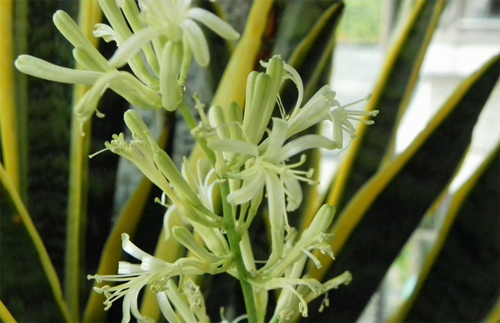
Snake Plant Flowering Care Methods:
As long as it is cared for properly, the snake plant can bloom every year, flowering in spring and summer. Right now is also its flowering season. Its flowers are white, and there are also white-green flowers. The flower shape is like a mini version of an aloe flower. Its flowers smell slightly fragrant and are quite pleasant!
Its fruit basically never appears; in natural conditions it is very hard to find even one!
If you want your snake plant to bloom, you need to create a cool, dry environment. You cannot water frequently. Today a gardening friend showed me her own snake plant, which had bloomed with strings of white flowers. It is still quite rare!
1. Pot and soil selection:
The soil for growing snake plants does not need to be very fertile, but it must be loose and breathable, and it must also have good drainage. Although humus soil is fertile, it is not as suitable for snake plants as sandy soil!
2. Watering
The principle of watering is to prefer dry over wet, and to water as little as possible. The exception is the first two weeks after transplanting, when you can keep it slightly moist, but it must not become waterlogged! Watering afterward should also depend on the weather. Do not water on cloudy and rainy days (in winter there is basically no need to water much either), and do not water too much on sunny days. Watering after the potting soil has been dry for a few days is most suitable!
3. Light
In fact, gardening friends' experience shows that a snake plant does not need abundant light to bloom. A snake plant kept in a ventilated spot with bright light can also bloom.
It should be noted that snake plants do not like too much sunlight. Indirect light or a semi-shaded environment is actually most suitable for them. Being able to get one or two hours of sun each day is enough.
In spring and autumn, you can give a little slow-release fertilizer! If the temperature is 18°C - 27°C year-round, that is best. Of course, we can only try our best to meet its needs! In winter, above 10°C is best, and in summer, below 30°C is best!
Tip: Its flowers smell stronger at night. That is it trying to attract some moths for pollination. During the day, its flowers have a relatively faint fragrance, or you cannot smell them at all!
What snake plants fear most is being watered with cold water, and also being watered too much. We need to pay attention to both of these, even though summer is almost here! But you still have to remember!
How do you solve leaf rot and rhizome rot in snake plants?
If the upper leaves are rotting, then directly cut off the rotten part, control watering in the potting soil, and place it in a ventilated, cool, semi-shaded environment! In severe cases, you can spray carbendazim or chlorothalonil, and spray according to the dosage!
If the rhizome is rotting, then you need to pull the snake plant out, cut away the rotten part, soak it briefly in carbendazim or potassium permanganate, let it dry slightly, and then replant it in the center of slightly moist sandy soil that has been disinfected or sun-baked!
What should you do if snake plants have insects?
Hot, humid weather in summer easily attracts insects, especially mealybugs, so in summer you should do good shading and ventilation work, and clean the environment regularly!
If you see insects, promptly spray phoxim. During overwintering, spray lime sulfur mixture. This can appropriately reduce future disease sources.
How do you deal with frostbitten or sunburned snake plants?
For frostbitten or sunburned snake plants, promptly remove the severely affected parts, cover with plastic film! Place it in a cool, semi-shaded spot to recover!
That is all for the care methods to make a snake plant bloom. The flowers even have a fragrance. Hurry and give it a try.
Do Snake Plants Bloom? Plus Snake Plant Care Methods
Many friends online are asking why their snake plants have not bloomed for several years. Do snake plants bloom? Here the editor tells everyone that snake plants do bloom, but sometimes it is like fate: something you can encounter but cannot seek. Here the editor also shares snake plant care methods, hoping to be helpful to everyone.
Do Snake Plants Bloom?
A blooming snake plant is relatively rare. That is to say, not every one will bloom, and it does not bloom every year either. It may bloom only once every few years, or even more than ten years. So growing this plant requires patience and perseverance, and you should also pay more attention to it in normal times. It is suggested that you buy and grow several different varieties together, so that the chance of blooming can be greatly increased!
Care Methods:
For potted snake plants, you can use equal parts leaf mold and garden soil mixed with a small amount of decomposed base fertilizer as the growing medium. It grows well under conditions of sufficient light. Apart from avoiding direct exposure to strong sunlight in midsummer, it should receive plenty of sunlight in other seasons. If it is placed in a too-dark indoor spot for too long, the leaves will become dull and lack vitality. In addition, if it has been kept indoors for a long time, it should not suddenly be moved directly into the sunlight. It should first be moved to a brighter spot and given time to adapt before getting sunlight, so the leaves do not get scorched.
Snake plants should be watered appropriately, following the principle of preferring dry over wet. In normal times, wipe dust off the leaf surface with clean water to keep the leaves clean and shiny. In spring, when new plants sprout from the root crown, water appropriately more to keep the potting soil moist. In the high-temperature season in summer, the potting soil should also be kept moist regularly. After late autumn, watering should be controlled, and the potting soil should be kept relatively dry to enhance cold resistance. It does not have high fertilizer requirements. During the growing season, apply 1-2 times a month of dilute liquid fertilizer to ensure the leaves are verdant and thick.
The snake plant likes warmth and humidity, tolerates drought, likes light and also tolerates shade. It is not strict about soil requirements, and sandy loam with better drainage is better. Its suitable growth temperature is 20-30°C, and its overwintering temperature is 10°C. Snake plants can be propagated by division and cuttings.
Snake Plant Care Tips
(1) Soil: Snake plants require loose soil with strong breathability, so when mixing soil for snake plants, be sure to use 2/3 leaf mold plus 1/3 garden soil. Remember that the soil must be loose and breathable, otherwise water will not evaporate easily, causing rhizome rot. You can also use 3 parts fertile garden soil mixed with 1 part cinder, plus a small amount of soybean cake or chicken manure as base fertilizer.
(2) Temperature: Snake plants have relatively high temperature requirements. Their suitable growth temperature is 20-30°C, and growth stops below 13°C. In winter, the lowest temperature should not be below 10°C, otherwise the base of the plant will rot, causing the whole plant to die.
(3) Watering: During the growing season, watering snake plants should follow the principle of preferring dry over wet. In spring, when new plants sprout from the root crown, water appropriately more to keep the potting soil moist. In the rainy season, never let water accumulate in the pot. In normal times, wipe dust off the leaf surface with clean water to keep the leaves clean and shiny. Generally speaking, if the soil is relatively loose, water twice a week. In winter, when the weather is colder, watering only once is enough.
(4) Light: Snake plants like light, so be sure to let them get sunlight often. It is best to place them where they can be directly exposed. If conditions do not allow, then place them somewhere close to sunlight. Being placed in a dark place for a long time will cause the leaves to turn yellow.
(5) Fertilizing: Do not apply excessively. During the peak growing season, apply fertilizer 1-2 times a month, and the amount should be small. If only nitrogen fertilizer is applied for a long time, the patterns on the leaves will become dull, so compound fertilizer is generally used. You can also evenly bury 3 holes of cooked soybeans in the soil at the edge of the pot, 7-10 beans per hole, and be careful not to let them touch the roots. Stop fertilizing from November to March of the following year.
(6) Pests and diseases: Bacterial soft rot; after infection, the leaves appear light yellow-green or gray-yellow, and water-soaked soft rot spots appear on the stem near the ground, making it easy to break. When watering, avoid splashing onto the leaves. If diseased leaves are found, remove and destroy them promptly. When disease occurs, spray 12% copper green emulsion at 600 times dilution or 72% agricultural streptomycin at 4000 times dilution. Spray once every 7-10 days, for 2-3 times in a row.
From the introduction above, I believe everyone now knows that snake plants do bloom. It just requires the right care methods and some lucky coincidence, because it is something you can encounter but cannot seek. If your snake plant blooms, then congratulations, your luck is something many people envy. For more information about snake plants, please continue to follow Tubatu Learning Decoration.
Snake Plant Care Methods and Precautions: A Detailed Explanation of How to Grow Snake Plants Correctly
Snake plant is what we commonly call sansevieria. Because of its strong adaptability, decorative value, and practicality, it is loved by more and more consumers. So what are the care methods and precautions for snake plants? Below is a detailed explanation of how to grow snake plants correctly, teaching you to grow robust and upright snake plants.
Snake Plant Care Methods and Precautions: A Detailed Explanation of How to Grow Snake Plants Correctly
The snake plant is a perennial herbaceous flowering plant in the orchid family, with upright leaves, thick texture, linear lanceolate shape, and white and dark green alternating “tiger tail”-like horizontal band patterns on the leaf surface, strange and interesting. It is native to North Africa and nearby areas. It has particularly strong adaptability, likes warmth and humidity, tolerates drought, likes light and also tolerates shade, is not strict about soil requirements, and sandy soil with good drainage is best. Mature snake plants can bloom every year, and the flowers are fragrant, but they are grown mainly for foliage. These plants are drought-tolerant, moisture-tolerant, and shade-tolerant, can adapt to various harsh environments, are suitable for garden landscaping or potted cultivation, and are high-grade indoor flowering plants, very suitable for decorating living rooms, studies, and similar places. Besides providing ornamental value, their biggest feature is that they can purify the air. According to experts, snake plants can absorb more than 80% of harmful gases indoors, especially with an extremely strong ability against formaldehyde. Their practicality is especially obvious in newly renovated houses, and snake plants can also resist radiation.
Based on the above characteristics, we summarize the care methods for snake plants:
Soil
Snake plants require loose soil with strong breathability, so when mixing soil for snake plants, be sure to use 2/3 leaf mold plus 1/3 garden soil. Remember that the soil must be loose and breathable, otherwise water will not evaporate easily, causing rhizome rot. You can also use 3 parts fertile garden soil mixed with 1 part cinder, plus a small amount of soybean cake or chicken manure as base fertilizer.
Propagation
They can be propagated by division and cuttings. All varieties of snake plants can use the division method, generally carried out together with repotting in spring. The method is to cut overgrown leaf clusters into several clumps. Each clump, in addition to leaves, must also have a section of rhizome and suckers, and then they can be potted separately.
For varieties with yellow edges or silver veins, use the cutting method. It can be done when the temperature is above 15°C. The method is to take leaves 5-10 cm long, let them dry slightly, and insert them into sand. When inserting, they must not be upside down. After cutting, spray with Xin Gao Zhi Mo. On the plant surface, it can prevent pathogen infection, improve resistance to natural disasters, and increase photosynthetic intensity. Be careful to maintain a certain humidity. After one month, they will take root.
Snake Plant Care Methods and Precautions: A Detailed Explanation of How to Grow Snake Plants Correctly
Temperature
Snake plants have relatively high temperature requirements. Their suitable growth temperature is 20-30°C, and growth stops below 13°C. In winter, the lowest temperature should not be below 10°C, otherwise the base of the plant will rot, causing the whole plant to die.
Humidity
During the growing season, watering snake plants should follow the principle of preferring dry over wet. In spring, when new plants sprout from the root crown, water appropriately more to keep the potting soil moist. In the rainy season, never let water accumulate in the pot. In normal times, wipe dust off the leaf surface with clean water to keep the leaves clean and shiny.
Generally speaking, if the soil is relatively loose, water twice a week. In winter, when the weather is colder, watering only once is enough.
Snake Plant Care Methods and Precautions: A Detailed Explanation of How to Grow Snake Plants Correctly
Light
Snake plants like light, so be sure to let them get sunlight often. It is best to place them where they can be directly exposed. If conditions do not allow, then place them somewhere close to sunlight. Being placed in a dark place for a long time will cause the leaves to turn yellow.
In addition, if it has been kept indoors for a long time, do not suddenly move it directly into the sunlight. It should first be moved to a brighter spot to let it adapt, otherwise the leaves are easily scorched. Move it indoors in early November. Keeping the room temperature above 0°C will allow it to overwinter safely, but during this period the potting soil should not be too wet, and it should receive plenty of sunlight.
Fertilizer
Snake plants do not have high fertilizer requirements. During the growing season, apply 15% soybean cake fertilizer water once every half month. Spraying Zhuang Jing Ling can make the plant stems thick, the leaves plump, the leaf color fresh and tender, and the plant lush. During the peak growing season, apply fertilizer 1-2 times a month, and the amount should be small. If only nitrogen fertilizer is applied for a long time, the patterns on the leaves will become dull, so compound fertilizer is generally used. You can also evenly bury 3 holes of cooked soybeans in the soil at the edge of the pot, 7-10 beans per hole, and be careful not to let them touch the roots. Stop fertilizing from November to March of the following year.
Snake Plant Care Methods and Precautions: A Detailed Explanation of How to Grow Snake Plants Correctly
Diseases and Pests
The common diseases of snake plants are mainly leaf spot and anthracnose. At this time, you can spray 50% carbendazim for treatment. Common pests include weevil damage. At this time, you can spray 50% fenitrothion emulsifiable concentrate at 1000 times dilution to kill them.