Aubrieta Cultorum Planting Method and Blooming Period Introduction
Many people are not very fond of growing Aubrieta cultorum. Aubrieta cultorum is a flower that grows in rock crevices. Let's take a look at what its planting method is like and how long its blooming period lasts.
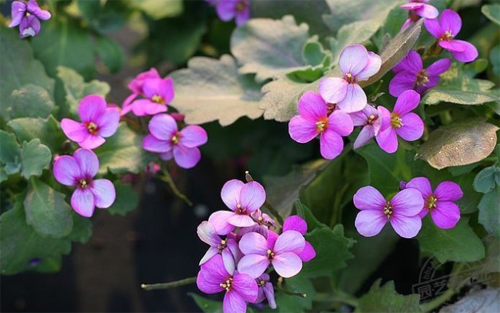
Planting method of Aubrieta cultorum:
Aubrieta cultorum is generally grown from seed. If you like it, you can buy seeds and try it yourself. Sowing in spring or autumn is fine, and autumn is generally the most suitable. In the second year it will bloom just a little, and it can be grown for two or three years!
It is a plant with very strong adaptability, so being drought-tolerant, cold-tolerant and shade-tolerant is a must. What it likes most is a cool, dry climate, but note that it does not like an overly hot environment or waterlogging. Of course, its greatest advantage is that it is not picky about soil. Otherwise, how would it grow among rocks!
Introduction to care during the growing period:
Its seedlings grow very quickly, especially in a cool autumn environment. If there is a little more sunlight, a patch will spread out at once. Moreover, it is drought-tolerant and barren-tolerant, very suitable for lazy people. It can survive at minus 15, and any lower is risky.
Generally, after autumn sowing, when it grows two pairs (four) of true leaves, it is time to thin the seedlings. Each plant should be left with a certain spacing (about 10 cm) to ensure that every one is robust.
When transplanting, be sure to transplant with soil. At that time it is very fragile and needs to be carefully tended.
Note that when it grows to about 15 cm, you can pinch the top appropriately, though some begin blooming at around 10 cm. It still depends on the intensity of the light.
When sowing, remember to keep the potting soil slightly moist, cover with plastic film to keep warm and moist. Once it grows two true leaves as above, remove the film and gradually expose it to light.
Note: Before sowing or transplanting, the nutrient soil must be sterilized and disinfected. Of course, this can be ignored for ground planting!
How long after autumn sowing does it bloom?
For greenhouse-sown Aubrieta cultorum, if sown in spring, it generally blooms about 3 months after sowing. Autumn sowing of course requires overwintering in a greenhouse. If sown around September or October, it generally blooms in April (there may be deviations if grown in the south).
It grows in rock crevices, and just a little soil is enough. It still looks quite nice!
Seed disinfection means soaking them in water before sowing, and then soaking them in carbendazim at the same time.
Blooming period of Aubrieta cultorum:
The blooming period is from May to July. It is a very nice small garden flower and can generally be seen in some courtyards and rock gardens. Arranging it in the yard is also a good choice.
That is all for the introduction to the growing method and blooming period of Aubrieta cultorum. Hurry and take a look.
Aubrieta cultorum Aubrieta cultorum Illustrated Guide: How to grow Aubrieta cultorum / How to propagate Aubrieta cultorum
Aubrieta cultorum ProfileAubrieta cultorum Aubrieta cultorum
Growing method and precautions for Aubrieta cultorum Introduction to Aubrieta cultorum
Aubrieta cultorum (Aubrieta cultorum) is a plant of the genus Aubrieta in the Brassicaceae family. Aubrieta cultorum has very strong vitality and adaptability, and is easy to cultivate.
Aubrieta cultorum is a perennial herb, growing in clumps but not forming cushions, with stellate hairs or forked hairs; leaves small, entire or with angular teeth; racemes terminal, flowers few but large, purple, violet or white. Flower diameter 1.2 cm, strongly fragrant; flowers purple to light purple, blooming period from May to June.
Aubrieta cultorum blooms early and has a large number of flowers, making it a very good variety for early spring use. It can be used in various low-growing combinations and can also be used in many places such as villas, parks and rock gardens. It is mostly cultivated in flower beds and rock gardens. The stems are low with stellate hairs and simple leaves. The leaves are small, mostly linear to spoon-shaped and alternate, with dense racemes, upright calyx, small white, blue or purple flowers, narrowly spoon-shaped and oblong. Apex slightly notched to entire, short silique.
Morphological characteristics of Aubrieta cultorum
Aubrieta cultorum is a perennial herbaceous flower, often grown as an annual or biennial. Plant height 20-30 cm, 3400 seeds per gram.
Aubrieta cultorum plant height 20-30 cm, clumping but not forming cushions, with stellate hairs or forked hairs, much branched and prostrate, plant height 15-30 cm. Leaves small, alternate, lanceolate, entire or with angular teeth. Racemes terminal, flowers few but large, purple, violet or white.
Simple morphological characteristics, strong vitality, it can be artificially cultured on ordinary medium, 3400 seeds per gram. There are also large-flowered, white-edged and variegated-leaf ornamental varieties with a slight fragrance. There are also large-flowered and white-edged foliage varieties. Blooming period 3-6 months, seeds flat.
Flower diameter 1.2 cm, strongly fragrant, flowers purple to light purple, blooming period from May to June.
Ecological habits of Aubrieta cultorum
Aubrieta cultorum likes light and is drought-tolerant, tolerating a low-temperature environment of minus 15 degrees, so it requires sufficient sunlight and is also slightly shade-tolerant.
Aubrieta cultorum likes a cool and dry climate, is not tolerant of cold and heat, likes loose soil with good drainage, and avoids waterlogging. It is relatively tolerant of drought and barren soil.
Cultivation techniques of Aubrieta cultorum Planting method
Seedlings grow rapidly, like coolness, avoid heat, require sufficient sunlight, are slightly shade-tolerant, prefer light soil, avoid waterlogging, and are relatively tolerant of drought and barren conditions. Suitable growing temperature 5-25°C.
If Aubrieta cultorum is grown indoors and the growing periods differ, you can use the method of covering the seedlings locally with plastic film to retain moisture without having to maintain the entire growing room at higher humidity. Then when transplanting, the row spacing is 10 x 10 cm to ensure that individual plants grow robustly and set full seed. Only at this distance is it easy to cultivate, and at this time the potted shape is the most beautiful.
Planting management
After the seedlings grow at least 2 pairs of true leaves, thinning can be carried out appropriately so that there is a certain spacing between plants to ensure that individual plants grow robustly and set full seed.
The dark/light cycle is 12/12 hours or 10/14 hours. The decisive factor for plant flowering is the length of daylight and has no necessary connection with plant size. Some plants bloom when only 0.5 cm tall. The light intensity is preferably between 80-120, and do not exceed 25°C-22°C. When sowing, vernalized seeds can be sown directly into pre-moistened nutrient soil, which can be purchased at flower markets, mixed with vermiculite. The seeds should be sown near the surface of the mixed soil; never sow deeply.
To ensure uniform emergence, several seeds can be sown at each spot. To maintain humidity, after sowing you can cover the pot or seedling tray with plastic film, and remove the film after the seedlings grow 2 pairs of true leaves. The growing room temperature is based on 20°C.
When growing Aubrieta cultorum, aphid damage is often encountered. According to the pest situation, use Abamectin or a mite insecticide diluted 2000 to 3000 times, used alternately to kill the insects. To prevent diseases and pests, attention should also be paid to sterilizing the nutrient soil used and treating insect eggs. In particular, nutrient soil that has had diseases and pests during use should be treated or discarded and no longer used.
Growing method of Aubrieta cultorum How long after autumn sowing does it bloom
For greenhouse-sown Aubrieta cultorum, if sown in spring, under good conditions it blooms in about 3 months after sowing. If sown in autumn, it must overwinter in a greenhouse. If sown around October, it blooms in April of the following year.
Propagation methods of Aubrieta cultorum
Aubrieta cultorum is commonly propagated by sowing, and can also be propagated by cuttings.
Sowing method
Suitable germination temperature 16-19°C. Sow seeds by broadcasting. The seedling medium must be soft and well aerated. Cover with sandy soil about 2 times the seed diameter, maintain humidity, and seedlings emerge in about 5-8 days.
Sowing can be done in spring or autumn. Germination temperature 15-20 degrees, germination in 7-14 days, and spring sowing blooms in 3 months. Suitable germination temperature 16-19°C. Sow seeds by broadcasting. The seedling medium must be soft and well aerated. Cover with sandy soil about 2 times the seed diameter, maintain humidity, and seedlings emerge in about 5-8 days. Seedlings grow rapidly, like coolness, avoid heat, require sufficient sunlight, are slightly shade-tolerant, prefer light soil, avoid waterlogging, and are relatively tolerant of drought and barren conditions. Suitable growing temperature 5-25°C.
Seed treatment before sowing: Before sowing, it is best to disinfect and vernalize the seeds. You can use a mixed solution of 0.5 sodium hypochlorite and 0.01 Triton-X 100 to disinfect the seeds for 10 minutes, then rinse with sterile water 3-4 times to prevent disease in the plants.
For seedlings that sometimes need to be cultured under sterile conditions, the same method can be used to disinfect the seeds. Vernalization of seeds is not absolutely necessary, but vernalization can effectively increase the germination rate of seeds. Vernalization of seeds can be carried out directly in an ordinary refrigerator at about 4°C. After disinfecting the seeds and vernalizing them under moist conditions for 2 to 3 days, they can be sown.
Sowing method: sowing can be done in spring or autumn
Germination temperature 15-20 degrees, germination in 7-14 days, spring sowing blooms in 3 months. Suitable germination temperature 16-19°C. Sow seeds by broadcasting. The seedling medium must be soft and well aerated. Cover with sandy soil about 2 times the seed diameter, maintain humidity, and seedlings emerge in about 5-8 days. Recommended sowing rate 0.5 g/sq m. If sown in autumn, it blooms profusely in May of the following year.
Cutting propagation
Before the heat of summer, carry out heavy pruning and place it in a cool spot to overwinter the summer, then it blooms even more profusely after autumn. Seedlings grow rapidly, like coolness, avoid heat, require sufficient sunlight, are slightly shade-tolerant, prefer light soil, avoid waterlogging, and are relatively tolerant of drought and barren conditions. Suitable growing temperature 5-25°C.
Disease and pest control of Aubrieta cultorum
When growing Aubrieta cultorum, aphid damage is often encountered. According to the pest situation, use Abamectin or a mite insecticide diluted 2000 to 3000 times, used alternately to kill the insects.
To prevent diseases and pests, attention should also be paid to sterilizing the nutrient soil used and treating insect eggs. In particular, nutrient soil that has had diseases and pests during use should be treated or discarded and no longer used.
Variety classification of Aubrieta cultorum Types and varieties
1. Aubrieta deltoidea
Perennial herb, height 15-30 cm, stems clustered and cushion-like, base woody. Also oblanceolate, sometimes spoon-shaped, with shallow teeth, gray and covered with soft hairs, 5-10 cm long. Flowers golden yellow, blooming period April. It is the main cultivated species in this book. Native to south-central and central Europe. In 1710 it was introduced to the UK from southern Europe. Suitable for rock gardens and small pots. There is also a variety, dense-flowered Aubrieta deltoidea, with a low clustered habit and densely borne flowers. Double-flowered Aubrieta deltoidea has double flowers.
2. Aubrieta columnae
Perennial herb, height 10-20 cm, plant form low and compact. Leaves obovate-oblong to linear, covered with stellate silver-gray hairs. Flowers yellow, relatively strong fragrance. Blooming period 6-7 months. Native to south-central Europe and the Caucasus. There is also a large-flowered variety with blooming period 5-6 months. In 1713 it was introduced to the UK from Germany.
3. Aubrieta alpina
Perennial herb, a dwarf species only 9 cm tall. Leaves obovate to linear, gray-green. Short racemes. Flowers small, yellow. Blooming period spring. Native to Europe. In 1777 it was introduced to the UK. Mostly grown in small pots.
4. Fragrant aubrieta, tall type, fragrant, suitable for potting.
Ecological habits: Aubrieta species like coolness and places with sufficient sunlight, and are not tolerant of the intense heat of summer or rainy, humid climates, so they are suitable for biennial cultivation. Although aubrieta is not picky about soil, it grows better in soil containing a little lime and in well-drained locations.
Propagation and cultivation: It is suitable to sow in autumn in September, germinating in about 2 weeks. Seed germination capacity can be maintained for 2-3 years. From April to September, bud cuttings can also be used for propagation. When transplanting seedlings, the root system should carry more soil, otherwise it is not easy to survive.
Garden use: Aubrieta has a low plant form and small but abundant flowers, suitable for planting at the edges of flower borders or in rock gardens.
Uses of Aubrieta cultorum Potted use
Aubrieta cultorum is a good material for flower beds, flower borders and rock gardens. It is suitable for edging or forming patterns, and can also be potted and used as ground cover. Its vitality is very strong, its adaptability is also very strong, and it is easy to cultivate.
Landscaping use
Aubrieta cultorum is fragrant and pleasant, an excellent material for edging flower beds and flower borders. It is suitable for planting along rock garden walls and can also be potted or used as ground cover.
Garden use of Aubrieta cultorum
Aubrieta cultorum blooms early and has a large number of flowers, making it a very good variety for early spring use. It can be used in various low-growing combinations and can also be used in many places such as villas, parks and rock gardens.
Flower language of Aubrieta cultorum
Flower language of Aubrieta cultorum: the temptation of the soul.
Aubrieta cultorum pictures
Cultivation and growing of Aubrieta cultorum
Aubrieta cultorum is also known as blue aubrieta. Latin name: aubrieta cultorum. Family and genus: Brassicaceae, genus Aubrieta. Ornamental period: April to June.
Propagation method: Sowing can be done in spring or autumn. Germination temperature 15-20 degrees, germination in 7-14 days, spring sowing blooms in 3 months. Suitable germination temperature 16-19°C. Sow seeds by broadcasting. The seedling medium must be soft and well aerated. Cover with sandy soil about 2 times the seed diameter, maintain humidity, and seedlings emerge in about 5-8 days. Seedlings grow rapidly, like coolness, avoid intense heat, require sufficient sunlight, are slightly shade-tolerant, prefer light soil, avoid waterlogging, and are relatively tolerant of drought and barren conditions. Suitable growing temperature 5-25°C.