Dahlia Tuber Planting Method and the Best Planting Time
Dahlias bloom in big, big flowers, they are extremely beautiful and very pleasing, dahlias are generally grown from tubers, let's take a look at what the dahlia tuber planting method is like? What time is good to start planting dahlia tubers:
1. Prepare tools and materials:
Spade, small pruning knife, stakes, watering can with a rose nozzle, slow-release nutrient fertilizer, etc.
Timing:
In April, once the ground starts to warm up again, take out the dahlia rhizomes stored in the storage room (if purchased that year, try to choose ones with healthy roots and plump flesh).
1. Remove the dried-up roots; if there are too many tubers, they can be divided (split them with a small pruning knife). Note that each rhizome should keep — an adventitious bud and some lateral roots.
2. Dig — a hole about 20cm deep, loosen the soil, and remove large stones and weed roots. If the soil is very sandy, enrich it with loam fertilizer or compost
3. To provide the nutrition dahlias will need later, especially nitrogen, mix in slow-release fertilizer while hoeing the soil, and note to apply the fertilizer according to the amount on the product instructions.
4. In order not to damage the tubers, set up — a stake in a hole about 15cm deep before the dahlia roots form. Place the tuber flat at the bottom of the hole, with the bud close to the stake.
5. Fill the hole with crumbled soil; to make the tuber and soil fully contact, gently press the soil flat with your foot, then water the hole thoroughly like light rain.
2. Setting up stakes and pruning
In July, dahlias planted in early spring grow very fast, like bamboo shoots after rain, and it is time to set up stakes, if they were not set up at planting time. To grow large and beautiful flowers, pruning is recommended.
6. Before the rhizome is overwhelmed by the weight of leaves and flowers, set up a stake at the foot of each dahlia. Be careful not to damage the tubers.
7. The stake should preferably be 5cm from the rhizome; loosely tie the rhizome and stake together with plastic or raffia fiber twine.
Note: do not pull the rhizome and stake too tight.
8. To grow large flowers, use a sharp small pruning knife to remove the leaf axils growing under the leaves, keeping only the flower buds growing on the rhizome. At the same time, remove small side branches.
9. Short dahlias do not need stakes; their clumping foliage can support the flowers. However, to prevent bolting and reduce the burden on the tubers, note to promptly remove faded flowers. Promptly removing faded flowers can also effectively promote the production of new flower buds.
3. Management after October
10. In October, when the dahlia season has passed, use pruning shears or sharp scissors to cut off all roots and stems 10cm above the ground. Do not touch the leaves, except of course the withered ones.
11. Wait until the plant has completely withered before pulling out the dahlia. If pulled too early, it may seriously damage its storage and affect future propagation.
12. When the plant has completely withered, use a long-handled fork and carefully pull it out, being careful not to damage its roots.
13. After air-drying in the open for several hours, remove the soil and dead leaves stuck to the tubers, cut off excess roots and stems (keep about 5cm), note down the variety name and color, and attach a label
14. Store them in a wooden box and place it in a dry and ventilated place. If you are afraid of damage, you can store them in a mesh bag and hang it up. Note to regularly observe their health status.
15. In places with very little frost and freezing, dahlia tubers can be left in the ground. Cut off all withered branches and leaves from 5cm above the ground. Cover with 20-30cm of dry fallen leaves or straw.
4. Harvesting and storing dahlia tubers
Dahlias are not cold-tolerant, mainly because the tubers cannot be frozen; dahlia tubers begin dormancy at 0.5°C and suffer cold damage below 0°C, so they cannot overwinter in the open in North China, and tubers should be harvested in each area before the early frost arrives.
After frost, the plant and leaves immediately wither, so the stems and leaves of the aboveground part should be cut off at once, and the tubers dug out; potted ones can be removed from the pot or stored in the pot in a greenhouse. Before harvesting, the varieties should be checked, keeping the good and discarding the poor, to ensure the purity of the varieties.
Precautions:
Before storage, all withered stems and leaves should be cut off about 15cm from the root crown; to prevent twisting and injuring the root crown (the part that will sprout in the future), the tubers should be dug out as a whole clump.
After digging out the tubers, first dry them in the sun for 2-3 days before storing. At night, to prevent frost, cover the tubers with reed curtains or straw and other coverings. Wait until
the soil on the tubers is dry, then shake off the soil, classify by variety, attach labels, and place them in a greenhouse at a temperature not exceeding about 5°C; at this time, maintaining a constant temperature of about 3-5°C and preventing excessively high temperatures is the key to preserving the tubers, because too high a temperature will make the basal shoots at the root crown sprout early, consuming water and nutrients and affecting the tubers, while too low a temperature will freeze and rot the tubers.
5. Disinfection and sterilization
In addition, the storage site should be sterilized and disinfected. When arranging them, place the root crown facing up on the greenhouse floor; to prevent premature sprouting and heating that rots the roots, generally stacking 3-5 layers is beneficial, and bury them with slightly moist sandy soil.
During winter storage, check frequently and promptly cut off rotten and useless roots. If the burying sand is found to be too dry, do not water directly; you can take out the tubers, then spray the sand wet until it reaches a damp degree, and then bury the tubers again. In addition, you can also cut off the withered stems and leaves of potted plants and put the original pots into a greenhouse at a temperature not exceeding 3-5°C, stack the pots up, and avoid direct strong light.
During storage, if the pot soil is too dry, water a little (the amount of water must not be too large), just keep the soil slightly moist, so as to avoid tuber rot. This method is relatively simple, but it takes up a relatively large storage area. Another storage method is to divide the dried tubers together with the adventitious buds growing on the root crown part.
After dividing, coat the cuts with plant ash, put them in a wooden trough or wooden box, and fill the gaps with dry sand or wood shavings. Then place the wooden trough or wooden box under conditions of 3-5°C, good ventilation, and no direct light for storage. During storage, there is no need to turn them over. This method is convenient for keeping and also convenient for taking out and using, and can save storage area.
Some dahlia varieties have tubers that are more difficult to store, such as Heju and Huoshu Yinhua.
When storing the tubers of these varieties, do not mix and place them together with other tubers. The dried tubers can be placed in a wooden box or flower pot, and a small amount of dry sand can be covered over the tubers, stored under conditions of 3-5°C.
A few days before the frost period arrives, the above-mentioned potted dahlias can be moved into a greenhouse at 5-10°C, the flowers and flower buds removed, and cultivation carried out for about 15-20 days, so that the nutrients are fully concentrated in the tubers, and then the stems and leaves on the plant are removed, and storage is carried out in the original pot or after removing from the pot.
The dahlia tuber planting method is introduced here; if you really like them, then hurry and plant one.
When are dahlias planted? Dahlia planting time and method
Dahlia, also known as Tianzhu peony, Oriental chrysanthemum, dahlia chrysanthemum, etc., is a perennial herbaceous plant of the genus Dahlia in the Asteraceae family. Dahlia is called one of the world's top ten famous flowers; its flowers are large and gorgeous with rich colors, and it has high ornamental value. So, when are dahlias planted? The dahlia planting time and method are introduced as follows.
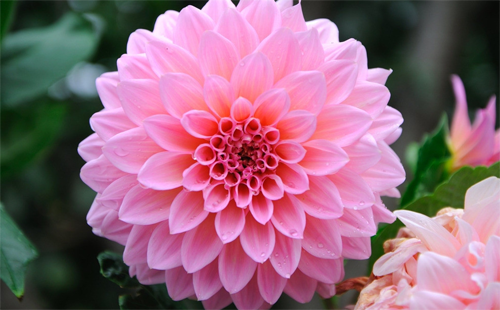
Image: Dahlia
1. Dahlia planting time
Depending on the propagation method, the planting time of dahlias also differs. Dahlia root division propagation is mostly planted in spring from March to April; dahlia cuttings are planted from June to August; dahlia hotbed sowing is in mid-to-late March, and flowerbed varieties are sown in the open from late April, with the seeds all scattered on the soil surface.
Image: Dahlia
2. Dahlia planting method
1. Temperature management:Dahlias prefer a cool climate, with 10-25°C being most suitable. In early spring, to make them bloom earlier, keep the daytime temperature at about 25°C; above 25°C must be ventilated to cool down, and at night when it is below 10°C the greenhouse temperature must be raised; in the hot season, cooling measures should be taken.
2. Timely fertilizing:Dahlia is a fertilizer-loving plant and must have a sufficient fertilizer supply, otherwise it easily causes smaller flowers and duller color, reducing ornamental value; according to the growth situation, apply cake fertilizer 4-5 times as a top dressing, preferably light fertilizer; when the summer high temperature exceeds 30°C, fertilizing is prohibited.
3. Water management:Appropriately reducing the amount of water for dahlias helps control plant growth and promotes thicker dahlia stems, shorter plants, and larger flowers; in summer high temperatures, while basically meeting their water needs, spray water on the leaves as much as possible, at least twice a day, to make up for evaporation loss.
Image: Dahlia
4. Pinching and pruning:Keeping a single bud to form a single plant can make dahlias bloom earlier; after flowering, cut back leaving 1-2 nodes, and the new buds that grow can continue to bloom. For varieties with poor branching, pinch in the young stage to promote branching, and from mid-July to early August, cut back the plants.
5. Flowering control:If dahlias are to bloom in winter and early spring, sunlight and temperature must be controlled; in winter, controlling sunlight to about 14 hours and night temperature above 10°C can produce cut flowers with large flowers and bright colors.
6. Cut flower harvest:For dahlias, the suitable harvest time is when they are 3-4 parts open; for the first batch of flowers in spring, cut leaving 2 nodes, and for the second batch, cut leaving one node; it is easy to choose to harvest in the morning or evening, and immediately after harvest insert them into water; after the tubers are harvested, place them in a dry place for storage.
[Editor's concluding remarks]Dahlias like a cool climate and are not tolerant of drought or waterlogging, so special attention is needed during care. The above has introduced the dahlia planting time and method for everyone, hoping it can be helpful to everyone!
How to plant dahlias, dahlia planting method
Dahlias are low in planting difficulty and have good effects when planted in patches; ordinary households can all grow them, and the flowering period is long. Tubers planted in late March can bloom in mid-June and can keep blooming until the frost period, which can both beautify the yard and bring economic income to farmers, so courtyard cultivation is a very good direction. So, how to plant dahlias? What is the dahlia planting method? Below, the editor will briefly introduce it for everyone.
Dahlia planting method
1. Soil: Dahlias are most suitable for growing in loose, fertile, well-drained sandy loam soil; they need crop rotation, have medium fertility requirements, and can grow well at pH 6.7-7.8.
2. Sunlight: Dahlias like light and are not shade-tolerant; if placed in a shaded place for a long time, they will grow poorly, with weak roots, thin leaves and slender stems, small and pale flowers, and some may even fail to bloom. Therefore, potted dahlias should be placed in a place with sufficient sunlight. During the leaf growth period, sufficient light is needed, with daily light requirements of more than 6 hours, so that the plants are robust and the flowers are large and full. If daily sunlight is less than 4 hours, the branching of stems and leaves and the formation of flower seedlings will be affected to a certain extent; especially with cloudy and rainy low light, flowering will be poor, stem and leaf growth will be poor, and they will be prone to disease.
3. Temperature: They like a cool climate and do not have strict requirements for ecological factors, so they are relatively adaptable. During the growth period, they do not have strict temperature requirements and can grow normally between 5-35°C, but 10-25°C is most suitable.
4. Watering: The amount of watering can control the height of dahlia plants. During the seedling stage, water should be controlled to promote dwarfing. In summer, to lower the temperature, increase air humidity, and reduce water evaporation from dahlia stems and leaves, spray water 1-2 times a day. Water once at 3-4 pm, and the amount of water should not be too large.
5. Fertilizing: Dahlias like fertilizer; during the growth period, apply a top dressing once every 7-10 days, or apply thin liquid fertilizer 2-3 times. However, because dahlias fear heat and are often in a semi-dormant state in summer, at this stage they may not be fertilized or may be given extremely thin fertilizer. After the plant forms buds, the amount of phosphorus fertilizer applied can be increased to make the flowers bloom better. The root system of dahlias is relatively delicate, and concentrated fertilizer should be avoided throughout the entire growth process.
6. Pests: Dahlias generally mainly have problems with pests and diseases such as powdery mildew, gray mold, bacterial wilt, viral disease, and stem borers, so pesticides should be sprayed regularly for treatment.
7. Pruning: For cultivating dahlias with medium and small flowers, only remove the side buds on several lower nodes of the stem so that they bloom successively. If you want to cultivate large single flowers, only the terminal bud should be kept, and all other side buds removed. At the end of June and the beginning of July, after the first flowering, as the weather gradually heats up and plant growth slows down, pruning can be carried out. When pruning, first twist the stem in the middle of the branch, between two leaves, to bend it down, leaving a height of 20-30cm. After a few days, when the wound part has dried and shrunk, cut it. This can avoid rainwater pouring into the hollow stem and causing rot. If grown until October, it can bloom again.
The above is the article on how to plant dahlias and the dahlia planting method. Dahlias like semi-shade; too strong sunlight affects flowering. The light duration is generally 10-12 hours, and when cultivating seedlings, direct sunlight should be avoided. Dahlias like a cool climate, and in late September the flowers are largest, most brilliant, and most abundant, but they are not tolerant of frost, and after frost the stems and leaves immediately wither. During the growth period, they do not have strict temperature requirements and can grow at 8-35°C, with 15-25°C being suitable.