What varieties of cypress vine are there? Detailed growing methods
When cypress vine grows up it looks just like a morning glory, bearing bright red flowers. It really makes anyone who sees it feel that this flower has magic, and like it so much. What are the growing methods for cypress vine? And what beautiful varieties are there?
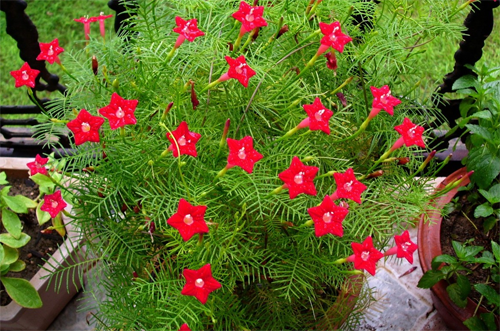
Growing methods for cypress vine:
In areas where the night temperature is still relatively low, do not plant out early. Cypress vine has strong self-seeding ability. If you do not care about how early or late it blooms, you can also use self-sown seedlings in the second year of cultivation.
1. Ground planting
Choose a sheltered, sunny spot with good drainage. Besides applying base fertilizer, you also need to apply liquid fertilizer as a top dressing 1 to 2 times before flowering. When planting out, be sure to water thoroughly; afterwards, water only once a week. (Note: once cypress vine has grown into a large seedling, it is not suitable for transplanting.)
2. Container growing
When potting up, put a little base fertilizer in the bottom of the pot, then apply liquid fertilizer as a top dressing once a month. Water in a timely manner, but do not let water accumulate.
3. Proper pruning
This not only helps ventilation and light penetration, but also gives the plant a graceful shape. After the flowers fade, promptly remove the spent flowers and do not let it set seed, so that nutrients are concentrated on supplying new branches to bloom and the flowering period is extended.
Cypress vine likes warmth, dislikes cold, and fears frost. When the temperature is low, growth is very slow. The suitable temperature for seed germination is 20 to 25°C. It requires a sunny environment, but has no strict requirement for day length.
4. Seedling care
Before sowing cypress vine, apply a little base fertilizer and spread it evenly. After planting out, give plenty of water to promote stem and leaf growth, but be careful not to let it grow rampantly, which would delay flowering.
5. Making a support
In the early stage, manually help guide the vines onto the support; in the middle and later stages it can climb on its own. You can also shape it yourself, or simply let it climb and twine freely.
Container-grown plants should be watered and fertilized frequently. (In winter it can also be grown indoors, but attention should be paid to conditions such as room temperature and light.)
6. Cultivation in the north
Cypress vine can also be cultivated in winter in the north. Once there is heating, use the "paper towel cultivation method" (also called sprouting) to make cypress vine seeds germinate within a short time.
Wait until the seeds show tender sprouts, then scatter them into a flower pot and cover with 1 to 1.5 cm of soil to ensure the growth of cypress vine.
After about a week, cypress vine will take root and sprout. At this time you must treat the cypress vine seedlings with care.
There is less light in winter, so you need to artificially choose a place with relatively sufficient light to grow cypress vine. It is recommended to place it in a south-facing room, and the flower pot should be placed relatively close to the heating to ensure a suitable temperature.
Seed propagation methods for cypress vine:
1. Sowing notes
Sow in a seedling tray. Sow about 100 g per square meter of seedbed. After sowing, cover with about 1.5 cm of fine soil; it must not be too thin, otherwise the seedlings easily emerge with the seed coat still attached. Control the soil temperature at 20 to 25°C; dry seeds emerge in 4 days after sowing.
Cypress vine emerges easily, but often unevenly, so seeds should be selected carefully to make the seedlings uniform.
2. Seedling moisture
Cypress vine seedlings are very afraid of drought. When drought is even slightly severe, they will wither and die, and even watering makes it hard for them to recover. Special attention should be paid to this during seedling raising.
3. Transplanting seedlings
You can raise seedlings in plastic pots about 8 cm in size. During the period of growing them into mature seedlings, also pay attention to the water supply. In the middle and later stages of seedling raising, control soil moisture moderately. During the seedling stage, always provide full light.
4. Mixed-color varieties
The red flowers of feathery cypress vine are more brilliant than the white flowers, and most people prefer the red flowers. So select seeds carefully every year and pay attention to isolation; the proportion of mixed colors in later generations will become smaller and smaller.
Introduction to cypress vine varieties:
1. Feathery cypress vine
Also known as cypress vine pine, dragon-twining flower, brocade screen, etc.; maple-leaf cypress vine is also known as large-flowered cypress vine, large red cypress vine, palm-leaf cypress vine, red five-pointed star, etc.; round-leaf cypress vine is also known as orange-red cypress vine.
2. Round-leaf cypress vine
The leaves are like those of morning glory, though of course the flowers are not that large, and are heart-shaped ovate.
Round-leaf cypress vine has ovate leaves with pointed tips, slightly heart-shaped; the corolla is carmine red with a yellow throat, and the flowers are numerous and brilliantly colored.
3. Lobed-leaf cypress vine
Also called fish-flower cypress vine, with heart-shaped leaves having 3 deep lobes, and many flowers densely borne in dichasial clusters.
4. Palm-leaf cypress vine (maple-leaf cypress vine)
Its leaves are palmately lobed, with lanceolate lobes and long, sharp-pointed tips. The common peduncle is thick and large, about 10 cm long, and the flowers are twice as large as those of cypress vine.
The growing methods and propagation methods of cypress vine are introduced here; there are still many varieties to choose from.
Cultivation methods for cypress vine
Cypress vine - cultivation methods, cypress vine seeds. Cypress vine is best propagated by seed. Sow in early April; after sowing, pay attention to shading and keep the seedbed moist. After about a week, seedlings will emerge.Cypress vine cultivation is relatively simple:
① Open-field planting. Choose a sheltered, sunny spot with good drainage. Besides applying base fertilizer, you also need to apply liquid fertilizer as a top dressing 1 to 2 times before flowering. When planting out, be sure to water thoroughly; afterwards, water only once a week.② Container-grown cypress vine. When potting up, put a little base fertilizer in the bottom of the pot, then apply liquid fertilizer as a top dressing once a month. Water in a timely manner, but do not let water accumulate.
③ Properly thin out vines and leaves. This not only helps ventilation and light penetration, but also gives the plant a graceful shape. After the flowers fade, promptly remove the spent flowers and do not let it set seed, so that nutrients are concentrated on supplying new branches to bloom and the flowering period is extended.Requirements for environmental conditions
Because cypress vine originates from tropical regions, it likes warmth, dislikes cold, and fears frost. When the temperature is low, growth is very slow. The suitable temperature for seed germination is 20°C to 25°C. It requires a sunny environment. Most species have no strict requirement for day length, but fish-flower cypress vine (Quamoclit lobata) only blooms when the day length is shorter than 12 hours. It has no strict requirement for soil, but grows well in fertile, loose soil.
Seeds
The thousand-seed weight of feathery cypress vine is about 139, and the seeds can be used for 3 to 4 years. The fruits ripen unevenly and fall off easily once ripe, so collect them as they ripen. Each fruit contains 3 to 4 seeds. If you have both red-flowered and white-flowered plants, collect seeds separately.
Different types of cypress vine also have different seed shapes.
Sowing and seedling raising of cypress vineRaise seedlings under protection in spring. For planting out in the open field after the last frost, the seedling-raising period is about 45 days; it must not be too long, otherwise the vines grown from the seedlings will become tangled together.
Using ordinary nutrient soil for seedling raising to sow and grow mature seedlings will allow good growth. Sow in a seedling tray. Sow about 100 g per square meter of seedbed. After sowing, cover with about 1.5 cm of fine soil; it must not be too thin, otherwise the seedlings easily emerge with the seed coat still attached. Control the soil temperature at 20°C to 25°C; dry seeds emerge in 4 days after sowing. The seedlings of feathery cypress vine and maple-leaf cypress vine are shown in Figure 7. Cypress vine emerges easily, but often unevenly, so seeds should be selected carefully to make the seedlings uniform. The author observed that cypress vine seedlings are very afraid of drought. When drought is even slightly severe, they will wither and die, and even watering makes it hard for them to recover. Special attention should be paid to this during seedling raising. Because it is a taproot plant, it is best to grow seedlings in plastic seedling pots 8 cm in diameter, and transplant only once, planting 1 seedling in each container. You can also use 72-cell plug trays to grow mature seedlings; during the period of growing them into mature seedlings, also pay attention to the water supply. In the middle and later stages of seedling raising, control soil moisture moderately. During the seedling stage, always provide full light. If the seedlings are relatively large and the vines have become tangled together, separate them as early as possible, and if necessary move the seedling pots a certain distance apart.The red flowers of feathery cypress vine are more brilliant than the white flowers, and most people prefer the red flowers. But even if you collect only seeds from red flowers, most offspring may still segregate out white flowers. Seeds are hard to distinguish, but it is very easy to distinguish them at the seedling stage. The stems of red-flowered plants are dark red, while the stems of white-flowered plants are green; as long as you observe carefully, you can distinguish them very well. If you select seeds carefully every year and pay attention to isolation, the proportion of mixed colors in later generations will become smaller and smaller.
CultivationPlant out after the last frost. In areas where the night temperature is still relatively low, generally speaking early planting out is not recommended. Cypress vine has strong self-seeding ability. If you do not care about how early or late it blooms, you can also use self-sown seedlings in the second year of cultivation, but because the seeds are not selected and the seedlings emerge late, the greening effect is somewhat poorer. Cypress vine has a large growth volume, so apply plenty of base fertilizer, spread it evenly, and dig deeply. Dig holes for planting out, remove the plastic seedling pot, plant the seedling in the hole, 1 plant per hole, cover the root ball with fine soil, then water, and cover with soil to close the hole. For single-row planting, the plant spacing is about 35 cm; for seedling-raised plants or fertile soil, the spacing should be appropriately larger; self-sown seedlings emerge late and their growth is delayed, so the spacing should be appropriately smaller. Timely watering can promote stem and leaf growth, but be careful not to let it grow rampantly, which would delay flowering. In the early stage, manually help guide the vines onto a trellis, fence, tree, or other support. In the middle and later stages the plant itself has a very strong climbing ability; apart from shaping, you do not need to manage it, just let it climb and twine freely. Container-grown plants should be watered and fertilized frequently. [2]
Growing methods for feathery cypress vine
Cypress vine originates from Mexico and is also known as dense cypress pine, commonly called five-pointed star flower or lion grass. It is an annual weak twining herb, hairless. Leaves ovate or oblong, 2-10 cm long, 1-6 cm wide, simple leaves alternate, the leaf lobes slender as threads, pinnately parted almost to the midrib. Do you know about it? Do you want to know the growing methods for cypress vine?
Growing conditions:
Because cypress vine originates from tropical regions, it likes warmth, dislikes cold, and fears frost. When the temperature is low, growth is very slow. It requires a sunny environment. Most species have no strict requirement for day length, but fish-flower cypress vine only blooms when the day length is shorter than 12 hours.
It has no strict requirement for soil, but grows well in fertile, loose soil. The thousand-seed weight of feathery cypress vine is about 139, and the seeds can be used for 3 to 4 years. The fruits ripen unevenly and fall off easily once ripe, so collect them as they ripen.

Growing cypress vine
Using ordinary nutrient soil for seedling raising to sow and grow mature seedlings will allow good growth. Sow in a seedling tray. After sowing, cover with about 1.5 cm of fine soil; it must not be too thin, otherwise the seedlings easily emerge with the seed coat still attached. Dry seeds emerge in 4 days after sowing. Cypress vine emerges easily, but often unevenly, so seeds should be selected carefully to make the seedlings uniform. Cypress vine seedlings are very afraid of drought. When drought is even slightly severe, they will wither and die, and even watering makes it hard for them to recover. Special attention should be paid to this during seedling raising.
Because it is a taproot plant, it is best to grow seedlings in plastic seedling pots 8 cm in diameter, and transplant only once, planting 1 seedling in each container. During the seedling stage, always provide full light. If the seedlings are relatively large and the vines have become tangled together, separate them as early as possible, and if necessary move the seedling pots a certain distance apart.
Cultivation management
Plant cypress vine out after the last frost. In areas where the night temperature is still relatively low, generally speaking early planting out is not recommended. Cypress vine has strong self-seeding ability. If you do not care about how early or late it blooms, you can also use self-sown seedlings in the second year of cultivation, but because the seeds are not selected and the seedlings emerge late, the greening effect is somewhat poorer. Cypress vine has a large growth volume, so apply plenty of base fertilizer, spread it evenly, and dig deeply.
Dig holes for planting out, remove the plastic seedling pot, plant the seedling in the hole, 1 plant per hole, cover the root ball with fine soil, then water, and cover with soil to close the hole. For seedling-raised plants or fertile soil, the plant spacing should be appropriately larger; self-sown seedlings emerge late and their growth is delayed, so the spacing should be appropriately smaller. Timely watering can promote stem and leaf growth, but be careful not to let it grow rampantly, which would delay flowering.