Wintersweet growing methods and precautions, and how it differs from plum blossom
When it comes to wintersweet, it is a sight to behold in winter. When all things wither, wintersweet still blooms naturally, and not only blooms but is fragrant too. Let's take a look at the growing methods and precautions for wintersweet. Plant one in your own yard, and it will fill winter with fragrance.
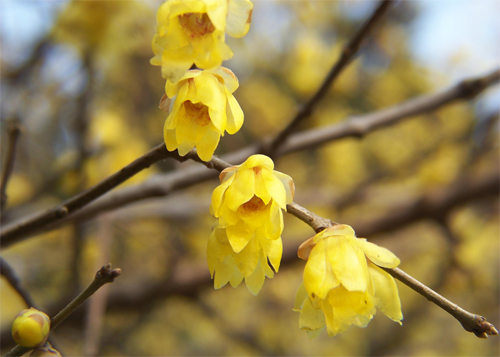
Wintersweet likes sunlight and also tolerates partial shade. It fears wind and is relatively cold-hardy. It can overwinter safely when temperatures do not drop below -15°C. It can be grown outdoors in areas south of Beijing. If the flowering period encounters a low temperature of -10°C, the flowers suffer cold damage.
It prefers deep, fertile, loose, well-drained, slightly acidic sandy loam soil, and grows poorly on saline-alkaline soil. It is fairly drought-tolerant and fears waterlogging. The tree grows vigorously with abundant branching, and suckers readily emerge from the root crown. It tolerates pruning and is easy to shape.
It flowers before leafing out, with the flowering period from November to March of the following year, and the fragrance is rich. The fruit receptacle is urn-shaped, and the achene is elliptical, chestnut brown, and glossy, ripening in July-August.
1. Soil
For potted wintersweet, choose a loose, fertile sandy loam rich in humus.
2. Watering
Wintersweet is by nature drought-tolerant and fears waterlogging. If moisture is too high and the soil is too wet, the plant grows poorly and flower bud differentiation is affected.
Potted wintersweet is relatively drought-tolerant. Normally the potting soil can be kept slightly dry. Water according to "water when dry, and when you water, water thoroughly." Once the dog days arrive, which is the flower bud formation period, do not let it lack water; water once in the morning and once in the evening. After autumn when the leaves fall, the potting soil can be kept on the drier side, watering once every 5-7 days.
3. Temperature
Wintersweet likes sunlight and also tolerates partial shade. It fears wind and is relatively cold-hardy. It can overwinter safely when temperatures do not drop below -15°C. It can be grown outdoors in areas south of Beijing. If the flowering period encounters a low temperature of -10°C, the flowers suffer cold damage.
4. Pot selection
For wintersweet, purple clay ceramic pots are suitable, and glazed ceramic pots can also be used. Generally, seedling wintersweets mostly use round pots, square pots, hexagonal pots, and so on. Old wintersweet stumps can use medium-deep horse trough pots or begonia pots, while cascade styles mostly use tall cylindrical pots.
5. Soil mix
Wintersweet is not strict about soil, but well-drained sandy loam is best. For potting, decomposed garden soil or leaf mold mixed with 20-30% rice husk ash is commonly used as the growing medium.
6. Planting
Transplanting wintersweet is mostly done in early spring, and the period around the time new shoots sprout on the flower stems in early March is suitable. Generally, it is best to plant it at an angle to make it easier to create a dynamic shape. Before planting, a shaping prune can be done, and when potting, sufficient base fertilizer can be applied at the bottom of the pot.
7. Placement
Wintersweet bonsai should be placed in a wind-sheltered, sunny spot, avoiding cold wind. In summer it needs slight shading. In winter, potted plants should be moved indoors to overwinter when the temperature drops below 1°C.
8. Fertilizing
Wintersweet loves fertilizer. From April to June, in the early stage of flower bud formation, it is suitable to apply cake fertilizer water once every 10 days. From the end of June to before the dog days, apply a diluted fertilizer water combining nitrogen and phosphorus once a week to promote flower bud formation.
During the dog days, apply 1-2 topdressings, and the fertilizer should be diluted. After autumn, apply just 1 more time. When repotting, sufficient base fertilizer such as bone meal or soybean cake can be applied at the bottom of the pot.
9. Pruning
To keep wintersweet full of branches and flowers year after year, pruning and bud pinching are extremely important. Pruning is generally done between March and June, and stops after August.
After flowering each year, the old flowering branches should be cut short immediately, leaving only 15-20 cm at most on each branch. After the new branches grow 2-3 pairs of buds, pinch off the terminal bud. Soon side branches will grow again. After they reach 10 cm, pinch the buds once more. Repeat this several times until the flower buds are basically formed.
Thin out all kinds of branches that affect the beauty of the tree shape, such as crossing branches, parallel branches, overlapping branches, opposite branches, water sprouts, and overly dense or weak branches. There is a saying in flower lore that "wintersweet never lacks branches," so wintersweet can be heavily pruned.
10. Repotting
Wintersweet bonsai should be repotted once every 1-2 years, preferably in late winter or early spring after the flowers fade. Before repotting, the already sprouted buds can be removed first. After about 5 days, when the latent buds begin to swell, transplant it. When repotting, remove one third of the old soil, cut off rotten and dead roots, and trim away overly long old roots. Replace with frost-crumbled pond mud or humus-rich leaf mold, mixed with an appropriate amount of rice husk ash and sand.
Precautions for growing wintersweet:
Wintersweet has fewer diseases but more pests. Common ones include aphids, scale insects, slug moths, and leaf-rolling moths. Aphids suck sap on tender shoots, young leaves, and flower buds; scale insects suck sap on branches; slug moths and leaf-rolling moths bite and eat leaves, new buds, flower buds, and so on.
Control method: prevention first. Place the flower pot in an environment with good light and ventilation to reduce the occurrence of pests and diseases.
If the above pests are found, spray with 50% fenitrothion at 1000 times dilution. To reduce pollution of the flower-growing environment, traditional methods can also be used to kill the pests. For example, scale insects can be killed with a vinegar solution, aphids can be killed with laundry detergent water, and if there are only a few, they can be caught by hand.
Propagation methods for wintersweet:
Wintersweet is commonly propagated by grafting, cuttings, layering, or division. Grafting is the method most often used.
1. Grafting
For grafting, select 2-3 year old wintersweet as the rootstock and use approach grafting or cleft grafting. Approach grafting is usually the method most adopted.
In early spring in March, cut open the bark of the rootstock and the scion, bring them together and tie them tightly. Wrap the union with plastic strips so it heals and survives. After it survives, it can be separated from the mother plant and planted in the same winter.
2. Cuttings
Softwood cuttings in summer are best. After soaking the cuttings in 50 mg/kg rooting powder for 6 hours, insert them in a shaded plastic film tunnel. In about 20-30 days they will root and can be transplanted.
3. Division
Division means taking seedlings with multiple fibrous roots at the base. After dividing, cut off the upper branches, apply diluted liquid fertilizer, and cover the top with a shade curtain. In spring and autumn, layering can also be used for propagation.
Wintersweet is relatively cold-hardy. As long as the temperature does not drop below -15°C, it can overwinter safely outdoors, but during the flowering period it must not go below -10°C. Wintersweet fears wind; strong wind causes the leaves to rub against each other and develop rust spots.
Wintersweet is drought-tolerant, but in the intense heat of summer it must not lack water, otherwise the leaves form dry, whitish patches, affecting flower bud formation. Watering should keep the soil at about half moisture.
Wintersweet must be pruned promptly after the flowers fade. It likes fertilizer. Each month, a ring-shaped trench 15-18 cm deep can be dug to apply diluted fertilizer once. Do not apply farmyard manure, to avoid "staying green" after autumn. Before leaf fall in autumn, apply an additional topdressing. A phosphorus, potassium, and nitrogen ratio of 2:1:0.5 is preferable.
Precautions:
Wintersweet is a deep-rooted tree species, so it must be planted in a deep pot. Repot once every 2-3 years, removing the surface soil from the root ball so that the root crown gradually emerges above the potting soil, with exposed roots and claws, which is especially distinctive.
Wintersweet is not suitable for growing in overly warm regions, because flowering requires temperatures of 0°C to -10°C lasting at least 5 days.
Differences between wintersweet and plum blossom:
Wintersweet always has straight branches, and its leaves range from broadly ovate to ovate. Plum blossom, besides straight branches, also has weeping and twisted branches, and the branches often have thorns. Its leaves are opposite, nearly leathery, long elliptical, entire, rough and green on the upper surface, and smooth and gray on the underside.
Wintersweet mostly blooms in winter, while plum blossom mostly blooms in spring. (Left: plum blossom, right: wintersweet)
The flower colors of wintersweet and plum blossom differ. Plum blossom has many colors such as white, pink, deep red, and purplish red, and its fragrance is relatively light. Wintersweet is mainly waxy yellow, with other colors rarely seen, and its floral fragrance is fresh and relatively strong.
Alternative names for wintersweet:
Alternative names: wintersweet, golden tea, yellow plum, yellow plum blossom, golden plum, wintersweet flower, wax wood, snow flower, winter plum, snow plum, cold plum, and so on. Wintersweet is distributed across central China, east China, and Sichuan and other places. It is planted in major cities nationwide except south China.
That is all for the introduction to wintersweet growing methods and precautions. Try it quickly and add a little fragrance to your own little garden.
Wintersweet growing methods and precautions
1. Light
Wintersweet likes sunlight, so during the growing period it should be placed in a spot with light, but in summer be careful not to expose it to harsh sun.
2. Watering
Wintersweet does not tolerate waterlogging, so when watering, be careful that there is no standing water. Only then can wintersweet grow healthily; otherwise it may wither.
3. Soil
According to the growth habits of wintersweet, the soil chosen must be loose, well-drained, and nutrient-rich, which can promote the growth of wintersweet.
4. Pruning
For wintersweet, frequent pruning not only maintains a beautiful plant shape but also promotes an increase in the number of flowers, so wintersweet should be pruned often.
5. Pest and disease control
Wintersweet often suffers from some pests and viruses. If pests are found, spray insecticide immediately. If a viral infection is found, immediately cut off the diseased branches. This is not only fast but also very effective.
Alright, that is today's content from the editor. Do you already understand the effects and functions of wintersweet? Thank you for reading!
How to grow potted wintersweet, potted wintersweet growing methods and precautions
As a flower with very high ornamental value, wintersweet can not only be planted in gardens and courtyards, but because its flowers are golden and translucent and its fragrance is refreshing, growing it as a potted plant at home is also a very good choice. Many flower lovers who like growing bonsai must have many questions about how to grow potted wintersweet, so let's take a look together with the editor of Huayu Network at the growing methods and precautions for potted wintersweet!
Growing methods and precautions for potted wintersweet
How to grow potted wintersweet? For potted wintersweet, the main thing is to master the four measures of pruning, fertilizer, water, and pests. Only by mastering the things to note in these four stages will potted wintersweet surely produce beautiful flowers.
1. Prune at the right time
After each new branch grows 2 to 3 pairs of leaves, pinch the growing tip to encourage short, sturdy flowering branches and make the plant shape even and graceful. Pruning is mostly done from March to June, and stops after July. If pruning is not done at the right time, many water sprouts will emerge, consuming nutrients, so that flower bud differentiation is reduced and flowering is affected.
2. Fertilize at the right time
Regarding how to grow potted wintersweet, I believe everyone now has a preliminary understanding. Wintersweet is a fertilizer-loving flower, and timely fertilization can promote flower bud differentiation and more flowering. For potted wintersweet, because the potting soil is limited, the soil should be chosen as a nutrient-rich sandy soil with high humus content and loose, airy texture. In spring, apply leaf-expansion fertilizer twice. From the end of June to before the dog days, apply a compound fertilizer about once every 10 days. The dog days are also the flower bud differentiation period.
It is also a period of vigorous new root growth, so apply phosphorus-potassium fertilizer 1 to 2 more times. At this time, fertilization should be diluted and thin, otherwise it is easy to burn the roots. After the autumn cools, apply a dry fertilizer once, applying 40 grams to 60 grams of decomposed cake powder per pot, to better support flower bud growth. Around the start of winter, apply organic liquid fertilizer 1 to 2 more times to supply the nutrients needed for flowering. Wintersweet fertilization should focus on phosphorus and potassium, with less nitrogen. The approximate ratio of phosphorus, potassium, and nitrogen is 2:1:0.5. Fertilizing this way makes wintersweet's flowers large, numerous, and strongly fragrant.
3. Water appropriately
To know how to grow potted wintersweet, you must know some of its characteristics. Wintersweet is by nature drought-tolerant and fears waterlogging. If moisture is too high and the soil is too wet, the plant grows poorly and flower bud differentiation is affected. Therefore, potted wintersweet should keep the soil on the drier side. Normally, do not water when it is not dry; when you water, water thoroughly. But during the high-temperature "dog days," water more so that flower buds develop normally. Before flowering or during the flowering period, especially pay attention to watering appropriately. Too much water easily causes bud and flower drop, but too little water also makes flowering uneven.
4. Pest and disease control
How to grow potted wintersweet? To grow potted wintersweet well, pest and disease control is key, and air circulation and light transmission must be maintained. Plum blossom diseases mainly come from anthracnose and leaf spot, generally occurring in late April or early May. Use 50% carbendazim or 70% thiophanate-methyl dissolved at 800 to 1000 times dilution and spray alternately for control. Aphid damage is greater each year; use laundry detergent solution at 500 times dilution for spraying. However, wintersweet is sensitive to pesticides such as dimethoate and dichlorvos, so do not use them.
Flowering period care for potted wintersweet
1. First calculate the flower-forcing date. About 20 days before Spring Festival, move the potted plum blossom into a greenhouse and place it in a sunny spot for care. The indoor temperature should be controlled at 10 to 15°C. At the same time, spray clean water on the flowering branches and around them every day to keep the branches moist. Water moderately. If too much water is given, it is not good for plum blossom growth and easily causes root rot and bud drop. If water is insufficient, the flower buds will shrivel.
2. Next, grasp temperature and flowering time well. One week before Spring Festival, if the flower buds are still small, move the pot to a moderate-temperature environment of 15 to 25°C for care. If it blooms early before Spring Festival, lower the temperature around the potted flowers by about 10°C, and give less sunlight and control water. Also, fertilize moderately. To make plum blossoms bloom vividly and with a stronger fragrance, fertilize moderately. Generally, apply diluted organic liquid fertilizer once every 7 to 10 days, and at the same time spray potassium dihydrogen phosphate and plant growth promoter on the flower buds once every 7 days.
3. To force plum blossoms to bloom, use the following method: in early June, select a potted wintersweet with thick, sturdy branches and apply chicken manure. After about 10 days, flower buds appear as large as rapeseeds. In late June, apply chicken manure once more, and the flower buds gradually enlarge. By mid-July, the leaves fall one after another, and begin spraying water 4 times a day. In mid-July, set up a shade awning for cover, and uncover it at 5 p.m.
In late August, carry out low-temperature treatment, with the temperature gradually dropping from 12°C to 4°C, then rising from 4°C back to between 12-18°C. After 16 days of low-temperature treatment, the flower buds develop into round shapes and turn greenish yellow. In mid-September, take them out of the cold storage. Place 1 pot at between 28-30°C, spraying water once every hour during the day on sunny days and once every 2 hours at night; place the other pot under a curtain shed, spraying water 4 times during the day. By mid-September, the flower buds of both wintersweet plants are already plump, round, and yellowing. At the end of September, they hold buds ready to open, and in early October they bloom one after another. Pay attention to fertilizing and irrigation.
More related knowledge about wintersweet for flower lovers' reference: