A Detailed Guide to Growing Moss Phlox and Its Blooming Period
Moss phlox can be planted over large areas, and it is very easy to grow. It does not need much water. If you plant a big patch of it, it looks absolutely beautiful, like a sea of flowers, and it is very eye-catching. So what are the growing methods for moss phlox? How long is its blooming period?
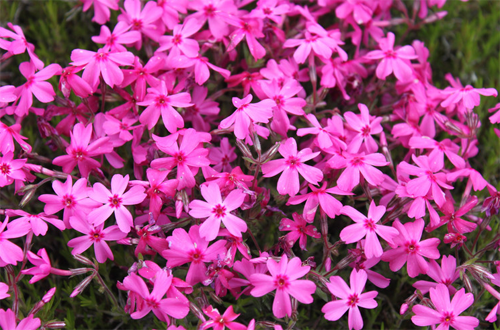
Growing methods for moss phlox:
Moss phlox is extremely drought-tolerant. Its leaves are small and needle-like, with a waxy surface, and its stems are woody, which greatly reduces water evaporation.
It has strong disease resistance, is not prone to pests, and has strong adaptability. It is truly easy to care for, and it is not demanding about soil or fertilizer. Whether it is thin, poor soil, dry hillsides, watersides, or damp ground, it can be planted. It is best planted along the paths of a small courtyard and in flowerbeds!
Moss phlox is cold-tolerant and heat-tolerant. It remains evergreen at -8°C, can withstand lows of -35°C, and tolerates highs of 42°C.
Moss phlox has strong adaptability. Although it likes a sunny environment, it can also grow in partial shade.
Because moss phlox is basically not propagated by seed and its spreading ability is not strong, there is no need to worry about its growth getting out of control.
Advantages of moss phlox:
1. Drought tolerance
This variety has many well-developed fibrous roots, small needle-like leaves, and a waxy leaf surface, which greatly reduces water evaporation. Therefore, it is extremely drought-tolerant and suitable for planting along both sides of roads, on slopes for erosion control, and in dry, low-rainfall areas. It is also the preferred plant for rooftop planting.
2. Cold tolerance
It can overwinter safely when planted in the open ground in the north. In winter, at -8°C to -10°C, it is an evergreen herbaceous plant, and it can withstand lows of -30°C.
3. Long blooming period
Moss phlox is an evergreen perennial plant with a height limit of 10-15 cm. The meristem cells in the internodes are active, and it grows creeping. In the Dalian area, it blooms in April, and at peak bloom it is like a pink carpet, giving off a fresh fragrance, very brilliant and spectacular. The blooming period can last 1.5-2 months, and it blooms a second time in August-September. It can also grow and bloom normally in partial shade.
4. Low-maintenance care
Moss phlox grows vigorously, is not particular about soil, has no serious pests or diseases, and grows quickly. It is easy to establish and can cover the ground in a short time. When flowers of various colors are combined, it is even more spectacular.
How long is the blooming period of moss phlox:
The so-called moss phlox is actually a herbaceous plant. Because its blooming period comes right after that of cherry blossoms, and its flower shape is also somewhat similar to cherry blossoms, it is called moss phlox. The blooming period is April to June.
Moss phlox blooms in 6 colors: purple, white, red, pink, light pink, and pale violet. The flowers are dense and vivid, and the small blooms form large masses of color, with a slight floral fragrance. Moss phlox blooms in two seasons, with a total blooming period of up to 3 months.
That is all for the introduction to moss phlox growing methods and blooming period. Why not hurry and add a different color to your own campus.
Moss Phlox Phlox subulata Moss Phlox Guide: How to Grow Moss Phlox / How to Propagate Moss Phlox
Moss Phlox ProfileMoss Phlox Phlox subulata
Growing Methods and Precautions for Moss Phlox An Introduction to Moss Phlox
Moss phlox is actually not a variety of cherry blossom. It belongs to the herbaceous plants. One stem divides into many branches and covers the ground. These single-petaled little flowers are called "cherry" because their color and form are similar to cherry blossoms. As for the so-called "moss," in Japanese it refers to "creeping wild grass," and the name "moss phlox" comes from this. The so-called moss phlox is actually a herbaceous plant. Because its blooming period comes right after that of cherry blossoms, and its flower shape is also somewhat similar to cherry blossoms, Japanese people call it moss phlox.
Moss means grass. Moss phlox is a perennial herbaceous plant with persistent roots, native to North America. In recent years it has been cultivated in China because when its flowers are in full bloom, their shape resembles cherry blossoms, while its stems creep along the ground like short grass (Japanese [moss]), so it is called moss phlox. Moss phlox is actually not a variety of cherry blossom. It belongs to the herbaceous plants. One stem divides into many branches and covers the ground. These single-petaled little flowers are called "cherry" because their color and form are similar to cherry blossoms. As for the so-called "moss," in Japanese it refers to "creeping wild grass," and the name "moss phlox" comes from this.
Origin of the genus name
It is called a "flowering ground cover." The genus name comes from Greek, meaning "lover of forests," and it is named for its brilliant red flowers that bloom like fire.
Morphological characteristics of moss phlox
Moss phlox is mostly planted on slopes. Its stems creep and extend according to the rises and falls of the terrain. The flowering stems bear small flowers 1.2 cm to 1.8 cm across, densely clustered at the top of the stem. The corolla is five-lobed, in a tall cup shape, with a slightly notched front edge. Flower colors include deep peach red, pink, and white. It can also be planted on stone walls or wall flowerbeds to appreciate the beauty of its profuse blooms.
Ecological habits of moss phlox
1. Drought tolerance
This variety has many well-developed fibrous roots, small needle-like leaves, and a waxy leaf surface, which greatly reduces water evaporation. Therefore, it is extremely drought-tolerant and suitable for planting along both sides of roads, on slopes for erosion control, and in dry, low-rainfall areas. It is also the preferred plant for rooftop planting.
2. Cold tolerance
It can overwinter safely when planted in the open ground in the north. In winter, at -8°C to -10°C, it is an evergreen herbaceous plant, and it can withstand lows of -30°C.
3. Long blooming period
Moss phlox is an evergreen perennial plant with a height limit of 10-15 cm. The meristem cells in the internodes are active, and it grows creeping. In the Dalian area, it blooms in April, and at peak bloom it is like a pink carpet, giving off a fresh fragrance, very brilliant and spectacular. The blooming period can last 1.5-2 months, and it blooms a second time in August-September. It can also grow and bloom normally in partial shade.
4. Simple, low-maintenance management
This variety grows vigorously, is not particular about soil, has no serious pests or diseases, and grows quickly. It is easy to establish and can cover the ground in a short time.
Moss phlox is extremely drought-tolerant. Its leaves are small and needle-like, with a waxy surface, and its stems are woody, which greatly reduces water evaporation. Moss phlox has strong disease resistance, is not prone to pests, and has strong adaptability, and it is easy to care for. It is not demanding about soil or fertilizer. Whether it is thin, poor soil, dry hillsides, watersides, or damp ground, it can all be planted in large quantities. Moss phlox is cold-tolerant and heat-tolerant. It remains evergreen at -8°C, can withstand lows of -35°C, and tolerates highs of 42°C. Moss phlox has strong adaptability. Although it likes a sunny environment, it can also grow in partial shade. "Because moss phlox is basically not propagated by seed and its spreading ability is not strong, there is no need to worry about its growth getting out of control."
Landscape uses of moss phlox
Landscape uses
Flower colors include deep peach red, pink, and white. It can also be planted on stone walls or wall flowerbeds to appreciate the beauty of its profuse blooms. Its drought tolerance, cold tolerance, long blooming period, long green period, and floral fragrance make it quite popular. It is an excellent planting variety for flowerbeds, flower borders, bonsai, lawns, and color bands, and has the reputation of being a flowering lawn. Moss phlox is very cold-tolerant and can be propagated by division, so it is often planted in parks or courtyards. Moss phlox tightly covers the ground like turf, and the sight of pink or white flowers blooming together is very spectacular.
In Japan, the main cultivation area for moss phlox is the Hokkaido region. In the south there is Ryūno Suzuran Hill Park at the southern end of Sapporo; in the center there is Akino-oka Park in Makubetsu, Nakagawa District; in the north there is Takinoue Park (this is Japan's most famous moss phlox viewing destination); in the east there is Higashimokoto Moss Phlox Park in Higashimokoto Village, Abashiri District. There are also some large planting areas in Tokyo, such as Hitsujiyama Park in the city. Large-scale planting has formed Japan's unique moss phlox landscape. Every year when the moss phlox blooming season arrives, visitors come in droves and linger, bringing huge economic benefits to the local area.
Moss phlox blooms in 6 colors: purple, white, red, pink, light pink, and pale violet. The flowers are dense and vivid, and the small blooms form large masses of color, with a slight floral fragrance. Moss phlox blooms in two seasons, with a total blooming period of up to 3 months.
Moss phlox, in the genus Phlox, clump-forming, native to eastern North America, is a perennial evergreen herbaceous flowering plant with persistent roots, and in recent years it has been cultivated in China. In Japan, because when its flowers are in full bloom, their shape resembles cherry blossoms, while its stems creep along the ground like short grass (Japanese "moss"), it is called moss phlox. Large-scale planting has formed Japan's unique moss phlox landscape. Every year when the moss phlox blooming season arrives, visitors come in droves.
Distribution area of moss phlox
Origin: eastern United States.
In Japan, the main cultivation area for moss phlox is the Hokkaido region. In the south there is Ryūno Suzuran Hill Park at the southern end of Sapporo; in the center there is Akino-oka Park in Makubetsu, Nakagawa District; in the north there is Takinoue Park (this is Japan's most famous moss phlox viewing destination); in the east there is Higashimokoto Moss Phlox Park in Higashimokoto Village, Abashiri District. There are also some large planting areas in Tokyo, such as Hitsujiyama Park in the city. Large-scale planting has formed Japan's unique moss phlox landscape. Every year when the moss phlox blooming season arrives, visitors come in droves and linger, bringing huge economic benefits to the local area.
Variety classification of moss phlox
Purple Carpet
Corydalis
Red Carpet
Pink Carpet
Daryl
White Carpet
Moss Phlox
Flower language of moss phlox
In Japan its flower language is "hope"; others include "memories, hope, shyness, if it suits you I feel deeply happy." It has no particular fragrance.
Moss phlox pictures
Growing Methods and Precautions for Phlox subulata
Chinese scientific name: Phlox subulataLatin scientific name: Phlox subulata L.Other names: clump-forming phlox, moss phloxKingdom: PlantaeDivision: AngiospermaeClass: DicotyledoneaeSubclass: SympetalaeOrder: TubifloraeSuborder: ConvolvulineaeFamily: PolemoniaceaeGenus: PhloxOrigin: North AmericaEcological traits: cold-tolerant plantBlooming period: April-SeptemberIt belongs to the Polemoniaceae family, genus Phlox, and is a perennial herbaceous plant native to North America. It grows 10-15 cm tall, tolerates cold down to around -40°C, and is extremely drought-tolerant. It remains evergreen at -12°C and blooms in both spring and autumn; in Liaoning it blooms in early April; in Beijing it blooms in late March. When in bloom it is like a pink carpet, and it is praised as a "flowering lawn" and "colorful carpet." In Japan it is called "ground-covering cherry" and is as famous as cherry blossoms. It is mostly used for patterns, lettering, or interplanting with lawns, with vivid and strong color contrast and excellent effect. It is the best ground cover plant to replace traditional lawns.1. Morphological characteristics
It is a perennial evergreen cold-tolerant herbaceous flowering plant with persistent roots. The flowers are purplish red, white, pink, etc. The old stems are semi-woody, the plant grows 8-10 cm tall, and the branches and leaves are dense, growing prostrate on the ground. The leaves are needle-like, clustered, leathery, about 1.3 cm long. In spring the leaves are bright green, in summer and autumn dark green, and in winter after frost they turn grayish green. The leaves and flowers open at the same time. Whenever the blooming season arrives, the abundant flowers cover all the stems and leaves, forming a sea of flowers, with a hundred beauties competing in fragrance, elegant and lovely. The flowers are goblet-shaped and fragrant, with 5 petals, obcordate, with deep notches. At the base of the petals there is a deep red ring. The flower diameter is 2 cm. The blooming period is April-December. The first peak blooming period is April-May, the second blooming period is August-September, and it continues into December with scattered small flowers opening one after another. It is a unique variety in the Phlox line. It is a ground cover flower and has the characteristics of simple planting, strong adaptability, drought tolerance, cold tolerance, and tolerance of saline-alkali soil.Clump-forming phlox blooms in spring and autumn each year. The open flowers have a slight fragrance, are tall cup-shaped, and come in deep pink, rose purple, white, light red, and yellow, etc. The plant grows robustly and can grow in many types of soil, and it can also grow well in slightly dry soil. This variety sprouts early, and the leaves and flowers emerge at the same time.
Clump-forming phlox is not demanding about fertilizer, but during the growth cycle, attention should be paid to applying base fertilizer. When preparing the land, add organic fertilizer, applying about 500 kg to 1000 kg per mu. During the growing period, apply a small amount of nitrogen and phosphorus fertilizer as appropriate. During the leaf-growing period, mainly use nitrogen fertilizer, and during the blooming period, phosphorus fertilizer can be sprayed.
2. Origin
Clump-forming phlox is native to North America. It was successfully introduced to Japan and used in large quantities for environmental greening, achieving very good results, and was named moss phlox.3. Growth habits
This plant is extremely cold-tolerant, drought-tolerant, poor-soil-tolerant, and heat-tolerant. At -8°C, the leaves still remain green, and it can overwinter at -32°C. In poor yellow sandy soil, even if there is no rain for many days, it can still survive and grow. It can also tolerate high temperatures of 42°C. It can bloom twice a year, each time for about 40 days. It is an excellent alternative variety to lawn grass.In summer, clump-forming phlox should be trimmed in time. Especially after blooming, cut off the branches that have already flowered and any irregular branches. Do not use a lawn mower to cut it; it can only be trimmed by hand with shears. If weeds are found, they must be removed manually; do not spray herbicide. In dry seasons, clump-forming phlox is prone to red spider mite damage, with symptoms of yellowing leaf clusters.
In areas that are too cold, a layer of leaves or branches can be spread over the seedlings in the field, which can avoid frost damage caused by severe cold.
4. Main uses
Clump-forming phlox has many excellent traits of perennial flowers and has many landscape uses: it can be planted on bare open ground; it can accent the edges of green belts; it can be planted among rocks; it can be mixed with tulips, campanula, dwarf daylilies, and other flowers; it can be planted under large trees to create the beautifying effect of no bare yellow soil; and it can also be planted on slope areas, not only beautifying the slope but also reducing soil erosion.Clump-forming phlox is highly valued in landscaping. It not only has a high coverage rate but also strong ornamental value. It is an excellent ground cover flower, can replace traditional lawns, and is a good ground cover plant. Clump-forming phlox is favored by the public for its long blooming period and long green period (330-360 days), especially when it blooms in early spring, with abundant flowers like brocade, festive and delightful. It is most suitable for courtyard flowerbed planting or planting in rock gardens. The group viewing effect is excellent. It can be used as ground cover decorative material to accent lawns or for hanging basket planting. Used for flowerbeds, flower borders, and ground cover.