Crape Myrtle: Planting and Propagation Methods, Plus Pest and Disease Control
Crape myrtle is extremely beautiful, blooming in long cascading clusters that are highly attractive. How do you plant crape myrtle? What are the propagation methods for crape myrtle? How do you prevent and control pests and diseases that appear while growing crape myrtle?
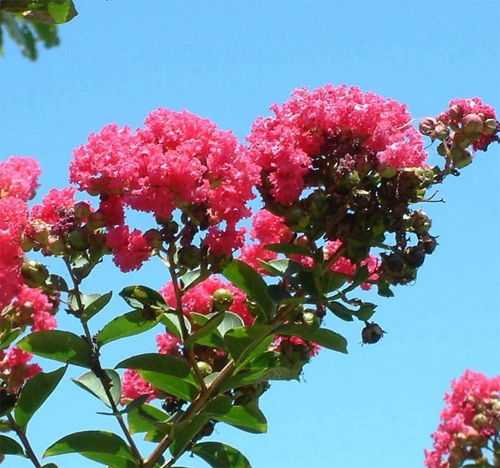
How to plant crape myrtle:
1. Light
It loves a sunny, well-lit environment. Whether grown in the ground or as a potted specimen, it needs plenty of sunlight to grow well.
2. Proper watering
It likes a warm, moist environment. Although it is fairly drought-tolerant, it can still be given some supplemental water during dry seasons, especially potted plants. Water in the morning and evening during summer and autumn, and increase watering appropriately during hot periods.
3. Reasonable fertilizing
Potted crape myrtle should not be over-fertilized, or it will grow weakly. Fertilize regularly in small amounts, slightly more in spring and summer, less after autumn begins, and none in winter. Master the principle of light, frequent feeding in small doses.
4. Reasonable pruning
As a common landscaping tree, crape myrtle is very tolerant of pruning and readily produces new branches. After flowering, remove the spent blooms so new flowers can grow again and to reduce energy consumption.
Diseased and weak branches should be pruned promptly to avoid excessive nutrient consumption.
5. Timing for repotting
Potted crape myrtle does not need frequent repotting; generally once every 2-3 years. Use a potting mix of ordinary loose humus soil blended with garden soil, combined with 2-3 parts river sand.
Of course, add an appropriate amount of organic fertilizer or decomposed cake fertilizer. These can serve as base fertilizer, but must not come into direct contact with the roots, as this will damage them.
Propagation methods for crape myrtle:
Crape myrtle is generally propagated by cuttings, but it can also be grown from seed or by layering. If you want something more interesting, you can try grafting, which lets a single tree produce flowers of different varieties and colors.
1. Cuttings
Hardwood cuttings (branches over one year old) are usually taken in spring after the weather warms. Select thick, sturdy branches, cut them into 15 cm cuttings, insert them into loose, well-drained sandy loam, water thoroughly, and cover with plastic film to retain moisture and warmth.
Softwood cuttings are taken in summer. Choose semi-lignified branches, cut them into 8-10 cm lengths, and leave 2-3 leaves at the top. Water thoroughly after inserting, shade them, and cover with film. Both methods have a good survival rate.
2. Sowing
Collect ripe seeds in late autumn, remove the husks, dry the seeds, and sow them the following year after the weather warms in spring.
3. Grafting
Crape myrtle actually has several varieties, such as silver crape myrtle, whose flowers are white; Cuvei, whose flowers are blue-purple or light purple; and red crape myrtle, whose flowers are peach-red or deep red. The survival rate is very high. Grafting is done in late winter or early spring, before crape myrtle buds break.
Disease control for crape myrtle:
1. Powdery mildew
Prune appropriately in winter, cutting off diseased and dead branches, and promptly remove weak branches and diseased leaves in spring.
When the disease occurs, spray with triadimefon, thiophanate-methyl and zineb. Be sure to alternate two or more of these chemicals to avoid resistance.
2. Sooty mold
If growth is too dense, prune diseased branches appropriately. Good ventilation and light penetration reduce the incidence of disease.
When affected, spray alternately with thiophanate-methyl and carbendazim.
3. Aphids, scale insects and other pests
Spray with omethoate or dichlorvos. The key to care is to prune more in winter and early spring, removing weak and diseased branches to reduce pests and diseases.
Other names for crape myrtle:
Bairihong (Hundred-Day Red) and Mantanghong (Hall-Full Red). It is very common throughout China, with extremely vivid flower colors, abundant blooms, and an exceptionally long flowering period that can be seen in both summer and autumn.
That covers the growing and propagation methods for crape myrtle. Why not start growing it at home right away and make your home more beautiful?
How to grow potted crape myrtle and what are its propagation methods
Crape myrtle is also known as yangyanghua, yangyangshu, and zijinhua. It is a deciduous shrub or small tree in the genus Lagerstroemia, family Lythraceae. It has been cultivated in China for thousands of years and is widely planted as a flowering ornamental tree. Let's take a look at how to grow potted crape myrtle!
How to grow potted crape myrtle:
1. Soil: Crape myrtle is vigorous and easy to cultivate, with no strict soil requirements. It prefers fertile, moist soil and can also tolerate drought. It grows well in both calcareous and acidic soils. It does best in slightly moist spots and grows best when planted in deep, fertile sandy loam.
2. Watering: Crape myrtle is drought-tolerant and afraid of waterlogging. Each year, water once before spring growth begins and once after leaf drop in autumn with a "greening-up" watering and a "freezing" watering. Normally, if it is not too dry, no watering is needed. Generally, water 1-3 times during spring droughts. In the rainy season, ensure good drainage to prevent root rot from excess water. Do not water in autumn.
3. Sunlight: Potted crape myrtle loves light. Generally place it in a sunny, well-ventilated spot. In southern regions, it can overwinter outdoors in a sheltered, sunny spot; in northern regions, it should be moved indoors. Insufficient light not only means fewer or no flowers, but can even cause weak growth with thin branches and small leaves. Therefore, during the growing season, place crape myrtle in a sunny spot outdoors.
4. Temperature: Crape myrtle is not very cold-hardy and is prone to freezing and drying out, and in severe cases can freeze to death. Therefore, move it indoors to overwinter in winter, keeping the room temperature above 7°C. When it drops below 7°C, use methods such as wrapping in plastic bags for insulation, heating with hot water, or adding stove heat. Also pay attention to ventilation. If the indoor temperature is too high, open doors and windows and reduce watering, otherwise normal dormancy will be affected and root rot may even occur.
5. Fertilizing: Crape myrtle is a heavy feeder. Lack of fertilizer leads to thin, weak branches and yellowing, which causes weak growth, few or no flowers. However, over-fertilizing causes excessive vegetative growth of branches and leaves. Fertilize each year after leaf drop in winter and before spring growth begins. Applying human waste or sesame paste residue is even better, making crape myrtle grow vigorously the following year with large, vividly colored flowers.
6. Pruning: Crape myrtle flower clusters form at the tips of the current year's new branches. Therefore, when pruning, heavily prune and cut back one-year-old branches to concentrate nutrients and encourage vigorous branching. Remove water sprouts, dry branches, drooping branches, diseased and pest-infested branches, slender branches, and inward-growing branches. During the young tree stage, also promptly remove side branches from the lower part of the main trunk so that the upper trunk receives sufficient nutrients and forms a good canopy.
7. Pests: Under insufficient light and poor ventilation, crape myrtle is susceptible to scale insects, which can also trigger sooty mold. Scale insects can be killed by spraying with 40% dimethoate emulsifiable concentrate at 1000x dilution or by applying 3% carbofuran granules to the soil. During the plum rain season, aphids and mealybugs often cause damage; spray with 40% dimethoate diluted to 1500x, or kill them with 80% dichlorvos emulsion at 1000-1200x. Sooty mold can be controlled with lime sulfur mixture.
8. Repotting: Potted crape myrtle needs its potting soil replaced every two to three years. Use a mix of 5 parts loose mountain soil, 3 parts garden soil, and 2 parts fine river sand as the growing medium. When repotting, use organic fertilizers such as bone meal or soybean cake meal as base fertilizer, mixed into the surface layer of the soil. Do not let the fertilizer come into direct contact with the roots, to avoid burning them and affecting plant growth.
Growth habits of crape myrtle:
Crape myrtle prefers a warm, humid climate, loves light, and tolerates partial shade. It loves fertilizer, especially deep, fertile sandy loam. It does well in slightly moist spots and also tolerates drought. It dislikes waterlogging and should not be planted in low, wet areas with a high water table. It likes warmth and can withstand cold, with strong suckering ability. It has fairly strong pollution tolerance, with good resistance to sulfur dioxide, hydrogen fluoride and chlorine gas. It is semi-shade tolerant, prefers fertile, moist soil, and can also tolerate drought. It grows well in both calcareous and acidic soils.
Propagation methods for crape myrtle:
1. Grafting propagation: Carry out from late February to early March, before crape myrtle branches bud. For grafting, choose a robust, well-developed seedling as the rootstock, take branches of the desired flower color as scions, and use the cleft grafting method. First make a vertical split about 5-8 cm deep at the top of the rootstock near the outer edge, then take a 5-8 cm scion with at least 2 buds, cut it into a wedge shape, and insert it into the cleft of the rootstock, aligning the cambium layers. Then wrap the entire scion branch with plastic film, leaving the bud tip exposed.
2. Hardwood cuttings: Generally done from mid-to-late March to early April, before branches sprout. Select thick, sturdy one-year-old branches, cut them into 15 cm cuttings, and insert them into a loose, well-drained sandy loam seedbed. Insert to a depth that leaves the topmost bud of the cutting exposed. After inserting, water thoroughly and cover with plastic film to retain moisture and warmth. Once the seedlings grow to 15-20 cm, remove the film and switch to a shade net, watering as needed. That year the branches can grow to about 60-80 cm.
3. Softwood cuttings: Done in July-August, when new branches are growing vigorously and are at their most vital. Choose semi-lignified branches, cut them into 8-10 cm cuttings, and leave 2-3 leaves at the top. Insert to a depth of 3-4 cm. After inserting, water thoroughly and set up a shade shed for shade. Roots generally form in about 20 days. Remove the film, keep the shade net, and water as needed. That year the branches can grow to about 60-80 cm, with a very good survival rate.
4. Layering propagation: Layering is best done from March to April in spring. Choose one- to two-year-old branches, use a sharp knife to score and ring-bark the bark about 1.5 cm, exposing the xylem. Apply rooting powder solution (diluted according to instructions) about 3 cm above the scored area. Once dry, cover the scored area with a tubular plastic bag, fill it with loose garden soil, water it, and tie both ends tightly. Check after one month; if the soil is too dry, add water to keep it moist. Once roots form, cut it off and plant separately.
5. Division propagation: In early March to April or in autumn, dig up the suckering shoots that sprout from the base of the plant, with roots attached, trim the roots and branches appropriately, and replant them separately. Small seedlings can be planted bare-root; larger seedlings should be planted with a soil ball. During cultivation, prune and shape regularly to maintain a graceful tree form and promote abundant flowering branches.
6. Seed propagation: Usually in March, sow in wide rows or broadcast on a sandy loam seedbed, cover with a layer of fine burned mud ash just enough to hide the seeds, and cover with grass. They sprout and emerge in about 10 days; remove the grass promptly. When the seedlings develop 2 pairs of true leaves, thin them after rain. Weed frequently during the seedling stage, apply light fertilizer 2-3 times in June-July, and irrigate to prevent drought in summer. By the end of the year the seedlings are about 40-50 cm tall. Vigorous ones may bloom the same year; these flowers should be removed promptly. Transplant and grow them on the following spring around the spring equinox.
Common pests of crape myrtle and their control methods
Aphid pests on crape myrtle
Symptoms
In northern regions, 5-8 generations occur each year, overwintering as eggs. The disease begins in May, with the peak period in June. Aphids suck sap and damage tender leaves, posing a threat to crape myrtle growth.
Control methods
In early spring, scrape off the old bark of crape myrtle trees, cut off affected branches, and burn them in a centralized manner to eliminate overwintering eggs as much as possible. Strengthen cultivation management during routine care to reduce sources of the disease.
When aphids are severe, spray with derris extract at 1000-2000x dilution, or 40% omethoate, or 40% acephate at 1000-1500x dilution to kill them, but also be careful to avoid chemical damage. Where conditions permit, artificial breeding and release of natural enemies can also be used; releasing the multicolored Asian lady beetle or green lacewing larvae are both good options. In addition, colored sticky boards can be used to trap and kill winged aphids, or white tin foil can be used to reflect light and repel migrating aphids.
Mealybug pests on crape myrtle
Symptoms
Two generations occur each year, overwintering as eggs or nymphs. Female adults and nymphs often suck sap at crape myrtle bud axils, leaves and branches, causing the branches and leaves to turn black and leaves to drop, harming crape myrtle growth. In addition, the pest's excrement can trigger sooty mold, posing a significant potential risk.
Control methods
In winter and early spring, prune branches and burn infested branches in a centralized manner to eliminate eggs as much as possible. Pests that are found can be removed manually. Strengthen management and quarantine, fertilize reasonably to enhance the plant's pest resistance, and avoid excessive plant density. Keep plants well ventilated and ensure good light penetration. A polymer film can be mixed with a spray and applied evenly, forming a thin film on the plant surface that makes it difficult for the insects to breathe, causing them to suffocate and die; or their natural enemy, the Chilocorus lady beetle, can be used to prey on and eliminate them. When necessary, chemical control can also be used.