How to Grow Hime Coral (Cylindropuntia) and Its Blooming Time
Hime Coral looks just like a cactus, only much more slender than a cactus, and it appears very vigorous. What are the cultivation methods for Hime Coral? When does it bloom?
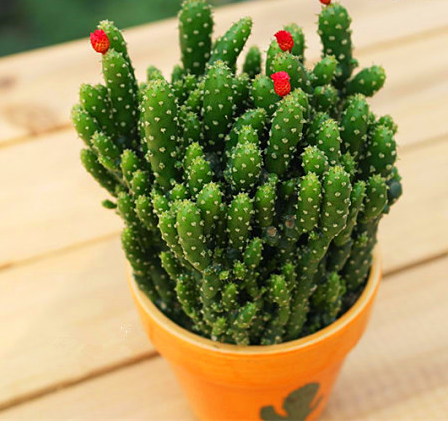
Cultivation methods for Hime Coral:
1. Pot and soil selection
When cultivating Hime Coral, the potting soil should preferably be a sandy soil with good drainage and aeration, rich in calcium. It can be prepared with 3 parts river sand, 2 parts shells, 2 parts coal cinder and 3 parts leaf mold (I use pond soil).
2. Fertilizing
Hime Coral should avoid chemical fertilizers, which easily cause root rot; it is best to apply little or none. In spring and from late summer to early autumn, you can apply two rounds of fully decomposed fermented liquid fertilizer at half-month intervals.
3. Watering
The potting soil should preferably be dry rather than wet. If it stays too wet for a long time, the lower part of the plant will rot, and it will quickly spread to the whole plant.
For a fully formed pad-shaped plant, extra care must be taken with watering and fertilizing. Once it rots, it will be a great loss of several years of effort.
Notes:
1. Avoid applying concentrated fertilizer.
2. Better dry than wet.
3. Keep sunlight sufficient. During the growing period, because the new stems are very tender, pay attention to prevention and catch insects promptly.
It is best to prepare a coarse clay pot, mix the soil, and maintain humidity.
Select some sturdier stem segments (one node is enough) and plant them in the pot, then spray with water so that the surface of the potting soil binds together, then place it directly under the sun to bake. Do not water frequently; keep the potting soil dry. This is the method to force the growth of pad-shaped stem segments.
After some time, some stems will begin to grow small golden-yellow spines, and then the newly grown stems will begin to become slightly flatter and wider, showing a tendency toward pad shape. If from the very beginning it is always kept relatively moist, then the new stems will not show a tendency toward pad shape.
Care notes:
Hime Coral can be placed in front of a window, on a balcony, or in other bright spots with scattered light. During the winter and summer dormancy periods, reduce water and provide shade. During the spring and autumn growing periods, when watering, wait until the potting soil is completely dry before watering, and when watering, soak the soil thoroughly. It can be propagated by cuttings.
If Hime Coral is placed indoors in insufficient light for a long time, it will become leggy, and the new stems will be light green and become very slender.
If moved outdoors, the newly grown stems will thicken again, and at this point it will seriously affect the overall shape of the plant.
During the growing period, because the new stems are very tender, they are often gnawed by snails and large green caterpillars, so attention must be paid to prevention and timely capture.
From late summer to early autumn, it is in a period of vigorous growth. At this time, pay attention to sufficient light, and you can apply a relatively dilute fertilizer solution once, then apply it again after half a month. During this period, the stem pads generally maintain their original width but continue to grow taller until the growing period ends.
When does Hime Coral bloom?
Hime Coral produces yellow flowers. From planting or cutting propagation, it takes three years to bloom; if grown well, it will bloom earlier.
The cultivation methods and notes for Hime Coral are introduced here. Seize the time to admire the flowers of Hime Coral.
Cultivation Methods and Notes for Hime Coral: How to Grow Hime Coral
Coral is undoubtedly beautiful and precious, and "hime" was what people in ancient times called a beauty, so Hime Coral, as the beauty among corals, must surely be beautiful beyond compare. However, whether it deserves such a name still remains to be tested by people. Now let's take a look together with the editor!
Cultivation Methods and Notes for Hime Coral
1. Soil requirements
When cultivating, the potting soil should preferably be a sandy soil with good drainage and aeration, rich in calcium. It can be prepared with 3 parts river sand, 2 parts shells, 2 parts coal cinder and 3 parts leaf mold (pond soil).
2. Planting method
Prepare a relatively large pot (a coarse clay pot is preferable), mix the soil well, and keep it slightly moist. Select some sturdier stem segments (one node is enough) and plant them in the pot, then spray with water so that the surface of the potting soil binds together, then place it directly under the sun to bake. Do not water frequently; keep the potting soil dry. After some time, some stems will begin to grow small golden-yellow spines, and the stems will begin to become slightly flatter and wider, showing a tendency toward pad shape.
Do not water frequently; this is the method to force the growth of pad-shaped stem segments. If from the very beginning it is always kept relatively moist, then the newly grown stems will not show a tendency toward pad shape, but will grow in the same form as the original plant. When the stem pads have grown to about 2 cm wide, they can be potted up.
3. Fertilizing method
Hime Coral should avoid chemical fertilizers, which easily cause root rot; it is best to apply little or none. In spring and from late summer to early autumn, you can apply two rounds of fully decomposed fermented liquid fertilizer at half-month intervals. The potting soil should preferably be dry rather than wet. If it stays too wet for a long time, the lower part of the plant will rot, and it will quickly spread to the whole plant.
4. Light requirements
If Hime Coral is placed indoors in insufficient light for a long time, it will become leggy, and the new stems will be light green and become very slender, giving the whole plant a different look. But if it is then moved outdoors, the newly grown stems will thicken again, and at this point it will seriously affect the overall shape of the plant. So do not casually change the light conditions for Hime Coral; keep the light relatively stable.
5. Notes
In the second year after transplanting, change the potting soil once before the spring growing period, and continue management as before. When the vigorous growth period arrives, fully pad-shaped stem segments will grow, but at this time the stem pads are not very large and the plant is not tall. If you want larger stem pads, you must remove some excess stem buds and let it "stand out alone as a single branch." In the third spring, change to a slightly larger pot. If managed properly, during the vigorous growth period it should grow its largest stem pads.
For a fully formed pad-shaped plant, extra care must be taken with watering and fertilizing. Once it rots, it will be a great loss of several years of effort. The main points to note are still the following: avoid applying concentrated fertilizer; better dry than wet; keep sunlight sufficient.
How to Grow Hime Coral
Hime Coral likes sunlight and should avoid exposure to intense sun. For home care, it can be placed in front of a window, on a balcony, or in other bright spots with scattered light. If light is insufficient, leggy growth will occur, the new stems will appear light green and become very slender, and the plant will be in a different state.
During the winter and summer dormancy periods, reduce water and provide shade. During the spring and autumn growing periods, when watering, wait until the potting soil is completely dry before watering, and when watering, soak the soil thoroughly.
The new stems of Hime Coral are very tender, and in the wild they are easily gnawed. In home care, they are also often gnawed by snails and other pests. Pay attention to prevention and timely capture.
When does Hime Coral bloom?
After planting or from the time of cutting propagation, Hime Coral must be grown for three years before it blooms. If propagated from seed, it takes five years to bloom, but if grown well, it will bloom earlier.
The flowering period of Hime Coral is generally in midsummer, so the blooms at that time are truly beautiful and abundant.
The flowers of Hime Coral are yellow, fresh and pleasant, with a faint delicate fragrance. The flowers open their petals and are reborn like lotus flowers, yellow from the inside out.
What to Do If Hime Coral Becomes Leggy
Generally, when Hime Coral becomes leggy, growing tall and thin, you first need to find the cause. Basically, give it sufficient light. For indoor cultivation, it is best to place it in a bright spot, and it can often be moved outdoors to get more sun, which can make the plant thicken again, but it easily affects the plant's shape. Water and fertilizer must be reasonably controlled, and water less. Generally, with more sunlight and less watering, leggy growth can be suppressed.
For Hime Coral plants that have already begun to become leggy, if discovered early, they can be cared for as described above to inhibit further leggy growth. Plants that have already grown very leggy are difficult to restore, and can only be gradually grown strong again. You can also cut off the leggy branches and use them for cuttings to propagate new plants.
People who know Hime Coral will know that its beauty has layers, just like coral. So for those who grow this succulent, admiring Hime Coral in leisure time is truly the best gift to life, and also the highest evaluation and reward for Hime Coral.
What Is the Difference Between Hime Coral and Euphorbia tirucalli: When Does Hime Coral Bloom
The diverse forms of succulents have given different shapes, colors and sizes different names to distinguish and describe them. Although Hime Coral and Euphorbia tirucalli can be clearly distinguished by name as two different succulents, how exactly should they be distinguished in appearance?
What Is the Difference Between Hime Coral and Euphorbia tirucalli
1. Morphological characteristics
Hime Coral is a shrub-like plant. Its stems and branches are generally round, 0.5-1.5 cm in diameter, generally emerald green in color, and the whole plant grows slender, straight and upright. The flowers are yellow and open in midsummer, so the flowering period is in summer.
Compared with Hime Coral, Euphorbia tirucalli has a more slender overall plant form and is tender green, with black spots growing on the stems, looking tender and watery, as if water could be pinched out of it.
2. Growth habits
Hime Coral is a plant that likes sunlight and should avoid exposure to intense sun. So when growing it, it can be placed in front of a window, on a balcony, or in other bright spots with scattered light. During the summer dormancy period, reduce watering and also pay attention to shading. During the spring and autumn growing periods, when watering, wait until the potting soil is completely dry before watering, and when watering, soak the soil thoroughly.
Euphorbia tirucalli likes a warm, dry and sunny growing environment. It is also tolerant of drought and semi-shade, but not cold-resistant and afraid of damp shade, as such conditions will affect the normal growth of the plant. The optimum temperature for growth is 15-25°C, and in winter the temperature should not be lower than 10°C.
3. Family and genus category
Hime Coral is a plant belonging to the cactus family (Cactaceae), and its growth habits and other aspects share many similarities with cacti.
Euphorbia tirucalli is a plant of the genus Euphorbia in the family Euphorbiaceae, clearly different in category from Hime Coral.
When does Hime Coral bloom?
After planting or from the time of cutting propagation, Hime Coral must be grown for three years before it blooms. If propagated from seed, it takes five years to bloom, but if grown well, it will bloom earlier.
The flowering period of Hime Coral is generally in midsummer, so the blooms at that time are truly beautiful and abundant.
The flowers of Hime Coral are yellow, fresh and pleasant, with a faint delicate fragrance. The flowers open their petals and are reborn like lotus flowers, yellow from the inside out.
Cutting Propagation of Hime Coral
1. Selecting cuttings
For cutting propagation of Hime Coral, first select a disease-free and pest-free branch segment from a robust Hime Coral plant, then use scissors to cut it at the branching point. Use chopsticks or tongs to hold the cut plant part to avoid damaging the branch and to prevent pricking your hands.
Then prepare a flower pot. In the flower pot, spread soil mixed with sand, that is, soil with good moisture, for use in cutting.
2. Preparing the cutting medium
The cut branch cuttings can be inserted directly into the soil. You can use chopsticks or tongs to hold them and insert them into the sandy soil, then straighten them. Then water, and water thoroughly in one go, but remember not to fertilize, so as to avoid burning the base and preventing root growth and sprouting.
3. Cutting care
Place the small Hime Coral plant in a spot without direct sunlight for care. During this period, also pay attention to providing shade for about 5 days. After the roots of the Hime Coral have grown stably, the Hime Coral can be placed in a spot with direct sunlight to supplement its light needs.
The Benefits of Hime Coral
1. Ornamental value of Hime Coral
The flowers of Hime Coral are yellow, plain and fresh, with a light elegant fragrance. Most people grow it in pots and place it on a balcony or on a bedroom windowsill.
Hime Coral likes sunlight and is afraid of exposure to intense sun. So place it in front of a window, on a balcony, or in other bright spots with scattered light for care.
During the winter and summer dormancy periods, pay attention to shading and controlling watering.
Good care will produce plants with rich forms and beautiful brightness, so Hime Coral is also a kind of home decoration plant. Placing a few pots indoors will make the living room feel dignified and elegant, with a good visual effect. It is a type of succulent, so it is easy to grow and easy to care for, and you can see a beautiful plant without much effort.
Its plant form is graceful, crisp and verdant. It is a very good stem-appreciation plant, and its colors are bright, so Hime Coral has ornamental value, can beautify a space, and cultivate one's mood.
2. Hime Coral can purify the air
The greatest benefit of growing Hime Coral is also air purification.
Hime Coral can absorb and remove polluted air in a room, playing a role in purifying the air.
Hime Coral can effectively absorb chemical substances contained in the air and can convert them into its own nutrients.
Therefore, Hime Coral has a strong ability to absorb harmful substances and can protect our physical and mental health.
Hime Coral itself also carries a natural fragrance, which is beneficial to people's health. Growing Hime Coral brings you the pleasure of both ornament and air purification. Growing one is truly excellent.
Hime Coral is not only beautiful in appearance and highly ornamental, but also has a certain air-purifying value. In short, it is a plant with both health-nourishing and mind-nourishing effects, so friends who need to calm the mind and have requirements for beautifying their homes can give it a try.