How to grow and propagate the bleeding heart, and how long does its flowering period last?
Although the bleeding heart (Dicentra spectabilis) has the two characters for "peony" in its Chinese name, it actually has nothing to do with the peony, and the flowers do not look alike either. The flowers of the bleeding heart hang upside down and are very beautiful. Let's take a look at how to grow and propagate the bleeding heart, and how long its flowering period lasts?
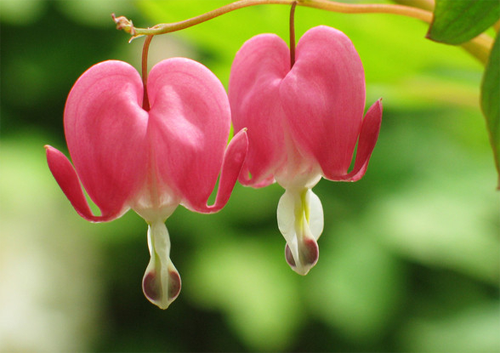
How to grow the bleeding heart:
1. Pot and soil selection
The bleeding heart can be planted in the ground or in pots. Choose a slightly deep and large earthenware pot with good permeability for planting.
If using a plastic or porcelain pot, place a layer of crushed charcoal chunks or crushed hard plastic foam chunks at the bottom of the pot to enhance air permeability and drainage. It likes to grow in loam soil rich in humus. You can use equal parts of leaf mold and topsoil from a vegetable garden mixed together as the growing medium. It grows poorly in both sandy soil and clay soil.
2. Water and fertilizer management
The bleeding heart is somewhat drought-tolerant and afraid of waterlogging, so it should be watered in moderation. Do not water when the soil is not dry; water as soon as it dries, and water thoroughly each time without leaving standing water. During the growing season in spring, autumn and early summer, water once a day or every other day on sunny days, and once every 3 to 5 days on cloudy days. Keeping the potting soil at about half moisture is beneficial to its growth. Too wet easily causes root rot, while too dry leads to poor growth and yellow leaves. During the dormant periods of midsummer and winter, the potting soil should be relatively drier, just slightly moist.
The bleeding heart likes fertilizer. When potting, planting out or repotting and changing the soil, it is best to add some bone meal or well-rotted organic fertilizer or a nitrogen-phosphorus-potassium compound fertilizer to the growing medium. During the growing season, apply a dilute nitrogen-phosphorus-potassium liquid fertilizer once every 10 to 15 days to make the leaves lush and the flowers abundant. Stop fertilizing after the flower buds show color, and do not fertilize during the dormant period.
3. Light and temperature
The bleeding heart originates from Hebei and Northeast China. It likes a semi-shaded environment with plenty of diffused light and is fairly cold-hardy, but it fears the intense heat of midsummer and strong direct sunlight. It can be placed under a large tree in the courtyard, under a shade frame, or on the shady side of a building, or on an east- or north-facing balcony.
During the summer dormant period, place it in a well-ventilated shady spot where it cannot receive direct sunlight, and frequently sprinkle water on the nearby ground to raise air humidity and lower the temperature.
4. Summer and drainage
The bleeding heart cannot tolerate prolonged rain and excessive moisture or scorching summer heat. When it encounters long periods of high temperature and high humidity, the leaves will scorch and the roots will rot.
During the intense heat of midsummer, the potted bleeding heart can be moved under a seedling shed for shade, or the pots can be buried together in the soil to prevent heat and lower the temperature, while keeping drainage and ventilation good. When there is no rain, spray water on the branches, leaves and surrounding area every day to increase air humidity and ensure the water supply during the flower bud differentiation period. In the rainy season, pay attention to drainage. On cloudy and rainy days, tip the flower pot over to prevent water from accumulating in the pot.
5. Care after flowering
After flowering, spray a 150-fold Bordeaux mixture or an 800-1000-fold Topsin solution once every 10-15 days to prevent and control leaf diseases. Peony roots are sweet and are prone to damage by ants or their grubs; a 1000-fold dichlorvos solution can be used instead of water for irrigation to kill them.
6. Overwintering and pruning
Ventilation and light penetration should be good. After the leaves fall in autumn and winter, carry out shaping and pruning. Cut off overly dense branches, such as parallel branches, crossing branches, inward-growing branches and pest- or disease-damaged branches, so that the plant keeps a beautiful shape. In late autumn and early winter, the potted peony can be buried in the soil with the branches left above the ground and the top covered with grass or earthed up for protection through the winter. (You can reply: shaping)
Some also place the flower pot directly indoors to overwinter. In the following spring, remove the covering, move it outdoors, place it in a ventilated, sunny spot, and strengthen fertilizer and water management; let it bloom naturally.
Notes on growing the bleeding heart:
1. Leaf spot disease
This disease infects leaves, petioles and stems. The lesions are round, then expand into irregular large spots. The lesions change from reddish-brown to dark brown, with a grayish-brown center. The leaf spot pathogen overwinters in diseased plant residues or moves with them to the soil surface, and infects the plant the following year during the disease period, spread by wind and rain.
Treatment: Remove the diseased tissue promptly and burn it in a centralized manner.
2. Leaf rust disease
Small dark brown round spots appear on the leaves, then expand or the lesions join together into irregular large patches, with the edges slightly raised, and small black dots scattered on both sides of the leaves. Planting too densely, poor ventilation and excessive humidity all make the disease more likely to occur.
Treatment:
Spray chemicals in the early stage of the disease to prevent it from spreading.
Common chemicals include carbendazim, Topsin, mancozeb, captan and so on. It is best to use the chemicals alternately to prevent the pathogen from developing resistance.
Propagation methods of the bleeding heart:
1. Division propagation
In early spring in February, when the new buds are swelling but the new leaves have not yet unfurled, take the plant out of the pot, shake off the soil from the roots, and use a sharp knife to cut off the tender shoots with fibrous roots that have sprouted around the roots. Plant two or three of them in one pot, cover with soil 2 to 3 cm above the old soil line, water, and place in a shady spot. After new leaves grow, manage them as usual, and they can bloom that same year.
Notes: Do not divide old plants when the new leaves are out, and do not divide during the dormant period in late autumn. Division can only be done once every 2 or 3 years, not every year.
2. Cutting propagation
After the flowers fade, cut off the flower spikes. After 7 to 10 days, cut healthy branches 10 cm to 15 cm long with axillary buds on the lower part. Dip the cut ends in sulfur powder or plant ash, insert them into plain soil, water and place in a shady spot. Spray water on the cuttings frequently, but limit watering of the potting soil; keep it slightly moist but not dry. Roots can form in about a month. The following spring, pot them up with the soil for planting. With good management, they can bloom that same year.
3. Seed propagation
After the seeds mature, sow them immediately after collecting. However, seedlings take 3 years to bloom, so home growers generally do not use this method. Garden departments use it only for mass propagation or for breeding new hybrid varieties.
In autumn, dig out the underground part, separate the rhizomes naturally along the segments, and plant them separately. Alternatively, cut the rhizomes into sections, each with a bud eye, insert them into sand, and plant them in pots after they root. For seed propagation, seedlings must be grown for 3 years before they can bloom.
During the growing season, give sufficient fertilizer and water. Move the plant as little as possible during the flowering period to avoid flower drop. After flowering, the above-ground part withers; the rhizomes can be dug up and potted, keeping the temperature at 15°C and a moist environment, and flowers can be seen again in about 70 days.
How long is the flowering period of the bleeding heart:
From April to June, two months, which is quite long.
That is all for the introduction to growing, propagating and the flowering period of the bleeding heart. Seize the flowering period to enjoy this beauty of the bleeding heart.
Propagation methods of the bleeding heart
The bleeding heart is commonly propagated by division or by cutting the rhizomes into sections. In autumn, dig out the underground part, separate the rhizomes naturally along the segments, and plant them separately. Alternatively, cut the rhizomes into sections, each with a bud eye, insert them into sand, and plant them in pots after they root. For seed propagation, seedlings must be grown for 3 years before they can bloom.During the growing season, the bleeding heart should be given sufficient fertilizer and water. Move it as little as possible during the flowering period to avoid flower drop affecting its ornamental value. After flowering, the above-ground part withers; the rhizomes can be dug up and potted, keeping the temperature at 15°C and a moist environment, and flowers can be seen again in about 70 days.
There are three propagation methods for the bleeding heart:
The first is the most commonly used division method. In early spring in February, when the new buds are swelling but the new leaves have not yet unfurled, take the plant out of the pot, shake off the soil from the roots, and use a sharp knife to cut off the tender shoots with fibrous roots that have sprouted around the roots. Plant two or three of them in one pot, cover with soil 2 to 3 cm above the old soil line, water, and place in a shady spot. After new leaves grow, manage them as usual, and they can bloom that same year.
Two points to note about division:
① Timing must be right. If the new leaves of the old plant have already unfurled before division, the roots are easily damaged and the survival rate is low. Division can also be done during the dormant period in late autumn, but the survival rate is not high.
② Division can only be done once every 2 or 3 years, not every year.
The second is the cutting method. After the flowers fade, cut off the flower spikes. After 7 to 10 days, cut healthy branches 10 cm to 15 cm long with axillary buds on the lower part. Dip the cut ends in sulfur powder or plant ash, insert them into plain soil, water and place in a shady spot. Spray water on the cuttings frequently, but limit watering of the potting soil; keep it slightly moist but not dry. Roots can form in about a month. The following spring, pot them up with the soil for planting. With good management, they can bloom that same year.
The third is sowing. After the seeds mature, sow them immediately after collecting. However, seedlings take 3 years to bloom, so home growers generally do not use this method. Garden departments use it only for mass propagation or for breeding new hybrid varieties.
Key points for propagating the bleeding heart
The bleeding heart is a perennial herbaceous root flower. Because its leaves resemble peony leaves and its flowers resemble a pouch, it is named as such. The bleeding heart can be said to be another kind of Chinese rose (see details); the meaning of giving it to a lover is the same as that of a rose. The bleeding heart can be propagated by division or by cutting the rhizomes into sections. The editor will introduce the propagation methods and precautions for the bleeding heart.
Bleeding heart
It is commonly propagated by division or by cutting the rhizomes into sections. In autumn, dig out the underground part, separate the rhizomes naturally along the segments, and plant them separately. Alternatively, cut the rhizomes into sections, each with a bud eye, insert them into sand, and plant them in pots after they root. For seed propagation, seedlings must be grown for 3 years before they can bloom. During the growing season, give sufficient fertilizer and water. Move the plant as little as possible during the flowering period to avoid flower drop affecting its ornamental value.
After flowering, the above-ground part withers; the rhizomes can be dug up and potted, keeping the temperature at 15°C and a moist environment, and flowers can be seen again in about 70 days. There are three propagation methods for the bleeding heart: The first is the most commonly used division method. In early spring in February, when the new buds are swelling but the new leaves have not yet unfurled, take the plant out of the pot, shake off the soil from the roots, and use a sharp knife to cut off the tender shoots with fibrous roots that have sprouted around the roots. Plant two or three of them in one pot, cover with soil 2 to 3 cm above the old soil line, water, and place in a shady spot. After new leaves grow, manage them as usual, and they can bloom that same year. Two points to note about division: ① Timing must be right. If the new leaves of the old plant have already unfurled before division, the roots are easily damaged and the survival rate is low. Division can also be done during the dormant period in late autumn, but the survival rate is not high. ② Division can only be done once every 2 or 3 years, not every year. The second is the cutting method. After the flowers fade, cut off the flower spikes. After 7 to 10 days, cut healthy branches 10 cm to 15 cm long with axillary buds on the lower part. Dip the cut ends in sulfur powder or plant ash, insert them into plain soil, water and place in a shady spot. Spray water on the cuttings frequently, but limit watering of the potting soil; keep it slightly moist but not dry. Roots can form in about a month. The following spring, pot them up with the soil for planting. With good management, they can bloom that same year. The third is sowing. After the seeds mature, sow them immediately after collecting. However, seedlings take 3 years to bloom, so home growers generally do not use this method. Garden departments use it only for mass propagation or for breeding new hybrid varieties.