How to grow wishbone flower (Torenia fournieri)? Detailed guide to care methods and propagation prices
Wishbone flower is a plant whose blooms look quite like morning glories, but it differs from morning glories in one way: wishbone flower does not climb. So what are the care methods and propagation methods for wishbone flower? What is the price of wishbone flower?
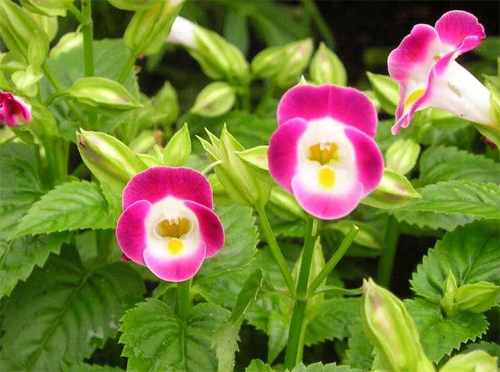
Care methods for wishbone flower:
1. Appropriate light
As mentioned above, wishbone flower is not afraid of sun, but potted plants still need attention: when the temperature is too high, do not expose them to blazing sun, and appropriate shading is also necessary.
Although excessive blazing sun will not kill it, the leaves will get sunburned; nor should it be shaded too much. In a dark place it can still grow, but the branches and leaves will become leggy (the spaces between leaves stretch out and the growth becomes weak and delicate), and flowering will also be affected.
2. Choice of potting soil
It likes neutral or slightly alkaline sandy soil best. Well-drained, fertile sandy loam is optimal. The soil mix commonly used by flower growers is ordinary garden soil + peat soil + perlite/fine sand = 5:3:2. Add some organic slow-release fertilizer appropriately, and the nutrients will be released slowly.
3. Appropriate fertilizing
Fertilizing can be done in spring, summer and autumn, 2~3 times is enough. Do not fertilize excessively; use thin fertilizer and apply it sparingly. It grows relatively robustly and does not need too much fertilizer.
Normally keep the potting soil slightly moist. Fertilizing is generally done with diluted liquid fertilizer, and each application should be spaced apart from watering. Ordinary compound fertilizer is enough. If it is in the seedling-raising stage, the phosphorus content can be a little lower.
4. Introduction to transplanting
Transplanting wishbone flower requires special care. Generally, once the seedlings have grown more than 4 true leaves, they can be transplanted. Be careful not to damage the roots, and transplant with the soil ball.
Note that wishbone flower is suitable for shallow planting. It is a shallow-rooted plant and should not be planted too deep; the soil only needs to just cover the root system. After transplanting, water thoroughly.
5. Adaptation period
Newly transplanted wishbone flower seedlings need an adaptation period, during which the potting soil should be kept slightly moist. Too dry or excessively wet is not acceptable.
Generally after two weeks of growth, the potting soil can be allowed to alternate between drying and moistening, watering when dry, and gradually exposing it to light. If it is too dry, it easily wilts.
When caring for wishbone flower, it is generally watered once a day. No watering is needed on cloudy and rainy days. You can judge by the dry or wet state of the potting soil!
6. The importance of pinching
If you want wishbone flower to be as showy as in the picture below, then you must pinch it frequently. The trick to pinching is to pinch above the third node on each branch. Generally, pinch the terminal bud. Observe carefully and do not worry that it will not grow well; the more you pinch the tips, the better it grows.
7. Disease and pest protection
If wishbone flower appears wilted, watering thoroughly will slowly revive it. If it is sunburned, just move it appropriately to a slightly shaded place.
If aphids are found on the plant and leaves, you can choose to spray with Huhuashen, spraying the entire plant carefully.
Propagation methods for wishbone flower:
Wishbone flower is generally propagated by sowing. Sowing in spring and autumn is fine; of course, if raising seedlings indoors, it can be done in all four seasons. A temperature of around 20 degrees is good for raising seedlings, and the germination rate is highest between 20~30 degrees.
Note that wishbone flower seeds are especially small (close to powder-like). They are generally mixed with fine sand for sowing. After sowing, there is no need to cover with soil; appropriately cover with plastic film or ground glass to keep warm and moist.
The seedling-raising container must of course have holes. Each time you replenish water, use the bottom-soaking method; watering from above the pot is definitely not acceptable.
Sowing in April~May or September~October is relatively suitable. Generally they germinate in about 10 days. After germination, place them in a spot with sufficient light and good ventilation. Transplanting has already been discussed above.
When sowing, cover the top with sterilized straw or the like; this way you can raise seedlings in summer, as it can lower temperature and provide shade.
What is the price of wishbone flower:
If you buy wishbone flower seeds, they are quite cheap; 5 jiao can buy a lot. If you buy a potted plant, the price is a bit higher, roughly between 10 and 20 yuan.
The care methods and propagation methods of wishbone flower are introduced up to here. If you find growing from seeds troublesome, then just buy a potted plant.
Wishbone flower cutting propagation method and sowing method of wishbone flower
Wishbone flower is relatively common in our lives and is an ornamental flowering plant with extremely high ornamental value. The flowers of wishbone flower are brilliantly colored, with elegant and lush flower shapes. It is a very good choice for decorating a room or courtyard! So do you know how wishbone flower is propagated by cuttings?
Wishbone flower cutting propagation method
Cutting propagation of wishbone flower is also relatively simple, convenient to operate, and relatively fast.
Wishbone flower cutting propagation is generally carried out in summer, between May and August. When taking cuttings, choose vigorously growing, thick and healthy branches as cuttings. You can prune appropriately, remove most of the leaves, and insert them into prepared soil. The soil should be breathable sandy soil.
Properly cut wishbone flower roots very quickly, usually rooting in 3~5 days. Before rooting, provide appropriate shade; after rooting, the plant can gradually receive sunlight and grow rapidly. Wishbone flower propagated by cuttings grows very quickly.
Sowing method of wishbone flower
Wishbone flower seeds are very small, so they can be mixed with some fine sand for sowing. After sowing, they do not need to be covered with soil, but plastic film should be used to cover them to retain moisture, and watering should be done by the soaking method. They can germinate in about 10 days. After the seedlings emerge, remove the plastic film and place them in a place with sufficient light and good ventilation for cultivation. When the seedlings are 10 cm tall, they can be transplanted. To maintain the brilliant color of wishbone flower, apply some organic fertilizer as base fertilizer before cultivation, and apply chemical fertilizer or organic fertilizer 2~3 times during the growing period to maintain soil fertility.
Care methods for wishbone flower
1. Light and temperature
Wishbone flower is a light-loving plant and needs sufficient light during its growth process. Cultivating wishbone flower in a place with sufficient sunlight will make the flowers more brilliant. However, when the summer sun is strong, attention should also be paid to shading in order to keep the leaves emerald green. But it should not be too shaded, or leggy growth will occur.
Wishbone flower likes high-temperature environments and can tolerate high temperatures, but not cold. In winter, when the temperature is below 12 degrees, it should be brought indoors for care. The overwintering temperature is best kept above 15 degrees, avoiding frost, so as to prevent the wishbone flower plant from dying.
2. Soil
Wishbone flower likes well-drained soil and requires fertile, moist soil.
3. Water and fertilizer management
Wishbone flower likes a moist environment. During the growing period, water frequently, but do not water too much; just keep the potting soil moist. If the potting soil dries out completely, water thoroughly. In summer, avoid watering during the high-temperature midday period, keep the soil somewhat moist, and also spray water frequently to increase air humidity. In winter, watering should also follow the principle of watering thoroughly only after the soil dries out.
Before cultivating wishbone flower, apply organic fertilizer as base fertilizer. However, wishbone flower does not have a great demand for fertilizer; applying chemical fertilizer or organic fertilizer 2~3 times during the growing period is enough. As long as sufficient nutrients are guaranteed for the growth of wishbone flower, it can grow vigorously and bloom brilliantly.
Brief introduction to wishbone flower
Wishbone flower is a low-growing clumping plant of the Scrophulariaceae family, native to tropical Asia and African woodlands, and distributed in Zhejiang, Taiwan, China, Guangdong, Guangxi, Guizhou and other places.
The stems of wishbone flower are slender and four-angled. The flower shape closely resembles snapdragon and stock. The flowers grow in the upper leaf axils or in terminal racemes. The flower colors are rich and varied. It likes high temperatures and tolerates heat. It is native to tropical Asia and African woodlands. It is named for blooming in summer and because its labiate flowers are quite similar to those of Viola. Wishbone flower is also known as butterfly grass, flower melon grass, flower male grass, blue pig's ear (the blue-purple patches on the whole flower are quite large, very much like the two ears on a pig's head, hence the name blue pig's ear), and blue moon. It is an important herbaceous flower plant in high-temperature regions in summer and autumn.
As mentioned above, in fact the care of wishbone flower is very simple. Generally, as long as you pay attention to temperature and watering amount, there are basically no problems. Flower lovers who like flowers or are relatively lazy may find that the tenacious and highly attractive wishbone flower is more suitable for you to grow!
Care methods and precautions for wishbone flower
Care methods for wishbone flower
Light and temperature
Wishbone flower is a light-loving plant and needs sufficient light during its growth process. Cultivating wishbone flower in a place with sufficient sunlight will make the flowers more brilliant. However, when the summer sun is strong, attention should also be paid to shading in order to keep the leaves emerald green. But it should not be too shaded, or leggy growth will occur.
Wishbone flower likes high-temperature environments and can tolerate high temperatures, but not cold. In winter, when the temperature is below 12 degrees, it should be brought indoors for care. The overwintering temperature is best kept above 15 degrees, avoiding frost, so as to prevent the wishbone flower plant from dying.
Soil
Wishbone flower likes well-drained soil and requires fertile, moist soil.
Water and fertilizer management
Wishbone flower likes a moist environment. During the growing period, water frequently, but do not water too much; just keep the potting soil moist. If the potting soil dries out completely, water thoroughly. In summer, avoid watering during the high-temperature midday period, keep the soil somewhat moist, and also spray water frequently to increase air humidity. In winter, watering should also follow the principle of watering thoroughly only after the soil dries out.
Before cultivating wishbone flower, apply organic fertilizer as base fertilizer. However, wishbone flower does not have a great demand for fertilizer; applying chemical fertilizer or organic fertilizer 2~3 times during the growing period is enough. As long as sufficient nutrients are guaranteed for the growth of wishbone flower, it can grow vigorously and bloom brilliantly.
Precautions for caring for wishbone flower
Propagation methods
The propagation methods of wishbone flower are mainly two kinds: sowing propagation and cutting propagation.
Other precautions
Throughout the entire growth process of wishbone flower, it should be pinched frequently. Pinching can promote more branching and more flowering.
In the daily management of wishbone flower, pay attention to the prevention and control of diseases and pests, and often observe the growth condition of wishbone flower so as to discover diseases and pests in time and treat them early.