Growing Methods and Propagation Techniques for Star Jasmine (Trachelospermum jasminoides)
Star jasmine is what we call the pinwheel flower. I have seen it before; star jasmine grows with feet and loves to climb everywhere, able to cover houses, trees and the like completely. So what are the growing methods for star jasmine? How do you propagate star jasmine?
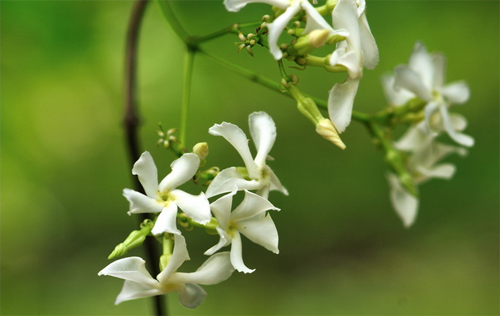
Growing methods for star jasmine:
1. Soil and light
Its adaptability is very strong; the soil only needs to have slightly good drainage. It likes plenty of light, though keeping it potted in a shady spot does no harm, it just slightly affects flowering.
2. Temperature
Star jasmine is a fairly cold-tolerant plant. In South China it can overwinter outdoors, while gardening enthusiasts in North China and Northeast China can only grow it in pots. It can grow healthily even at minus 20 degrees, which shows its cold tolerance is quite good.
How to propagate star jasmine:
It is generally propagated by layering, with a survival rate of basically one hundred percent. Cuttings also root easily; its sturdy stems and roots can practically grow just by being tossed into soil.
Layering is the simplest: once a section of stem node touches the soil and roots, cut it off and divide it into separate plants. This method can propagate many star jasmine plants at once.
Varieties of star jasmine:
Variegated star jasmine is a variety of star jasmine, relatively common in the south. Its new leaves are pink mixed with white and green, looking extremely colourful, and it is a wonderful ornamental variety.
It is also a good potted variety and is quite popular. Its new leaves look from a distance just like a flowering plant, truly charming.
Its leaves change according to the intensity of light, but it cannot be exposed to too much sun; appropriate light is best.
That is all for the growing methods and propagation methods of star jasmine. Why not hurry and grow one at home?
An Overview of Star Jasmine Growing Methods and Techniques
Vine plants are generally used for shade or as natural screens, but that is just the role of ordinary vines. However, among traditional Chinese medicinal materials there is one vine that is used as medicine. This vine is star jasmine (Trachelospermum jasminoides). Star jasmine is often used to treat rheumatic paralysis and to cool the blood and reduce swelling. When an ordinary person has a bruise or sprain, a Chinese medicine practitioner will prescribe star jasmine to cool the blood and reduce swelling and to promote faster recovery of the wound. Star jasmine generally grows as a vine, with a reddish-brown surface and a fairly hard texture that does not break easily. Therefore, today I will introduce the growing methods for star jasmine as well as related information about it.
Star jasmine, also known as Shiling, Mingshi, Xuanshi, Yunzhu, Yundan, Hongduiyeshen and Baihuateng, Latin name (Trachelospermum jasminoides) is the leafy vine stem of the plant star jasmine of the Apocynaceae family. Its nature is slightly cold and its taste is bitter. It dispels wind and unblocks collaterals, cools the blood and reduces swelling. It is used for wind-damp-heat impediment, spasms of the sinews and vessels, soreness and pain of the waist and knees, throat impediment, carbuncles and swellings, and bruises and injuries. It is distributed in Henan, Shandong, Anhui, Jiangsu, Zhejiang, Fujian and other places.
Growing methods for star jasmine:
Star jasmine likes shade and is fairly resistant to cold; it can overwinter outdoors. It is not demanding about soil or fertiliser, and any fertiliser can be applied.
Star jasmine can be grown in ordinary soil. Star jasmine blooms in April, and the flowers can last about half a month. It grows very fast and can grow 1.5 m taller in a year.
Star jasmine is generally planted on the north side of a house. Star jasmine propagated by sowing generally does not bloom. For potted star jasmine, the soil should be a light soil, and it should be given one appropriate watering of manure fertiliser water, but seedlings that have just survived layering must not be fertilised.
Repot about once every 4 years; the best time to repot is around March. Move it indoors before Frost's Descent.
The following year, move it back outside before Qingming. Pay attention to watering before moving it outside.
In summer, when there are heavy rains, the flower pot must be laid on its side so that water does not accumulate in the pot, to avoid root rot.
Star jasmine is generally not pruned or shaped during the growing season. When transplanting and repotting, the soil ball must be kept.
The stems and branches of star jasmine are slender and can be trained into various shapes.
Propagation methods:
Star jasmine is mainly propagated by layering, and can also be propagated by cuttings and sowing. Layering can be done every year in spring and autumn; the time is around March, using old branches for layering, while in July use tender branches for layering. Either pot layering or open-ground layering is fine. When pot layering, one branch can be continuously layered into several pots. The depth at which the layer is placed into the soil is generally about 3 cm, and at least 3 buds must be buried, with the middle bud pressed into the soil.
The other two buds are left exposed outside the soil while staying in contact with the pot soil surface; this way rooting is fastest. Roots can form at both the internodes and the nodes, but there are fewer roots at the internodes than at the nodes. Generally, old branches of star jasmine layered in spring root slowly and can only be cut away from the mother plant around August. In winter, move them indoors to overwinter. For open-ground layering, in winter a straw mat must be added to prevent freezing. For the part of the branch layered into the soil, the green leaves are generally removed. After layering, star jasmine is not watered. Old branches often have dense leaves and many flowers, while tender branches tend to have sparse leaves and few flowers.
After today's patient introduction of star jasmine's cultivation, it is used together with drugs such as Eluotie. People who are averse to cold and prone to diarrhoea must never use it, otherwise it can easily cause damage to the body.
Is star jasmine Boston ivy? Is star jasmine poisonous? How do you grow star jasmine?
Star jasmine, also known as Xuanshi, Mingshi and so on, like Boston ivy, belongs to the woody vine plants, and both are good materials for green hedges, so people often think star jasmine is Boston ivy. At the same time, since star jasmine is an Apocynaceae plant, and as we know, Apocynaceae plants generally contain a certain toxicity. So, is star jasmine Boston ivy? Is star jasmine poisonous? How do you grow star jasmine? Below, the editor will answer these one by one for everyone.
Image: Star jasmine
1. Is star jasmine Boston ivy?
Star jasmine is not Boston ivy.Star jasmine is a plant of the genus Trachelospermum in the Apocynaceae family, while Boston ivy is a plant of the genus Parthenocissus in the Vitaceae family, so the two are different plants. The biggest difference between star jasmine and Boston ivy is that the leaves of star jasmine are ovate-lanceolate or elliptical, while the leaves of Boston ivy are often 3-lobed with coarse serrations along the edges, and turn bright red in autumn.
Image: Boston ivy
2. Is star jasmine poisonous?
Star jasmine is poisonous.The sap of star jasmine is poisonous, that is, the milky juice that flows out when a branch is broken. Eating it by mistake can harm the heart and cause poisoning, so do not try it recklessly. Apart from this, star jasmine has no other toxicity, so as long as everyone does not eat star jasmine, there is no need to worry at all about being poisoned.
3. How do you grow star jasmine?
1. Planting management:Star jasmine likes shade and is fairly resistant to cold; it can overwinter outdoors. It is not demanding about soil or fertiliser, and any fertiliser can be applied. Star jasmine can be grown in ordinary soil. Star jasmine blooms in April, and the flowers can last about half a month. It grows very fast and can grow 1.5 m taller in a year. Star jasmine is generally planted on the north side of a house. Star jasmine propagated by sowing generally does not bloom. For potted star jasmine, the soil should be a light soil, and it should be given one appropriate watering of manure fertiliser water, but seedlings that have just survived layering must not be fertilised. Repot about once every 4 years; the best time to repot is around March. Move it indoors before Frost's Descent, and the following year move it back outside before Qingming. Pay attention to watering before moving it outside. In summer, when there are heavy rains, the flower pot must be laid on its side so that water does not accumulate in the pot, to avoid root rot. Star jasmine is generally not pruned or shaped during the growing season. When transplanting and repotting, the soil ball must be kept. The stems and branches of star jasmine are slender and can be trained into various shapes.
Image: Star jasmine
2. Propagation methods:Star jasmine is mainly propagated by layering, and can also be propagated by cuttings and sowing. Layering can be done every year in spring and autumn; the time is around March, using old branches for layering, while in July use tender branches for layering. Either pot layering or open-ground layering is fine. When pot layering, one branch can be continuously layered into several pots. The depth at which the layer is placed into the soil is generally about 3 cm, and at least 3 buds must be buried, with the middle bud pressed into the soil, while the other two buds are left exposed outside the soil while staying in contact with the pot soil surface; this way rooting is fastest. Roots can form at both the internodes and the nodes, but there are fewer roots at the internodes than at the nodes. Generally, old branches of star jasmine layered in spring root slowly and can only be cut away from the mother plant around August. In winter, move them indoors to overwinter. For open-ground layering, in winter a straw mat must be added to prevent freezing. For the part of the branch layered into the soil, the green leaves are generally removed. After layering, star jasmine is not watered. Old branches often have dense leaves and many flowers, while tender branches tend to have sparse leaves and few flowers.
[Editor's Conclusion]Star jasmine is not Boston ivy, and its sap contains toxicity, so everyone must never eat it. The above is content compiled by the editor of First Agricultural Economics Network for everyone, and I hope it can help everyone!