Four O'Clock Flower Seed Prices and Planting Methods
The four o'clock flower is a very common plant that can be seen in many places. One plant this year becomes a whole patch next year, showing that its reproductive capacity is extraordinarily strong. How do you grow four o'clock flowers, and how much do the seeds cost?
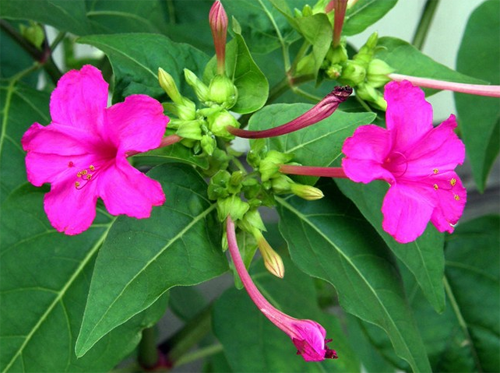
How to grow four o'clock flowers:
1. Soil selection
It likes fertile, deep, loose, well-draining sandy or humus soil. Potted soil must drain well, and the container should be large enough. Although its root system is very shallow, the plant grows quickly.
2. Appropriate light
Four o'clock flowers can be planted in slightly shady environments with just a bit of scattered light; they actually cannot tolerate harsh sun. They do best under tree shade, in a shaded courtyard spot, or in a sheltered spot on a balcony.
Exposure to blazing summer sun easily causes leaf drop and sunburn, so pay attention to ventilation in summer.
3. Watering and humidity
It likes a warm, moist environment but is also slightly drought-tolerant. Keep the soil moderately moist and just avoid waterlogging.
Propagation methods for four o'clock flowers:
Four o'clock flowers are usually propagated by sowing seeds, which is simple and efficient. Next is propagation by cuttings, and occasionally by the tubers underground, though rarely.
However, note that although sowing four o'clock flowers is simple, they do not transplant well, so seedlings must be moved with soil attached.
1. Seed propagation
If you already grow four o'clock flowers, you can easily collect seeds yourself. They are self-pollinating and will set seed with just wind. Different colors grown together can even produce hybrid varieties.
Sowing can be done in spring or autumn, with 15-20°C being the most suitable temperature. For ground planting, simply scatter the seeds evenly over the soil; potted seedling raising also works.
After sowing, cover with about 3 cm of soil, water thoroughly, and keep the soil slightly moist. Roots and sprouts will appear in about a week. After 4 leaves have grown, transplant with soil attached, and provide shade for two weeks before transplanting.
2. Tuber propagation
For flower lovers who enjoy bonsai, you can even cultivate the tubers of four o'clock flowers. Each year in late autumn, dig up the tubers (for gardeners north of the Yangtze River), prune them, store them indoors, and replant when the weather warms. After years of cultivation, the tubers become very charming!
In Guangdong, Guangxi, Fujian and other regions, four o'clock flowers are perennial root flowers, while in the north they are annual or biennial plants. Care for them according to your situation!
3. Cutting propagation
Cuttings are the simplest. Cut a section of healthy branch, preferably with a basal shoot, terminal bud, or axillary bud. The cutting medium is usually humus soil mixed with fine sand, and you can add an appropriate amount of garden soil, etc. It is not too picky about soil.
How much do four o'clock flower seeds cost:
For 1.5 yuan you can buy quite a lot. If you see them growing around your house, just take one seed and you're set; the next year you'll have many.
That's all for the introduction to growing and propagating four o'clock flowers from seed.
How to care for four o'clock flowers and an introduction to their prices
The common name for the four o'clock flower is rouged flower, also called wild jasmine. In fact, the appearance of the four o'clock flower is not at all like jasmine, but it has a faint jasmine fragrance, and the word "wild" suits it perfectly, because if you casually toss a few seeds into the soil, the four o'clock flower will vigorously grow into a large clump and expand its territory year after year. So, how much do four o'clock flowers cost?
I. Introduction to four o'clock flowers
The four o'clock flower, also called grass jasmine, rouged flower, landmine flower, and pink bean flower, is a perennial herbaceous flower of the Nyctaginaceae family, Mirabilis genus. It gets its name because its flowers are purple-red and its fragrance is like jasmine. It is a common ornamental flower. The four o'clock flower is named for its purple-red blooms, but its flower colors are rich; common ones include red, yellow, white, and variegated. When it blooms in summer, a single plant is densely covered with many four o'clock flowers of different colors, very cute and beautiful. The four o'clock flower's blooms are delicate and pretty with a pleasant light fragrance. They are often planted in flower beds and along roadsides for ornament, and can also be made into bonsai for display at home.
Four o'clock flowers grow robustly and are extremely easy to keep alive. They also have the characteristic of resisting sulfur dioxide, so they can be planted whether on residential balconies or in industrial and mining pollution areas. When growing them at home, if you occasionally water them with water used to wash meat or fish, or rice-rinsing water, the flowers will bloom more vigorously and the colors will be more vivid. The rouged flower is not only fragrant, but its seeds and leaves also have beauty, heat-clearing, and detoxifying effects. When the seeds mature, they look black and spherical on the outside and white inside. For beauty purposes, you can take several mature seeds, grind them into powder, remove the outer skin, and apply the powder to the face to remove facial spots, making the face smooth and fair, achieving a beautifying effect.
II. Growth habits of four o'clock flowers
They like mild and humid climate conditions and are not cold-tolerant. In winter the aboveground parts die back. In the Jiangnan region, the underground parts can safely overwinter and become perennial root herbaceous flowers, sending up new plants again the following spring. Open-ground cultivation requires deep, loose, fertile loam; for pots, general flower potting soil can be used. They grow even better in slightly shaded spots. The flowers open from evening to early morning and close under strong light. If there is tree shade in summer, they grow and bloom well; under intense summer heat and blazing sun, they often lose leaves. They like well-ventilated environments and have a mosquito-repelling effect in summer. Four o'clock flowers have rich flower colors, strong resistance, and can self-sow and propagate. The flowers open at night and close by day, and bloom with fragrance, making them suitable for placement in spots where people relax in the evening or at night, adding much charm.
Four o'clock flowers are not tall. If the temperature is suitable, they can bloom year-round. They are perennial plants with flowers shaped like morning glories. The calyx is the most beautiful part, taking on a corolla-like form. Because their fragrance is elegant and resembles that of jasmine, and because the color is purple, they are called four o'clock flowers. However, their flower color is not fixed; the common color is purple, but there are also many other colors, such as white and yellow. There is also a type of four o'clock flower that is red, and because its petals are double, it is called "Lou Shang Lou" (upstairs tower) and is highly ornamental. As a plant that is relatively easy to keep alive in the south, four o'clock flowers are also planted by many people in courtyards or flower pots for ornament. But growing four o'clock flowers also requires some skill. Before growing them, only by understanding their habits can you cultivate them better.
III. Prices of four o'clock flowers
Four o'clock flowers originate from tropical America. They like warm, humid climates, are not particular about soil, and are not cold-tolerant. In North China they are grown as annuals, and south of the Yangtze River as perennials. They like light and grow better in slightly shaded spots. Four o'clock flowers are robust, grow fast, and are easy to manage. They are suitable for clump planting in front of and behind houses, by hedges and fences, and beside sparse woods. Their seed endosperm can be made into cosmetic powder. Because regions and varieties differ, their prices also differ. Potted courtyard ornamental plant flower landmine flower seeds 0.5 yuan, colorful fragrant four o'clock flower seeds 1.5 yuan, South American four o'clock flower 9 yuan, white double-petal perfume jasmine fragrant plant potted four o'clock flower 7.5 yuan.
Finally, besides ornament, the roots, leaves, and flowers of four o'clock flowers can be used as medicine to treat dysentery. The leaves and endosperm can be made into cosmetic powder. The roots and leaves can be used medicinally, with effects of clearing heat, detoxifying, invigorating blood, regulating menstruation, and nourishing. The white powder from the seeds can remove facial spots and acne. So no matter how expensive it is, the price is reasonable.
Moderate price, worth recommending
Introduction: The four o'clock flower, also known as rouged flower, is a herbaceous plant that can be cultivated as a flower. It can also be used in cosmetics. Speaking of this, won't many girls be interested? It likes plenty of sunlight, is not cold-tolerant and fears heat and frost, and is suitable for growing in fertile, loose soil, so overall it is still relatively difficult to cultivate. Also, its price varies by variety. This article will give you some reference. Now let's learn about the four o'clock flower together.
Four o'clock flower prices
Potted courtyard ornamental plant flower landmine flower seeds 0.5 yuan
Colorful fragrant four o'clock flower seeds 1.5 yuan
South American four o'clock flower 9 yuan
White double-petal perfume jasmine fragrant plant potted four o'clock flower 7.5 yuan
All information is for reference only; actual prices may differ
Growth habits
They like mild and humid climate conditions and are not cold-tolerant. In winter the aboveground parts die back. In the Jiangnan region, the underground parts can safely overwinter and become perennial root herbaceous flowers, sending up new plants again the following spring. Open-ground cultivation requires deep, loose, fertile loam; for pots, general flower potting soil can be used. They grow even better in slightly shaded spots. The flowers open from evening to early morning and close under strong light. If there is tree shade in summer, they grow and bloom well; under intense summer heat and blazing sun, they often lose leaves. They like well-ventilated environments and have a mosquito-repelling effect in summer.
Planting techniques
This species is simple to cultivate and manage. Sow in early spring, and it blooms and sets seed in summer and autumn. It tolerates transplanting, grows fast, and is robust. South of the Yangtze River it is grown as a perennial. In North China it is mostly grown as an annual, or in late autumn the old roots are dug up, placed indoors at 5°C to overwinter, and planted in the open ground the following spring, where they can still bloom in the afternoon and wither by the next morning.
Four o'clock flowers are naturally robust with strong adaptability and require only extensive care and management. When cultivating, note:
① Propagation: Four o'clock flowers are commonly propagated by seed. You can direct-sow in the open ground in spring and thin the seedlings after they emerge; you can also raise seedlings first, and when the seedlings grow 3-4 true leaves, transplant and set them out at a spacing of about 1250px. After transplanting, provide appropriate shade and watering.
② Care and management: Four o'clock flowers are easy to grow and require relatively extensive care and management. Just apply appropriate fertilizer and water during the growing period.
③ Seed collection: Because four o'clock flowers are wind-pollinated, varieties crossbreed very easily. To ensure that the collected seeds retain good characteristics, different varieties should be grown in isolation.
Four o'clock flowers like a warm climate. The soil should be loose, fertile, deep loam rich in humus, or preferably sandy loam. Daily management of four o'clock flowers is relatively simple: spray some water on clear evenings, and apply dilute fertilizer 1-2 times per week in the evening to promote normal growth. There are few pests and diseases; dry weather makes them prone to aphids, and keeping them moist normally can prevent aphids. Grown in flower gardens and courtyards, no pests or diseases have been found for many years. Daily management is relatively simple: spray some water on clear evenings, and apply dilute fertilizer 1-2 times per week in the evening to promote normal growth. Grown in flower gardens and courtyards, no pests or diseases have been found for many years.
At this point, my introduction to the four o'clock flower is about finished, and I believe everyone has gained some understanding. Its color is purple, it looks very beautiful overall, and it can also be used as a cosmetic ingredient. Moreover, the four o'clock flower also has certain medicinal value, with the function of clearing heat and detoxifying. As for price, it varies for different varieties. For some imported ones, such as the South American four o'clock flower, it is relatively expensive. With this understanding, I believe you won't be cheated when buying in the future and can pick out suitable four o'clock flowers.