How to grow and propagate bromeliads (Neoregelia), and do they bear fruit?
When it comes to Neoregelia, it really is quite common, and many people have one at home. It is also a very good ornamental plant that many people love to grow. So what are the methods for growing Neoregelia? Do Neoregelia bear fruit?
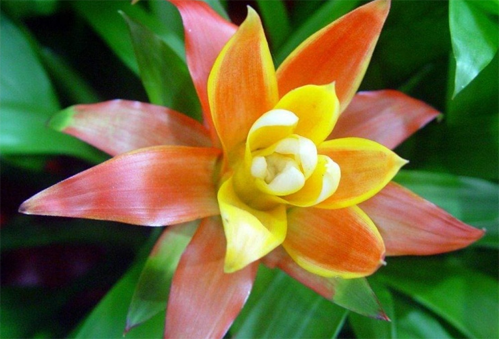
Methods for growing Neoregelia:
1. Potting soil medium
The formula commonly used by gardeners is peat soil mixed with perlite at 1:1, plus an appropriate amount of osmund fiber, and the effect is quite good, simple and effective.
The bottom of the pot is generally lined with coarse sand, small gravel, etc., which of course helps with drainage and aeration.
2. Appropriate light
Neoregelia certainly cannot be exposed to scorching sun; it likes weak, diffused light and should be grown in a bright spot, so that its leaf color stays vivid.
Of course, it is also fairly shade-tolerant, but it should not be placed in a dark spot for a long time. Although it can survive, the leaf color will become dull.
Note: Remember it must not be exposed to scorching sun; scorching sun easily causes scorched edges and yellowing leaves, and appropriate morning and evening light is most suitable.
3. Suitable temperature
It likes a warm environment; low temperatures or muggy heat are both unsuitable. 20-25 degrees is most suitable, and in winter it should also be above 15 degrees, which limits where it can be grown. Not every gardener can provide it with a suitable environment, but it can overwinter safely above 10 degrees in winter.
When the temperature is low, watering should be controlled and the soil kept dry so it does not get frost damage.
4. Appropriate watering
Potted Neoregelia likes a warm, moist environment, especially in the west; keep the soil slightly moist, just without waterlogging.
You can often spray water around it to increase air humidity.
You can also often pour water over the leaves and into the leaf cups. Of course, this cannot be done in winter; when winter temperatures are low, stop spraying and reduce watering.
Do not water at night in winter, and the potting soil must not be too wet, otherwise the roots rot easily.
5. Appropriate fertilizing
Before planting the bromeliad, you can apply a little base fertilizer; ordinary diluted slow-release organic fertilizer is best. In spring, summer and autumn, give a little diluted liquid fertilizer every two weeks, with more phosphorus fertilizer and less nitrogen fertilizer. Liquid fertilizer should not remain on the leaf surface or in the leaf center.
If you grow quite a few, you can spray a monopotassium phosphate solution once every two weeks, to make the leaf color more vivid and of course also appropriately promote stronger plant growth.
Note: Once the temperature falls below 15 degrees, fertilizing must be stopped.
Propagation methods for Neoregelia:
Neoregelia is generally propagated by division, carried out together with repotting in spring. The mother plant of the bromeliad grows some small offsets, and if they are a bit larger, the survival rate is still quite high.
How large must the offsets be before they can be divided?
Generally about 7 cm is enough. Separate them with a sterilized bromeliad knife; each small offset must carry some roots to survive well. The cut can be smeared with some plant ash, and you should wait a little for the wound to dry before transplanting. The transplanting medium should be slightly moist; vermiculite or perlite mixed with peat soil is fine.
Do Neoregelia bear fruit?
Neoregelia do not bear fruit; they are all grown for ornamental purposes.
That is all for the introduction to Neoregelia growing methods, propagation methods and whether they bear fruit.
Neoregelia Neoregelia illustrated guide: how to grow Neoregelia / how to propagate Neoregelia
Neoregelia profileNeoregelia
Growing methods and precautions for Neoregelia Introduction to Neoregelia
Neoregelia, also known as urn plant, is native to Brazil.
It likes a warm and humid environment, likes bright light, fears strong direct sunlight, and prefers fertile, loose, well-drained soil. In winter the temperature should not be lower than 10°C.
Morphological characteristics of Neoregelia
The plant is 20-30 cm tall. The leaves are broadly linear, 25-30 cm long and 3-4 cm wide; the leaves are rather thin, bright green, with smooth, spineless leaf margins, and the leaf rosette is tightly clasped into a funnel shape.
The flower stalk emerges from the center of the leaf rosette and bears a simple or mostly branched compound spike inflorescence. The flower stalk is about 30 cm long and rises above the leaves; the bracts are mostly bright red, and there are also dark red, orange-red and other colors, while the small flowers are yellow.
There are about 250 species in the same genus, most of which are epiphytic.
Ecological habits of Neoregelia
It likes a warm and humid environment, likes bright light, fears strong direct sunlight, and prefers fertile, loose, well-drained soil. In winter the temperature should not be lower than 10°C.
Cultivation techniques for Neoregelia
During the growing season, the potting soil should be kept moist often and must not dry out. In midsummer, spray the leaves often, and the cylindrical leaf rosette should be filled with water without interruption, changing the water once every 2 weeks. Fertilize once a month. Let the plant receive sufficient light so its leaf color becomes more vivid. In winter, watering should be reduced.
Planting
For potting, do not use too large a pot; 8-13 cm is suitable. The bottom of the pot should be appropriately filled with some broken bricks or rubble to aid drainage. Use loose leaf mold or peat soil as the medium. Generally repot once every 2-3 years.
Temperature and light
The most suitable growing temperature for Neoregelia is 22-25°C. In winter it should be placed indoors at a temperature above 15°C; below 15°C growth stops, and being below 10°C for a long time causes cold damage. It likes light, and the leaves are more vivid under sufficient light. But in summer, avoid direct strong sunlight to prevent scorching the leaves. Generally, first grow leaves with beautiful color under relatively strong sunlight, then place it in a bright room for appreciation. If the light is too dim, the leaf color will fade. Generally it can be enjoyed indoors for several weeks in a row. If the environmental conditions are suitable, this variety has no obvious dormant period and can grow all year round.
Watering and fertilizing
During cultivation, the potting soil should be kept moist often, but not waterlogged or overly wet. If grown in peat soil or leaf mold, keep the potting soil slightly moist, or water again when the top 1-2 cm of the potting soil surface has dried, and water thoroughly. In the rainy season, avoid waterlogging in the pot. During the growing season, spray the leaves often and pour water into the leaf cups; change the water in the leaf cups about once every 7 days to keep it fresh, and do not let the water run out. In winter, reduce watering, keep the potting soil appropriately dry, and remove the clear water from the leaf cups, then add water again when the temperature warms up the following year. During the growing season, apply liquid fertilizer once a month, and add phosphorus and potassium fertilizer 1-2 times a month. In addition to root application, foliar feeding can also be done, at 1/3 the concentration of the root fertilizer; do not fertilize in winter.
Propagation methods for Neoregelia
Mainly propagated by division.
After the flowering period, offsets sprout from beside the mother plant. When the offsets have grown into small plants 10 cm tall, peel them off and cultivate them separately.
Pest and disease control for Neoregelia
Common leaf spot disease is harmful.
Control method
Spray 100-fold Bordeaux mixture once every half month, for 3-4 consecutive sprays.
Uses and purposes of Neoregelia
Before the urn plant blooms, the lower half of the inner whorl leaves, or the whole leaves, turn red and can remain so for several months; in spring it blooms with small blue-purple flowers. It is suitable for indoor potted appreciation or for flower arranging and bottle gardens.
Neoregelia pictures
How to grow Neoregelia and the precautions to take
1 Morphological characteristics: Bromeliaceae, Neoregelia genus. Perennial epiphytic evergreen herb. The leaves form a basal rosette, with many leaf bases joined into a tube, and the leaf cups hold water noticeably. The plant is 20 cm tall and 3-3.6 cm wide; the leaves are green, and before flowering the inner ring of leaves at the center turns nearly purple-red or red. The flowers are small and lilac, withering in one day, but the beautiful bracts can remain ornamental for 2-3 months. It is a famous indoor foliage plant. There are many cultivated varieties, with the main leaf color variations including: the red-heart variety with red inner leaves, the white-edged variety with white margins and red inner leaves, and varieties whose leaves have various colored stripes, etc.2. Growth habits: Native to Brazil, growing in tropical hot rainforests. It likes a warm and humid climate and is not cold-tolerant; in winter the temperature should be kept above 10°C. The optimal growing temperature is 22-25°C. It needs a shaded environment and must block strong direct sunlight all year round, and it also needs relatively high air humidity.
3 Propagation method: Generally propagated by dividing root offsets. After the mother plant flowers, it can grow several root offset shoots. The following year the old plant gradually dries up; after the offset shoots are divided and potted, place them in a high-temperature, humid and shaded environment, and they will soon take root. After rooting, gradually expose them to stronger light so they grow robustly.
4. Cultivation management: In summer, maintain relatively high air humidity; you can fill the leaf cups with water and spray the leaves often. In winter, a certain humidity should also be maintained, but when the temperature is below 15°C, spraying should be stopped. Watering should be controlled to just keep the soil appropriately moist; too much watering or water that is too cold is bad for the plant. Another thing to note is that the leaf surface must be kept dry at night, otherwise fungi easily multiply and cause the plant to rot. Choose a shaded spot with diffused light for placing the plant. When management is improper, the plant is easily harmed by scale insects.