African Violet Care and Propagation Techniques
The flowers of the African violet are purple, and many people still like them. What are the care methods for African violets? How do you propagate African violets?
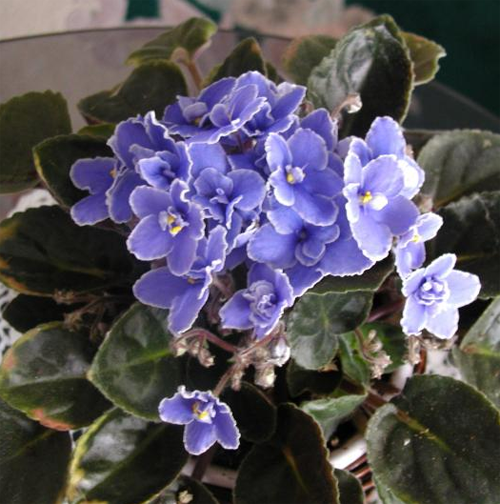
African violet care methods:
1. The soil must be loose and breathable, and it must also have good drainage. You can use leaf mold and perlite in a 1:1 ratio, then add some vermiculite; you can also use humus soil mixed with coarse sand in a 1:1 ratio.
2. Watering does not need to be frequent, and the potting soil must not become waterlogged. Except when it is too cold in winter, keep it slightly moist in the other seasons.
3. The water method gives us more assurance, because we can see the roots growing.
African violets like bright light. In the morning they can get a little sunlight; just a little light is enough!
They are still very easy to care for. As long as the potting soil does not stay dry for too long or waterlogged for too long, there will basically be no problems!
Leaf-propagated seedlings generally take 8 months from growth to flowering, and variegated varieties grow a bit more slowly from leaf cuttings.
African violet propagation methods:
First method: water propagation by leaf cuttings
First choose a healthy African violet, select a few robust leaves, and use a sharp knife or scissors to cut the leaves off at the petiole. The petiole should be about 4 or 5 cm long.
Note: Do not damage the plant's roots or leaves.
Find a cup or bottle and fill it with room-temperature clean water (cool boiled water also works). Insert the leaf into the cup with the petiole soaking in the water, then place the cup in a warm, ventilated, brightly lit place. Do not let the leaf soak in too much water! (A cultivation temperature of around 20°C is most suitable; if the temperature is too high, it affects the success rate.)
Note: Do not place the propagation cup in direct sunlight, as it will scorch. Instead, place it in a warm, bright place. After 2-4 weeks, you will see roots growing from the petiole.
After roots have grown, you can transplant the leaf into slightly moist sandy soil. Each leaf that has grown roots can quickly produce new small leaves (small shoots)!
Second method: soil propagation by leaf cuttings
The propagation method is to insert the leaf directly into slightly moist sandy soil (the petiole length should ideally be 4-5 cm; if it is too long or too short, it will affect the sprouting rate). Bury 1/3 of each leaf in the soil. If buried too shallow, it easily rots at the roots! If buried too deep, it will not sprout!
Note: The small pot for leaf cuttings should preferably be small, just a little bigger than the leaf. If placed in a large pot, more moisture is retained and the moisture dissipates slowly, making the leaf prone to rotting!
Many flower enthusiasts have also tried this method, but the leaves always rot. What is going on? Is it because no rooting powder was used?
In fact, soil propagation by leaf cuttings does not need any rooting hormones at all (adding a little is fine too). The most important trick is not to water, but to prop it up with plastic film to make it look like a tent, which can achieve moisture retention and heat retention. After about 2-4 weeks, the leaf will root and sprout!
After 4 weeks, the potting soil under the slightly moist plastic film begins to dry out. At this time, you can see new small leaves growing from the petiole, very cute little shoots, with leaves growing in clusters, full of vitality! At this point, these seedlings need to be transplanted into new flower pots. Remember to transplant them together with the soil, and the success rate is also very high!
That is all for the introduction to African violet care methods and propagation methods. Why not hurry and get a few for your own home?
How to Propagate African Violets: African Violet Propagation Methods
African violets are a type of flowering plant, and African violets are a flower that people relatively like to use to decorate and beautify the environment. How do you propagate African violets? Let us take a look together at the propagation methods for African violets.
1. African violet leaf-cutting propagation method
African violets commonly use cutting propagation, mainly leaf cuttings. After flowering, choose healthy, plump leaves, cut them off leaving 2 cm of petiole, let them dry slightly, insert them into a sand bed, and maintain relatively high air humidity. The room temperature should be 18-24°C. After insertion, they root in 3 weeks, and in 2-3 months seedlings will be produced. Move them into 6 cm pots. During the cutting process, treatment with vitamins is beneficial for the growth of seedlings after African violets root. Treating the petioles with 25 mg/L kinetin for 24 hours is beneficial for the formation of adventitious buds. From cutting to flowering takes 4-6 months.
2. African violet stem-cutting propagation method
Stem-cutting propagation is also a propagation method chosen for African violets. It is mainly done after the flowers fade in spring. Along with repotting and changing the soil, divide the underground tubers and plant them. Seedlings form quickly, but the plant shape is not attractive enough. At the same time, because the plant has not been renewed, growth is not vigorous enough.
3. African violet tissue culture propagation method
At present, a relatively popular propagation method for African violets is tissue culture propagation, using leaves, petioles, and epidermal tissue as explants. Use MS medium supplemented with 1 mg/L 6-benzylaminopurine and 1 mg/L naphthaleneacetic acid. After inoculation, adventitious buds grow out in 4 weeks, and after 3 months the rooted small plantlets can be planted. The small plantlets are transplanted into a substrate of half leaf mold and half peat moss soil, with a survival rate of 100%. At present, the United States, the Netherlands, Israel and other countries all have African violet test-tube plantlet production. However, this method cultivates relatively many plantlets, so it is not very suitable for home cultivation.
4. African violet seed propagation method
African violet seed propagation can be carried out in spring and autumn. For greenhouse cultivation, autumn sowing in September-October is best, with a high germination rate, robust seedling growth, and large plants with many flowers when they bloom the following spring. Sowing in February leads to flowering in August, but the growth vigor is somewhat poorer and there are fewer flowers. African violet seeds are tiny, so the sowing soil should be fine. After sowing, do not cover with soil; just press flat. The suitable germination temperature is 18-24°C. They germinate 15-20 days after sowing, and seedlings are transplanted in 2-3 months. During the seedling stage, note that the potting soil should not be too wet. Generally, from sowing to flowering takes 6-8 months.
How to Propagate African Violets: A Complete Guide to African Violet Propagation Methods
African violets are short in stature, with elegant and refined flower shapes and rich flower colors. They are excellent indoor ornamental plants. Many flower enthusiasts hope to propagate more African violets. So how do you propagate African violets? Let us learn about it together next.
I. A Complete Guide to African Violet Propagation Methods
1. African violet leaf-cutting propagation method
African violets commonly use cutting propagation, mainly leaf cuttings. After flowering, choose healthy, plump leaves, cut them off leaving 2 cm of petiole, let them dry slightly, insert them into a sand bed, and maintain relatively high air humidity. The room temperature should be 18-24°C. After insertion, they root in 3 weeks, and in 2-3 months seedlings will be produced. Move them into 6 cm pots. During the cutting process, treatment with vitamins is beneficial for the growth of seedlings after African violets root. Treating the petioles with 25 mg/L kinetin for 24 hours is beneficial for the formation of adventitious buds. From cutting to flowering takes 4-6 months.
2. African violet stem-cutting propagation method
Stem-cutting propagation is also a propagation method chosen for African violets. It is mainly done after the flowers fade in spring. Along with repotting and changing the soil, divide the underground tubers and plant them. Seedlings form quickly, but the plant shape is not attractive enough. At the same time, because the plant has not been renewed, growth is not vigorous enough.
3. African violet tissue culture propagation method
At present, a relatively popular propagation method for African violets is tissue culture propagation, using leaves, petioles, and epidermal tissue as explants. Use MS medium supplemented with 1 mg/L 6-benzylaminopurine and 1 mg/L naphthaleneacetic acid. After inoculation, adventitious buds grow out in 4 weeks, and after 3 months the rooted small plantlets can be planted. The small plantlets are transplanted into a substrate of half leaf mold and half peat moss soil, with a survival rate of 100%. At present, the United States, the Netherlands, Israel and other countries all have African violet test-tube plantlet production. However, this method cultivates relatively many plantlets, so it is not very suitable for home cultivation.
4. African violet seed propagation method
African violet seed propagation can be carried out in spring and autumn. For greenhouse cultivation, autumn sowing in September-October is best, with a high germination rate, robust seedling growth, and large plants with many flowers when they bloom the following spring. Sowing in February leads to flowering in August, but the growth vigor is somewhat poorer and there are fewer flowers. African violet seeds are tiny, so the sowing soil should be fine. After sowing, do not cover with soil; just press flat. The suitable germination temperature is 18-24°C. They germinate 15-20 days after sowing, and seedlings are transplanted in 2-3 months. During the seedling stage, note that the potting soil should not be too wet. Generally, from sowing to flowering takes 6-8 months.
The above isAfrican violet propagation methodsintroduced: leaf cuttings, stem cuttings, tissue culture, and sowing. Everyone can choose any one propagation method to propagate African violets. I hope it is helpful to everyone.