Maidenhair fern care methods and precautions: what to do when the leaves dry out and the edges scorch?
Maidenhair fern has been very popular in recent years, many people love growing it, and it looks quite beautiful. What are the care methods and precautions for maidenhair fern? What should you do if the leaves dry out and the edges scorch during cultivation?
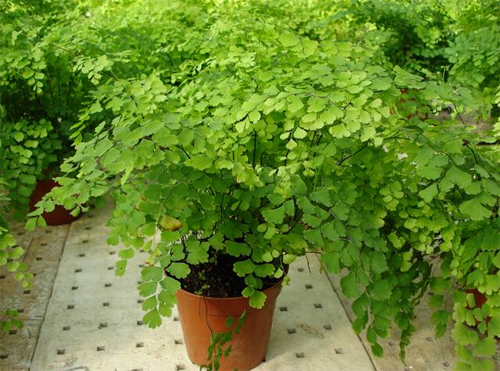
Maidenhair fern care methods and precautions:
1. Pot and soil selection
When potting, you can choose light-colored glazed pots, clay pots, etc.
The potting soil must have good drainage and aeration. Generally use humus-rich peat soil or leaf mold, then add about 1/3 coarse sand and fine sand, and you can add some bone meal. Line the bottom of the pot with broken tile pieces or coarse sand, and plant the rhizome at a depth of about 2cm.
2. Repotting
Plant or repot and change the soil in spring. For potting, a growing medium commonly used is a mix of leaf mold or peat soil with a small amount of river sand and base fertilizer.
Repot every spring. Do not damage the roots when repotting, avoid wind, keep the potting soil moist and the air humidity relatively high, and resume normal care after new shoots grow.
3. Container selection
For bottle-grown maidenhair fern, choose a colorless, transparent, smooth-surfaced square glass bottle; it looks quite nice. Mix equal parts peat and fine sand as the growing medium and put it into the bottle.
Put old wall lime at the bottom of the bottle, with 2~3cm of growing medium. Do not let the growing medium stick to the bottle walls. Divide the mother maidenhair fern into several clumps and carefully plant them into the bottle.
Press the plant roots and growing medium firmly, water, then cap the bottle and place it somewhere without direct sunlight.
Water once a month and apply fertilizer once every few months; do not place it where the temperature varies greatly.
4. Proper pruning
After early autumn, as temperatures drop, maidenhair fern enters a slow-growth stage, and old leaves gradually turn yellow. At this time, cut them off.
Throughout winter, the ambient temperature should not be lower than 5°C. When the weather warms up the following spring, the plant will grow a large number of new leaves, presenting a thriving scene.
If you do not water on time, the plant will suffer withered leaves and broken branches.
5. Temperature and light
Maidenhair fern likes a warm, humid and semi-shaded environment. The suitable growing temperature is 21-25°C during the day and 12-15°C at night.
In winter it should be moved into a greenhouse. At temperatures above 5°C the leaves can still remain fresh green, but below 5°C the leaves will suffer cold damage.
6. Watering notes
Maidenhair fern likes a humid environment. During the peak growing season, water thoroughly. In addition to keeping the potting soil moist, also pay attention to relatively high air humidity; when the air is dry, sprinkle water around the plant.
In summer, water 1-2 times a day. Lack of water will cause the leaves to shrivel. Avoid letting the potting soil alternate between dry and wet, which easily turns the leaves yellow.
7. Fertilizing
Apply dilute liquid fertilizer 2-3 times a month. When fertilizing, do not stain the leaf surface, to avoid leaf rot. Because maidenhair fern likes calcium, the potting soil should be mixed with an appropriate amount of lime and crushed eggshells; regularly applying calcium fertilizer will give better results. In winter, reduce watering and stop fertilizing.
8. Wintering and summer care
Winter temperatures are low, and the plant may suffer damage from late frost or early frost. Maidenhair fern likes a warm and humid climate and is not cold-tolerant. The suitable growing temperature is 15~24°C. If the winter room temperature is above 10°C, the leaves can remain emerald green; below 5°C they turn black and yellow. It also suffers from being too shady and not seeing sunlight for a long time.
Maidenhair fern fears summer heat. It cannot be exposed to the sun, nor kept fully shaded. In summer, it is best to provide appropriate shade; you can also move it outside at night and back indoors during the day.
In winter it should receive plenty of light; in summer, increase air humidity and strengthen ventilation.
What to do when maidenhair fern leaves dry out and the edges scorch?
1. Causes of scorched leaf edges
Maidenhair fern leaves most easily develop brown scorched edges; this is a common problem in cultivation. Maidenhair fern originally grows in damp, shady wall crevices or on stone surfaces, and likes moisture most of all.
Summer light is intense, so place maidenhair fern in a shaded environment. Direct sunlight quickly dries the moisture from the leaves, the green gradually fades, and scorched edges appear.
2. Treating scorched edges:
After scorching, grow it in semi-shade, cut off the scorched leaves, and spray water on the leaf surfaces and the surrounding ground to avoid strong light stimulation.
3. How to keep maidenhair fern evergreen through the four seasons
① Water thoroughly during the growing period and maintain air humidity
During the peak growing season, spray water on the branches and leaves 2~3 times a day to keep the leaf color dark green. If water supply is insufficient or the air is dry, the leaves will turn yellow or curl and scorch at the edges.
② It does not need much fertilizer; apply dilute cake fertilizer water once every 2~3 weeks
If you can add a small amount of calcium fertilizer, the effect will be even better. But note: when watering and fertilizing, do not stain the leaf surface, otherwise the leaves easily turn yellow and dry, affecting the ornamental effect.
③ Maidenhair fern is a shade-loving plant and needs only a little light
When caring for it indoors in spring, summer and autumn, it is best to place the pot on a windowsill on the east or north side of the room. If grown outdoors, never expose it to direct sunlight; strong direct sunlight very easily causes the leaf edges to scorch and the leaves to turn yellow and dry.
④ Remove dead leaves promptly when found
Keep the plant fresh and attractive, and help new leaves sprout. When the leaf clumps are too dense, you can properly prune the old leaves each autumn; otherwise the branches and leaves become too messy and crowded, which leads to weak growth and yellowing leaves.
⑤ In winter, place the pot on a south-facing windowsill
and keep the air humid, maintaining room temperature above 12°C; this way the leaves will grow fresh green and lovely.
⑥ Repotting
Maidenhair fern grows fast and needs repotting every spring, adding fresh growing medium each time.
That is all for the maidenhair fern care methods and precautions. The solutions for dried leaves and scorched edges during cultivation have also been explained. Go and grow one now.
How to grow maidenhair fern: care methods and precautions / avoid dryness and strong light
Maidenhair fern is not only good for foliage viewing, but can also be kept at home to remove harmful substances such as formaldehyde and nicotine, and its care and management are relatively simple, so more and more people are preparing to keep a few pots at home. So is maidenhair fern easy to grow? How do you grow maidenhair fern? Today let us learn about the care methods and precautions for maidenhair fern.
Is maidenhair fern easy to grow?
Maidenhair fern is one of the relatively easy plants to grow. Its requirements for soil, temperature, water and fertilizer are ordinary, but its requirements for light and humidity are relatively high. Ensure its environment is not too dry and the light is not especially strong, then use suitable soil and water and fertilize reasonably, and it can be grown very well.
How to grow maidenhair fern
In terms of growing environment, maidenhair fern prefers fertile, loose soil with good drainage; in terms of light, it likes bright places where the light is not too strong; in terms of water, it likes a humid environment; in terms of temperature, its leaves need above 5°C to stay emerald green, so when caring for it we should try to create such an environment for it.
Maidenhair fern care methods and precautions
1. What soil does maidenhair fern use?
For soil selection, the minimum requirement is good drainage and looseness, and the most suitable soils are two types. The first is made by mixing garden soil, leaf mold and fine sand in a ratio of 40%, 50%, 10%; the second is made by mixing peat soil, leaf mold and fine sand in a ratio of 40%, 40%, 20%.
Precautions: Whichever soil you use, be sure to disinfect it before planting. The simplest method is to put it in the sun to dry for 1-2 days, and if conditions permit, you can use carbendazim or potassium permanganate solution to water it and achieve disinfection.
2. Light requirements
Maidenhair fern likes a bright environment with no lack of light. It is relatively afraid of direct sunlight, so when growing it at home, it is best to place it on an east- or north-facing windowsill, which can prevent it from being exposed to the sun. If grown in a courtyard, more than 50% of the sunlight should be shaded in summer.
Precautions: When the light is too strong, the leaves of maidenhair fern may scorch and dry out, so never grow it in a full-sun environment. However, in the care methods and precautions for maidenhair fern, we should also note that it cannot lack light. If the light is too dim, the leaves will become thin and weak, and it will not be able to display the ornamental value of maidenhair fern's effects and functions.
3. Suitable temperature
The most suitable temperature for maidenhair fern is 10-20°C, but as long as the temperature stays above 5°C, its leaves can remain emerald green. However, if it is often below 5°C, it may suffer cold damage, so keep it warm in winter. In summer, spray more water to lower the temperature.
Precautions: In autumn or winter, the temperature difference between day and night is relatively large. At this time, how do you grow maidenhair fern? It is recommended that gardeners move it indoors. This not only keeps the temperature within a suitable range, but also reduces the yellowing of maidenhair fern leaves caused by too large a temperature difference.
4. Watering method
When watering, try to keep the soil moist, because maidenhair fern is a plant that likes a humid environment. So during the growing season, water once every 1-2 days. In summer, when the temperature is relatively high, water once in the morning and once in the evening, without using too much water each time.
Precautions: If you often fail to water, the leaf edges will dry out and curl, so avoid watering too much one time and too little the next. Although watering is frequent, there must never be standing water in the soil; water by spray irrigation as much as possible.
5. Fertilizing techniques
Maidenhair fern does not have high fertilizer needs. Just apply dilute fertilizer water once a month. Because maidenhair fern is an indicator of calcareous soil, you can apply a little calcium fertilizer when fertilizing; it can make maidenhair fern grow better.
Precautions: When summer temperatures are relatively high, stop fertilizing, and wait until the weather is cool before applying organic fertilizer. Generally no fertilizing is needed in winter either, especially when the temperature drops below 5°C. Also, when fertilizing, fertilizer should not be sprinkled on the leaves.
How to grow maidenhair fern: care methods and precautions for maidenhair fern
Maidenhair fern habits: it likes fertile, well-drained calcareous sandy loam. For home potting, a mix of loam, leaf mold and river sand can be used. Maidenhair fern originally grows beside flowing streams or on dripping rock walls at altitudes of 100~2800 m, and is an indicator plant of calcareous soil. The suitable growing temperature for maidenhair fern is 21~25°C during the day and 12~15°C at night. As long as the temperature is above 5°C, the leaves will remain fresh green, but below 5°C the leaves will suffer cold damage. Maidenhair fern likes scattered light and fears direct sunlight. Indoors it should be placed in a bright place; even if placed there for 1 year, it can still grow normally.
How to grow maidenhair fern hydroponically (basic method)
Environment: The environment suitable for maidenhair fern should be a dark and humid one. This plant cannot tolerate cold or drought, and relatively prefers living in acidic soil, but it can also be placed for short periods in places with scattered sunlight, which allows it to grow better.
Soil: For soil, the best combination is mainly a growing medium made by mixing half mountain forest soil and half garden soil.
Watering: Maidenhair fern very much likes a high-humidity environment, so in spring, summer and autumn it should be watered 4~5 times a day. In winter it can be reduced to 1~2 times, but it still needs frequent misting to prevent the leaves from becoming too dry. During the growing season, watering must be kept sufficient.
Fertilizing: Fertilizing is necessary for maidenhair fern. On average, a thin fertilizer should be applied once about every 2 weeks to promote its growth. But grasp the principle of "small amounts, applied often"; a 1000~2000 times dilution such as Hyponex is enough.
Temperature: Generally, above 5°C the leaves will not show scorched yellowing, but it also cannot exceed 30°C. When growing hydroponically, besides controlling the indoor temperature, also control the water temperature; the water temperature should be comparable to room temperature.
Light: Be sure to shade it and avoid direct sunlight; the weaker the light, the better. It cannot be placed in a bathroom or indoors for more than 3 days, then move it to a windowsill for 3 days. Pay attention to spraying water; this can ensure the plant grows well.
Humidity: Summer weather is often too hot and stuffy, and room ventilation is not very good either. At this time, increase indoor air humidity and pay attention to strengthening ventilation.
Pruning: When the leaf clumps are too dense, use scissors to properly prune the old leaves; otherwise, the leaves easily turn yellow, which hinders viewing.
Hydroponic cultivation of maidenhair fern
First, wash the roots of soil-grown maidenhair fern clean and disinfect them with potassium permanganate. Then find a container, add clean water, and pair it with a nutrient solution in an appropriate ratio (the nutrient solution can be bought on the market), or fix it at the container mouth or on the water surface with something. Maidenhair fern is suitable for planting on coral stone; just place the coral stone directly in water, and after it survives it grows very well.
Precautions for hydroponic maidenhair fern: Coral stone can be bought at shops that make rockeries in flower and bird markets; there are many styles, so you can choose one. Before using coral stone, soak it in water to remove salt. To let the stone grow moss, do not keep it indoors for a long time; let it receive appropriate sunlight. When growing hydroponically, do not let the water submerge the crown of the maidenhair fern. Replenish water promptly during care, and change the water once every 5~10 [days].
Precautions for growing maidenhair fern:
1. Maidenhair fern naturally likes warm, humid and semi-shady, cool environments, and very much dislikes direct sunlight. Therefore, it is best to place the plant somewhere indoors where sunlight does not reach it. After all, too much and too strong light easily causes the leaf edges to scorch.
2. Ferns all grow in humid environments, and maidenhair fern is naturally no exception. When cultivating it, in addition to keeping the soil moist, also frequently spray water mist on the leaf surface to increase air humidity. When the plant shows yellowing, it is often caused by insufficient humidity. Of course, it may also be caused by cold damage.
3. Repot once every spring, and at the same time prune off dry leaves and old roots. The potting soil should also be changed to fresh, fertile and loose leaf mold, preferably with a small amount of brick crumbs added.
Four-season care for maidenhair fern
Spring care for maidenhair fern
Maidenhair fern can be repotted every April. Maidenhair fern likes a shady, humid environment and fears strong light. In early spring, give it light in the morning and evening, and place it indoors with bright scattered light. Spring is the growing season for maidenhair fern; pay attention to water and fertilizer management. Especially when caring for it indoors, pay attention to increasing indoor air humidity; suitable air humidity is the key to growing maidenhair fern at home. In addition, you can water it once a month with ferrous sulfate solution to increase the acidity of the soil, which both benefits growth and keeps its leaves emerald green.
Summer care for maidenhair fern
Maidenhair fern grows normally in summer, but a high-temperature, hot and dry environment is not conducive to its growth. Maidenhair fern should be placed indoors in bright light, keep the potting soil moist, water once in the morning and once in the evening, and frequently spray around it to increase air humidity. When the weather is too hot, do not water or fertilize. Fertilizing is usually done in the evening, and water the next morning after fertilizing. This is more conducive to the fertilizer taking effect. Maidenhair fern fears wind, so it should not be placed in front of an electric fan or an air conditioner vent. Rooms with air conditioning have lower air humidity, so the number of mistings should be increased.
Autumn care for maidenhair fern
Maidenhair fern grows normally in autumn; pay attention to water and fertilizer management. After temperatures drop in late autumn, pay attention to maintaining indoor temperature, gradually reduce the amount of watering so that the potting soil is moist, and gradually move it to a place with morning and evening light. Once the temperature drops, do not fertilize anymore.
Winter care for maidenhair fern
Maidenhair fern is not cold-tolerant, and room temperature should be kept above 5°C. Below 5°C maidenhair fern enters a state of stagnant growth, and the leaves are dark green. You can appropriately increase the intensity and duration of morning and evening light (avoid midday light), reduce watering, keep the potting soil on the dry side, and do not fertilize.
If the indoor temperature is on the high side in winter, air humidity will be lower; pay attention to supplementing air humidity.