How to grow night-blooming jasmine (Cestrum nocturnum) and points to note: is its fragrance toxic?
Night-blooming jasmine - this flower is so fragrant at night you just cannot get enough of it, and many people love this scent; having one at home is a real pleasure. Let's look at how to grow night-blooming jasmine and what points to note. Is the fragrance of night-blooming jasmine toxic?
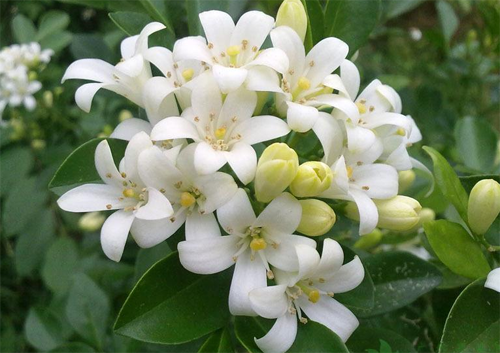
How to grow night-blooming jasmine:
First, soil
Night-blooming jasmine likes loose, well-drained, organic-rich, slightly acidic soil. It can be mixed from peat soil, leaf mold and sand in a 3:3:4 ratio; this mix gives the bed soil the qualities of raising bed temperature, retaining water, aerating, being fertile and slightly acidic, and is suitable for rooting and sprouting of cuttings.
Second, watering
Summer is the peak growing season for night-blooming jasmine. Besides applying enough fertilizer, the potting soil must stay moist, and if necessary water twice a day. For seedlings, spray water on the leaves 1—2 times a day.
Third, temperature
Every year in mid-to-late October, night-blooming jasmine should be moved into a shed or greenhouse, where the temperature should be kept at 8—12℃. If the temperature is below 5℃, the leaves easily turn yellow, drop off, and the plant may even die.
Fourth, fertilizing
During the growing process, apply a thin, well-rotted liquid fertilizer once every 10—15 days. From mid-May onward this ensures continuous blooming of fragrant flowers, raising its ornamental value. If conditions allow, applying a nitrogen, phosphorus and potassium compound fertilizer gives even better results.
Fifth, pests
Night-blooming jasmine is prone to sooty mold and ring spot disease; a 500-fold dilution of 50% thiophanate-methyl wettable powder can be sprayed.
Sixth, pruning
The branches of night-blooming jasmine grow quickly and need pruning every year to sprout more side branches and encourage blooming. Pruning is generally done in autumn, and each side branch can be kept to a length of 10—12cm. After the flowers fade, dried-up branches and overly dense branches should be cut away.
Points to note when growing night-blooming jasmine:
First, night-blooming jasmine likes a warm, humid, sunny, well-ventilated, dry climate and loose, fertile soil. It tolerates drought and poor soil, does not tolerate waterlogging or cold, and mostly grows in woodland or thickets.
Second, it begins to bloom every spring and has a very long flowering period. After the leaves drop in winter, night-blooming jasmine stops growing; after the weather warms in spring it sprouts branches and leaves, with axillary buds or flower buds at each node, and as it grows it keeps producing side branches and putting out inflorescences. It generally blooms successively from May—10, with a fragrant scent when in bloom that is even stronger at night. It bears fruit in winter.
Third, night-blooming jasmine has strong adaptability to its environment, vigorous vitality and a well-developed root system, and mainly grows in well-drained, fertile soil.
Fourth, night-blooming jasmine has fairly high temperature requirements, and the average annual temperature should be kept at around 20℃.
Fifth, night-blooming jasmine likes fertilizer, so during its growth it should be fertilized little and often.
Sixth, night-blooming jasmine also has high water requirements; water more in summer, and in winter keep the soil moist but not waterlogged, and especially guard against frost.
Is the fragrance of night-blooming jasmine toxic?
The flowers, leaves, roots and stems of night-blooming jasmine can all be used as medicine, and can be used to treat acute and chronic conjunctivitis, keratitis, corneal opacity, conjunctivitis caused by measles, and so on. But every medicine has some toxicity; this is not to say that the flowers and leaves of night-blooming jasmine are toxic, but that the gas it releases at night is harmful to the human body. This is because after night-blooming jasmine stops photosynthesis at night, it releases harmful gases, and if you breathe them in for a long time you may experience symptoms such as dizziness and chest tightness.
That is all for how to grow night-blooming jasmine and the points to note. Although night-blooming jasmine is fragrant, it is also toxic; if you are allergic to pollen, that is even more serious.
Night-blooming jasmine - how to grow night-blooming jasmine | night-blooming jasmine pictures | is night-blooming jasmine toxic
Night-blooming jasmine
Night-blooming jasmine, also called night fragrant flower, night fragrant tree, night clove, tuberose, night orchid fragrance and so on, is a flowering ornamental plant native to the tropical regions of the Americas. Its twigs are slender and hairy, with milky sap. Its flowers are mostly yellow-green with a fresh fragrance that is even stronger at night. It is mostly grown as a potted ornamental plant, but it should not be placed indoors, as its floral scent makes breathing difficult.How to grow night-blooming jasmine
1. Soil: night-blooming jasmine likes loose, well-drained, organic-rich, slightly acidic soil. Mix peat soil, leaf mold and sand in a 3:3:4 ratio; the bed soil prepared this way has the qualities of raising bed temperature, retaining water, aerating, being fertile and slightly acidic, and is suitable for rooting and sprouting of cuttings.
2. Watering: summer is its peak growing season. Besides applying enough fertilizer, the potting soil must be kept moist regularly, and if necessary water twice a day. For seedlings, spray water on the leaves 1 to 2 times a day.
3. Temperature: every year in mid-to-late October it should be moved into a shed or greenhouse, where the temperature should be kept at 8℃ to 12℃. If the temperature is below 5℃, the leaves will turn yellow, drop off, and the plant will die.
4. Fertilizing: during growth, apply a thin, well-rotted liquid fertilizer once every 10-15 days. From mid-May onward this ensures continuous blooming of fragrant flowers, raising its ornamental value. Applying a nitrogen, phosphorus and potassium compound fertilizer gives even better results.
5. Pests: sooty mold and ring spot disease often occur; a 500-fold dilution of 50% thiophanate-methyl wettable powder can be sprayed.
6. Pruning: the branches of night-blooming jasmine grow quickly; if left to grow naturally, it can grow about 1 m in a year, so it needs pruning every year to sprout more side branches and bloom more. Pruning is generally done in autumn, keeping each side branch 10-12cm long. After the flowers fade, dried branches and overly dense branches should be cut away.
Points to note when planting night-blooming jasmine
Night-blooming jasmine is best placed outdoors. As an ornamental plant, its scent can make patients with high blood pressure and heart disease feel dizzy, depressed and unwell, causing symptoms such as chest tightness and difficulty breathing, so night-blooming jasmine is not suitable for placing indoors. If it is kept indoors for a long time, it can cause dizziness, coughing, and even asthma and insomnia, so people growing night-blooming jasmine should put safety first.
Is night-blooming jasmine toxic
Is night-blooming jasmine toxic? In fact, night-blooming jasmine can also be used as medicine; its flowers, leaves and roots and stems can all be used medicinally. It can be used for acute and chronic conjunctivitis, keratitis, corneal opacity, conjunctivitis caused by measles, and so on. But every medicine has some toxicity; this is not to say that the flowers and leaves of night-blooming jasmine are toxic, but that the gas it releases at night is harmful to the human body. This is because after night-blooming jasmine stops photosynthesis at night, it emits harmful gases, and if a person breathes them in for a long time they will feel symptoms such as dizziness and chest tightness. So at night, best to keep your distance from night-blooming jasmine.
When does night-blooming jasmine bloom
When does night-blooming jasmine bloom? It blooms at night. This is because the petals of night-blooming jasmine differ in structure from those of flowers that generally bloom during the day: the stomata on its petals that release fragrance have a strange quirk - once the air humidity is high, they open wide, and when the stomata open wide, more aromatic oil evaporates. Although there is sun during the day, the humidity is much lower than at night; at night, although there is no sun, the air is very moist, so the stomata open wide at night, more aromatic oil is released, and the fragrance becomes especially strong.
The flower language of night-blooming jasmine
The flower language of night-blooming jasmine ~ seeking pleasure on the edge of danger Legend has it that in ancient times there was a young man whose flute playing was so beautiful that everyone knew of it. On a beautiful moonlit summer evening, he leaned against a tree playing his flute, when suddenly a beautiful fairy descended lightly from the clouds. The fairy said that because Chang'e had heard his flute playing and loved it very much, she invited the young man up to the moon palace to serve as a musician. But the young man was attached to the mortal world and asked the fairy to delay one day before going to the moon palace; the fairy did not agree, and only took the jade hairpin from her head and gave it to him as a keepsake. When the fairy tossed it to him in the air, the young man failed to catch it, and however he searched he could not find the jade hairpin that had fallen to the ground. In the end, the jade hairpin became a flower, and the young man remained in the mortal world forever. This flower not only gives off fragrance at night, but especially under the bright moonlight emits a rich, fragrant scent, so it also has the lovely name "lover of the night".
The uses of night-blooming jasmine
The uses of night-blooming jasmine: 1. Ornamental. Night-blooming jasmine has slender branches and blooms in summer and autumn; its yellow-green flowers open in the evening and give off waves of strong, sweet fragrance. In the south it is often used to decorate courtyards, windowsides, pond edges and pavilion sides, and has a certain ornamental value.
The uses of night-blooming jasmine: 2. Medicinal. Night-blooming jasmine can be used as medicine; it has the effect of clearing the liver and brightening the eyes, and can treat red, swollen and painful eyes, measles affecting the eyes, corneal opacity, and so on.
The uses of night-blooming jasmine: 3. Edible. Night-blooming jasmine can be eaten, mainly using its fresh flowers and flower buds; it is a semi-wild vegetable.
The uses of night-blooming jasmine: 4. Repelling mosquitoes. The scent of night-blooming jasmine is fairly strong and it is somewhat toxic, so it can drive away mosquitoes, which is also a convenience in daily life. Usually a screen is fitted over the window and the plant is grown outdoors.
Related encyclopedia
Pocket scale non-woven bag rush pith bamboo shoot crab claw Redmi Note 3 YKK zipper YBS zipper Prunus sargentii climbing rose Senna nomame wintersweet green pine wristwatch Omega Longines famous watch children's building blocks flint orchid rolled stick soursop
Is the jade plant flower toxic_Complete guide to how to grow the jade plant and points to note
The jade plant flower is a very popular plant; its crown is very upright and also very elegant, its stems and leaves are emerald green, and its flowers grow at the top with white petals, looking very refined and unique. It is suitable as a potted plant and has a good decorative effect, with very high ornamental value. In the growing process, if the jade plant is grown very well, it can bloom every year, but if grown poorly, it generally cannot bloom even once in twenty years. Below let us look together at whether the jade plant flower is toxic, and at the complete guide to how to grow the jade plant and points to note.
[Introduction to the jade plant flower]
The jade plant flower is also called the jade plant tree, eight treasures, wintergreen, fleshy evergreen, glass tree, fat baby doll, and is a green plant belonging to the genus Crassula in the family Crassulaceae. It likes to grow in a sunny, warm and dry environment. It is not especially cold-tolerant, but it fears strong light, and its shade tolerance is fairly good. It grows best in fertile, well-drained soil, and in winter the temperature must not drop below 7 degrees Celsius. The jade plant flower is native to the southern region of Africa and is often grown by people as a household potted plant. It is a succulent, fleshy subshrub; the plant height is generally 1-3m, and the stem is fleshy and fairly thick and sturdy. After the plant's bark dries it is grayish-white, and the color is very light; it is a multi-branching plant. Its branchlets are brown-green on top, a very deep color. The jade plant flower is also fleshy, egg-shaped; the leaf length is generally 4cm * width 4cm, the upper side of the leaf is grayish-green, and the edges are in a state of red blush. Its flowering period is generally from late spring to early summer; the flowers are tubular, generally 2cm in diameter, and the flower color is white or pale pink.
[The growth habits of the jade plant flower]
The jade plant flower is native to the southern region of Africa. It likes to grow in a sunny, dry and warm natural environment. It dislikes direct strong light and is a fairly shade-tolerant plant, but it is not cold-tolerant. In winter the temperature must not be below 7 degrees Celsius, and the growing soil is best fertile, well-drained and loose, as this is more conducive to growth.
[How to grow the jade plant]
The jade plant flower is often propagated by the cutting method. During the growing season, cut a fairly plump and full tip stem, generally 8-10cm long, let it dry slightly and then insert it for cutting; it generally takes half a month to root. After cutting, if you want the jade plant flower to bloom every year, it needs careful care.
1. Soil: the jade plant flower likes to grow in a sunny environment, and is suited to a fertile, loose, well-drained environment.
2. Light: light is crucial for the jade plant flower to bloom. During the year, placing it in a fairly sunny environment is suitable, as this can better raise its ornamental value.
3. Watering: the jade plant flower is a succulent plant and is fairly drought-tolerant. Control the amount of watering and follow the principle of watering when dry and stopping when wet, generally watering again when the potting soil has dried out. In summer, when high temperatures occur, protect it from blazing sun and heavy rain, otherwise it will cause a large amount of leaf drop.
4. Fertilizing: generally during the growing season, fertilize about once a week, applying nitrogen fertilizer, phosphorus fertilizer, potassium fertilizer, thin liquid fertilizer, etc.; always apply thin fertilizer, and avoid fairly concentrated fertilizer. In this way, by November flower buds will appear at the leaf tips, and from January to March the flowers will bloom fully. If the jade plant flower is watered with fertilizer water for a long time, and in winter placed in a fairly sunny indoor spot with air circulation and a stable temperature, the old jade plant can produce pinkish-white flowers with a slight fragrance, very alluring.
5. Disease and pest prevention: the pests and diseases the jade plant flower often encounters include leaf spot disease, scale insects, brown soft scale, anthracnose, and so on. Corresponding propagation should be carried out, otherwise it will cause the plant to die or affect its ornamental value.
[Complete guide to points to note for the jade plant]
1. When growing the jade plant flower, strengthen air circulation to ensure the temperature inside the plant can be released, as this is more conducive to abundant blooming and thus raises the ornamental value.
2. You can spray the jade plant flower two or three times a day to ensure the humidity of the growing environment. Place it in a fairly semi-shaded environment and give it 50% shade, as this is more conducive to growth.
3. In winter, place the jade plant flower in a fairly bright environment to grow, letting it receive sufficient photosynthesis. If grown outdoors, it can be wrapped with plastic film, and then when the temperature rises at noon, remove the film, as this is more conducive to growth.
[Is the jade plant flower toxic]
The jade plant flower is a succulent plant, suitable for growing as a household potted plant. But when growing it, do not place it in the bedroom; its ability to absorb oxygen is very strong, which is not conducive to growth. Placing it in a fairly well-ventilated environment is more conducive to growth and can raise the ornamental value. It is a flowering plant with no toxins at all, so it can be grown with peace of mind.
More related information how to grow night-blooming jasmine is the fragrance of hyacinth toxic how to grow the sensitive plant exquisite canna Malus spectabilis pictures