Beaucarnea recurvata (Bottle Palm) Growing Methods, Precautions and Price Explained
The base of the Beaucarnea recurvata near the root crown grows especially large, the trunk is relatively thin, and the leaves are numerous and very long, giving it a somewhat deformed appearance. Let's take a look at the growing methods and precautions for Beaucarnea recurvata. How much does a Beaucarnea recurvata cost?
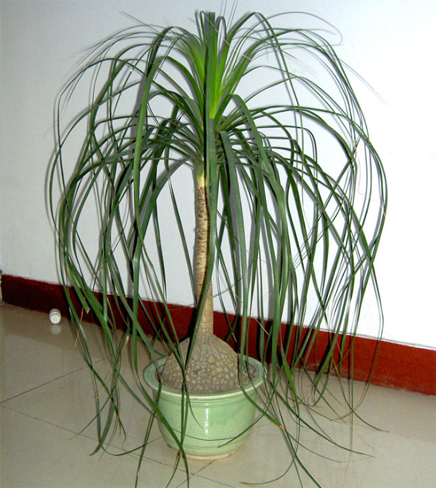
Growing methods and precautions for Beaucarnea recurvata:
1. Sunlight and temperature
Beaucarnea recurvata likes sunlight and can be placed in direct sun all year round. Even in the scorching heat of midsummer, continuous exposure under the blazing sun
will not scorch its leaves. However, it is not cold-tolerant, and in the north it must be brought indoors before Frost's Descent, placed in a warm, sunny spot.
The room temperature should preferably be around 10°C. If it drops below 5°C, cold-protection and warming measures must be taken to prevent frost damage. Since Beaucarnea recurvata is relatively drought-tolerant, it should not be watered too much, otherwise the roots easily rot.
2. Water and fertilizer
In spring and autumn, water when the soil is dry and let it dry out between waterings; in summer keep it moist; in winter water again when the soil is dry. During the growing season, when grown outdoors, apply a dilute liquid fertilizer once every half month; when grown indoors, granular fertilizer is preferable.
3. Potting soil and watering
For potted Beaucarnea recurvata, a mix of 2 parts leaf mold, 1 part garden soil, 1 part river sand and a small amount of plant ash can be used as the growing medium. During the growing season from March to October, fertilizer and water management should be strengthened to promote swelling of the stem. Because the swollen stem can store a certain amount of water and has strong drought tolerance, watering should be done only to the extent of keeping the potting soil moist, following the principle of preferring dry over wet, and avoiding water accumulation in the potting soil, otherwise the fleshy roots and stem easily rot.
4. Care after autumn
Especially after late autumn when temperatures drop, watering should be reduced to improve the tree's cold resistance. During the growing season, apply liquid fertilizer or compound fertilizer twice a month, and pay attention to increasing phosphorus and potassium fertilizer when fertilizing. Regularly pruning old leaves can promote the plant's height growth. It likes high temperatures and is drought-tolerant, with an optimal growing temperature of 20-28°C.
5. Overwintering care of Beaucarnea recurvata. In northern regions, to ensure the plant overwinters safely, the following measures should be taken: strengthen water and fertilizer management to promote robust plant growth and further improve its cold resistance; indoors, place it in a sunny spot so it can receive sufficient light during the day; to prevent cold air from entering the room, the temperature should be maintained above 3°C.
If the temperature is too low, timely measures should be taken; in northern regions, to help the plant overwinter, watering should be controlled, and the potting soil should preferably be dry rather than wet; after the weather warms up around Qingming Festival, gradually move it outdoors.
6. How does Beaucarnea recurvata propagate?
Beaucarnea recurvata is generally propagated by sowing and cuttings. Sowing is best done indoors in pots. Potted plants in the north seldom bloom and set seed, so only the suckers sprouting from the base can be used for spring cuttings. After breaking off the young shoots, they must be dried for 1-2 days, then inserted into river sand or plain soil, covered with plastic film to retain moisture and warmth, and they root very easily at 20-25°C.
7. To grow Beaucarnea recurvata well, pay attention to the details
From April to November, during the growing period of Beaucarnea recurvata, do not move it around casually. Unless absolutely necessary, it is best to keep it in one fixed place.
At this time, sufficient water and nutrients can be given to promote swelling of the stem.
According to the dryness and wetness of the potting soil and the depth of leaf color, water and fertilize timely and appropriately, so that there is neither water accumulation nor water loss.
From January to March, water should be strictly controlled, watering only once a month with water at room temperature, thoroughly. When fertilizing, do not apply raw fertilizer or concentrated fertilizer.
How much does a Beaucarnea recurvata cost:
If you buy a Beaucarnea recurvata without a flower pot, the price is around 15 yuan. This is also affected by the size of the Beaucarnea recurvata plant.
That's all for the introduction to the growing methods, precautions and price of Beaucarnea recurvata. Why not hurry up and grow one?
Growing Methods and Precautions for Beaucarnea recurvata, Beaucarnea recurvata Price and Pictures
Beaucarnea recurvata closely resembles a large wine bottle, with bark cracked into small squares and clustered leaves that sway gracefully, forming a very peculiar ornamental plant. But many people do not know how to grow Beaucarnea recurvata. Next, Xiao Qi will tell everyone about the growing methods and precautions for Beaucarnea recurvata as well as the price of Beaucarnea recurvata.
I. Growing methods for Beaucarnea recurvata
1. Soil: Beaucarnea recurvata likes loose sandy soil and humus soil, and is tolerant of drought and poor soil. The potting soil should be well-draining; you can mix 3 parts fertile garden soil with 1 part cinder, then add a small amount of bean cake or chicken manure as base fertilizer.
2. Sunlight: Beaucarnea recurvata likes ample sunlight, but also has a certain shade tolerance. If light is insufficient, the leaves grow thin and weak, and the plant grows poorly. In spring and autumn, place it in a spot with ample light; in summer, provide appropriate shade, otherwise the leaf tips will scorch and the leaf color will turn yellow. To prevent the plant from growing lopsided, rotate the pot 180° every 4-6 weeks.
3. Humidity: Beaucarnea recurvata likes a humid climate, with an optimal relative air humidity of 70-80%. If humidity is too low, the lower leaves will turn yellow and drop, and the upper leaves will lose their luster.
4. Pests and diseases: Beaucarnea recurvata sometimes suffers from leaf spot disease, and Bordeaux mixture (1:1:100) can be sprayed once every half month. For damage by mirid bugs, whiteflies and scale insects, 40% omethoate emulsifiable concentrate at 1500 times dilution can be sprayed to kill them. In winter, prune off the weak, diseased, pest-infested, dead and overly dense branches of Beaucarnea recurvata.
5. Fertilizer: Spring, summer and autumn are the peak growing seasons for Beaucarnea recurvata. Apply liquid fertilizer or compound fertilizer once every 2-3 weeks to promote swelling of the base. When fertilizing, pay attention to increasing phosphorus and potassium fertilizer, with a nitrogen-phosphorus-potassium ratio of 5:10:5. Stop fertilizing in winter.
6. Pruning: In winter, prune off the weak, diseased, pest-infested, dead and overly dense branches of Beaucarnea recurvata.
II. Precautions for growing Beaucarnea recurvata
Light control: Cutting propagation cannot do without sunlight, because the cuttings still need to carry out photosynthesis to produce nutrients and rooting substances to supply their rooting needs. However, the stronger the light, the higher the temperature inside the cuttings, the more vigorous the transpiration of the cuttings, and the more water they consume, which is not conducive to the survival of the cuttings. Therefore, after cutting, a shade net must be used to block out 50-80% of the sunlight. After the root system grows out, gradually remove the shade net: on sunny days, remove the shade net at 4:00 PM each day, and cover it again before 9:00 AM the next day.
Temperature and humidity: Beaucarnea recurvata likes a humid climate and requires a relative air humidity of 70-80% in its growing environment. If the relative air humidity is too low, the lower leaves will turn yellow and drop, and the upper leaves will lose their luster. Because it originates from tropical regions and likes high-temperature and high-humidity environments, it has strict requirements for winter temperatures. It stops growing when the ambient temperature is below 10°C, and cannot overwinter safely when frost occurs.
III. Price of Beaucarnea recurvata
The price of Beaucarnea recurvata is affected by many factors, such as region, season, planting cost, as well as plant quality such as variety, plant height, and stem volume. Prices vary from place to place, climates differ, and the costs invested in planting also differ, plus there are non-locally grown plants brought in from elsewhere. However, the price of Beaucarnea recurvata is generally not particularly expensive. Without a flower pot it is usually 15 yuan per plant, while with a flower pot it is generally 30 yuan per plant.
Growing methods and precautions for Beaucarnea recurvataas well asBeaucarnea recurvata priceare introduced here for everyone. Beaucarnea recurvata has a peculiar shape and is a very good home potted plant. Friends who like it can consider getting one.
Growing methods for Elephant's Foot Tree, how much is the price
Elephant's Foot Tree, this plant is quite interesting in appearance, the lower section is super large. What are the growing methods for Elephant's Foot Tree? How much is the price of Elephant's Foot Tree:
Growing methods for Elephant's Foot Tree:
1. Soil
Elephant's Foot Tree likes fertile soil, so if you want to grow it in a pot, the potting soil should be well-draining, such as loose sandy soil or humus soil, or humus-rich sandy loam soil are all good choices.
2. Temperature
Beaucarnea recurvata likes a warm, humid environment with ample sunlight, and its suitable growing temperature is 16-28°C. If it drops below 13°C, it stops growing. In winter, the temperature should not stay below 10°C for a long time, otherwise the base of the plant will rot, causing the entire plant to die.
3. Fertilizing
When growing Elephant's Foot Tree in a pot, what to note about fertilizing is that it should not be excessive, and compound fertilizer is generally used; a small amount of bean cake or chicken manure can also be added as base fertilizer. Also, the number of fertilizations differs at different growth stages. For example, during the peak growing season, fertilizer can be applied 1 to 2 times a month, and from November to March of the following year, fertilizing should be stopped.
4. Pest and disease prevention
I believe everyone knows that growing many flowers, plants and greenery in pots can lead to different pests and diseases, and potted Elephant's Foot Tree likewise needs attention to pest and disease prevention. Common pests and diseases include bacterial soft rot, leaf spot disease, and arrowhead scale. The treatments for these pests and diseases are different. If it is bacterial soft rot, streptomycin at 1000 times dilution can be sprayed; if it is leaf spot disease, 75% chlorothalonil can be sprayed; and if it is arrowhead scale, there are two methods, one is biological control (natural enemies include short-fringed wasp, long-beaked wasp, golden aphid wasp and Chilocorus kuwanae), and the other is chemical control, that is, spraying 40% omethoate.
How much is the price of Elephant's Foot Tree:
Elephant's Foot Tree is also called Beaucarnea recurvata, and if you want to grow it indoors in a pot, you can only pot it when it is young. So how much does it generally cost? Actually, this mainly depends on what kind you want to buy. If it is a potted Beaucarnea recurvata, the price is not very expensive. Generally, a Beaucarnea recurvata without a flower pot costs about 15 yuan per plant, and a Beaucarnea recurvata with a flower pot costs about 30 yuan per plant. But if it has grown large, the price is quite expensive, generally over 10,000 yuan.
That's all for the introduction to the growing methods and price of Elephant's Foot Tree. The price of this Elephant's Foot Tree is still a bit on the expensive side.