Is Monstera Toxic? A Detailed Guide to Propagation and Pruning Methods
When it comes to Monstera, it is a plant that many people love to grow, with leaves that shine bright green. Let's take a look at whether Monstera is toxic, and what its propagation and pruning methods are:
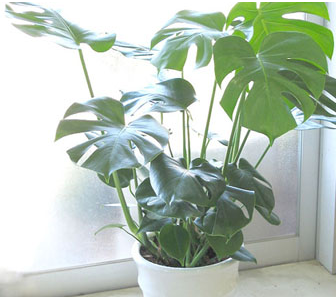
Is Monstera toxic:
Monstera is mildly toxic. It mainly absorbs water through its roots, and when the temperature is low, water droplets will condense on the leaves. Some children, upon seeing it, may find it very cute and pick it to play with. If they accidentally take a bite, they may be poisoned. However, the toxicity of Monstera is not very harmful. As long as you do not eat its sap or rub the sap into your eyes, it generally will not cause any adverse effects on people.
When growing Monstera at home, besides choosing a good variety, you should also pay attention to its placement. Try not to place it in a child's room, because children are mischievous and may pick its leaves. To avoid poisoning, the placement must be chosen carefully.
Monstera Propagation Methods:
Cuttings: In spring and summer, when the temperature is moderate, using stem node cuttings to propagate Monstera gives a high survival rate. First, select a 20-25 cm side branch as the cutting, cut off most of the leaves, leaving only the small leaves at the top, and then insert it into a mixed substrate. When selecting side branches, note that the side branch needs solid stem tissue and robust growth, and there should not be too many axillary buds. To accelerate rooting of the side branch, keep short leaves to absorb water, strengthen fertilizer and water management, and control the room temperature. If you want to use it as a hanging decoration, you can make a wooden frame, put fertile leaf mold soil on it, and plant the rooted, surviving Monstera on it.
Division: In summer and autumn, plant the stem tip and axillary buds of Monstera directly into a wooden barrel, using MS medium plus 10 mg/L 6-benzylaminopurine as the substrate. After 6 weeks, the axillary buds will take root, with a very high survival rate and good form. In addition, you can also use side branches of a large Monstera as cuttings and plant them directly into a pot, watering and fertilizing, slowly inducing them to take root.
Monstera Pruning Methods:
When Monstera leaves grow too densely and the overall appearance is affected, the leaves need to be pruned. Do not use scissors directly to prune the leaves, because cutting leaves with scissors will cause the wound to appear squeezed and water-soaked, making it difficult to heal later. In addition, Monstera has only one growing point. When picking leaves, remember not to damage the growing point, unless there is a bud on a main stem that can be cultivated to grow a tender branch.
To prune Monstera, first remove a portion of its upper leaves, and then prune the side leaves according to the needs of the overall shape. After pruning, water and fertilize regularly to let it regrow. If the overall shape is not affected, do not prune too many times a year. It is recommended to prune once a year.
Monstera is mildly toxic, so it should be placed where children cannot see it. That's all for the pruning and propagation methods of Monstera. Get a few plants for your own home right away.
How to Grow Monstera
Monstera's leaves are very unusual, but its plant shape is elegant, and its overall ornamental effect is very good, so it is a very well-known indoor foliage plant. However, not all foliage plants can be grown indoors. The editor will analyze for you whether Monstera can be grown indoors and how to grow Monstera well.
Monstera
Monstera's young leaves are heart-shaped with no holes. When mature, they become broadly ovate, with oval perforations between the veins. The leaves have long petioles and are dark green. It has a spadix inflorescence with a boat-shaped spathe, blooming in November, light yellow. Monstera is also known as "split-leaf philodendron" and "electric wire grass". It is an evergreen climbing foliage plant of the Araceae family. Brown aerial roots grow on the stem, shaped like electric wires, hence the name "electric wire grass". The leaves are ovate, with many oblong holes and deep splits scattered in a turtle-shell pattern between the pinnate veins. Their shape resembles a turtle-shell pattern, and the stem has nodes like a bamboo stem, hence the name "Monstera" (turtle-back bamboo).
I. Is Monstera Suitable for Growing Indoors
By consulting materials, we have learned that Monstera is a toxic plant included in the Chinese plant atlas database. Its toxicity is that the sap is irritating and corrosive, causing pain and burns upon skin contact. The unripe flesh contains needle-like calcium oxalate crystals, which burn the tongue if eaten. It can be seen that Monstera is a toxic plant, but its toxicity is much milder compared to the Alocasia macrorrhizos of the same family. The toxicity of Monstera mainly takes effect through deep contact and ingestion. As long as you do not eat its sap or rub the sap into your eyes or wounds, the toxicity of Monstera will not harm people.
Moreover, Monstera is not among the 52 included cancer-promoting plants. It does not release harmful gases or harm everyone's health. On the contrary, Monstera is a natural scavenger that can remove harmful substances from the air and purify the air. Experiments have shown that Monstera can remove 80 percent of harmful gases from the air, making it very suitable for homes that have just finished renovation.
In addition, Monstera has the unique ability to absorb carbon dioxide at night. Monstera contains many organic acids. These organic acids can react chemically with the carbon dioxide absorbed at night and become another kind of organic acid that is retained. During the day, this changed organic acid is reduced back to the original organic acid, and carbon dioxide is decomposed and released for photosynthesis. Monstera will not compete with people for oxygen at night. It will also remove the carbon dioxide released by human breathing, keeping indoor air fresh and helping people sleep.
Monstera
II. How to Grow Monstera
1. Soil: Monstera prefers loose, well-drained soil. It can be prepared by mixing garden soil, river sand, and leaf mold soil.
2. Sunlight: Monstera is relatively shade-tolerant, avoids scorching sun, and prefers scattered light. Avoid direct strong light. If the sunlight is too strong, the leaves will be scorched; if the light is too dark, the leaf color will fade. In summer, the flower pot can be placed at a north window. In winter, it needs sufficient sunlight and should be placed on a south-facing windowsill.
3. Temperature: Monstera prefers warmth, with an optimum growing temperature of 15-25°C. Indoor overwintering in winter cannot be below 5°C.
4. Water: Monstera prefers moisture. Keep the pot soil dry without cracking and moist without being soggy. The ideal air humidity is 60 percent. In summer, spray and water the leaf surface every day to keep the leaf color bright. In winter, do not spray water on the leaf surface, otherwise black spots may appear on the leaves, or even blackening and rotting.
5. Fertilizing: From April to September is the vigorous growth period. Apply diluted liquid fertilizer once every half month. During the growing period, apply a 20 percent or 30 percent nitrogen liquid fertilizer about once every 2 weeks to promote robust plant growth. After autumn, increase phosphorus and potassium fertilizer to make the stem thick and strong and prevent lodging.
6. Pruning: After the shape is set, when the stem node leaves grow too densely and the branches and vines grow too long, pay attention to pruning the whole plant, striving for a natural and beautiful appearance. If you want the stem vines to grow taller quickly, you can moderately prune the lower aged leaves.
7. Pest and disease control: The main pests and diseases harming Monstera are scale insects and gray spot disease. They can be killed by spraying with 40 percent omethoate emulsifiable concentrate at 1000 times dilution. For gray spot disease, strengthen plant care, remove pests in time, prune some diseased leaves, and spray with 70 percent thiophanate at 1000 times dilution or 0.5 percent equal-amount Bordeaux mixture.
Although Monstera is somewhat toxic, its toxicity will not pollute the air, so it is still a relatively suitable foliage plant to grow indoors. However, the editor wants to remind all friends that families with children and pets must be careful not to let them eat it by mistake, otherwise it will cause poisoning.
Monstera Growing Methods and Precautions You Need to Know
Monstera is a vine ornamental plant originating from the tropical rainforests of Mexico. Its shape is simple and it stays evergreen all year round, so it is deeply loved by everyone. So what are the growing methods and precautions for Monstera? Let's take a specific look below.
Monstera picture
I. How to Grow Monstera (Is Monstera toxic? Can it be placed indoors?)
(1) Soil
When Monstera cuttings have taken root and are transplanted into pots, fertile pond mud or black mountain soil can be used. Because it grows rapidly, it needs to be repotted once a year. Repotting should be done between March and April. When repotting, remove part of the old soil and dead roots, and change to a pot one size larger. Put some hoof pieces, crushed bones, etc. at the bottom of the pot as base fertilizer, and fill in a growing medium mixed with 1/3 leaf mold soil, 1/3 vegetable garden soil, and 1/3 sandy soil.
Monstera picture
(2) Light and Temperature
Monstera is a typical shade-tolerant plant. Large-scale production requires shade facilities, and 50 percent shade netting can be used. Especially for sown seedlings and newly rooted cuttings, direct sunlight must be avoided to prevent leaf scorching. Mature plants also need attention to shading during midsummer, otherwise the leaves will age, lack natural luster, and affect ornamental value. In midsummer, it should be placed indoors or under a shade shed, and cannot be placed on a balcony with too strong sunlight, otherwise it is easy to cause dead leaves. In winter, when the temperature drops to 6°C, it should be moved indoors for warmth to prevent cold wind from hitting it, otherwise the leaves are prone to yellowing and falling off.
Monstera picture
(3) Water and Fertilizer
Monstera prefers moisture and needs sufficient water during the growing period. For daily watering, once a day is fine. In summer, water once in the morning and once in the evening. In dry weather, it is even more necessary to spray water on the leaves and sprinkle water in the growing environment to maintain air moisture and bright leaves. In winter, water once every 3-4 days. Every 7-10 days, spray the leaf surface once with clean water close to room temperature to keep the plant evergreen and fresh and improve ornamental value. Monstera is a flowering plant that relatively prefers fertilizer. From April to September, apply diluted cake fertilizer water once every 15 days; you can also apply decomposed human urine diluted with water. With sufficient fertilizer, the leaf color will be pleasing. At the same time, Monstera's roots are relatively tender, and raw fertilizer and concentrated fertilizer should be avoided to prevent root burn. It is best to use "Huiyou" 20-8-20 four-season high potassium nitrate fertilizer and 20-20-20 general fertilizer, which are more beneficial to the growth of Monstera.
Monstera picture
(4) Growth Habits
Monstera often grows epiphytically on tall trees in tropical rainforests. It prefers warm and humid environments, and strongly avoids strong light exposure and dryness. It is shade-tolerant and easily grows in fertile, loose, highly water-absorbent, water-retentive, slightly acidic loam, with leaf mold soil or peat soil being best. The optimum growing temperature is 20-25°C. Below 5°C, it is prone to cold damage. When the temperature rises above 32°C, growth stops.
Monstera picture
II. Precautions for Monstera
(1) Watering
Because the leaves are relatively large, which leads to rapid water loss, it needs frequent watering to keep the soil moist. Never let it become waterlogged, which would cause root rot. In summer, spray water on the leaf surface 3-5 times a day to avoid stunted growth of branches and leaves. Reasonably control the amount of water. In dry hot weather and during the vigorous growth period, water more; in winter and for seedlings, water as little as possible.
Monstera picture
(2) Fertilizing
Monstera needs sufficient fertilizer for growth. During the vigorous growth period, apply fertilizer about once every two weeks. Pay attention to controlling the amount of fertilizer to maintain its ornamental appearance.
Monstera picture
(3) Repotting
It should be repotted once every year in March-April. Of course, if it is outdoors, it should be moved indoors, and early October can be chosen. During repotting, first replace the old soil, prune the roots, cut off the withered parts, and then add an appropriate amount of organic fertilizer.
Monstera picture
(4) Pests and Diseases
Its diseases generally include stem blight, leaf spot, gray spot, and other conditions. Scale insect damage is common. It needs strengthened prevention and control on ordinary days. Usually, an old toothbrush is used to clean the surface, and then 40 percent omethoate at 1000 times dilution is sprayed on.