Which country's national flower is the hibiscus? Differences from rose of Sharon and how to grow it
Speaking of this hibiscus, it actually looks quite beautiful, but on closer look, how come it looks so much like rose of Sharon? Instantly you just can't tell them apart. Let's take a look at how to grow hibiscus. What are the differences between hibiscus and rose of Sharon? Which country's national flower is the hibiscus?
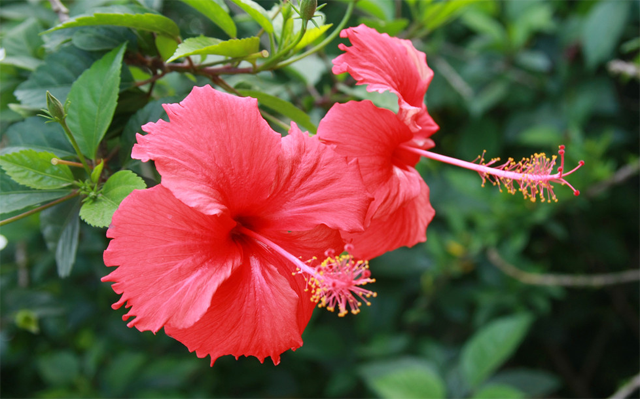
How to grow hibiscus:
Hibiscus likes warm, humid places with plenty of sunlight. It does not like drought and cannot tolerate freezing. In the north it is suitable for container growing, and in winter it must be moved indoors to overwinter.
The hibiscus flowering period is very long. Above 15°C, it blooms continuously all year round. Hibiscus has strong resistance and is relatively easy to manage.
1. Potting soil selection
For container growing, the soil should be loose, fertile sandy loam. Every year in early spring before moving it outdoors in April, it should be repotted.
2. Repotting and pruning
Replace with fresh growing medium, cut away some of the overly dense, curled fibrous roots, and also apply plenty of base fertilizer, adding a little phosphate fertilizer at the bottom of the pot.
After pruning, because the above-ground part consumes less, water and fertilizer should be appropriately reduced.
3. Sunlight, water and fertilizer
It is best grown in a spot with plenty of sunlight, and drainage should also be good. Apply a dilute liquid fertilizer once every half month. Watering should depend on how dry or moist the potting soil is; too dry or too wet will both affect flowering.
With insufficient light, flower buds tend to drop and blooms become smaller. Daily sunlight must not be less than 8 hours.
4. Overwintering treatment
After the weather turns cool at the end of October, gardening friends in the north should move the hibiscus indoors. After autumn, apply less fertilizer (or simply no fertilizer), otherwise it will suffer cold damage in cold weather.
Hibiscus cannot tolerate frost. After Frost's Descent and before the Start of Winter, it must be moved indoors to keep warm. The overwintering temperature should be no lower than 5°C to avoid cold damage, and no higher than 15°C to avoid affecting dormancy.
Differences between hibiscus and rose of Sharon:
The biggest difference is that the hibiscus stamen extends long beyond the corolla, while the rose of Sharon stamen is more restrained.
Leaf differences:
Hibiscus leaves are ovate with a bumpy texture, smooth on both sides, and the leaf surface shows a glossy sheen;
The most obvious feature of rose of Sharon leaves is their shallow three-lobed shape, though some cultivars are rhombic-ovate, but the leaf surface is never smooth and has no gloss.
Which country's national flower is the hibiscus:
The hibiscus is the national flower of Fiji. Do not underestimate the hibiscus; being able to become a country's national flower is quite competitive.
That is all for how to grow hibiscus. Come and grow it now! Now you can clearly tell the difference between rose of Sharon and hibiscus. This is the national flower of Fiji.
How to grow hibiscus Hibiscus
Hibiscus photo albumHibiscus is a famous Chinese flower and is very commonly cultivated in South China. Its flowering period is long, almost never ending through the year, with large, brightly colored flowers and abundant blooms. In addition, it is easy to manage. Besides being widely used in landscaping in subtropical regions, it is an important greenhouse and indoor flower in the Yangtze River basin and areas to the north. It can also be used medicinally. The term "Fusang" in modern times also refers to Japan, but what it refers to in Chinese mythology and historical records is still disputed. There is a novel of the same name.
Basic information
Plant name: Hibiscus
Aliases: Fo Jin, Zhu Jin, Fo Sang, Da Hong Hua, Chi Jin, Ri Ji, Hua Shang Hua
Scientific name: Hibiscusrosa-sinensis
Family and genus: Malvaceae, Hibiscus
Introduction
Although hibiscus is both the national flower of Malaysia and Panama, and also the state flower of Hawaii, its place of origin is actually China, and it has a long history of cultivation. As early as the pre-Qin "Classic of Mountains and Seas", there is a record that "on Tanggu there is Fusang." In the Jin Dynasty, Ji Han's "Plants and Trees of the South" records "its flower is like rose of Sharon but deep red in color, called Zhu Jin," "deep red, flowers with five petals," and so on.
Hibiscus, also known as Zhu Jin, is native to southern China. It likes a warm, humid climate, cannot tolerate cold or frost, and cannot tolerate shade. It is suitable for growing in sunny, well-ventilated places. It is not strict about soil, but grows best in fertile, loose, slightly acidic soil. In winter the temperature should not be lower than 5°C.
There are many hibiscus cultivars, wonderfully colorful. According to petals they can be divided into single and double, and according to flower color into red, pink, yellow, blue-green, white, and so on. Among them, the deep red double-petaled ones are somewhat similar and not often seen, hence the name Zhu Jin.
The cultivated variety Cooperi hibiscus (Hibiscusrosa-sinensiscv.Cooperi.), also known as Jin Ye Da Hong Hua, is mainly grown for its foliage. The leaves have varied markings of white, red, yellow, green, and so on, and are very beautiful.
Records in ancient texts
"Fo Sang Flower at Gengyuan Post Station" by Cai Xiang of the Song Dynasty
At the stream lodge, early cold feels like early spring; cold-season flowers lean on one another, charming the traveler.
Pitiful that all the trees have shed and withered away; only this one shows lush branches, brilliantly new.
Clear and gorgeous, its robe moistened by dew beyond the clouds; its subtle fragrance now and then passes over the dust of the tracks.
In the famous garden it will not compete in color; burning bright like a young peach by the wild waterside.
Fo Sang, a plant name. A shrub. Leaves ovate. Corolla large, in colors such as red and white. Mostly planted in southern China. It blooms all year round and is a famous ornamental plant.
Ming Dynasty, Li Shizhen, "Compendium of Materia Medica, Wood Section Three, Fusang": "Fusang is produced in the south and is a separate variety of rose of Sharon. Its branches are weak and soft, its leaves deep green, slightly astringent like mulberry. Its flowers come in red, yellow, and white; the red ones are especially prized and are called Zhu Jin."
Ming Dynasty, Xu Wei, one of the poems "Hearing Someone in the Village Bought a Hibiscus Flower": "Remembering parting at Tangjiang fifty frosts ago, the southern flowers I long remember, the brilliant Fusang."
Qing Dynasty, Wu Zhenfang, "Miscellaneous Records of Lingnan," lower volume: "Hibiscus flowers are found everywhere in Guangdong. The leaves resemble mulberry but are slightly smaller. There are three colors: deep red, light red, and yellow. The large ones open expansively like peonies, opening in the morning and falling at dusk, and after falling they bloom again, continuing without interruption from March to October."
Morphological characteristics
The leaves resemble mulberry leaves, and there are also round leaves. Trumpet-shaped flowers grow in the leaf axils, with single and double forms. The largest flower diameter reaches 25 cm. It is an evergreen large shrub or small tree. The stem is upright and much branched, reaching up to 6 m tall. Leaves alternate, broadly ovate to narrowly ovate, 7-10 cm long, with 3 main veins, the tip abruptly pointed or gradually pointed, the leaf margin with coarse serrations or incisions, the base nearly entire, hairless or with a few sparse hairs on the veins beneath, shaped like mulberry leaves. Flowers large, with drooping or upright stalks, borne singly in the upper leaf axils, divided into single and double forms; single
ones are funnel-shaped, double ones are not funnel-shaped, in colors such as red, yellow, pink, and white. The flowering period is all year, most abundant in summer and autumn.
The hibiscus flower's appearance is warm and bold, yet it has a unique flower center. This is formed by many small stamens joined together and wrapped around the outside of the large pistil, and the structure is quite delicate, just like a delicate heart beneath a passionate exterior. Ming Dynasty, Li Shizhen, "Compendium of Materia Medica, Wood Section Three, Fusang": "Fusang is produced in the south and is a separate variety of rose of Sharon. Its branches are weak and soft, its leaves deep green, slightly astringent like mulberry. Its flowers come in red, yellow, and white; the red ones are especially prized and are called Zhu Jin." Ming Dynasty, Xu Wei, one of the poems "Hearing Someone in the Village Bought a Hibiscus Flower": "Remembering parting at Tangjiang fifty frosts ago, the southern flowers I long remember, the brilliant Fusang." Qing Dynasty, Wu Zhenfang, "Miscellaneous Records of Lingnan," lower volume: "Hibiscus flowers are found everywhere in Guangdong. The leaves resemble mulberry but are slightly smaller. There are three colors: deep red, light red, and yellow. The large ones open expansively like peonies, opening in the morning and falling at dusk, and after falling they bloom again, continuing without interruption from March to October."
Cultivars
There are many hibiscus cultivars, with more than 3,000 worldwide at present, the most in Hawaii. In China there are still not many cultivars to date. By convention, petals are used as the first-level standard, flower color as the second level, and flower diameter as the third level for classification. Varieties suitable for courtyard planting include Xiao Xuan Fen, Mi Ni Bai, Hua Shang Hua (this Zhu Jin has petals on the filament tube; in ancient China it was called by names such as Fo Sang and Hua Shang Hua, see the image on the right), Fen Mu Dan, and Fen Xi Shi. Varieties suitable for containers include Yan Hong and others.
Common cultivars include:
American Beauty, flowers deep rose red.
Aurantiacus, single, flowers orange-red with a purple flower center.
Butterball, double, flowers yellow.
Butterfly, single, flowers small, yellow.
California Gold, single, flowers golden yellow with a deep red flower center.
Cheerful, single, deep rose red with a white flower center.
Cooperi, leaves narrow and long, lanceolate, green, with white, pink, and red markings. Flowers small, bright red.
Crown of Bohemia, double, flowers yellow and can turn orange.
Golden Dust, single, orange, with an orange-yellow center.
Hula Girl, single, flowers large, flower diameter 15 cm, yellow turning orange-red, with a deep red flower center.
Lateritia, flowers orange-yellow with a black-red flower center.
Lute, single, flowers orange-yellow.
Matensis, stems red, leaves gray-green, single, flowers magenta, with deep red veins and flower center.
Mist, double, flowers large, yellow.
President, single, flowers red with a deep pink flower center.
Red Dragon, double, flowers small, deep red. Rosea, double, flowers rose red.
Sundown, double, flowers orange-red.
Toreador, single, flowers large, flower diameter 12-15 cm, yellow with a red flower center.
Vulcan, single, flowers large, red. White Wings, single, flowers large, white.
Plants of the same genus: Hibiscus schizopetalus (see image on the right)
Plant name: Hibiscus schizopetalus
Aliases: Diao Deng Hua, Diao Lan Hua
Scientific name: Hibiscusschizopetalus
Family and genus: Malvaceae, Hibiscus
Morphological characteristics: Basically the same as hibiscus, with the main differences being the slender, long flower stalk, large and drooping, petals deeply split into fringed strips and curling upward, like a hanging lantern; the united stamens and pistil are much longer than the corolla, extending far beyond it.
Origin and distribution: Native to central Africa. Now it can be cultivated outdoors in South China, and in the north it is a greenhouse flower.
How to grow rose of Sharon / Care knowledge for rose of Sharon
Rose of Sharon pictures / How to grow rose of Sharon / Care knowledge for rose of Sharon
Introduction to rose of Sharon
Rose of Sharon flower, that is, the flower of Hibiscus syriacus L. of the Malvaceae family, genus Hibiscus. Rose of Sharon flowers are many-colored and vivid, very beautiful. Those with large, complete flowers, dry, white in color and free of impurities are considered best. It is an excellent plant for free-growing flower hedges. It is suitable for arranging along roadsides, in parks, courtyards, and other places, and can be planted singly, in rows, or in masses. Rose of Sharon flowers can also be used as a traditional Chinese medicine and can be eaten as well. Moreover, poems and prose through the ages have recorded rose of Sharon flowers.
Rose of Sharon flowers come from places such as Changjing Garden in Jiangsu, Shandong, Anhui, Henan, and so on. Rose of Sharon flowers can also be used as a traditional Chinese medicine and can be eaten as well. Moreover, poems and prose through the ages have recorded rose of Sharon flowers.
Rose of Sharon is the national flower of South Korea. When it blooms, the rose of Sharon branches produce many flower buds. After one flower withers, the other buds open continuously, blooming with full spring feeling and brilliant spring light.
Therefore, Koreans also call it "Mugunghwa" (flower of infinity). Rose of Sharon is also called Mugunghwa, and also Wuji Hua. Since ancient times it has been a famous hedge plant. The flowers are very beautiful, the flowering period is very long, and it is extremely tough and full of vitality, a flower with very strong life force, symbolizing the national character of the Republic of Korea, which has endured hardships yet remains steadfast. Rose of Sharon is deeply loved by Koreans and has been designated the national flower as a symbol of beauty and enduring happiness. July to October is the season when Mugunghwa blooms and shows its stamens.
Rose of Sharon is also called morning glory and also Mugunghwa. Since ancient times it has been a famous hedge plant and is also a common courtyard tree. Rose of Sharon blooms in summer and autumn, the flowering period is very long, the flowers are very beautiful, and its flowers open in the morning and fall at dusk, continuing every day without interruption, which people call the "virtue of daily renewal." The Korean people love this flower very much and have designated it as the national flower. Rose of Sharon is also a flower often eaten by farming families. In mountain farming households, rose of Sharon trees can be seen everywhere in front of and behind houses and in vegetable gardens. Rose of Sharon also blooms freely; it is not the delicate, precious kind.
Rose of Sharon is also known as Mian Hua, Zhao Kai Mu Luo Hua, morning glory, and also Fo Die Hua, Ji Tui Lei, Bai Mu Dan, Li Zhang Hua, and so on. It is a deciduous shrub or small tree of the Malvaceae family, genus Hibiscus. Rose of Sharon flowers bloom in summer and autumn, opening in the morning and falling at dusk, continuing every day without interruption, which people call the "virtue of daily renewal." Flower colors include white, purple, cream yellow, and light red, spreading in profusion, greeting the rosy clouds and basking in the sun, fluttering in the wind, radiant and beautiful.
Morphological characteristics of rose of Sharon
Rose of Sharon flower is the flower of Hibiscus syriacus of the Malvaceae family, genus Hibiscus. The flower is irregular in shape, 1.5-3 cm long, 1-1.5 cm wide, with a bluntly rounded base, short stalk, and one whorl of bracts. The calyx is gray-green, with lobes curled or recurved; the flower stalk, bracts, and outside of the calyx all have fine hairs; petals 10, wrinkled, pale yellow or pale purple-blue, obovate, densely covered with white long soft hairs at the base; stamens united into a staminal column, anthers numerous, purple-black. Slight odor, mild taste.
Rose of Sharon is a deciduous shrub; ovate leaves often three-lobed, with three main veins, blooming in summer and autumn, flowers borne singly in leaf axils, trumpet-shaped, about 4 to 10 cm in diameter. The whole plant can reach 2 to 4 m tall. The flowering period is from July to September. The flowers of rose of Sharon open in the morning and fade at dusk; one flower only opens for one day, opening in the morning and withering at night. Flowers bloom one after another in succession, and the flowering period is very long, so in South Korea it is called Mugunghwa.
Deciduous shrub or small tree; 3 m to 5 m tall, much branched; leaves triangular or rhombic-ovate, sometimes with 3 lobes above the middle. Flowers large, borne singly in leaf axils, 5-8 cm in diameter, single or double, in colors such as white, pink, and purple-red, with the petal base sometimes red or purple-red; flowers very numerous, and although each flower opens only one day, large numbers of flowers open every day, very beautiful.
Dried rose of Sharon flowers are curled into ovate or cylindrical clumps, about 3 cm long and about 1.5 cm in diameter. At the base there is a gray-green calyx, densely covered with fine down on the surface, with 5 lobes at the margin. Outside the calyx there are several gray-green linear bracts. There is often a short flower stalk. Petals white, in 5 or many layers, wrinkled and curled. In the middle there is a yellow flower center, which is numerous stamens united into a cylindrical shape, surrounding the pistil. Light in texture, slightly fragrant, sweet in taste. Those with large flowers and white color are best. The flower is irregular in shape, with a bluntly rounded base, short stalk, and one whorl of bracts. The calyx appears gray-green, with lobes curled or recurved; the flower stalk, bracts, and outside of the calyx all have fine hairs; petals 10, wrinkled, pale yellow or pale purple-blue, obovate, densely covered with white long soft hairs at the base; stamens united into a staminal column, anthers numerous, purple-black. Slight odor, mild taste.
Rose of Sharon flowering period is June-October, fruiting period September-October.
Properties of rose of Sharon
The flower is irregular in shape, 1.5-3 cm long, 1-1.5 cm wide, with a bluntly rounded base, short stalk, and one whorl of bracts. The calyx is gray-green, with lobes curled or recurved; the flower stalk, bracts, and outside of the calyx all have fine hairs; petals 10, wrinkled, pale yellow or pale purple-blue, obovate, densely covered with white long soft hairs at the base; stamens united into a staminal column, anthers numerous, purple-black. Slight odor, mild taste.
Plant morphology
Rose of Sharon is a deciduous shrub, 3-4 m tall. The stem is much branched, and young branches are densely covered with yellow stellate hairs and down. Leaves alternate, ovate or rhombic-ovate, 4-7 cm long, 2-4 cm wide, not lobed or with 3 lobes above the middle, base wedge-shaped, margin with blunt teeth. Flowers large, borne singly in leaf axils, 5-6 cm in diameter, flower stalk 4-14 mm long; bracteoles 6-7, linear, with stellate hairs; calyx bell-shaped, 5-lobed, with stellate hairs and short soft hairs; petals white, red, light purple, and so on, often double; stamens and stigma not extending beyond the corolla. Capsule oblong, about 2 cm long, with a short beak at the tip, densely covered with stellate hairs. Seeds brown.
Ecological habits of rose of Sharon
Rose of Sharon likes cool and warm, humid, sunny climatic conditions, and prefers fertile neutral to slightly acidic soil. It is relatively drought-tolerant, tolerant of poor soil, tolerant of partial shade, dislikes waterlogging, and tolerant of cold. The suitable growth temperature is 15-28°C.
Rose of Sharon likes plenty of sunlight and tolerates slight shade. It likes warmth and humidity, is relatively cold-tolerant, and can overwinter safely outdoors in most of North China. It likes fertile, loose soil with good drainage. It is not tolerant of drought or poor soil, nor of waterlogging.
Cultivation techniques for rose of Sharon
Open-air cultivation
Rose of Sharon has strong adaptability, grows easily and vigorously, and is relatively easy to cultivate and manage. From December each year to March of the following year, the dry season in the south, rose of Sharon enters a semi-dormant state, and management mainly focuses on watering to keep the seedlings alive; from April to October it enters the hot, rainy season. In April the plant can be cut back, and fertilizer and water management strengthened to promote new shoots and make the flowers bloom abundantly.
Planting and fertilizing
Rose of Sharon can be transplanted in spring and autumn. Bare roots can be dipped in mud slurry, and some branch tips appropriately cut off; it roots very easily. When planting, base fertilizer should be applied in the planting hole. Generally compost or rotted barnyard manure with a small amount of compound fertilizer is used, and afterward no fertilizer may be needed; but to increase flower yield and quality, before the summer flowering period, trees with weaker vigor should be top-dressed, using compost mixed with an appropriate amount of compound fertilizer and applied at the base along with weeding and earthing up. With extensive management, it can also flourish naturally.
Watering
Pay attention to drainage and waterlogging prevention in the rainy season. During the flowering period, if drought occurs, take care to irrigate. At the end of autumn, the late-autumn shoots, overly dense branches, weak small branches, and dead branches should be cut away to facilitate ventilation and light penetration, maintain plant shape, and protect against cold for overwintering.
Pruning
For rose of Sharon planted as hedges or walls, 2-3 shaping and pruning sessions should be carried out before spring bud break and during the growing period; for those scattered in gardens, cut back the trunk in the spring of the second year after planting to promote branching at the base, so that 2-year-old seedlings can be trained into an ideal tree shape.
Intertillage, earthing up, and weeding
During the growth period of rose of Sharon, 2-3 rounds of weeding and earthing up should be carried out. Carry out the first earthing up before the seedlings sprout in spring; after leaf expansion, when the branches have grown their 4th-5th leaves, carry out the second earthing up along with weeding.
Planting
Rose of Sharon is not strict about soil. Generally, vacant land in front of and behind houses, hillside land, and corner wasteland can be used for planting. It can also be planted as a hedge in a single row around vegetable plots and orchards, or planted in masses for specialized production.
Rose of Sharon is a perennial shrub with fast growth and can be planted once and harvested for many years. To obtain higher yields and facilitate field management and flower harvesting, single-row ridge cultivation can be used, with ridge spacing of 110-120 cm and plant spacing of 50-60 cm, with planting holes or planting furrows opened in the middle of the ridges. When transplanting and planting rose of Sharon, sufficient base fertilizer should be applied in the planting holes or planting furrows. Generally, household manure such as garbage soil or rotted stable manure is the main component, with a small amount of compound fertilizer applied as well. Transplanting and planting are best carried out during the seedling dormancy period, but can also be done in the rainy growing season. When transplanting, some branches and leaves should be cut off to help survival. After planting, water once to settle the roots and keep the soil moist until the plants survive.
Field management
Fertilizer and water management
When the branches begin to sprout, top-dress promptly, mainly with quick-acting fertilizer, to promote vegetative growth. Before flower bud formation, top-dress 1-2 times with phosphorus and potassium fertilizer to promote bud formation; during the peak flowering period from May to October, top-dress twice along with weeding and earthing up, mainly with phosphorus and potassium fertilizer supplemented by nitrogen fertilizer, to maintain flower quantity and tree vigor; during winter dormancy, weed and clean the garden, open furrows or dig holes around the plants and apply fertilizer, mainly household manure supplemented with an appropriate amount of inorganic compound fertilizer, to supply the nutrients needed for growth and flowering the following year. In long periods of drought without rain, take care to irrigate, and when there is too much rain, drain to prevent waterlogging.
Shaping and pruning
Newly planted rose of Sharon (Hibiscus syriacus) plants are relatively small, so in the first 1-2 years they can be left to grow freely or given light pruning, that is, removing dead branches, weak diseased and pest-infested branches, and declining branches in autumn and winter. Once the tree grows larger, the rose of Sharon plants should be shaped and pruned. Shaping and pruning should preferably be done after leaf fall in autumn. According to the degree of spread of the rose of Sharon branches, plants are divided into upright type and spreading type. The upright type has branches with a small angle of attachment, nearly vertical, strong sprouting ability, and relatively poor branching ability, and is not tolerant of long-term unpruned growth; it can be trained and transformed into a trunked, non-tiered tree form, selecting and retaining 3-4 main branches on the trunk and thinning out the rest, and selecting and retaining 1-2 side branches on each main branch, which is called the trunked open-center form.
Pruning methods
Promptly use watersprouts (branches growing on the upper side of limbs) to renew the leader, preventing the outer branch tips from drooping and prematurely aging; treat the branch tips the same as for the open-center form; for upright branches sprouting from the inner canopy, generally thin them out to prevent excessive branches from disrupting the tree form.
1. Rationally select and retain main branches and side branches, and thin out excess main and side branches in batches, so that the main and side branches are distributed reasonably and the density is moderate;
2. Heavily renew (cut back) the main branches and side branches; the branching angle of the new branch tips should be large and the direction correct; rationally thin out excessively dense outer branches to allow ventilation and light penetration;
3. For 1-year-old vigorous flowering branches, leave them unpruned after flowering to grow on; the following year thin out all the vigorous shoots and vigorous flowering branches that sprout on them, leaving the medium and short branches to flower; for the thinner perennial branches in the inner canopy, continuously cut back and renew them; for medium flowering branches, cut back at the branching point, which can effectively regulate branch vigor and promote improved flower bud quality;
4. Cut back the outer branch tips, pruning to retain the outer bud, which generally can produce 3 vigorous branches; remove the competing branches at the branch tip, leave the others unpruned to grow on, then cut back and train them into branch groups. The spreading type of rose of Sharon has a large branch angle and spreading branches, and produces more vigorous shoots and medium flowering branches than the upright type, and can be trained into a clump-forming shrub form. In the spreading type of rose of Sharon, there are often too many shoots arising from the base, the outer branch tips droop prematurely, and the upright branches in the inner canopy are numerous and tangled.
How to grow rose of Sharon
Indoor cultivation
Potting up, repotting, rotating pots
The potting soil can be prepared with peat soil or leaf mold plus 1/4 river sand or perlite and a small amount of base fertilizer, or sandy loam can be used. Before potting up, cut the rooted cutting back at 15-20 cm to promote branching. Rose of Sharon grows relatively fast, so it should be repotted once a year to increase the nutrients in the pot, and root pruning and branch pruning should be carried out to maintain the plant shape. Rose of Sharon grows fast; because indoor light is uneven, to maintain good plant shape and produce more flowers, the pot can be rotated once a week.
Watering, fertilizing and pruning
Indoor potted rose of Sharon grows fast and has a high demand for water and fertilizer. In summer, water once every 2-3 days; during spring and autumn when there is no heating, water once every 4-6 days; during the winter heating period when the indoor air is dry, water once every 2-3 days. The nutrients of the base fertilizer in the pot cannot meet the growth needs of rose of Sharon, so foliar fertilizer should be sprayed once every 2 weeks; during the bud stage and flowering stage, spray a 500-1000 times diluted solution of monopotassium phosphate on the leaves once a week; during the post-flowering pruning recovery period, urea solution can be sprayed. To maintain the plant shape, pruning is generally done after flowering, mainly cutting off weak branches and dead branches.
Fresh flower harvesting
The harvest period of rose of Sharon flowers is long; during the several months from the start of flowering to the end of flowering in a year, fresh flowers open every day. For flowers used as a vegetable, picking should preferably be done every morning, harvesting flowers that have just opened; when harvesting, pick gently and handle gently, and use appropriate packaging to bring them to market as soon as possible to ensure the flowers stay fresh.
Rose of Sharon has a long flowering period; in the Yangtze River basin it begins flowering in May and ends in October. As for a single flower, it opens in the early morning and withers the next day. Therefore, flowers used as a vegetable should preferably be picked every morning. If they are to be processed and sun-dried, they should be picked on a sunny morning and dried immediately; after drying, store them in a ventilated, dry place, and protect them from pressure and insects.
Propagation methods of rose of Sharon
Rose of Sharon can be propagated by sowing, cuttings and grafting. Rose of Sharon has strong adaptability, grows easily and vigorously, and is relatively easy to cultivate and manage.
Rose of Sharon has strong adaptability, grows easily and vigorously, and is relatively easy to cultivate and manage. From December each year to March of the following year, the dry season in the south, rose of Sharon enters a semi-dormant state, and management focuses mainly on watering to keep the seedlings alive; from April to October it enters the hot, rainy season, and in April the plants can be cut back and fertilizer and water management strengthened to promote new shoots and make the flowers bloom profusely.
From December each year to March of the following year, the dry season in the south, rose of Sharon enters a semi-dormant state, and management focuses mainly on watering to keep the seedlings alive; from April to October it enters the hot, rainy season, and in April the plants can be cut back and fertilizer and water management strengthened to promote new shoots and make the flowers bloom profusely.
Division propagation
Before sprouting in early spring, dig up vigorous mature clumps, take 3 main branches as 1 clump, and plant them at a spacing of 50 x 60 cm between plants and rows.
Cutting propagation
Cuttings can be taken from mid-March to early April in conjunction with pruning and shaping. Select lignified, robust branches as cuttings, 10-12 cm long, and insert them outdoors in red soil or sandy soil; the soil must be kept moist, but the survival rate is relatively low; it is best to insert them in a seedbed kept moist with plastic film, where at a temperature of 17°C to 20°C they root very easily.
Select 1-2 year old robust branches that have not yet sprouted. Cut them into small sections 15-20 cm long. When taking cuttings, prepare a small stick, make small holes in the seedbed at the plant and row spacing, then insert the rose of Sharon branches, firm the soil, with a planting depth of 10-15 cm, that is, a planting depth reaching 2/3 of the cutting is suitable, and water thoroughly immediately after insertion. No base fertilizer needs to be applied when taking cuttings.
Raising seedlings from cuttings
Rose of Sharon has a high survival rate from cuttings, and the cutting material is also relatively easy to obtain, so it is often propagated by cuttings. Raising seedlings from cuttings should preferably be done in early spring before the branches and leaves sprout. Select robust plants free of pests and diseases as mother plants, and before the mother trees sprout, select 1-2 year old middle and upper branches with a diameter of more than 1 cm as propagation material, cut the branches into 15-20 cm long sections, soak them in clean water for 4-6 hours, and then take the cuttings. Before inserting, prepare the seedbed well, make beds with a bed-and-furrow width of 130 cm and a height of 25 cm, and apply 6 kg of barnyard manure, 1.5 kg of burnt soil, and 75 g of calcium magnesium phosphate per square meter as base fertilizer.
For cuttings, the furrow depth is required to be 15 cm, the furrow spacing 20-30 cm, and the plant spacing 8-10 cm; the upper end of the cutting should be exposed 3-5 cm above the soil surface, or the planting depth should be 2/3 of the cutting. After insertion, cultivate soil and firm it, and water promptly.
Cuttings generally root and sprout in about 1 month. Using facilities such as plastic greenhouses for heat preservation and warming, cuttings can also be taken for seedling raising after leaf fall in autumn; soak the prepared cuttings in a 100-200 mg/L NAA solution for 18-24 hours, insert them into sand, water promptly, cover with agricultural film, maintain a temperature of 18-25°C and a relative humidity above 85%, and after rooting move them to the nursery for cultivation.
Because rose of Sharon roots very easily from cuttings, when the number to be cultivated is small, direct cutting cultivation can be carried out, directly planting the cuttings into the planting holes at the cultivation density without transplanting and establishing; long branches can also be used for direct cutting cultivation, with a planting depth of more than 20 cm to prevent lodging and drought damage due to too-shallow roots.
Key points for raising seedlings from cuttings
Rose of Sharon has strong growth vigor and roots very easily, so cutting propagation is mostly used in production. Cuttings are best taken in spring when the buds are about to swell; in conjunction with pruning, collect 1-year-old vigorous branches, cut them into cuttings about 15-20 cm long, soak them in clean water for several hours, and then insert them; the depth of insertion into the bed soil is 2/3-3/4 of the cutting length. Because rose of Sharon is a shallow-rooted plant, the cuttings should be inserted more than 15 cm into the soil to prevent lodging or early death during the seedling stage. Keep 1 axillary bud at the top of the cutting at the soil surface, spray water frequently to keep moist, and they root and survive very easily. The current-year seedlings reach more than 80 cm in height, and are transplanted after leaf fall or in the following spring when they sprout.
Alternatively, in June-July collect current-year semi-lignified new shoots, cut the lower part of the new shoots into 8-10 cm sections as cuttings, keep 1 leaf at the top, insert them into a sand bed at 2/3, then shade and mist to keep moist. After the cuttings root and survive, gradually remove the shade net and reduce water spraying; after hardening off for 1-2 weeks, transplant or pot up.
Seed propagation
Generally carried out in April in spring. After the fruit matures in October, collecting seeds in November-December is most suitable; after harvesting, extract the seeds and store them dry at low temperature, and by the following spring in April drill-sow or broadcast-sow them. For division propagation, after leaf fall in autumn or before sprouting in early spring, dig up the suckers at the base of the plant and plant them separately. Before planting, the roots can be appropriately pruned, and the aboveground part can be heavily cut back. Rose of Sharon has strong adaptability, is simple to cultivate, and requires extensive management; generally it can be left to grow freely. However, to improve its ornamental effect and make its flowers abundant and brightly colored, necessary management should be provided. Rose of Sharon flowers on current-year new branches, and appropriate pruning can be carried out after leaf fall in autumn. When pruning, thinning and cutting back should be combined; moderately cut back long branches, and thin out overly dense branches and thin, weak branches, so that nutrients are concentrated and the plant is full. In mid-to-late April in spring after the plants sprout, fertilizer should be applied once, and watering should be done in a timely manner to ensure sufficient fertilizer and water in the soil. When planting rose of Sharon, base fertilizer should be applied in the planting hole, and generally no further fertilizing is needed afterward. From before bud sprouting in spring to the flowering period in summer, irrigate 2-3 times depending on the weather. In the rainy season, drain water to prevent waterlogging. After autumn before frost, irrigate once thoroughly to prevent freezing. In late summer and early autumn, irrigation is not advisable, so as to avoid autumn shoots growing too tender and reducing cold resistance. For seedlings below 5-6 years old, cold protection measures should be taken when overwintering, such as mounding soil around the roots.
Layering propagation techniques
Because rose of Sharon branches root very easily, before sprouting in spring dig a shallow trench beside the mother plant, lay 1-year-old branches horizontally into the small trench, cover with soil, and keep the soil in the layering trench moist; they root and send out shoots very quickly. After leaf fall in autumn, cut the layered branch from the base, then dig out the seedling and divide it into individual plants.
Pest and disease control of rose of Sharon
During the growth period, rose of Sharon has relatively few pests and diseases. The main diseases include anthracnose, leaf blight, and powdery mildew; the main pests include red spider mites, aphids, bagworms, noctuid moths, and longhorn beetles. When pests and diseases occur, the diseased and pest-infested branches can be pruned off, and safe, efficient, low-toxicity pesticides can be selected for spray control or trapping. Attention should be paid to early control, and pesticide application should be avoided during the flowering and harvest period to ensure that the harvested rose of Sharon flowers are not contaminated by pesticides.
Rose of Sharon is easily harmed by mites, aphids, longhorn beetles, and others. Pay attention to early control. When pests occur, some efficient, low-toxicity pesticides such as TIANWANGXING and CARDIS can be used, and the branches and trunk should be checked regularly; when longhorn beetle damage is found, plug the holes promptly and kill the borers heavily.
The pests commonly occurring on rose of Sharon are mainly aphids, leaf-roller moths, geometer moths, and slug moths.
1) Aphids
In spring, when the nymphs first hatch, spray 80% dimethoate emulsion at 200 times dilution, or spray 40% omethoate at 2000 times dilution to kill the nymphs on the branches and trunk; for aphids that have already formed galls or that appear on the trees in autumn, the pesticide concentration should be appropriately increased.
2) Leaf-roller moths
When the larvae first hatch or before they fall to the ground while in the leaf-rolling damaging state, spray 50% phoxim at 1000 times dilution or 90% trichlorfon at 1000 times dilution.
3) Geometer moths
During the larval occurrence period, spray 90% trichlorfon or 40% dimethoate at 1000 times dilution to catch and kill the larvae, and protect and release parasitic wasps. 4) Slug moths: collect cocoons by picking, tapping, digging, and other methods, and bury them deeply in pits, which can effectively reduce the pest population density. The small larvae of slug moths mostly cluster to cause damage and can be removed and destroyed manually; their adults' phototaxis can also be used by setting up black-light lamps to trap and kill them, with very good results.
Variety classification of rose of Sharon
Types
White single-center series
Red single-center series
Purple single-center series
Blue single-center series
Korean series
Asda series
There are also double-flowered rose of Sharon.
Common varieties
White double-flowered rose of Sharon: white petals with fine purplish-red lines and small spots, double-flowered.
Glass double-flowered rose of Sharon: branches straight, flowers double, sky-blue.
Purple-red double-flowered rose of Sharon: petals purple-red or with white, double-flowered.
Variegated-leaf rose of Sharon: leaves with white spots, flowers purple, double-flowered.
Distribution range of rose of Sharon
Rose of Sharon is mainly distributed in tropical and subtropical regions. Species of the genus Hibiscus originated in the African continent, and there are many species of Hibiscus in Africa, showing rich genetic diversity.
In addition, wild types of this species have also been found in Southeast Asia, South America, Australia, and Central America. China is also one of the places of origin of some Hibiscus species. Globally, research on and cultivation of Hibiscus species are mostly concentrated in Hawaii, USA, New South Wales and Queensland in Australia, Malaysia, South Korea, and other places, mainly for ornamental cultivation; the most widely used are Chinese hibiscus (H. rosa-sinensis), rose of Sharon, cotton rose (H. mutabilis), and their varieties and hybrids.
Resource distribution: the medicinal material is produced in Jiangsu, Hubei, Sichuan, Henan, Hebei, Shaanxi, and other places.
Place of origin: China, India, Syria, Korean Peninsula.
Landscape uses of rose of Sharon
Rose of Sharon is colorful and showy, and is an excellent plant for free-growing flowering hedges; it is suitable for placement along roadsides, in parks, courtyards, and other places, and can be planted singly, in rows, or in masses.
In landscapes, rose of Sharon is commonly used as a flowering hedge, planted singly, planted in rows, or used as a background for other shrubs. During the flowering period the whole tree is covered with flowers, delicate and eye-catching, very spectacular and beautiful.
Uses and purposes of rose of Sharon
Ornamental value
Rose of Sharon is colorful and showy, very beautiful. Those with large, complete flowers, dried, white in color and free of impurities are preferred; it is an excellent plant for free-growing flowering hedges.
Rose of Sharon serves as a background for other shrubs; during the flowering period the whole tree is covered with flowers, delicate and eye-catching, very spectacular and beautiful.
Economic value
Rose of Sharon can also be used as a traditional Chinese medicine, and can also be eaten, and has relatively high economic value.
Dietary therapy or medicinal value of rose of Sharon
The medical information and health dietary therapy information on Huhua.com is for reference only and cannot be used as a basis for diagnosis or medical treatment. For any health problem, consult professional medical personnel, and for the treatment of any disease, follow the doctor's advice.
Ultimate flower-protecting mission: love yourself, start from reality, and strictly follow the doctor's advice. For illness, do not be careless, do not delay, do not give up hope; face it bravely, use love to warm the silent world, and use your heart to care for the flower field within.
Medicinal material information
Basic information
[Alternative names]: Limei flower (Lingwai Daida), flower that opens in the morning and falls at dusk (Gangmu), malaria flower (Qunfangpu), hedge flower, trumpet flower (Chinese Tree Taxonomy), white jade flower (Fujian Folk Herbal Medicine), fence flower, lard flower (Compilation of Commonly Used Folk Herbal Medicines), bowl-breaking flower (Jiangxi Traditional Chinese Medicine), lamp flower (Hunan Materia Medica), white rice flower, white flour flower (Fujian Chinese Herbal Medicine).
[Prescription names]: rose of Sharon flower, hibiscus tree flower, fresh rose of Sharon flower, white hibiscus flower
[Trade names]: rose of Sharon flower, Sichuan hibiscus flower. Those with large, complete flowers, dried, white in color and free of impurities are preferred.
[Harvesting and storage of the medicinal material]: From Major Heat to End of Heat, choose a sunny morning and pick the flowers when half-open, then sun-dry.
[Textual research]: From Rihuazi Bencao.
Main indications and usage
Flower
Main indications: intestinal-wind bloody stool, red and white dysentery, hemorrhoid bleeding, lung-heat cough, coughing blood, leukorrhea, sores, boils and carbuncles, and scalds. Leaves: mainly for red and white dysentery; intestinal wind; carbuncles, swelling, sores and toxins. Stem bark or root bark: mainly for damp-heat dysentery, intestinal-wind bloody stool, rectal prolapse, hemorrhoids, red and white leukorrhea, vaginal trichomoniasis, skin scabies and tinea, and scrotal eczema. Fruit: mainly for phlegm asthma and cough, bronchitis, migraine and general headache, impetigo, and eczema. Root: mainly for intestinal wind, dysentery, lung abscess, intestinal abscess, hemorrhoid swelling and pain, red and white leukorrhea; scabies and tinea, pulmonary tuberculosis. Flower: oral use: decoct in water, 3-9 g, fresh 30-60 g. External use: appropriate amount, grind into powder or mash fresh material and apply.
Leaves
Oral use: decoct in water, 3-9 g, fresh 30-60 g. External use: appropriate amount, apply. Stem bark or root bark: external use: appropriate amount, apply soaked in wine or decoct in water for fumigation and washing. Oral use: decoct in water, 3-9 g. Fruit: oral use: decoct in water, 9-15 g. External use: appropriate amount, decoct in water for fumigation and washing. Root: oral use: decoct in water, 15-25 g, fresh 50-100 g. External use: appropriate amount, decoct in water for fumigation and washing.
1. Coughing blood: fresh rose of Sharon flowers 30 g, rock sugar 15 g. Decoct in water and take. (Fujian Yaowu Zhi)
2. Diabetes thirst: rose of Sharon root 30-60 g. Decoct in water and take as a tea frequently. (Fujian Folk Herbal Medicine)
Single prescriptions and proven recipes
1. To treat dysentery: rose of Sharon flowers and rock sugar 30 g each, decoct in water and take, 1 dose per day.
2. To treat hemorrhoid bleeding: rose of Sharon flowers 15 g, decoct in water and take.
3. To treat red and white dysentery: rose of Sharon flowers 15 g, decoct in water and take with honey. For red dysentery use red flowers, for white dysentery use white flowers; avoid sour foods and permit.
4. To treat eye diseases due to wind-heat: rose of Sharon flowers 15-30 g, decoct in water and take.
5. To treat leukorrhea: rose of Sharon flowers, Patrinia scabiosaefolia, and white cockscomb 15 g each, 1 dose per day, decoct in water and take in 2 divided doses.
6. To treat edema: fresh rose of Sharon root and common rush 30 g each, decoct in water and take before meals, twice a day.
7. To treat impetigo: grind rose of Sharon bark into powder, mix with vinegar and stew until glue-like, then apply.
Collection and processing of the medicinal material
In summer and autumn on sunny days when the flowers first open, pick the fully open flowers and sun-dry them.
Discussion by various authors
1. Rihuazi Bencao: treats intestinal-wind bloody stool and red and white dysentery, and is roasted for medicinal use; made into a decoction as a tea, it treats wind.
2. Bencao Gangmu: reduces sores and swelling, promotes urination, and removes damp-heat.
3. Bencao Huiyan: can remove various heats, is lubricating and can guide away accumulated stagnation, and is good at treating red and white accumulated dysentery, with dry astringency and blockage, and a bearing-down sensation with the desire to defecate but inability to do so; pound the juice and mix with raw white liquor and drink warm.
4. Benjing Fengyuan: the red ones treat intestinal-wind blood dysentery, the white ones treat leukorrhea and white dysentery.
5. Anhui Medicinal Materials: treats skin diseases.
6. Jiangxi Traditional Chinese Medicine: the white flowers, boiled and eaten together with mountain finch, can stop nosebleeds.
7. Yilin Zuanyao: rose of Sharon flowers, the white flowers are suitable for those with lung-heat cough and blood vomiting, and also treat lung abscess, by virtue of the effects of sweet tonification and bland diuresis. Also, the red and white flowers separately treat red and white dysentery, because the large intestine and lung are interior-exterior paired, and the small intestine and heart are interior-exterior paired; all dysentery is damp-heat of the two intestines, and by using lubrication to remove stagnation, it is cured.
Clinical application of rose of Sharon flowers
Wash the rose of Sharon flowers clean and sun-dry them, then grind them into powder for later use. Take 2 g each time, reduced as appropriate for children, once every 2 hours, with 3-5 days as one course of treatment. In a trial treatment of 300 cases, symptoms were controlled in 96.3%; generally after taking the medicine body temperature dropped rapidly, and bowel movements improved within 2-3 days.
Usage and dosage: oral use: decoct in water, 1-3 qian (fresh 1-2 liang); grind into powder, 0.5-1 qian.
Selected prescriptions
1. To treat dysentery with inability to eat: remove the calyx from red rose of Sharon flowers, dry in the shade and grind into powder; first fry two wheat cakes, dip them in the powder and eat. (Jiji Xianfang)
2. To treat red and white dysentery: rose of Sharon flowers 1 liang (halved for children), decoct in water, and take mixed with white honey 3 fen. For red dysentery use red flowers, for white dysentery use white flowers; avoid sour and cold foods. (Yunnan Traditional Chinese Medicine Proven Recipes)
3. To treat vomiting blood, passing blood, and red and white dysentery: rose of Sharon flowers 9-13 blossoms. Add appropriate amounts of boiling water and rock sugar and steep for half an hour, take before meals, twice a day. (Fujian Folk Herbal Medicine)
4. To treat wind-phlegm congestion and counterflow: sun-dry rose of Sharon flowers, roast and grind them; take 1-2 spoonfuls each time, taken on an empty stomach with boiling water; the white flowers are especially good. (Jianbian Danfang)
5. To treat regurgitation: thousand-petal white rose of Sharon flowers, dry in the shade and grind into powder, mix with old rice broth and take three to five mouthfuls; if there is no improvement, then mix with rice broth and take again. (Xiuzhen Fang, Jinhua San)
6. To treat leukorrhea in women: two qian of hibiscus flowers, ground into powder, mixed with human milk, steamed over rice and eaten. (Dian Nan Ben Cao)
7. To treat boils and swellings: an appropriate amount of fresh hibiscus flowers, a little sweet rice wine, pounded into a paste and applied externally. (Jiangxi Herbal Medicine)
Precautions for Hibiscus Flowers
Hibiscus flowers are the blossoms of the hibiscus plant of the Malvaceae family. There are two kinds, red and white, and both are used medicinally. Their nature and flavor are sweet and bitter, cool. In Ri Hua Zi Ben Cao, they are used mainly to treat intestinal wind with bloody stool and red-white dysentery. They can be dried by roasting for medicinal use, and can also be "made into a decoction as a substitute for tea" and drunk.
In Ji Ji Xian Fang, to treat dysentery with inability to eat, it says: "Remove the calyx from red hibiscus flowers, dry them in the shade and grind into powder. First cook two wheaten cakes, dip them in the powder and eat."
In Fujian Folk Herbal Medicine, to treat vomiting of blood, passing blood, and red-white dysentery, it says: "Use nine to thirteen hibiscus flowers, add an appropriate amount of boiling water and rock sugar, stew for half an hour, take before meals, twice a day."
In Dian Nan Ben Cao, to treat leukorrhea in women, it says: "Grind two qian of hibiscus flowers into powder, mix with human milk, steam over rice and eat."
The above materials show that hibiscus flowers have good effects in stopping bleeding and treating leukorrhea, and that there are many ways to eat them.
Pharmacological tests: The ethanol extract of the roots and stems has an inhibitory effect in test tubes on Gram-positive bacteria, dysentery bacilli and typhoid bacilli.
Edible Value
Hibiscus Flower Tea
Suitable pairings: Hibiscus flowers are suitable for brewing alone and are not suitable for pairing with other flower teas.
Brewing and drinking method: Brewing and drinking method for hibiscus flowers: one teaspoon of petals, brewed with a cup of boiling hot water, covered and left for about ten minutes, then it is ready; brown sugar or honey may be added to taste.
Tea saying: Hibiscus flower represents the lucky plant
Dietary Nutrition
Hibiscus flower is an edible flower. Eating hibiscus flowers was already recorded as early as in the Book of Songs. People of Tingzhou in Fujian use hibiscus flowers with thin batter and chopped scallions, fry them in oil, and they are crisp and delicious, commonly known as "flour flowers" and "flower fritters". Residents of the mountainous areas of Huizhou cook hibiscus flowers with tofu, and the taste is very fresh and delicious.
Hibiscus flowers are sweet in flavor and cool in nature. Eating them can clear heat, drain dampness, cool the blood, expel toxins and beautify the complexion.
Hibiscus flower buds have a crisp texture when eaten. Fully blooming hibiscus flowers are smooth and refreshing when eaten.
The nutritional value of hibiscus flowers is extremely high. Every 100 grams of the edible portion contains 1.68 grams of protein, 0.19 grams of fat, 0.38 grams of total acid, 1.4 grams of crude fiber, 10.3 grams of dry matter, 2.10 grams of reducing sugar, 24.6 milligrams of vitamin C, 1.19 grams of total amino acids, 0.8 milligrams of iron, 60.6 milligrams of calcium, 0.30 milligrams of zinc, and also contains flavonoid active compounds and mucilage. If referring to the pollen, its nutritional value is even higher.
Dish Preparation
Crispy Fried Hibiscus Flowers, Shredded Pork with Hibiscus Flowers, Hibiscus Flower with Crucian Carp.
Hibiscus and Amomum Tofu Soup
10-12 white hibiscus flowers, 1 g of Yangchun amomum, 250 g of tender tofu, appropriate amounts of fine salt, monosodium glutamate, sesame oil and minced ginger. Heat a pan, add peanut oil and heat until 80% hot, add Yangchun amomum and minced ginger and stir-fry until fragrant, remove the residue, add 500 g of clear water, add sliced tofu and bring to a boil. Remove the calyx from the hibiscus flowers, wash them clean, put them into the pan and bring to a boil again, add fine salt and monosodium glutamate to adjust the taste, drizzle with a little sesame oil and it is done. It tastes of flower fragrance, the tofu is pure and clear, sweet and delicious. It can be used to treat excessive wind-phlegm, nausea, and hemorrhoids with bloody stool, etc.
Cultural Background of Hibiscus Flowers
About Poetry
Watching the Hu Teng Dance at Night in the Residence of Vice Censor-in-Chief Wang - by Liu Yanshi
Few have seen the Hu boy of Shiguo; he crouches and dances before the wine cup, swift as a bird. His woven foreign hat has a hollow pointed top,
His fine woolen Hu robe has small double sleeves. He tosses down the grape cup from his hand, and turning west suddenly thinks of the long road home.
He leaps and spins like a wheel, his jeweled belt rings; his feet move in profusion, his brocade boots soft. All four seats are silent, everyone stares wide-eyed,
The transverse flute and pipa quicken all at once. He tumbles wildly on the new carpet like snow and vermilion hair; beside him brush the light flowers beneath the red candles.
When the wine is done and the dance ends and the strings and pipes fall silent, west of the hibiscus flowers the waning moon appears.
Hibiscus Flower
Poet Jin Pengshuo, Dynasty: Song Dynasty, Genre: none
Closing at night and opening at dawn, the autumn dew is fresh; in the quiet courtyard it well suits the clear painted screen.
If it can indeed remove the resentment of the world, why need one have favored Taizhen in those years?
Legend
In the Puyang area, the story of the three flower deities Shunhua, Shunying and Shunji has been passed down for a long time, and the more it is told, the more magical it becomes. In fact, they were originally common hibiscus trees. So how did the trees become immortals, and how did they get such elegant names?
This must be told from ancient times.
In ancient times, east of the ancient capital hill there was a ridge called Mount Li. At the foot of Mount Li grew three clumps of hibiscus, as tall as two zhang, with crowns that could fill a mu. Every summer and autumn, flowers bloomed all over the trees, splendid as brocade.
One year in early autumn, the so-called "Four Fiends" - "Hundun", "Qiongqi", "Taowu" and "Taotie" - also came to Mount Li to sightsee. Seeing this beautiful scene, they at once conceived evil intentions and vainly tried to move the trees away and make them their own. So the "Four Fiends" launched a battle at Mount Li over the hibiscus. The "Four Fiends" and their underlings all fought until heads were broken and blood flowed, and finally they dug up the three clumps of hibiscus. Strangely enough, as soon as the hibiscus trees fell, they quickly withered, and even the flowers perished and the leaves fell. Seeing this state, the "Four Fiends" reckoned that even if they took them back they would hardly survive, so one by one they left Mount Li dejected.
Yu Shun, who was then leading farmers in cultivation at Mount Li, came upon hearing the news. He called the farmers to lift up the three clumps of hibiscus and draw water to irrigate them. A miracle appeared: the branches and leaves of the three clumps of hibiscus immediately revived, and the flowers bloomed as before. Yu Shun smiled, and the farmers were delighted.
To repay Yu Shun's kindness in saving their lives, the hibiscus fairies took Yu Shun's taboo name as their surname in remembrance. Yu Shun understood this very clearly in his heart. It turned out that on the very night the hibiscus revived, Yu Shun saw the lovely faces of three fairies in a dream, and they told him the above matters...
In the hazy state, Yu Shun saw three fairy maidens floating toward him. Looking closely, each had a face like a peach blossom, like three lotuses emerging from water. Just as Yu Shun was gazing spellbound, he suddenly saw the three immortals make a wanfu salute and say "Benefactor." Yu Shun did not know what to do, and asked blankly: "Where do you come from, and why call me benefactor?" The three fairy maidens smiled and said: "We are not human; we are hibiscus fairies. Thanks to your kindness in saving us in danger, we were able to preserve our forms." Hearing this, Yu Shun rose in a fluster and made a long bow, saying: "I did not know the immortal deities had descended; I have failed in proper ceremony. I beg the high immortals to forgive me." Hearing this, the three immortals could not help laughing. One immortal said solemnly: "We sisters are only subordinate members of the hundred flowers; you, benefactor, are a proud son of heaven. How dare we trouble you for such great ceremony? Moreover, we sisters have already reported to the Heavenly Emperor and taken your taboo name Shun as our surname, to repay your great kindness." Yu Shun was about to ask again, but the beautiful figures had already vanished, and only threads of moonlight were visible before the bed.
After Yu Shun moved to Fuxia, he divided the clumps and transplanted them inside the new city, and the hibiscus branches flourished and the leaves were luxuriant; after he ascended the throne as Son of Heaven, he transplanted them again to Pugu, and the hibiscus bloomed in profusion like brocade. The hibiscus flower then became the national flower.
National Flower and City Flower of the Hibiscus
National Flower of South Korea
In South Korea, hibiscus is also called "Mugunghwa" and is the national flower of the Republic of Korea. In Korean history, the Taegukgi first appeared in the 19th century. In the 19th year of King Gojong of the Joseon dynasty, that is, August 1882, envoys Pak Yeong-hyo and Kim Ok-gyun were ordered to go to Japan for negotiations. On the way, the two discussed that it would not do for representatives of a country to have no national flag. So they drew the Taegukgi on the ship going to Japan. After Pak and Kim returned, in 1883, the flag was formally adopted as the national flag of the Joseon dynasty and promulgated for use. In 1948, when the South Korean government was established, it was also decided to use the Taegukgi as the national flag. In 1990, South Korea named the single-petaled red-heart series cultivar as the South Korean national flower, and the South Korean Ministry of Education formally promulgated the production standards for the Taegukgi and decided: the top of the flagpole should be decorated with the national flower, the hibiscus flower.
The pattern on the flag: the white background represents the land, the central circle represents the people, and the four trigrams around it represent the government. The national emblem of that country is also circular, with the circular face being a five-petaled hibiscus flower and the center being the taiji pattern. On the ribbon is written "Republic of Korea".
The national emblem of South Korea takes the national flower, the hibiscus, as its main body. Many flower buds grow on the branches of the hibiscus tree. After one flower withers, the other buds will continue to bloom one after another. Therefore, South Koreans also call it "Mugunghwa", symbolizing the national spirit of endless life from generation to generation; the white hibiscus flower can also represent a noble national spirit. In the center of the flower is paired the traditional taiji pattern, promoting a distinctive Korean national style.
National Flower of Malaysia
Malaysia's national flower is also hibiscus (also called big red flower), Bunga Raya.
Among these, Chinese hibiscus is the national flower of Malaysia and Fiji. In 1950, the United States established the Hibiscus Society and made extensive collections of hibiscus species worldwide, taking a leading position in the breeding of Chinese hibiscus and hibiscus cultivars, with new cultivars introduced every year. Among the more than 200 hibiscus cultivars, more than 100 are native Korean cultivars. In 1990, South Korea named the single-petaled red-heart series cultivar as the South Korean national flower.
National Flower Name
The hibiscus flower is the national flower of the Republic of Korea. In Korean history, the Taegukgi first appeared in the 19th century. In the 19th year of King Gojong of the Joseon dynasty, that is, August 1882, envoys Pak Yeong-hyo and Kim Ok-gyun were ordered to go to Japan for negotiations. On the way, the two discussed that it would not do for representatives of a country to have no national flag. So they drew the Taegukgi on the ship going to Japan. After Pak and Kim returned, in 1883, the flag was formally adopted as the national flag of the Joseon dynasty and promulgated for use.
In 1948, when the South Korean government was established, it was also decided to use the Taegukgi as the national flag. Later, the South Korean Ministry of Education formally promulgated the production standards for the Taegukgi and decided: the top of the flagpole should be decorated with the national flower, the hibiscus flower. The pattern on the flag: the white background represents the land, the central circle represents the people, and the four trigrams around it represent the government. The national emblem of that country is also circular, with the circular face being a five-petaled hibiscus flower and the center being the yin-yang pattern. On the ribbon is written "Republic of Korea".
The Flower Language of the Hibiscus Flower
The flower language of the hibiscus flower: tenacity, eternal beauty.
The hibiscus flower has extremely strong vitality. The flower symbolizes a character that remains firm in purpose despite all hardships, and also symbolizes prosperity, remembrance of old ties, and valuing affection and loyalty.
The flower language of the hibiscus flower: gentle persistence.
The hibiscus flower opens in the morning and falls at dusk, like a fleeting epiphyllum bloom, but people often say: things are precious when rare. Precisely because the hibiscus flower's blooming time is short, people cherish its flowering time even more, but the hibiscus flower also gives people a power of long accumulation released in a burst. Every withering is for the sake of blooming more brilliantly next time. The feeling it gives is like the sun constantly setting and rising again, and also like spring going and autumn coming as the four seasons turn, yet endless life goes on. It is even more like loving a person: there will be emotional lows and romantic passion, but every low point is a gathering of momentum, preparing for a new blooming, with charm retained even in ordinariness. Because they understand that ups and downs are always unavoidable, but nothing will make them waver in their original choice; the faith of love remains eternal and unchanging.
The flower language of the hibiscus flower: rising step by step.
Hibiscus flower with plum blossom means rising step by step, meaning to wish the other party a steady rise in position or status.
Edible Hibiscus Flowers
Every 100 grams of the edible portion of hibiscus flowers contains 1.68 grams of protein, 0.19 grams of fat, 0.38 grams of total acid, 1.40 grams of crude fiber, 10.3 grams of dry matter, 2.10 grams of reducing sugar, 24.6 milligrams of vitamin C, 1.19 grams of total amino acids, 0.8 milligrams of iron, 60.66 milligrams of calcium, 0.30 milligrams of zinc, and also contains brassin glycosides, large amounts of saponins and mucilage, etc.
1. Hibiscus Tofu Pudding
Add ingredients according to your own preference. First bring the tofu pudding to a boil, add hibiscus flowers and bring to a boil again, and it becomes delicious hibiscus tofu pudding.
2. Hibiscus and Amomum Tofu Soup
10-12 white hibiscus flowers, 1 gram of Yangchun amomum, 250 grams of tender tofu, appropriate amounts of fine salt, monosodium glutamate, sesame oil and minced ginger.
Heat the pan, add peanut oil and heat until 80% hot, add Yangchun amomum and minced ginger and stir-fry until fragrant, remove the residue, add 500 grams of clear water, add sliced tofu and bring to a boil. Remove the calyx from the hibiscus flowers, wash them clean, put them into the pan and bring to a boil again, add fine salt and monosodium glutamate to adjust the taste, drizzle with a little sesame oil and it is done. It tastes of flower fragrance, the tofu is pure and clear, sweet and delicious, and has the effect of treating excessive wind-phlegm, nausea, and hemorrhoids with bloody stool.
3. Hibiscus Flower with Crucian Carp
15-20 hibiscus flowers, 2 crucian carp, 500 grams of large scallions, 100 grams of pork leaf fat, appropriate amounts of ginger, salt, cooking wine, vinegar, white sugar, soy sauce, lard and peanut oil.
Remove the calyx from fresh hibiscus flowers, take the petals, wash them clean and cut into thick shreds. After scaling and cleaning the crucian carp, wash away the blood with clear water, cut off the fins, and make several straight cuts on both sides of the fish body. Smear with soy sauce and put on a plate for later use. Wash and tidy the large scallions. Cut the white parts into 7 cm long sections, then split each in half. Keep the remaining scallions for later use. Cut the pork leaf fat into square dice about the size of broad beans. Heat the pan, add peanut oil, and when the oil is 50% hot, put the soy-sauce-coated crucian carp into the oil and fry until light yellow, then scoop it out and put it on a plate for later use. Take another clean pan, line the bottom with the remaining scallions and shredded ginger, place the fish on top, arrange the white scallion sections on the fish, sprinkle the diced leaf fat on top, add cooking wine, salt, soy sauce, white sugar and clear water, enough to cover the fish body. Bring to a boil over high heat, then move to low heat and simmer for about 1 hour. Then use high heat again, add lard, hibiscus petals and monosodium glutamate, adjust the taste and reduce the sauce, add a little vinegar, and plate it. The color is light yellow; it tastes fragrant, the fish is fresh, clear and tender, and it has the effect of strengthening the spleen and draining dampness. It is suitable for weakness of the spleen and stomach, intestinal wind and red-white dysentery, bloody stool, edema, dampness syndromes, skin diseases and other conditions.
4. Crispy Fried Hibiscus Flowers
250 grams of hibiscus flowers, 250 grams of flour, 500 grams of vegetable oil, 50 grams of leavened dough, appropriate amounts of refined salt, monosodium glutamate, alkaline water and scallions.
Pick and wash the hibiscus flowers clean and drain the water; wash the scallions clean and cut into shreds. First soak 50 grams of leavened dough in a small amount of warm water, add 250 grams of flour and water and stir into a batter, let it stand and ferment for about 3 hours. Before use, add a small amount of peanut oil and alkaline water and mix well, then add hibiscus flowers, shredded scallions, refined salt and monosodium glutamate and mix well. Place the pan over high heat, add vegetable oil and heat until 70% hot, then take hibiscus flowers coated with the batter and put them in to fry until crisp, and it is ready. It is crisp and delicious when eaten. It is used to treat nausea, bloody stool and other conditions.
5. Hibiscus Flower Congee
10 hibiscus flowers, 100 grams of japonica rice, appropriate amount of white sugar.
Pick the hibiscus flowers clean, then rinse them well with clear water. Wash the japonica rice clean. Take a pot, add clear water and japonica rice, and when the congee is almost done, add the hibiscus flowers and white sugar, then bring to a gentle boil two or three more times and it is done. It is refreshing and delicious when eaten, and has the effects of clearing heat, cooling the blood and stopping dysentery. It is suitable for people with bloody stool and women with abnormal leukorrhea.
6. Hibiscus Ginger Tea
10 hibiscus flowers, 12 grams of ginger, 250 grams of brown sugar.
Remove the calyx from the hibiscus flowers and wash them clean. Wash the ginger clean and cut into shreds with a knife. Add water to the hibiscus flowers and fresh ginger, decoct and take the liquid, add brown sugar and mix evenly, and it is done. The drink is fragrant with flowers and the ginger sugar is delicious. It has the effect of treating dysentery.
7. Hibiscus White Honey Tea
15 grams of hibiscus flowers, 30 grams of white honey.
Brew with boiling water, and when it is warm, drink it as a substitute for tea. It has the effects of clearing heat, cooling the blood and draining dampness. It is suitable for excessive leukorrhea and other conditions.
8. Hibiscus Rock Sugar Drink
30 grams of hibiscus flowers, appropriate amount of rock sugar.
Stew hibiscus flowers with rock sugar and drink the liquid. It has the effect of treating dysentery, belching, passing blood and other conditions.
9. Hibiscus Pork Soup
Stew soup with pork; it supplements the center and boosts qi, and is suitable for yin deficiency cough, physical weakness, fatigue and other conditions.
10. Hibiscus Tea
Tender hibiscus leaves are delicious in taste and can also be drunk as a substitute for tea.